

This is the Northern Hemisphere edition of the 2027 almanac. Every time is in UTC. Add your offset, listed in the Year at a glance section, to get local time. The month sections give a day-by-day calendar with each month’s events. Anything that depends on your exact location, such as moonrise and moonset and solunar periods, is left to the live tools at moonphase.today.
2027 Lunar Almanac
All times UTC
Year at a glance
Every principal Moon phase of 2027, in UTC. To convert to local time, add your offset: Alaska UTC-9, Pacific UTC-8, Mountain UTC-7, Central UTC-6, Eastern UTC-5, Atlantic UTC-4, Newfoundland UTC-3:30, UK UTC+0, Australian Eastern UTC+10. These are standard-time offsets; in daylight saving time add one hour (Newfoundland becomes UTC-2:30).
| Month | New Moon | First Quarter | Full Moon | Last Quarter |
|---|---|---|---|---|
| Jan | Jan 7, 20:25 | Jan 15, 20:35 | Jan 22, 12:18 | Jan 29, 10:56 |
| Feb | Feb 6, 15:57 | Feb 14, 07:59 | Feb 20, 23:24 | Feb 28, 05:17 |
| Mar | Mar 8, 09:30 | Mar 15, 16:26 | Mar 22, 10:44 | Mar 30, 00:55 |
| Apr | Apr 6, 23:52 | Apr 13, 22:57 | Apr 20, 22:28 | Apr 28, 20:19 |
| May | May 6, 10:59 | May 13, 04:44 | May 20, 11:00 | May 28, 13:59 |
| Jun | Jun 4, 19:41 | Jun 11, 10:57 | Jun 19, 00:45 | Jun 27, 04:55 |
| Jul | Jul 4, 03:03 | Jul 10, 18:40 | Jul 18, 15:46 | Jul 26, 16:55 |
| Aug | Aug 2, 10:06 Aug 31, 17:42 | Aug 9, 04:55 | Aug 17, 07:29 | Aug 25, 02:28 |
| Sep | Sep 30, 02:37 | Sep 7, 18:32 | Sep 15, 23:04 | Sep 23, 10:21 |
| Oct | Oct 29, 13:37 | Oct 7, 11:48 | Oct 15, 13:48 | Oct 22, 17:30 |
| Nov | Nov 28, 03:25 | Nov 6, 08:01 | Nov 14, 03:26 | Nov 21, 00:49 |
| Dec | Dec 27, 20:13 | Dec 6, 05:23 | Dec 13, 16:09 | Dec 20, 09:11 |
Within a row, each column lists that phase on its own, so the dates are not always in order across the row (for example, September’s New Moon is on Sep 30 but its First Quarter is on Sep 7).
Full Moon dates 2027
All 12 Full Moons, in UTC, with the New Moon dates for each month.

January: Wolf Moon
22nd, Friday
New Moon: 7th

February: Snow Moon
20th, Saturday
New Moon: 6th

March: Worm Moon
22nd, Monday
New Moon: 8th

April: Pink Moon
20th, Tuesday
New Moon: 6th

May: Flower Moon
20th, Thursday
New Moon: 6th
June: Strawberry Moon
19th, Saturday
New Moon: 4th

July: Buck Moon
18th, Sunday
New Moon: 4th

August: Sturgeon Moon
17th, Tuesday
New Moon: 2nd & 31st

September: Harvest Moon
15th, Wednesday
New Moon: 30th

October: Hunter’s Moon
15th, Friday
New Moon: 29th

November: Beaver Moon
14th, Sunday
New Moon: 28th

December: Cold Moon
13th, Monday
New Moon: 27th
Eclipses, supermoons and apsides
Eclipses
| Feb 6, 16:00 | Annular solar eclipse |
| Feb 20, 23:13 | Penumbral lunar eclipse (penumbral magnitude 0.93) |
| Jul 18, 16:03 | Penumbral lunar eclipse (magnitude 0.0014, too slight to notice) |
| Aug 2, 10:07 | Total solar eclipse |
| Aug 17, 07:14 | Penumbral lunar eclipse (penumbral magnitude 0.55) |
Supermoons and micromoons
| Jan 7, 20:25 | Micro New Moon, New Moon, 406,514 km |
| Jan 22, 12:18 | Supermoon, Full Moon, 357,635 km |
| Jul 4, 03:03 | Super New Moon, New Moon, 358,793 km |
| Jul 18, 15:46 | Micromoon, Full Moon, 405,968 km |
| Aug 2, 10:06 | Super New Moon, New Moon, 357,375 km |
| Aug 17, 07:29 | Micromoon, Full Moon, 405,069 km |
A supermoon is usually discussed for full Moons, when a nearby Moon looks a little larger and brighter. Applying the term to new Moons is a wider convention: a new Moon cannot be seen, but it marks a Moon near perigee. The thresholds are this almanac’s own, and other sources use different cutoffs.
Perigee and apogee
Distances are measured from the centre of the Earth to the centre of the Moon.
| Perigee (closest) | Distance | Apogee (farthest) | Distance |
|---|---|---|---|
| Jan 21, 21:47 | 357,273 km | Jan 7, 08:09 | 406,597 km |
| Feb 19, 07:30 | 361,004 km | Feb 3, 13:31 | 406,178 km |
| Mar 19, 04:29 | 366,426 km | Mar 3, 05:40 | 405,206 km |
| Apr 14, 00:37 | 369,994 km | Mar 31, 01:34 | 404,315 km |
| May 9, 20:07 | 366,621 km | Apr 27, 21:21 | 404,157 km |
| Jun 6, 14:53 | 361,692 km | May 25, 15:14 | 404,790 km |
| Jul 4, 20:55 | 358,273 km | Jun 22, 05:07 | 405,686 km |
| Aug 2, 06:25 | 357,352 km | Jul 19, 11:52 | 406,205 km |
| Aug 30, 15:42 | 359,195 km | Aug 15, 14:24 | 406,073 km |
| Sep 27, 20:12 | 363,441 km | Sep 11, 23:36 | 405,371 km |
| Oct 25, 05:36 | 368,641 km | Oct 9, 15:46 | 404,519 km |
| Nov 19, 00:12 | 369,353 km | Nov 6, 11:36 | 404,169 km |
| Dec 16, 02:25 | 364,018 km | Dec 4, 08:41 | 404,649 km |
Sun and seasons
Equinoxes and solstices are the same instant everywhere on Earth. Which season begins depends on your hemisphere.
| Event | UTC | Northern | Southern | Days to next |
|---|---|---|---|---|
| March equinox | Mar 20, 20:25 | Spring begins | Autumn begins | 92.7 |
| June solstice | Jun 21, 14:11 | Summer begins | Winter begins | 93.7 |
| September equinox | Sep 23, 06:02 | Autumn begins | Spring begins | 89.9 |
| December solstice | Dec 22, 02:42 | Winter begins | Summer begins | 89.0 |
Earth and the Sun
| Perihelion (closest) | Jan 3, 02:33 UTC, 0.9833 AU (147.1 million km) |
| Aphelion (farthest) | Jul 5, 05:06 UTC, 1.0167 AU (152.1 million km) |
Earth is closest to the Sun in early January, during the northern winter. The seasons come from the tilt of Earth’s axis, not from its distance from the Sun.
The Sun and the Moon’s path
Because a Full Moon sits opposite the Sun, the Full Moon climbs high in the winter sky and rides low in summer, the reverse of the Sun. The Harvest Moon is the Full Moon nearest the September equinox. In 2027 that is Sep 15, 8 days before the equinox on Sep 23. Around the autumn equinox (September for the Northern Hemisphere), the Moon rises at a shallow angle to the horizon, so it rises only a little later each night for several evenings in a row.
Your hemisphere
This is the Northern Hemisphere edition. Season names for both hemispheres are listed, so the table works for readers anywhere.
Lunar orbit and eclipse seasons
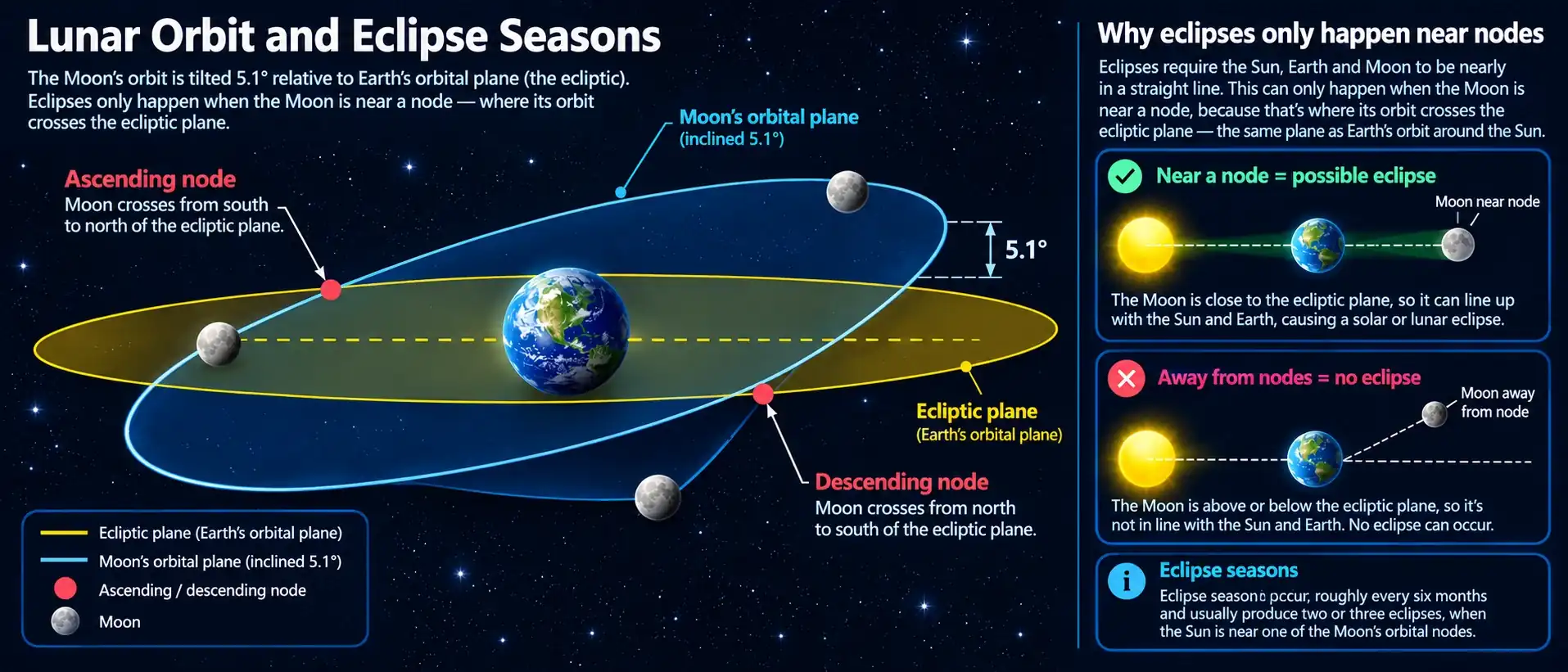
The Moon’s orbit is tilted about 5.1 degrees to the ecliptic, the Sun’s apparent path. The two points where the orbit crosses the ecliptic are the nodes: the ascending node, where the Moon crosses going north, and the descending node, where it crosses going south. An eclipse can happen only when a New Moon (solar eclipse) or Full Moon (lunar eclipse) falls close to a node. That is why eclipses do not happen every month: most months the Moon passes above or below the Sun’s path.
The nodes slide slowly westward around the ecliptic, once every 18.6 years. So the Sun reaches a node about 173 days apart, and each year the eclipse seasons arrive about 19 days earlier. Solar eclipses are possible when the Sun is within about 18 days of a node, lunar eclipses within about 12 days.
Eclipse seasons
| Season centre | When | Eclipses in the season |
|---|---|---|
| Feb 9 | Sun at the ascending node | Feb 6 Annular solar eclipse; Feb 20 Penumbral lunar eclipse |
| Aug 4 | Sun at the descending node | Jul 18 Penumbral lunar eclipse; Aug 2 Total solar eclipse; Aug 17 Penumbral lunar eclipse |
Node crossings (UTC)
| Ascending (to the north) | Descending (to the south) |
|---|---|
| Jan 10, 15:57 | Jan 23, 17:26 |
| Feb 6, 21:43 | Feb 20, 04:40 |
| Mar 6, 04:40 | Mar 19, 13:06 |
| Apr 2, 10:16 | Apr 15, 16:31 |
| Apr 29, 13:23 | May 12, 17:03 |
| May 26, 15:20 | Jun 8, 19:23 |
| Jun 22, 18:25 | Jul 6, 02:15 |
| Jul 19, 23:33 | Aug 2, 12:34 |
| Aug 16, 05:48 | Aug 29, 23:01 |
| Sep 12, 11:25 | Sep 26, 06:03 |
| Oct 9, 14:58 | Oct 23, 08:14 |
| Nov 5, 16:53 | Nov 19, 08:33 |
| Dec 2, 19:37 | Dec 16, 12:19 |
| Dec 30, 00:50 |
Declination and lunation lengths
Declination is the Moon’s angle north or south of the celestial equator. It sets how high the Moon climbs, where it rises and sets, and how long it stays up. In 2027 the Moon’s declination ranges from -27.7 to +27.7 degrees. This range itself swells and shrinks over an 18.6-year cycle. At a major lunar standstill, last reached around 2024 and 2025, the range is widest, close to 29 degrees either way. At a minor standstill, due in the 2030s, it narrows to about 18 degrees.
| Greatest north | Declination | Greatest south | Declination |
|---|---|---|---|
| Jan 19, 23:10 | +27.7° | Jan 5, 20:39 | -27.6° |
| Feb 16, 07:58 | +27.7° | Feb 2, 02:32 | -27.7° |
| Mar 15, 14:14 | +27.6° | Mar 1, 09:37 | -27.7° |
| Apr 11, 19:25 | +27.4° | Mar 28, 17:38 | -27.5° |
| May 9, 01:38 | +27.2° | Apr 25, 01:39 | -27.3° |
| Jun 5, 09:54 | +27.2° | May 22, 08:47 | -27.2° |
| Jul 2, 19:45 | +27.2° | Jun 18, 14:50 | -27.1° |
| Jul 30, 05:43 | +27.2° | Jul 15, 20:19 | -27.2° |
| Aug 26, 14:15 | +27.2° | Aug 12, 02:07 | -27.2° |
| Sep 22, 20:36 | +27.0° | Sep 8, 08:55 | -27.1° |
| Oct 20, 01:40 | +26.8° | Oct 5, 16:49 | -26.9° |
| Nov 16, 07:35 | +26.6° | Nov 2, 01:11 | -26.7° |
| Dec 13, 15:58 | +26.6° | Nov 29, 09:05 | -26.6° |
| Dec 26, 15:49 | -26.6° |
Lengths of the lunations
A synodic month, New Moon to New Moon, averages 29.53 days but varies. The shortest this year is 29.29 days and the longest 29.81 days.
| Jan 7: 29 d 19 h 32 m | Feb 6: 29 d 17 h 33 m | Mar 8: 29 d 14 h 22 m |
| Apr 6: 29 d 11 h 07 m | May 6: 29 d 8 h 42 m | Jun 4: 29 d 7 h 22 m |
| Jul 4: 29 d 7 h 03 m | Aug 2: 29 d 7 h 36 m | Aug 31: 29 d 8 h 55 m |
| Sep 30: 29 d 11 h 00 m | Oct 29: 29 d 13 h 48 m | Nov 28: 29 d 16 h 48 m |
| Dec 27: 29 d 19 h 00 m |
Lunar calendar dates
Festivals whose dates are set by the Moon, for 2027. Jewish holidays begin at sunset on the evening before the date shown. Islamic dates are expected dates, and Islamic, Hindu and Buddhist dates can move by a day or two with local sighting or region. Easter, Passover and Hebrew dates are calculated by rule, and Chinese dates use the New Moon in UTC+8.
| Date | Festival | How the Moon sets the date |
|---|---|---|
| Sat, Feb 6 | Chinese New Year | Day 1 of the first lunar month: the second New Moon after the December solstice (New Moon Feb 6, 15:56 UTC). |
| Mon, Feb 8 | Ramadan begins (expected) | Starts with the sighting of the new crescent. Ramadan lasts 29 or 30 days. |
| Sat, Feb 20 | Lantern Festival | Day 15 of the first lunar month, near the Full Moon. |
| Tue, Mar 9 | Eid al-Fitr (expected) | Day 1 of Shawwal, after Ramadan. It may fall one day later in some places. |
| Mon, Mar 22 | Holi (Hindu) | The day after Holika Dahan (evening of Mar 21), on the Full Moon of the month of Phalguna (Mar 22). |
| Tue, Mar 23 | Purim | The 14th of Adar II (this is a Hebrew leap year). |
| Fri, Mar 26 | Good Friday | Two days before Easter Sunday. |
| Sun, Mar 28 | Easter Sunday (Western) | The first Sunday after the Paschal Full Moon, an ecclesiastical date tied to the March equinox. |
| Thu, Apr 22 | Passover begins | The 15th of Nisan, around the Full Moon (Apr 20). |
| Sun, May 2 | Easter Sunday (Orthodox) | Calculated on the Julian calendar, so it often falls later than Western Easter. |
| Sun, May 16 | Eid al-Adha (expected) | The 10th of Dhu al-Hijjah. It may fall one day later in some places. |
| Thu, May 20 | Buddha Purnima / Vesak | Observed on the Full Moon of the month of Vaishakha (May 20). Some regions keep May 19. |
| Sun, Jun 6 | Islamic New Year (expected) | Day 1 of Muharram 1449. |
| Sun, Jul 18 | Guru Purnima (Hindu) | The Full Moon of the month of Ashadha (Jul 18). |
| Tue, Aug 17 | Raksha Bandhan (Hindu) | The Full Moon of the month of Shravana (Aug 17). |
| Wed, Sep 15 | Mid-Autumn Festival | Day 15 of the eighth lunar month, near the Full Moon (Sep 15). |
| Sat, Oct 2 | Rosh Hashanah | The 1st of Tishrei, the Hebrew New Year. |
| Mon, Oct 11 | Yom Kippur | The 10th of Tishrei. |
| Fri, Oct 29 | Diwali (Hindu) | Falls on the New Moon of the month of Kartika (Oct 29) in most regions of India. |
January 2027
Events this month
| Jan 7, 08:09 | Apogee, 406,597 km |
| Jan 7, 20:25 | New Moon (Micro New Moon, 406,514 km) |
| Jan 15, 20:35 | First Quarter |
| Jan 21, 21:47 | Perigee, 357,273 km |
| Jan 22, 12:18 | Full Moon, Wolf Moon (Supermoon, 357,635 km) |
| Jan 29, 10:56 | Last Quarter |
Key: the percentage is the share of the Moon’s disc lit by the Sun at 12:00 UTC. New, 1st Q, Full and 3rd Q mark the principal phases. A ring around the Moon marks an eclipse day. Drawings are Northern Hemisphere views. See the January 2027 moon phases page for the month in full.
February 2027
Events this month
| Feb 3, 13:31 | Apogee, 406,178 km |
| Feb 6, 15:57 | New Moon |
| Feb 6, 16:00 | Annular solar eclipse (greatest eclipse) |
| Feb 14, 07:59 | First Quarter |
| Feb 19, 07:30 | Perigee, 361,004 km |
| Feb 20, 23:13 | Penumbral lunar eclipse (greatest eclipse) |
| Feb 20, 23:24 | Full Moon, Snow Moon |
| Feb 28, 05:17 | Last Quarter |
Safety: never look at a partial or annular solar eclipse without ISO 12312-2 eclipse glasses. Ordinary sunglasses are not safe.
Key: the percentage is the share of the Moon’s disc lit by the Sun at 12:00 UTC. New, 1st Q, Full and 3rd Q mark the principal phases. A ring around the Moon marks an eclipse day. Drawings are Northern Hemisphere views. See the February 2027 moon phases page for the month in full.
March 2027
Events this month
| Mar 3, 05:40 | Apogee, 405,206 km |
| Mar 8, 09:30 | New Moon |
| Mar 15, 16:26 | First Quarter |
| Mar 19, 04:29 | Perigee, 366,426 km |
| Mar 22, 10:44 | Full Moon, Worm Moon |
| Mar 30, 00:55 | Last Quarter |
| Mar 31, 01:34 | Apogee, 404,315 km |
Key: the percentage is the share of the Moon’s disc lit by the Sun at 12:00 UTC. New, 1st Q, Full and 3rd Q mark the principal phases. A ring around the Moon marks an eclipse day. Drawings are Northern Hemisphere views. See the March 2027 moon phases page for the month in full.
April 2027
Events this month
| Apr 6, 23:52 | New Moon |
| Apr 13, 22:57 | First Quarter |
| Apr 14, 00:37 | Perigee, 369,994 km |
| Apr 20, 22:28 | Full Moon, Pink Moon |
| Apr 27, 21:21 | Apogee, 404,157 km |
| Apr 28, 20:19 | Last Quarter |
Key: the percentage is the share of the Moon’s disc lit by the Sun at 12:00 UTC. New, 1st Q, Full and 3rd Q mark the principal phases. A ring around the Moon marks an eclipse day. Drawings are Northern Hemisphere views. See the April 2027 moon phases page for the month in full.
May 2027
Events this month
| May 6, 10:59 | New Moon |
| May 9, 20:07 | Perigee, 366,621 km |
| May 13, 04:44 | First Quarter |
| May 20, 11:00 | Full Moon, Flower Moon |
| May 25, 15:14 | Apogee, 404,790 km |
| May 28, 13:59 | Last Quarter |
Key: the percentage is the share of the Moon’s disc lit by the Sun at 12:00 UTC. New, 1st Q, Full and 3rd Q mark the principal phases. A ring around the Moon marks an eclipse day. Drawings are Northern Hemisphere views. See the May 2027 moon phases page for the month in full.
June 2027
Events this month
| Jun 4, 19:41 | New Moon |
| Jun 6, 14:53 | Perigee, 361,692 km |
| Jun 11, 10:57 | First Quarter |
| Jun 19, 00:45 | Full Moon, Strawberry Moon |
| Jun 22, 05:07 | Apogee, 405,686 km |
| Jun 27, 04:55 | Last Quarter |
Key: the percentage is the share of the Moon’s disc lit by the Sun at 12:00 UTC. New, 1st Q, Full and 3rd Q mark the principal phases. A ring around the Moon marks an eclipse day. Drawings are Northern Hemisphere views. See the June 2027 moon phases page for the month in full.
July 2027
Events this month
| Jul 4, 03:03 | New Moon (Super New Moon, 358,793 km) |
| Jul 4, 20:55 | Perigee, 358,273 km |
| Jul 10, 18:40 | First Quarter |
| Jul 18, 15:46 | Full Moon, Buck Moon (Micromoon, 405,968 km) |
| Jul 18, 16:03 | Penumbral lunar eclipse (greatest eclipse) |
| Jul 19, 11:52 | Apogee, 406,205 km |
| Jul 26, 16:55 | Last Quarter |
Key: the percentage is the share of the Moon’s disc lit by the Sun at 12:00 UTC. New, 1st Q, Full and 3rd Q mark the principal phases. A ring around the Moon marks an eclipse day. Drawings are Northern Hemisphere views. See the July 2027 moon phases page for the month in full.
August 2027
Events this month
| Aug 2, 06:25 | Perigee, 357,352 km |
| Aug 2, 10:06 | New Moon (Super New Moon, 357,375 km) |
| Aug 2, 10:07 | Total solar eclipse (greatest eclipse) |
| Aug 9, 04:55 | First Quarter |
| Aug 15, 14:24 | Apogee, 406,073 km |
| Aug 17, 07:14 | Penumbral lunar eclipse (greatest eclipse) |
| Aug 17, 07:29 | Full Moon, Sturgeon Moon (Micromoon, 405,069 km) |
| Aug 25, 02:28 | Last Quarter |
| Aug 30, 15:42 | Perigee, 359,195 km |
| Aug 31, 17:42 | New Moon |
Safety: never look at a partial or annular solar eclipse without ISO 12312-2 eclipse glasses. Ordinary sunglasses are not safe.
Key: the percentage is the share of the Moon’s disc lit by the Sun at 12:00 UTC. New, 1st Q, Full and 3rd Q mark the principal phases. A ring around the Moon marks an eclipse day. Drawings are Northern Hemisphere views. See the August 2027 moon phases page for the month in full.
September 2027
Events this month
| Sep 7, 18:32 | First Quarter |
| Sep 11, 23:36 | Apogee, 405,371 km |
| Sep 15, 23:04 | Full Moon, Harvest Moon |
| Sep 23, 10:21 | Last Quarter |
| Sep 27, 20:12 | Perigee, 363,441 km |
| Sep 30, 02:37 | New Moon |
Key: the percentage is the share of the Moon’s disc lit by the Sun at 12:00 UTC. New, 1st Q, Full and 3rd Q mark the principal phases. A ring around the Moon marks an eclipse day. Drawings are Northern Hemisphere views. See the September 2027 moon phases page for the month in full.
October 2027
Events this month
| Oct 7, 11:48 | First Quarter |
| Oct 9, 15:46 | Apogee, 404,519 km |
| Oct 15, 13:48 | Full Moon, Hunter’s Moon |
| Oct 22, 17:30 | Last Quarter |
| Oct 25, 05:36 | Perigee, 368,641 km |
| Oct 29, 13:37 | New Moon |
Key: the percentage is the share of the Moon’s disc lit by the Sun at 12:00 UTC. New, 1st Q, Full and 3rd Q mark the principal phases. A ring around the Moon marks an eclipse day. Drawings are Northern Hemisphere views. See the October 2027 moon phases page for the month in full.
November 2027
Events this month
| Nov 6, 08:01 | First Quarter |
| Nov 6, 11:36 | Apogee, 404,169 km |
| Nov 14, 03:26 | Full Moon, Beaver Moon |
| Nov 19, 00:12 | Perigee, 369,353 km |
| Nov 21, 00:49 | Last Quarter |
| Nov 28, 03:25 | New Moon |
Key: the percentage is the share of the Moon’s disc lit by the Sun at 12:00 UTC. New, 1st Q, Full and 3rd Q mark the principal phases. A ring around the Moon marks an eclipse day. Drawings are Northern Hemisphere views. See the November 2027 moon phases page for the month in full.
December 2027
Events this month
| Dec 4, 08:41 | Apogee, 404,649 km |
| Dec 6, 05:23 | First Quarter |
| Dec 13, 16:09 | Full Moon, Cold Moon |
| Dec 16, 02:25 | Perigee, 364,018 km |
| Dec 20, 09:11 | Last Quarter |
| Dec 27, 20:13 | New Moon |
Key: the percentage is the share of the Moon’s disc lit by the Sun at 12:00 UTC. New, 1st Q, Full and 3rd Q mark the principal phases. A ring around the Moon marks an eclipse day. Drawings are Northern Hemisphere views. See the December 2027 moon phases page for the month in full.
Eclipse guide
Solar eclipse safety
Never look directly at the Sun during a partial or annular solar eclipse, and do not use ordinary sunglasses. Use eclipse glasses or handheld viewers that meet the ISO 12312-2 standard. Only during the brief total phase of a total solar eclipse, when the Sun is completely covered, can it be watched without a filter. Lunar eclipses are safe to watch with the naked eye.
Feb 6, 16:00 UTC. Annular solar eclipse (Saros 131)
The Moon is relatively far from Earth (402,700 km at new moon), so it cannot fully cover the Sun and leaves a ring. Eclipse magnitude 0.928, annularity up to 7 min 51 s, path about 282 km wide. Greatest eclipse is in the South Atlantic (31.3°S, 48.5°W). The annular path passes over South America. The eclipse is not visible from North America.
Feb 20, 23:13 UTC. Penumbral lunar eclipse (Saros 143)
Penumbral magnitude 0.927 and umbral magnitude -0.057, so the Moon just misses the dark umbra. The penumbral phase runs 21:12 UT to 01:13 UT on Feb 21. At greatest eclipse the Moon is overhead at 10°N, 15°E over central Africa, so Africa and Europe are best placed. The Moon is also above the horizon from western and southern Asia and from the Atlantic side of the Americas, including New York. The shading is subtle and easiest to notice near maximum.
Jul 18, 16:03 UTC. Penumbral lunar eclipse (Saros 110)
Extremely shallow. The penumbral magnitude is only 0.0014 and the umbral magnitude -1.068. The penumbral phase lasts about 12 minutes (15:57 to 16:09 UT), so the Moon shows no noticeable change. The Moon is overhead at 22°S, 121°E over Australia. The eclipse is not visible from North America.
Aug 2, 10:07 UTC. Total solar eclipse (Saros 136)
The Moon is close to Earth (357,375 km at new moon). Eclipse magnitude 1.079, totality up to 6 min 23 s, path about 258 km wide, with greatest eclipse at 25.5°N, 33.2°E near Luxor, Egypt. It is the longest total solar eclipse between 1991 and 2114. Totality crosses southern Spain, Morocco, Algeria, Tunisia, Libya, Egypt, Sudan, Saudi Arabia, Yemen and Somalia. A partial eclipse is seen across Europe, Africa, the Middle East and western Asia. It is also seen from Iceland, Ireland, Great Britain, southern Greenland, northern Maine and eastern Canada, including Newfoundland and the Atlantic Provinces, shortly after sunrise (in Canada it starts around 5:36 NDT).
Aug 17, 07:14 UTC. Penumbral lunar eclipse (Saros 148)
Penumbral magnitude 0.546 and umbral magnitude -0.525. The penumbral phase runs 05:24 to 09:03 UT. The Moon is overhead at 12°S, 108°W over the eastern Pacific, so the Americas and the Pacific are best placed, including North America. A faint shading on one side of the Moon may be noticeable near maximum.
Saros series
Eclipses repeat in families called Saros series, about 18 years 11 days apart. Each eclipse above belongs to a numbered series, shown in its heading. Magnitudes, Saros numbers and phase times come from NASA’s Eclipses During 2027 page.
Visibility maps and local timings
Maps are not reproduced here. NASA and timeanddate.com publish maps and local times for every eclipse:
Moon and planet meetings
Selected close approaches: the Moon within 5 degrees of Mercury, Venus, Mars or Jupiter, and within 3 degrees of Regulus, Spica, Aldebaran or the Pleiades. A conjunction is the moment the Moon and the object share the same ecliptic longitude. It is a calculated instant and can differ slightly from the moment of closest approach. Gaps are geocentric, measured from the centre of the Earth, so from your location the gap differs by up to about 1 degree. Where the Moon passes within 1.2 degrees, an occultation may be visible from some part of the Earth. That is only a screening test: it needs the observer to be inside the occultation’s visibility zone. Occultations of stars are in the next section.
Passes closer than 15 degrees to the Sun are left out. Mercury and Venus are often low in twilight. Occultations of Antares are not repeated here.
| Date (UTC) | Object | Gap | Moon is | Sky, angle from Sun | Occultation |
|---|---|---|---|---|---|
| Jan 23, 23:33 | Jupiter | 1.4° | South of it | Most of night, 159° | |
| Jan 24, 09:06 | Regulus (star) | 1.4° | South of it | Most of night, 154° | |
| Jan 28, 06:37 | Spica (star) | 2.7° | South of it | Morning, 104° | |
| Feb 8, 03:53 | Mercury | 0.3° | South of it | Evening, 17° | Possible |
| Feb 20, 05:07 | Jupiter | 1.1° | South of it | Most of night, 169° | Possible |
| Feb 20, 20:20 | Regulus (star) | 1.4° | South of it | Most of night, 178° | |
| Feb 24, 15:59 | Spica (star) | 2.7° | South of it | Morning, 132° | |
| Mar 4, 20:05 | Venus | 2.0° | South of it | Morning, 40° | |
| Mar 6, 06:17 | Mercury | 1.1° | South of it | Morning, 24° | Possible |
| Mar 19, 09:34 | Jupiter | 0.9° | South of it | Evening, 139° | Possible |
| Mar 19, 16:16 | Mars | 3.9° | South of it | Evening, 143° | |
| Mar 20, 05:59 | Regulus (star) | 1.4° | South of it | Most of night, 151° | |
| Mar 24, 02:02 | Spica (star) | 2.6° | South of it | Most of night, 159° | |
| Apr 4, 04:09 | Venus | 2.9° | North of it | Morning, 34° | |
| Apr 15, 14:27 | Jupiter | 0.9° | South of it | Evening, 112° | Possible |
| Apr 15, 23:11 | Mars | 3.0° | South of it | Evening, 116° | |
| Apr 16, 13:01 | Regulus (star) | 1.5° | South of it | Evening, 124° | |
| Apr 20, 11:01 | Spica (star) | 2.6° | South of it | Most of night, 174° | |
| May 12, 22:04 | Jupiter | 1.2° | South of it | Evening, 86° | |
| May 13, 17:32 | Mars | 3.0° | South of it | Evening, 97° | |
| May 13, 18:28 | Regulus (star) | 1.8° | South of it | Evening, 97° | |
| May 17, 18:02 | Spica (star) | 2.6° | South of it | Evening, 148° | |
| Jun 6, 06:41 | Mercury | 2.7° | North of it | Evening, 20° | |
| Jun 9, 09:51 | Jupiter | 1.7° | South of it | Evening, 63° | |
| Jun 10, 00:22 | Regulus (star) | 2.0° | South of it | Evening, 71° | |
| Jun 10, 20:04 | Mars | 3.5° | South of it | Evening, 82° | |
| Jun 13, 23:39 | Spica (star) | 2.8° | South of it | Evening, 121° | |
| Jul 7, 01:49 | Jupiter | 2.2° | South of it | Evening, 41° | |
| Jul 7, 08:18 | Regulus (star) | 2.1° | South of it | Evening, 45° | |
| Jul 9, 04:30 | Mars | 4.2° | South of it | Evening, 70° | |
| Jul 11, 05:22 | Spica (star) | 3.0° | South of it | Evening, 96° | |
| Aug 3, 18:17 | Regulus (star) | 2.2° | South of it | Evening, 19° | |
| Aug 3, 20:50 | Jupiter | 2.7° | South of it | Evening, 21° | |
| Aug 6, 17:32 | Mars | 4.7° | South of it | Evening, 59° | |
| Sep 2, 01:29 | Mercury | 4.0° | South of it | Evening, 18° | |
| Sep 3, 21:44 | Spica (star) | 2.9° | South of it | Evening, 43° | |
| Sep 4, 10:26 | Mars | 4.8° | South of it | Evening, 50° | |
| Sep 27, 14:49 | Regulus (star) | 2.2° | South of it | Morning, 34° | |
| Sep 28, 12:55 | Jupiter | 3.8° | South of it | Morning, 21° | |
| Oct 1, 07:54 | Spica (star) | 2.8° | South of it | Evening, 16° | |
| Oct 1, 23:22 | Mercury | 1.6° | South of it | Evening, 25° | |
| Oct 3, 06:42 | Mars | 4.4° | South of it | Evening, 41° | |
| Oct 24, 22:16 | Regulus (star) | 2.4° | South of it | Morning, 61° | |
| Oct 26, 06:16 | Jupiter | 4.4° | South of it | Morning, 43° | |
| Oct 31, 06:00 | Venus | 4.3° | South of it | Evening, 21° | |
| Nov 1, 06:01 | Mars | 3.2° | South of it | Evening, 33° | |
| Nov 21, 03:48 | Regulus (star) | 2.7° | South of it | Morning, 88° | |
| Nov 22, 20:06 | Jupiter | 4.9° | South of it | Morning, 67° | |
| Nov 25, 01:01 | Spica (star) | 2.9° | South of it | Morning, 38° | |
| Nov 30, 07:59 | Mars | 1.5° | South of it | Evening, 26° | |
| Nov 30, 13:26 | Venus | 0.9° | South of it | Evening, 28° | Possible |
| Dec 18, 09:39 | Regulus (star) | 2.9° | South of it | Morning, 116° | |
| Dec 29, 11:58 | Mars | 0.5° | North of it | Evening, 18° | Possible |
| Dec 30, 23:52 | Venus | 2.9° | North of it | Evening, 35° |
Lunar occultations
An occultation is the Moon passing in front of a star or planet. The Moon moves eastward against the stars, so the object disappears at the Moon’s eastern limb and reappears at its western limb. With a waxing Moon that means it disappears at the dark limb, which is easy to time, and reappears at the bright limb. With a waning Moon it is the other way round. A grazing occultation is one where the object just skims the limb and blinks in and out among lunar mountains. It is visible only along a path a few kilometres wide.
These are the passes where the Moon gets within 1.2 degrees of the object, or 2 degrees of the Pleiades cluster. Gaps are geocentric, so each is only a screening test: an occultation is seen only from the region of Earth the Moon’s shadow track crosses, and your location decides whether you are in it. For local times and paths, use occultation prediction software or the International Occultation Timing Association.
| Date (UTC) | Object | Gap | Moon | Disappears at | Sky |
|---|---|---|---|---|---|
| Jan 4, 17:13 | Antares (star) | 0.3° | 9% lit, waning | Bright limb | Morning sky |
| Jan 8, 05:11 | Mercury | 0.5° | 0% lit, waxing | Dark limb | In daylight, near the Sun |
| Jan 18, 09:10 | Pleiades (cluster) | 1.1° | 77% lit, waxing | Dark limb | Evening sky |
| Jan 31, 23:26 | Antares (star) | 0.4° | 27% lit, waning | Bright limb | Morning sky |
| Feb 8, 03:53 | Mercury | 0.3° | 2% lit, waxing | Dark limb | Evening sky |
| Feb 14, 16:37 | Pleiades (cluster) | 1.2° | 54% lit, waxing | Dark limb | Evening sky |
| Feb 20, 05:07 | Jupiter | 1.1° | 99% lit, waxing | Dark limb | Evening sky |
| Feb 28, 06:47 | Antares (star) | 0.4° | 50% lit, waning | Bright limb | Morning sky |
| Mar 6, 06:17 | Mercury | 1.1° | 4% lit, waning | Bright limb | Morning sky |
| Mar 13, 22:09 | Pleiades (cluster) | 1.1° | 31% lit, waxing | Dark limb | Evening sky |
| Mar 19, 09:34 | Jupiter | 0.9° | 88% lit, waxing | Dark limb | Evening sky |
| Mar 27, 15:16 | Antares (star) | 0.2° | 72% lit, waning | Bright limb | Morning sky |
| Apr 10, 03:59 | Pleiades (cluster) | 0.9° | 12% lit, waxing | Dark limb | Evening sky |
| Apr 15, 14:27 | Jupiter | 0.9° | 69% lit, waxing | Dark limb | Evening sky |
| Apr 24, 00:00 | Antares (star) | 0.1° | 90% lit, waning | Bright limb | Morning sky |
| May 7, 11:44 | Pleiades (cluster) | 0.8° | 2% lit, waxing | Dark limb | In daylight, near the Sun |
| May 21, 07:54 | Antares (star) | 0.0° | 99% lit, waning | Bright limb | Morning sky |
| Jun 3, 21:20 | Pleiades (cluster) | 0.8° | 1% lit, waning | Bright limb | In daylight, near the Sun |
| Jun 17, 14:32 | Antares (star) | 0.0° | 98% lit, waxing | Dark limb | Evening sky |
| Jul 1, 07:34 | Pleiades (cluster) | 0.9° | 11% lit, waning | Bright limb | Morning sky |
| Jul 14, 20:19 | Antares (star) | 0.0° | 87% lit, waxing | Dark limb | Evening sky |
| Jul 28, 16:49 | Pleiades (cluster) | 1.0° | 29% lit, waning | Bright limb | Morning sky |
| Aug 1, 15:54 | Mercury | 0.3° | 1% lit, waning | Bright limb | In daylight, near the Sun |
| Aug 2, 05:32 | Venus | 0.6° | 0% lit, waning | Bright limb | In daylight, near the Sun |
| Aug 11, 02:15 | Antares (star) | 0.1° | 69% lit, waxing | Dark limb | Evening sky |
| Aug 25, 00:07 | Pleiades (cluster) | 0.9° | 51% lit, waning | Bright limb | Morning sky |
| Sep 7, 09:19 | Antares (star) | 0.0° | 46% lit, waxing | Dark limb | Evening sky |
| Sep 21, 05:47 | Pleiades (cluster) | 0.8° | 73% lit, waning | Bright limb | Morning sky |
| Oct 4, 17:48 | Antares (star) | 0.2° | 24% lit, waxing | Dark limb | Evening sky |
| Oct 18, 11:28 | Pleiades (cluster) | 0.6° | 91% lit, waning | Bright limb | Morning sky |
| Nov 1, 03:02 | Antares (star) | 0.4° | 8% lit, waxing | Dark limb | Evening sky |
| Nov 14, 18:55 | Pleiades (cluster) | 0.5° | 99% lit, waning | Bright limb | Morning sky |
| Nov 28, 11:44 | Antares (star) | 0.5° | 0% lit, waxing | Dark limb | In daylight, near the Sun |
| Nov 30, 13:26 | Venus | 0.9° | 6% lit, waxing | Dark limb | Evening sky |
| Dec 12, 04:35 | Pleiades (cluster) | 0.5° | 97% lit, waxing | Dark limb | Evening sky |
| Dec 25, 18:52 | Antares (star) | 0.4° | 4% lit, waning | Bright limb | Morning sky |
| Dec 28, 16:45 | Mercury | 0.7° | 1% lit, waxing | Dark limb | In daylight, near the Sun |
| Dec 29, 11:58 | Mars | 0.5° | 3% lit, waxing | Dark limb | Evening sky |
Planetary events of 2027
When each planet is best placed. At opposition a planet is opposite the Sun, rises at sunset and is at its brightest and closest. Mercury and Venus are best seen near their greatest elongations, when they are farthest from the Sun in our sky. Dates are in UTC.
| Date | Planet | Event | Details |
|---|---|---|---|
| Jan 1 | Mercury | Superior conjunction | Behind the Sun, not visible |
| Jan 3 | Venus | Greatest elongation west | 47 degrees from the Sun, morning sky |
| Feb 3 | Mercury | Greatest elongation east | 18 degrees from the Sun, evening sky |
| Feb 11 | Jupiter | Opposition | 4.36 AU from Earth, up all night |
| Feb 18 | Mercury | Inferior conjunction | Passes between us and the Sun |
| Feb 19 | Mars | Opposition | 0.68 AU from Earth, up all night |
| Mar 17 | Mercury | Greatest elongation west | 28 degrees from the Sun, morning sky |
| Mar 24 | Neptune | Conjunction with the Sun | Behind the Sun, not visible |
| Apr 7 | Saturn | Conjunction with the Sun | Behind the Sun, not visible |
| Apr 28 | Mercury | Superior conjunction | Behind the Sun, not visible |
| May 27 | Uranus | Conjunction with the Sun | Behind the Sun, not visible |
| May 28 | Mercury | Greatest elongation east | 23 degrees from the Sun, evening sky |
| Jun 23 | Mercury | Inferior conjunction | Passes between us and the Sun |
| Jul 15 | Mercury | Greatest elongation west | 21 degrees from the Sun, morning sky |
| Aug 11 | Mercury | Superior conjunction | Behind the Sun, not visible |
| Aug 12 | Venus | Superior conjunction | Behind the Sun, not visible |
| Aug 31 | Jupiter | Conjunction with the Sun | Behind the Sun, not visible |
| Sep 24 | Mercury | Greatest elongation east | 26 degrees from the Sun, evening sky |
| Sep 28 | Neptune | Opposition | 28.87 AU from Earth, up all night |
| Oct 18 | Saturn | Opposition | 8.33 AU from Earth, up all night |
| Oct 19 | Mercury | Inferior conjunction | Passes between us and the Sun |
| Nov 4 | Mercury | Greatest elongation west | 19 degrees from the Sun, morning sky |
| Nov 30 | Uranus | Opposition | 18.38 AU from Earth, up all night |
| Dec 11 | Mercury | Superior conjunction | Behind the Sun, not visible |
Dark skies and meteor showers
A dark-sky window is a run of nights when the Moon is under 25 percent lit, so moonlight does little to wash out faint objects. The very dark nights have the Moon under 5 percent lit.
| Dark window | Moon under 25% lit | Nights | Very dark nights |
|---|---|---|---|
| New Moon Jan 7 | Jan 2 to Jan 12 | 11 | Jan 6 to Jan 9 |
| New Moon Feb 6 | Feb 1 to Feb 11 | 11 | Feb 4 to Feb 8 |
| New Moon Mar 8 | Mar 3 to Mar 12 | 10 | Mar 6 to Mar 10 |
| New Moon Apr 6 | Apr 2 to Apr 11 | 10 | Apr 5 to Apr 8 |
| New Moon May 6 | May 2 to May 10 | 9 | May 4 to May 7 |
| New Moon Jun 4 | May 31 to Jun 8 | 9 | Jun 3 to Jun 6 |
| New Moon Jul 4 | Jun 30 to Jul 7 | 8 | Jul 2 to Jul 5 |
| New Moon Aug 2 | Jul 29 to Aug 6 | 9 | Aug 1 to Aug 3 |
| New Moon Aug 31 | Aug 27 to Sep 4 | 9 | Aug 30 to Sep 2 |
| New Moon Sep 30 | Sep 26 to Oct 4 | 9 | Sep 28 to Oct 1 |
| New Moon Oct 29 | Oct 25 to Nov 3 | 10 | Oct 28 to Oct 31 |
| New Moon Nov 28 | Nov 23 to Dec 2 | 10 | Nov 26 to Nov 29 |
| New Moon Dec 27 | Dec 23 to Jan 1 | 10 | Dec 26 to Dec 29 |
These windows use the Moon’s illumination at 12:00 UTC each day. They are date ranges, not a guarantee of dark skies at your location. Local moonrise and moonset decide how much moonlight reaches you on a given night, and twilight, cloud, haze and light pollution matter as well.
Meteor showers
Peak times for these meteor showers follow the International Meteor Organization’s 2027 calendar and are usually good to within a day or so. ZHR is the zenithal hourly rate: the number of meteors an ideal observer would see in perfectly clear, dark skies with the radiant overhead. The counts you actually see are usually lower. The Moon column is how lit the Moon is at the peak time, or at midday UT when the IMO gives no time.
| Shower | Peak (UTC) | ZHR | Moon | Conditions | Best from |
|---|---|---|---|---|---|
| Quadrantids | Jan 4, 03:25 | 80 | 12% lit | Good | Northern Hemisphere |
| Lyrids | Apr 23, 01:40 | 18 | 95% lit | Poor, moonlit | Northern Hemisphere |
| Eta Aquariids | May 6, 09:00 | 50 | 0% lit | Good | Tropics and south |
| Southern Delta Aquariids | Jul 31 | 25 | 6% lit | Good | Tropics and south |
| Perseids | Aug 13, 08-10 | 110+ | 87% lit | Poor, moonlit | Northern Hemisphere |
| Orionids | Oct 22 | 20 | 53% lit | Fair | Both hemispheres |
| Leonids | Nov 18, 06:00 | 15+ | 80% lit | Poor, moonlit | Both hemispheres |
| Geminids | Dec 14, about 20:00 | 150 | 98% lit | Poor, moonlit | Both hemispheres |
| Ursids | Dec 23, 04:00 | 10 | 22% lit | Good | Northern Hemisphere |
Minor showers
| Shower | Peak (UTC) | ZHR | Moon | Conditions | Best from |
|---|---|---|---|---|---|
| Alpha Centaurids | Feb 8 | 6 | 3% lit | Good | Southern Hemisphere |
| Alpha Capricornids | Jul 31 | 5 | 6% lit | Good | Both; bright fireballs |
| Aurigids | Sep 1, 15:30 | 6 | 1% lit | Good | Northern Hemisphere |
| September Epsilon Perseids | Sep 10, 00:00 | 8 | 71% lit | Poor, moonlit | Northern Hemisphere |
| Draconids | Oct 9, 07:00 | 5, variable | 67% lit | Poor, moonlit | Northern Hemisphere |
| Southern Taurids | Nov 6 | 5-10 | 52% lit | Fair | Both hemispheres |
| Northern Taurids | Nov 13 | 5 | 99% lit | Poor, moonlit | Both hemispheres |
| November Orionids | Nov 28 | 3 | 0% lit | Good | Both hemispheres |
| Puppid-Velids | Dec 7 | 10 | 62% lit | Poor, moonlit | Tropics and south |
Tides
The Moon and Sun raise the tides. Spring tides, with the largest range between high and low water, come around every New Moon and Full Moon. Neap tides, with the smallest range, come around the First and Last Quarters. When a New or Full Moon falls near perigee, the Moon’s stronger pull gives a perigean spring tide, with higher highs and lower lows than usual.
These are the New and Full Moons within 48 hours of perigee. The timing is the gap between the two events.
| Spring tide | Phase | Perigee | Timing | Strength |
|---|---|---|---|---|
| Jan 22, 12:18 | Full Moon | Jan 21, 21:47 | perigee 15 h earlier | Strongest |
| Feb 20, 23:24 | Full Moon | Feb 19, 07:30 | perigee 40 h earlier | Stronger |
| Jun 4, 19:41 | New Moon | Jun 6, 14:53 | perigee 43 h later | Stronger |
| Jul 4, 03:03 | New Moon | Jul 4, 20:55 | perigee 18 h later | Strongest |
| Aug 2, 10:06 | New Moon | Aug 2, 06:25 | perigee 4 h earlier | Strongest |
| Aug 31, 17:42 | New Moon | Aug 30, 15:42 | perigee 26 h earlier | Stronger |
Before you rely on it
The heights and times of real tides depend on your coastline, the weather and air pressure. Use your national tide tables, such as NOAA in the United States or the Canadian Hydrographic Service in Canada, for local predictions. Live tide charts are on moonphase.today.
Libration
Libration is the Moon’s slow rocking, which lets observers see about 59 percent of its surface over time. Near the extremes below, craters along that edge of the disc are tilted into better view. Values are in degrees. Positive latitude tips the north pole toward Earth and negative tips the south pole.
| Longitude (side to side) | Value | Latitude (up and down) | Value |
|---|---|---|---|
| Jan 15, 13:28 | -7.8° | Jan 3, 04:23 | +6.8° |
| Jan 27, 21:29 | +7.4° | Jan 17, 17:26 | -6.7° |
| Feb 12, 07:55 | -6.8° | Jan 30, 09:05 | +6.9° |
| Feb 25, 05:51 | +6.5° | Feb 13, 23:27 | -6.8° |
| Mar 11, 01:05 | -5.6° | Feb 26, 16:09 | +6.9° |
| Mar 25, 06:06 | +5.4° | Mar 13, 03:42 | -6.7° |
| Apr 6, 13:10 | -5.4° | Mar 25, 23:27 | +6.7° |
| Apr 21, 15:28 | +4.7° | Apr 9, 07:17 | -6.6° |
| May 3, 20:54 | -6.1° | Apr 22, 04:55 | +6.6° |
| May 18, 01:49 | +4.9° | May 6, 11:36 | -6.5° |
| May 31, 16:42 | -6.9° | May 19, 08:09 | +6.6° |
| Jun 13, 16:19 | +6.1° | Jun 2, 17:29 | -6.6° |
| Jun 28, 18:27 | -7.5° | Jun 15, 10:33 | +6.7° |
| Jul 11, 09:43 | +7.2° | Jun 30, 00:37 | -6.7° |
| Jul 26, 22:01 | -7.5° | Jul 12, 14:03 | +6.8° |
| Aug 8, 12:44 | +7.7° | Jul 27, 07:41 | -6.8° |
| Aug 23, 22:23 | -6.8° | Aug 8, 19:37 | +6.9° |
| Sep 5, 17:12 | +7.4° | Aug 23, 13:15 | -6.8° |
| Sep 20, 07:32 | -5.6° | Sep 5, 02:44 | +6.8° |
| Oct 3, 18:40 | +6.6° | Sep 19, 16:50 | -6.7° |
| Oct 16, 14:02 | -4.7° | Oct 2, 09:52 | +6.6° |
| Oct 31, 12:09 | +5.7° | Oct 16, 19:32 | -6.5° |
| Nov 12, 10:38 | -5.0° | Oct 29, 15:30 | +6.6° |
| Nov 27, 12:56 | +5.2° | Nov 12, 23:16 | -6.5° |
| Dec 10, 03:38 | -6.1° | Nov 25, 19:20 | +6.6° |
| Dec 23, 19:13 | +5.8° | Dec 10, 05:20 | -6.7° |
| Dec 22, 22:32 | +6.8° |
Earthshine and the Lunar X
Earthshine is the faint glow on the dark part of a thin crescent Moon, sunlight bounced off Earth. It is best seen when the crescent is between about 1 and 20 percent lit, in a dark sky, and is visible to the eye or with binoculars.
| Month | Morning sky (waning crescent) | Evening sky (waxing crescent) |
|---|---|---|
| January | Jan 3-6 | Jan 9-12 |
| February | Feb 2-5 | Feb 8-10 |
| March | Mar 4-6 | Mar 9-12 |
| April | Apr 2-5 | Apr 8-10 |
| May | May 2-5 | May 7-9 |
| June | Jun 1-3, Jun 30 | Jun 6-8 |
| July | Jul 1-2, Jul 30-31 | Jul 5-7 |
| August | Aug 1, Aug 28-30 | Aug 3-5 |
| September | Sep 26-28 | Sep 2-4 |
| October | Oct 26-28 | Oct 1-3, Oct 30-31 |
| November | Nov 24-26 | Nov 1-2, Nov 29-30 |
| December | Dec 23-26 | Dec 1-2, Dec 29-31 |
The Lunar X
The Lunar X, also called the Werner X, is a feature that forms where sunlight catches the rims of three craters, with the Lunar V nearby. It is visible through binoculars or a small telescope for about 4 hours around First Quarter. The best start time shifts by a couple of hours from month to month with libration. Check that the Moon is up at your location at that time. First Quarter times:
| Jan 15, 20:35 UTC | Feb 14, 07:59 UTC | Mar 15, 16:26 UTC |
| Apr 13, 22:57 UTC | May 13, 04:44 UTC | Jun 11, 10:57 UTC |
| Jul 10, 18:40 UTC | Aug 9, 04:55 UTC | Sep 7, 18:32 UTC |
| Oct 7, 11:48 UTC | Nov 6, 08:01 UTC | Dec 6, 05:23 UTC |
Understanding lunar phases
The Moon takes about 29.53 days to go from one New Moon to the next (the synodic month). Twelve of these add up to about 354 days, which is why each phase falls on different calendar dates from year to year.
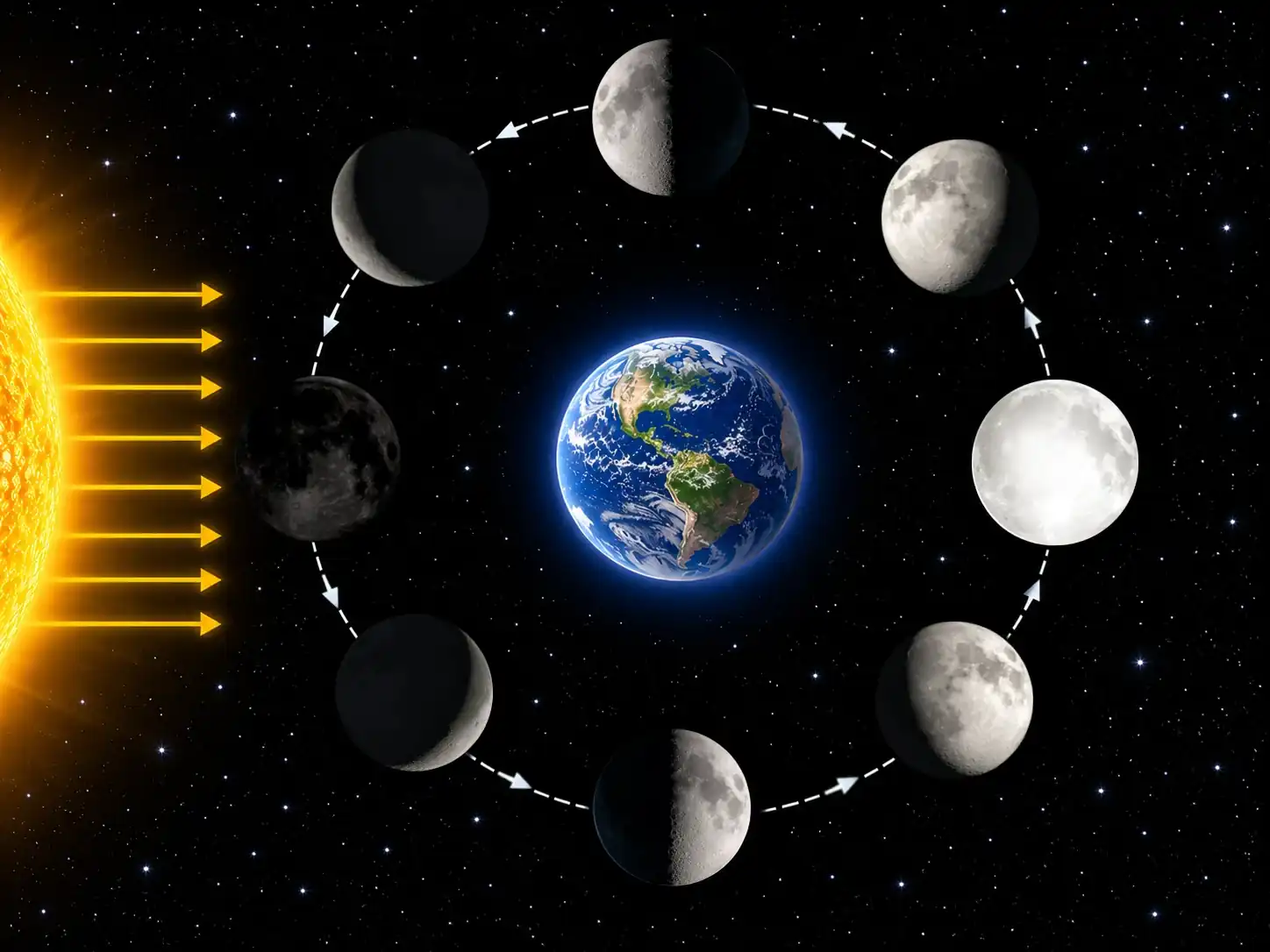
| Phase | In the sky | Good for |
|---|---|---|
| New Moon | Near the Sun and up in the daytime. Not visible. | The darkest skies for galaxies, nebulae and star clusters. |
| Waxing crescent | Low in the west after sunset. | Thin crescent photos at dusk and earthshine on the dark part. |
| First Quarter | High at sunset, sets around midnight. | Long shadows along the terminator bring out craters and mountains. |
| Waxing gibbous | Up in the afternoon and most of the evening. | Good detail, but the bright sky starts to wash out faint objects. |
| Full Moon | Rises near sunset, sets near sunrise. | The whole disc and bright ray craters. Flat light hides relief. |
| Waning gibbous | Rises after sunset, up in the morning. | Detail returns as shadows grow on the other side. |
| Last Quarter | Rises near midnight, high at sunrise. | Crater detail in the morning sky, with shadows opposite to First Quarter. |
| Waning crescent | Low in the east before sunrise. | Morning crescent and earthshine. Skies are dark again later in the night. |
Phase is not the same as visibility
Phase times in this almanac are exact astronomical instants, the same moment everywhere on Earth. Whether you can see the Moon at that moment depends on where you are, because moonrise and moonset vary with latitude and longitude. A Full Moon can happen while the Moon is below your horizon. A New Moon is not the only dark time either: the days around it have a thin crescent that sets early. For rise and set times, use the moonrise tool on moonphase.today.
Illumination
The percentage on each calendar day is the share of the Moon’s disc, as seen from Earth, that is lit by the Sun. It is not the share of the Moon’s whole surface.
Moon names and distances
Traditional Full Moon names were popularized by North American almanacs and draw on Native American, colonial and European traditions. They vary between cultures and are not official astronomical designations.
| Wolf (Jan) | Wolves heard howling in the depth of winter. |
| Snow (Feb) | Often the month of heaviest snowfall in northern climates. |
| Worm (Mar) | The ground thaws and earthworms reappear. |
| Pink (Apr) | Named for early spring wild phlox, not the colour of the Moon. |
| Flower (May) | Spring flowers in bloom. |
| Strawberry (Jun) | The strawberry harvest season. |
| Buck (Jul) | Male deer grow new antlers in midsummer. |
| Sturgeon (Aug) | Sturgeon were easiest to catch in the Great Lakes around this time. |
| Harvest (Sep) | The full Moon nearest the September equinox, when farmers worked late by moonlight. |
| Hunter’s (Oct) | The full Moon after the Harvest Moon, in hunting season. |
| Beaver (Nov) | Time to set beaver traps before the swamps froze. |
| Cold (Dec) | Long, cold nights near the winter solstice. |
Lunar distance
The Moon’s orbit is an ellipse. Perigee is the closest point and apogee the farthest. In 2027 perigee ranges from about 357,000 to 370,000 km and apogee from about 404,000 to 407,000 km. All distances here are measured from the centre of the Earth to the centre of the Moon, not from the surface. A Full Moon at perigee can look up to about 14 percent wider and 30 percent brighter than one at apogee.
Supermoons and micromoons
This almanac calls a full or new Moon within 360,000 km a supermoon and one beyond 405,000 km a micromoon. There is no official cutoff, so other sources may list different dates. The term is mainly used for Full Moons. For New Moons it is a wider convention, since a New Moon cannot be seen, but it marks a Moon near perigee.
Apparent size of the Moon
| Date (UTC) | Distance | Angular diameter | |
|---|---|---|---|
| Closest Full Moon | Jan 22, 12:18 | 357,635 km | 33.4 arcmin |
| Farthest Full Moon | Jul 18, 15:46 | 405,968 km | 29.4 arcmin |
| Closest perigee | Jan 21, 21:47 | 357,273 km | 33.4 arcmin |
| Farthest apogee | Jan 7, 08:09 | 406,597 km | 29.4 arcmin |
The closest Full Moon looks about 14 percent wider than the farthest. That is a change in angular size, how wide the Moon appears, not in its physical diameter of about 3,475 km.
Folklore and traditions
Traditional lore, not science. Everything on this page comes from folk custom and almanac tradition. Studies have found weak or no reliable effect of the Moon’s phase on plant growth, fishing success, hair or health. Treat these as cultural history, not guidance.
Planting by the Moon
Planting by lunar phase is a longstanding agricultural tradition. Scientific evidence that lunar phases independently improve crop growth or yields remains insufficient. Gardeners in the almanac tradition plant crops that grow above ground, such as leafy greens, grains and beans, while the Moon is waxing, from New Moon to Full Moon. They plant root crops and bulbs, and do pruning and weeding, while the Moon is waning, from Full Moon to New Moon.
| Waxing (above-ground crops) | Waning (root crops, pruning) |
|---|---|
| Jan 7 to Jan 22 | Jan 22 to Feb 6 |
| Feb 6 to Feb 20 | Feb 20 to Mar 8 |
| Mar 8 to Mar 22 | Mar 22 to Apr 6 |
| Apr 6 to Apr 20 | Apr 20 to May 6 |
| May 6 to May 20 | May 20 to Jun 4 |
| Jun 4 to Jun 19 | Jun 19 to Jul 4 |
| Jul 4 to Jul 18 | Jul 18 to Aug 2 |
| Aug 2 to Aug 17 | Aug 17 to Aug 31 |
| Aug 31 to Sep 15 | Sep 15 to Sep 30 |
| Sep 30 to Oct 15 | Oct 15 to Oct 29 |
| Oct 29 to Nov 14 | Nov 14 to Nov 28 |
| Nov 28 to Dec 13 | Dec 13 to Dec 27 |
Fishing and hunting
Solunar lore says fish and game are most active when the Moon is overhead or underfoot (major periods, about 2 hours) and at moonrise and moonset (minor periods, about 1 hour), strongest near New and Full Moons. The periods depend on your location, so none are printed here. The solunar fishing calendar and solunar hunting calendar on moonphase.today calculate them for any place.
Glossary
| Angular diameter | How wide an object looks from where you are, measured as an angle. The Moon averages about 31 arcminutes, or 0.52 degrees. |
| Angular separation | The apparent distance between two objects in the sky, measured as an angle. |
| Aphelion | The point in Earth’s orbit farthest from the Sun, in early July. |
| Apogee | The point in the Moon’s orbit farthest from Earth. |
| Ascending node | The point where the Moon’s orbit crosses the ecliptic going from south to north. |
| AU | Astronomical unit, the average Earth-Sun distance, about 149.6 million km. |
| Conjunction | The moment two objects share the same ecliptic longitude. It is a calculated instant and can differ from the moment of closest approach. |
| Declination | Celestial latitude: the angle of an object north or south of the celestial equator. |
| Descending node | The point where the Moon’s orbit crosses the ecliptic going from north to south. |
| Earthshine | A faint glow on the dark part of a crescent Moon, from sunlight reflected off Earth. |
| Eclipse magnitude | The fraction of the Sun’s or Moon’s diameter covered, or inside the shadow, at greatest eclipse. A solar magnitude above 1 means a total eclipse. |
| Ecliptic | The apparent yearly path of the Sun across the sky. The Moon and planets always stay close to it. |
| Elongation | The angle between a planet and the Sun as seen from Earth. |
| Geocentric | Measured from the centre of the Earth. The distances and gaps in this almanac are geocentric. |
| Grazing occultation | An occultation where a star just skims the Moon’s limb and blinks in and out among lunar mountains. Visible only along a narrow path. |
| Greatest eclipse | The moment an eclipse is at its maximum. |
| Libration | The Moon’s slow rocking, which brings parts of the far side into view from Earth. |
| Lunar illumination | The share of the Moon’s visible disc that is lit by the Sun. |
| Lunar standstill | The extremes of the Moon’s declination cycle, repeating every 18.6 years. At a major standstill the Moon swings farthest north and south and its rising and setting points are widest. |
| Micromoon | A full or new Moon near apogee. The cutoff used here is 405,000 km. |
| Neap tide | A tide with the smallest range, near First and Last Quarter. |
| Occultation | One object passing in front of another, such as the Moon covering a star or planet. |
| Opposition | When a planet is opposite the Sun in the sky, so it rises at sunset and is up all night. |
| Penumbra | The outer, lighter part of Earth’s shadow, where the Sun is only partly blocked. |
| Perigee | The point in the Moon’s orbit closest to Earth. |
| Perihelion | The point in Earth’s orbit closest to the Sun, in early January. |
| Saros | A cycle of about 18 years 11 days after which the Sun, Moon and nodes line up again, so similar eclipses recur in numbered series. |
| Spring tide | A tide with the largest range, near New and Full Moon. |
| Supermoon | A full or new Moon near perigee. The cutoff used here is 360,000 km. |
| Synodic month | The time from one New Moon to the next, 29.53 days on average. Individual months vary by several hours. |
| Syzygy | The alignment of the Sun, Earth and Moon in a straight line, at New and Full Moon. |
| Terminator | The line between the lit and dark parts of the Moon. Shadows along it make craters and mountains stand out. |
| Topocentric | Measured from a point on Earth’s surface. The Moon’s topocentric position can differ from its geocentric position by up to about 1 degree because of parallax. |
| Umbra | The inner, darker part of Earth’s shadow, where the Sun is fully blocked. A penumbral eclipse never enters it. |
| UTC | Coordinated Universal Time, the time standard used for every time in this almanac. |
| ZHR | Zenithal hourly rate: meteors per hour an ideal observer would see in perfectly clear, dark skies with the radiant overhead. |
Notes and method
Time and precision
Every time is UTC, rounded to the nearest minute. Dates are rounded to the day, distances to the nearest kilometre, angles to a tenth of a degree and libration and declination extremes to the nearest hour. A phase is the same instant everywhere, but the calendar date can differ by a day depending on your time zone.
Calculations
Phases, distances, eclipse peaks, libration, declination, nodes, planetary events and conjunctions were computed with Astronomy Engine (Python version 2.1.19) on November 4, 2026. In spot checks against the US Naval Observatory table, phase times matched to within one minute, usually running one minute later. For official reference instants, use the USNO table.
Seasons and apsides
Equinox, solstice, perihelion and aphelion times are the US Naval Observatory’s published values. Perihelion and aphelion times differ by a few minutes between sources, because Earth’s distance from the Sun changes very slowly near those points.
Eclipses
Magnitudes, Saros numbers, phase times and greatest-eclipse locations are from NASA’s Eclipses During 2027 page, retrieved November 4, 2026. NASA shows visibility regions as maps only, so the written regions come from timeanddate.com and other published eclipse summaries, and the Moon’s position at greatest eclipse.
Geocentric positions
Conjunctions and the planet-meeting tables use apparent geocentric positions, corrected for aberration, with the Moon measured from the centre of the Earth. Observers see the Moon shifted by up to about 1 degree against the background (topocentric parallax). Distances are geometric, centre to centre. Occultations are screened at 1.2 degrees (2 for the Pleiades), which says an occultation is possible somewhere, not where.
Daily illumination and hemisphere
Percentages and Moon drawings use the Moon’s position at 12:00 UTC. The drawings are standardized Northern Hemisphere views. In the Northern Hemisphere the lit side of a waxing Moon is on the right. The orientation also shifts with your latitude.
Calendar dates (cultural, not astronomical)
These are predictions from calendar rules, not astronomical events. Easter uses the standard Gregorian and Julian rules, and Hebrew dates use the pyluach library. Islamic dates use the Umm al-Qura calendar through the hijri-converter library, and match published expectations, but the actual dates depend on local moon sighting. Chinese dates use the New Moon in UTC+8: New Year is the second New Moon after the December solstice, and Mid-Autumn is day 15 of the lunar month that holds the September equinox. Hindu and Buddhist dates are from published panchang calendars and vary by region.
Meteor showers
Peak times, ZHR values and the minor showers follow the IMO 2027 Meteor Shower Calendar, retrieved November 4, 2026. The Moon column is computed here.
Dark skies, tides, planets
Dark windows use the Moon’s illumination at 12:00 UTC. Perigean spring tides are New or Full Moons within 48 hours of perigee, and strongest within 24 hours. Opposition and conjunction times are from geocentric ecliptic longitudes, and greatest elongations from Astronomy Engine’s search.
Libration, earthshine, Lunar X
Libration extremes are the greatest tilts of the Moon’s sub-Earth point. Earthshine ranges use days when the Moon is 1 to 20 percent lit. The Lunar X is visible for about 4 hours around First Quarter, with the exact timing varying with libration.
Folklore
The folklore section is tradition only and is kept apart from the astronomical tables.
Data sources
- US Naval Observatory, Phases of the Moon and Earth’s Seasons
- NASA, Eclipses During 2027
- International Meteor Organization, 2027 calendar
- Astronomy Engine
Independent references for cross-checking (not used here)
JPL Horizons (ssd.jpl.nasa.gov/horizons) for planetary and lunar positions, the International Astronomical Union for terminology, NOAA and the Canadian Hydrographic Service for tide predictions, and the International Occultation Timing Association for local occultation predictions.
Live moon tools: moonphase.today