
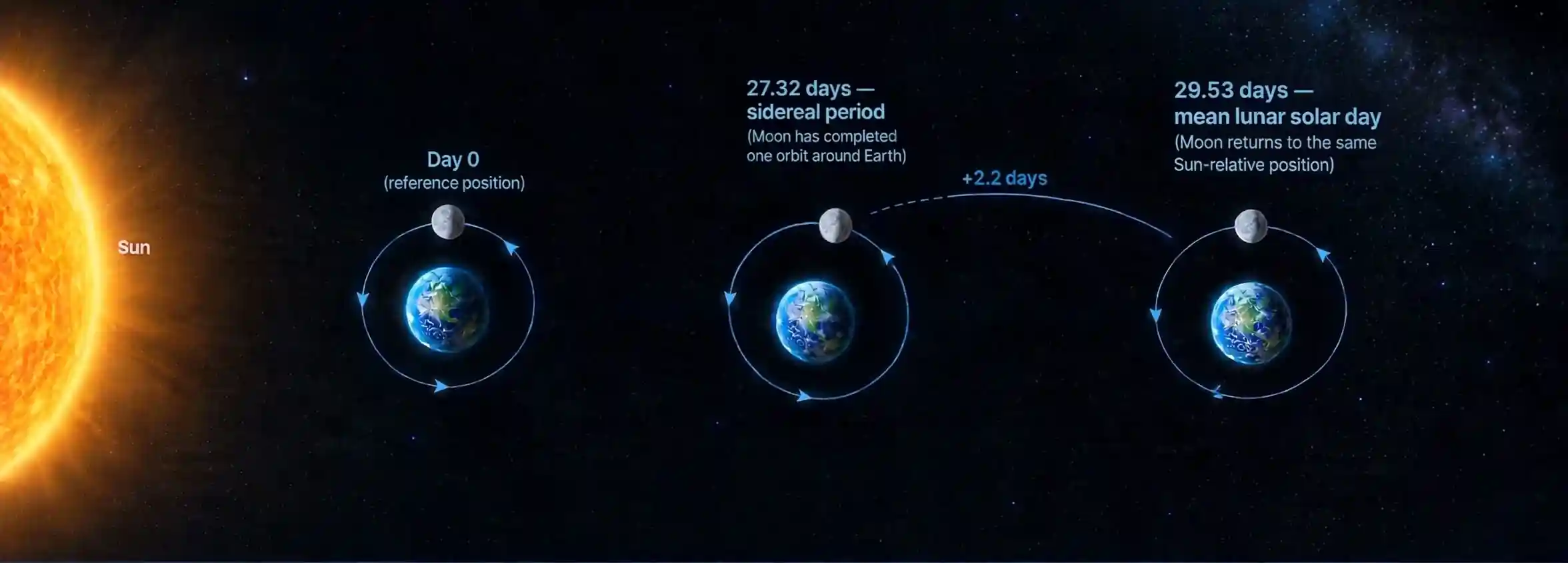
Short answer: at a typical spot away from the poles, one lunar day (one sunrise to the next) lasts about 29.53 Earth days (29 days, 12 hours, 44 minutes). That usually means roughly two weeks of daylight followed by two weeks of night. Exact timing depends on latitude, elevation and terrain, especially near the poles. Other things also get called a “lunar day,” and they are sorted out below.
Which “lunar day” do you mean?
Sunrise to sunrise is a local measurement: it is the interval between successive sunrises at one spot, and exact sunrise and sunset times differ from place to place with horizon and terrain. The phrase “lunar day” also has several meanings. Which one applies depends on whether you stand on the Moon, stand on Earth, or are reading a calendar.
| Meaning | Length | What it measures |
|---|---|---|
| Solar day on the Moon | ~29.53 Earth days | Sunrise to sunrise at one spot on the Moon |
| Rotation period (sidereal) | ~27.32 Earth days | One spin of the Moon relative to the stars |
| Lunar day as seen from Earth | ~24 h 50 min (average) | Moonrise to the next moonrise; the actual interval varies from day to day |
| Calendar lunar day (tithi) | ~19 to 26 hours | One thirtieth of a synodic month in traditional Hindu calendars |
This article focuses on the first, the one most people want when they ask how long a day lasts on the Moon.
In short: a day on the Moon is about 29.5 Earth days long.
Why the lunar day is 29.5 days
The Moon is tidally locked to Earth. Over billions of years, tidal forces slowed its rotation until its average rotation period matched its orbital period, about 27.32 days (the sidereal period; see the NASA Moon fact sheet). As a result, roughly the same hemisphere always faces Earth. Small apparent rocking motions, called libration, let observers on Earth see about 59% of the surface over time, though never all of it at once.
The Sun, though, is not a fixed star. While the Moon circles Earth, Earth circles the Sun and moves about 27 degrees along its orbit. The Moon has to travel a little farther, roughly two more days, to “catch up” before the Sun is back in the same position in its sky (NASA StarChild). That gives the synodic period of about 29.53 days, which is also the cycle of lunar phases.
1/S = 1/P − 1/E = 0.036600 − 0.002738 = 0.033862, so S ≈ 29.53 days.
This is a simplified model. The real lunar orbit is perturbed, so it explains the basic relationship rather than predicting each individual month.
In short: the Moon spins once every 27.3 days, but the Sun needs 29.5 days to return to the same place in the sky.
Why it isn’t exactly constant
The 29.53-day figure is an average. Individual synodic months range from about 29.3 to 29.8 days, a spread of roughly 13 hours. Three effects explain most of it:
- Elliptical orbits. The Moon moves faster near its closest point to Earth and slower near its farthest. Earth’s own orbit is also elliptical.
- Gravitational perturbations. The Sun’s pull constantly nudges the Moon’s orbit.
- Libration. The Moon appears to rock slightly, so over time we can see about 59% of its surface in total (never that much at once), even though it is tidally locked. Libration does not change the length of the day.
Over geological time the average is changing too. The Moon drifts away from Earth by about 3.8 cm per year, and tidal friction slowly lengthens Earth’s day. Neither change is noticeable on human timescales.
In short: 29.53 days is a long-run average, and single months vary by up to several hours.
What a lunar day is like on the surface
With no thick atmosphere to spread heat around, the surface goes through extreme swings. Away from the poles, sunlit surface temperatures can reach roughly 120 °C (250 °F), and nighttime temperatures can fall to roughly −175 °C (−280 °F). NASA sources quote slightly different values; its Moon fact sheet gives about 390 K and 95 K at the equator. These are representative values, not universal ones: actual conditions depend on location, surface properties and illumination.
The sky looks different from anything on Earth. At a typical location the Sun takes about two weeks to travel from one horizon to the opposite one, and shadows lengthen slowly. On the near side, Earth stays in roughly the same part of the sky (libration makes it wobble slightly), going through phases opposite to the Moon’s. On the far side there is no Earth in the sky at all, but sunrise and sunset happen on the same 29.5-day schedule. The far side is not permanently dark. It is just permanently hidden from us.
In short: about two weeks of intense sunlight, then two weeks of deep cold and darkness.
Exceptions at the poles
The Moon’s spin axis is tilted only about 1.5 degrees from the perpendicular to the ecliptic (Earth’s orbital plane around the Sun). As a result, the Sun stays close to the horizon near the poles. Ridges and crater rims can be lit for unusually long stretches, while the floors of some deep craters never receive direct sunlight. These are called permanently shadowed regions, and their temperatures can drop below −200 °C, cold enough to preserve water ice. Because the pattern depends on precise terrain, no single daylight schedule applies to the whole polar region.
That pairing of nearly constant light and nearby ice is why the south polar region is a focus for landing site selection.
In short: at the poles, “day” and “night” depend on terrain more than on the calendar.
Lunar days and exploration
Mission planners schedule around the two-week cycle.
- Apollo landings were timed for favorable lighting, with the Sun fairly low so shadows revealed surface relief and hazards. Planners also had to fit surface operations inside the available daylight, well before lunar night.
- Robotic landers and rovers without a nuclear heat source usually shut down at sunset, because batteries cannot keep electronics warm through 14 nights. India’s Chandrayaan-3 lander and rover completed their planned operations and were put into sleep mode in September 2023 as night approached. Attempts to revive them after the next sunrise were unsuccessful (Space.com).
- China’s Chang’e missions have used radioisotope heaters and other designs to survive repeated lunar nights, and Yutu-2 on the far side has operated far beyond its planned life.
- Artemis candidate sites near the south pole are chosen partly for how much sunlight they get, alongside terrain, communications, thermal conditions and access to scientifically valuable locations.
In short: surviving the lunar night is one of the hardest engineering problems of any Moon mission.
Keeping time on the Moon
A common time standard matters more as many spacecraft, landers and crews operate on and around the Moon. NASA is working with other U.S. agencies and international partners on Coordinated Lunar Time (LTC), a framework for navigation, communications and mission coordination, designed to work consistently with Earth-based time standards, including UTC. A 2024 White House memo set a deadline of December 31, 2026 to deliver a strategy for implementing it.
Relativity complicates this. Because of weaker gravity and differences in motion, a clock on the lunar surface gains about 56 microseconds per Earth day on average relative to one on Earth. Estimates differ slightly by method (one report gives 58.7), and the rate depends on the reference frame, so it is not a universal correction for every lunar clock.
According to the sources cited here, LTC is still being developed and is not yet an operational standard.
In short: lunar clocks tick slightly faster, and a shared lunar time standard is being developed.
Lunar day vs. other worlds
| World | Solar day (sunrise to sunrise) |
|---|---|
| Earth | 24 hours |
| Moon | ~29.5 Earth days |
| Mars | 24 h 39 min (one “sol”) |
| Mercury | ~176 Earth days |
| Venus | ~117 Earth days |
Many planets in close orbits around their stars may become tidally locked like the Moon, in which case they keep one face toward their star, and have permanent day and permanent night instead of a cycle. The Moon’s day exists because it faces Earth, not the Sun.
In short: the Moon’s day is long, but not the longest in the solar system.
How scientists measure it
Laser ranging measures the Moon’s distance and orbital motion extraordinarily precisely. Since Apollo, retroreflectors left on the surface have let observatories time laser pulses bounced off the Moon, measuring distance to within millimeters and tracking orbital changes over decades. Lunar orbiters such as NASA’s Lunar Reconnaissance Orbiter add maps of surface illumination and temperature, which show exactly how long any given spot stays lit.
In short: laser ranging and orbiters pin the cycle down far more precisely than is needed for everyday use.
Common misconceptions
- “There is a permanent dark side.” No. The far side gets sunlight on the same roughly 29.5-day cycle as the near side. It is simply the side we cannot see. The exceptions are permanently shadowed craters near the poles, which are dark on both sides of the Moon.
- “The Moon doesn’t rotate.” It does. It rotates exactly once per orbit, which is why one face stays toward us.
- “A lunar day is the same as a lunar month.” Related but different. A month can mean the sidereal (27.3-day) or synodic (29.5-day) cycle, and the mean local solar day is approximately equal to the synodic month, even though one is a sunrise-to-sunrise interval and the other a phase cycle.
Frequently asked questions
How long is a day on the Moon?
About 29.5 Earth days from sunrise to sunrise: roughly 14.75 days of daylight and 14.75 days of night.
How cold does the lunar night get?
Roughly −175 °C (−280 °F) away from the poles, and below −200 °C in permanently shadowed polar craters.
Does the Moon rotate?
Yes. It completes one rotation every 27.3 days, the same time it takes to orbit Earth once.
Why do we only see one side of the Moon?
Tidal locking: the Moon’s rotation period matches its orbital period, so the same face always points at Earth.
Why is the lunar day 29.5 days but the rotation 27.3 days?
Earth moves around the Sun while the Moon orbits Earth, so the Moon needs about two extra days to bring the Sun back to the same position in its sky.
Can humans survive a full lunar night?
Not without substantial infrastructure. Habitats would need power storage or nuclear sources and heavy insulation. Sites at the poles with near-continuous light are attractive for this reason.
How much later does the Moon rise each day?
About 50 minutes on average, because the Moon moves eastward along its orbit while Earth rotates. So the interval from one moonrise to the next averages about 24 h 50 min, though it varies from day to day.
Is a lunar day the same length everywhere on the Moon?
The average sunrise-to-sunrise cycle is about 29.5 days nearly everywhere, but local sunrise, sunset and continuous illumination depend on terrain and horizon geometry, especially near the poles.
How long is an hour on the Moon?
Still 60 minutes. The long lunar day does not stretch the hour; it just contains about 709 of them.
Does the Moon have seasons?
Yes, although its small axial tilt produces much weaker seasonal changes in the Sun’s height than on Earth. Near the poles, the timing and duration of sunlight can still change significantly with season and terrain, which matters when choosing landing sites and planning solar-powered missions.
Why can’t solar-powered rovers easily survive the night?
They face two weeks of darkness, extreme cold, limited battery capacity and the need to keep electronics within their operating temperatures.
Will the lunar day ever change?
Yes, very slowly. As the Moon recedes and tidal interactions continue, its orbital period will lengthen over hundreds of millions of years.
Key numbers
| Quantity | Value |
|---|---|
| Mean synodic month (mean lunar day) | 29.53059 days |
| Sidereal rotation and orbital period | 27.32166 days |
| Moonrise to moonrise, seen from Earth | ~24 h 50 min (average) |
| Typical surface extremes away from the poles | ~+120 °C day, ~−175 °C night |
| Moon’s recession from Earth | ~3.8 cm per year |
| Spin axis tilt from the ecliptic perpendicular | ~1.5° |
Glossary
- Solar day
- The interval between successive sunrises at one location.
- Sidereal period
- The time to return to the same position relative to distant stars: about 27.32 days for the Moon’s orbit and its rotation.
- Synodic month
- The interval between identical Moon phases, about 29.53 days on average.
- Tidal locking
- A state in which a body’s rotation period equals its orbital period, so one side always faces its partner.
- Libration
- Small apparent rocking of the Moon that reveals slightly more than half its surface over time.
- Permanently shadowed region
- A spot, usually a deep polar crater floor, that never receives direct sunlight.
References and further reading
- SpacePolicyOnline: “What Time Is It On the Moon? OSTP Wants to Know” (2024 White House memo on Coordinated Lunar Time)
- UPI: White House orders NASA to develop lunar time standard
- NASA Moon Fact Sheet (orbital and rotation periods, equatorial temperature range)
- NASA StarChild: What is the orbital period of the Moon? (sidereal vs. synodic month)
- Space.com: India tries waking up Chandrayaan-3 moon lander
