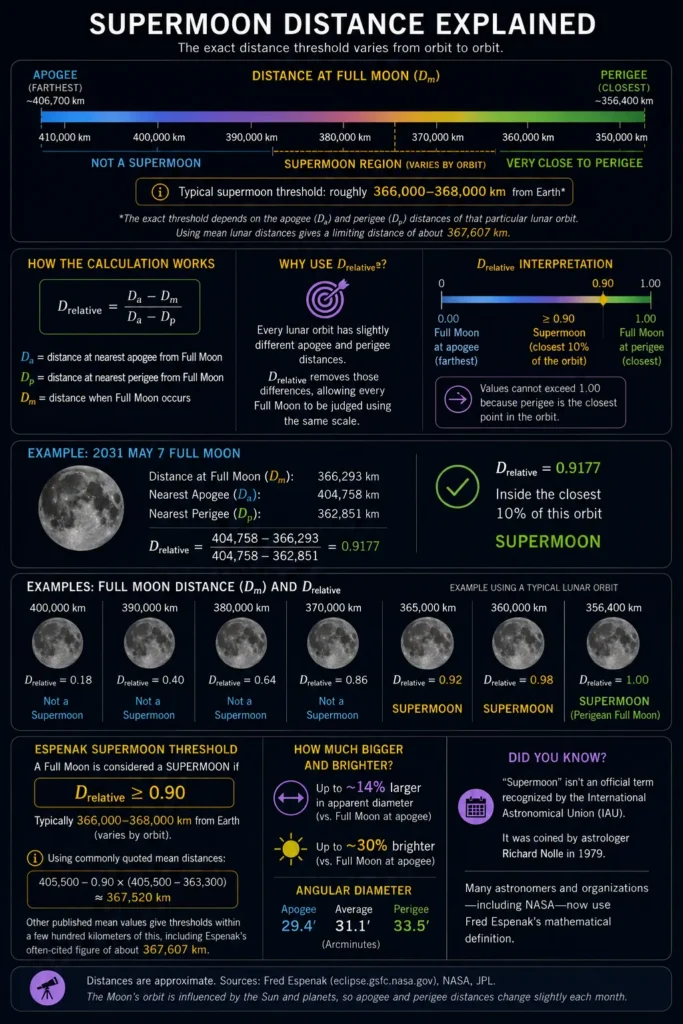
If you’ve ever wondered exactly how close the Moon has to be before it counts as a supermoon, you’re not alone. Plenty of sites quote a fixed number like 366,000 km, but that’s only an approximation. The real definition compares each full moon with its own orbit, which means the cutoff shifts slightly every month. For this year’s actual dates, see our 2026 supermoon calendar.
What is the supermoon distance?
Using the most widely cited definition (from NASA eclipse scientist Fred Espenak), a full moon is a supermoon when it falls within roughly the closest 10% of that month’s orbit — mathematically, when its relative distance value (Drelative) is 0.90 or higher. In real-world numbers, that typically works out to a full moon occurring at a distance of about 366,000–368,000 km from Earth or closer. Using mean lunar distances, the limiting figure comes out to about 367,607 km.
~406,700 km PERIGEE (~closest)
~356,400 km
Key takeaways
- There is no single, fixed supermoon distance.
- The commonly quoted 366,000 km figure is only an approximation.
- Espenak’s definition: a supermoon is a full moon with Drelative ≥ 0.90.
- The true threshold usually falls between about 366,000 and 368,000 km.
- “Supermoon” isn’t an official IAU term — it comes from astrology, not astronomy.
- Every supermoon is a full moon, but not every close full moon qualifies as one.
What is a supermoon?
A supermoon is a full moon that happens close enough to perigee — the Moon’s closest approach to Earth that month — to appear noticeably larger and brighter than average. It’s worth knowing where the word comes from: although NASA, observatories, and the media all use “supermoon” freely, it isn’t a term recognized by the International Astronomical Union. It was coined in 1979 by astrologer Richard Nolle, who defined it loosely as a new or full moon within about 90% of its closest approach to Earth. Modern astronomy borrowed the term but replaced Nolle’s vague wording with Espenak’s precise, orbit-relative math.
Why there’s no single fixed distance
The Moon’s orbit isn’t a perfect circle. Every month it swings from apogee (its farthest point), about 406,700 km away, to perigee (its closest point, about 356,400 km away) and back again. The Sun’s gravity — and to a much smaller extent the other planets — continually tugs on the Moon’s orbit, so the exact apogee and perigee distances shift slightly from one month to the next. Because of that, a fixed cutoff like “366,000 km” is only ever an approximation. The real definition compares each full moon to its own orbit, not to a universal number.
Why Drelative exists
Rather than measuring against one fixed distance, Espenak’s definition measures the full moon’s position within its own orbit:
D_relative = (D_a − D_m) / (D_a − D_p)- Da — distance at the nearest apogee to that full moon
- Dp — distance at the nearest perigee to that full moon
- Dm — the Moon’s actual distance at the moment it’s full
A Drelative of 0.90 means the Moon is 90% of the way from apogee to perigee when it’s full. A value of 1.00 means the moment of full moon coincides with perigee — a “perigean full moon,” the closest possible supermoon.
Worked example: the May 7, 2031 full moon
On that date, the full moon occurred at a distance of 366,293 km. The nearest apogee for that orbit was 404,758 km, and the nearest perigee was 362,851 km. Plugging those into the formula:
D_relative = (404,758 − 366,293) / (404,758 − 362,851) = 0.9177In other words, this full moon had already completed about 92% of the journey from apogee to perigee, placing it comfortably inside the closest 10% of that month’s orbit — even though 366,293 km isn’t unusually close in absolute terms.
Average threshold calculation
Using NASA’s own average apogee and perigee distances — 405,500 km and 363,300 km — you can solve for the distance that corresponds to Drelative = 0.90 directly:
Average apogee (D_a)  = 405,500 km
Average perigee (D_p) = 363,300 km

Threshold = D_a − 0.90 × (D_a − D_p)
          = 405,500 − 0.90 × 42,200
          ≈ 367,520 km
That’s close to — but not identical to — Espenak’s own mean-distance figure of about 367,607 km, since the two calculations start from slightly different mean apogee/perigee values. Both land comfortably inside the same 366,000–368,000 km range.
Example using a typical lunar orbit
The table below illustrates how distance and Drelative relate to each other for one representative orbit. Because the exact apogee and perigee shift slightly every month, these particular Drelative values won’t be identical for every full moon at that distance — a full moon at, say, 370,000 km could land slightly above or below 0.86 depending on that month’s actual apogee and perigee.
| Distance at full moon (Dm) | Drelative (typical orbit) | Status |
|---|---|---|
| 400,000 km | 0.18 | Not a supermoon |
| 390,000 km | 0.40 | Not a supermoon |
| 380,000 km | 0.64 | Not a supermoon |
| 370,000 km | 0.86 | Not a supermoon |
| 365,000 km | 0.92 | Supermoon |
| 360,000 km | 0.98 | Supermoon |
| 356,400 km | 1.00 | Supermoon (perigean full moon) |
Distances are approximate. Sources: Fred Espenak (eclipse.gsfc.nasa.gov), NASA, JPL.
Why do different websites quote different supermoon distances?
Search around and you’ll find several different numbers, and it can look like a disagreement about where the Moon actually is. It isn’t — it’s a difference in which definition a site is using:
- Richard Nolle’s original 1979 definition — loosely “within 90% of closest approach,” with no fixed formula, which is why Nolle’s own published lists were never fully consistent.
- Fred Espenak’s Drelative ≥ 0.90 definition — the orbit-relative math this article uses, typically landing around 366,000–368,000 km.
- A flat 366,000 km cutoff — a simplified stand-in some sites use instead of recalculating Drelative for every orbit.
- Other flat cutoffs — Sky & Telescope has used a distance around 358,884 km, and TimeAndDate.com uses 360,000 km, both stricter than Espenak’s.
The difference comes from using different definitions, not disagreement about the Moon’s position.
How much bigger and brighter does a supermoon look?
Compared with a full moon near apogee, a perigean full moon appears about 14% larger in apparent diameter and about 30% brighter, although the exact values vary slightly depending on the Moon’s actual apogee and perigee distances during that orbit. From one supermoon to the next, the visible difference is usually far more subtle, and most people won’t notice a size change with the naked eye unless the Moon is shown side by side with a comparison image.
| Moon position | Angular diameter |
|---|---|
| Apogee (farthest) | ~29.4 arcminutes |
| Average distance | ~31.1 arcminutes |
| Perigee (closest) | ~33.5 arcminutes |
Frequently asked questions
What is the exact distance threshold for a supermoon?
There isn’t one exact number that applies every time. Using Fred Espenak’s Drelative ≥ 0.90 definition, the threshold typically falls somewhere between about 366,000 and 368,000 km, depending on that month’s specific apogee and perigee distances. Using mean lunar distances as a stand-in gives a limiting distance of about 367,607 km.
Is a supermoon just any full moon closer than 366,000 km?
Roughly, yes — 366,000 km is a commonly cited rule-of-thumb figure. But the precise cutoff for any given month depends on that orbit’s own apogee and perigee distances, so the real threshold can land anywhere in the 365,000–367,000 km range.
What does Drelative actually measure?
It measures the full moon’s position within its orbit, expressed as a fraction. A Drelative of 0 means the Moon is full right at apogee (farthest); a value of 1.00 means the moment of full moon coincides with perigee (closest). A supermoon is anything at 0.90 or above.
Is “supermoon” an official astronomical term?
No. It isn’t recognized by the International Astronomical Union. The word was coined in 1979 by astrologer Richard Nolle, and modern astronomy generally follows Fred Espenak’s mathematical Drelative definition when identifying supermoons, rather than Nolle’s original astrological one.
Why do different websites give different supermoon distances?
Because they’re using different definitions, not because they disagree about where the Moon actually is. Some follow Nolle’s original loose 90%-of-perigee wording, some use Espenak’s Drelative formula, and some just apply a flat cutoff like 366,000 km or 360,000 km as a simplification.
How much bigger and brighter does a supermoon look?
At most, a perigean full moon appears about 14% larger in apparent diameter and about 30% brighter than a full moon near apogee. That’s the theoretical maximum, comparing the two extremes of the Moon’s orbit — the difference between one supermoon and another is usually much harder to spot.
Why does the supermoon threshold change from month to month?
Because the Moon’s orbit isn’t identical every month. The Sun’s gravity (and, to a lesser extent, the other planets) perturbs the Moon’s path, so the exact locations of apogee and perigee shift slightly from one orbit to the next. That moves the distance corresponding to Drelative = 0.90 along with them — typically within a range of about 365,000–367,000 km.
What is a “perigean full moon”?
It’s the closest possible supermoon: a full moon where the moment of full moon coincides with perigee, giving a Drelative of 1.00. This is when the Moon looks as large and bright as it can get. (For why perigee itself shifts over time, see our piece on lunar precession cycles.)