

The Moon swings from about 127°C in full sunlight to about -173°C in darkness, driven mainly by the Sun with no thick atmosphere to soften it.
Why the lunar surface gets so hot and so cold, how it varies by place and depth, how we know, and what it means for anyone planning to land there.
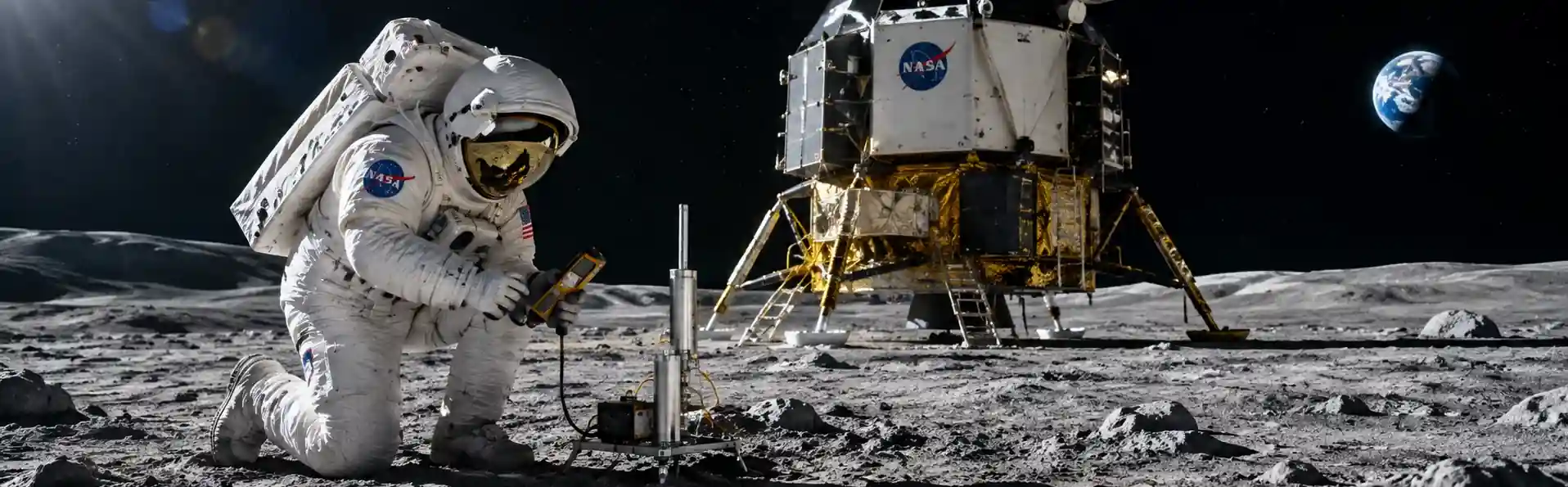
The short answer
At ordinary low-latitude sites, the lunar surface reaches about 127°C in full sunlight and drops to about -173°C during the lunar night, a swing of roughly 300°C. Other figures you will see, such as 120°C and -170°C, are rounded or from other sources. In the coldest permanently shadowed polar craters, temperatures fall below -243°C.
| Where and when | Approximate temperature |
|---|---|
| Low latitudes, local noon | 127°C (about 400 K) |
| Low latitudes, lunar night | -173°C |
| Mid-latitudes | Noon temperatures fall with latitude; no single figure fits because terrain matters |
| Polar regions, sunlit ground | Highly variable. Slope, illumination and terrain change temperatures over meters (see Chandrayaan-3 below) |
| Permanently shadowed craters | Below -243°C, as low as about -248°C in Hermite crater |
| About 1 m deep, Apollo 15 and 17 sites | Close to -20°C |
What temperature means here
When scientists quote a lunar temperature, they mean the temperature of the surface or the material just below it. The Moon has no meaningful “air temperature,” because it has only an extremely tenuous exosphere, far too thin to carry heat. Orbiters report brightness temperature, derived from the infrared a surface emits. Landers and Apollo probes measured temperatures in contact with the ground.
Why the swings are so extreme
No substantial atmosphere
Earth’s air and oceans store heat and move it around. The Moon has no substantial atmosphere, so sunlight is absorbed directly and nothing redistributes the heat. Convection, which equalizes temperature on Earth, does not operate.
Porous regolith conducts heat poorly
The surface is covered in fine, loosely packed, fragmented regolith, often called moon dust. Its porosity gives it very low thermal conductivity near the surface, and Apollo heat-flow measurements showed conductivity rising with depth. So the daily heat wave penetrates only a short distance: a large surface swing sits on top of a stable subsurface.
Long days and radiative cooling
The surface radiates infrared energy to space all the time. In daylight, absorbed sunlight outweighs that loss and the surface heats up. After sunset, the solar input vanishes, radiation dominates the energy balance, and the surface cools through a night lasting about two Earth weeks.
Distance from the Sun is not the reason
The Moon is the same distance from the Sun as Earth. The difference comes from what the Moon lacks.
The Sun dominates, but is not the only input
Sunlight is overwhelmingly the main energy source. Surfaces also receive light and infrared from nearby terrain, and Earthshine contributes a little. In permanently shadowed craters, scattered light and thermal emission from surrounding terrain matter, which is why those craters sit near 25 to 30 K and not at absolute zero.
Rocks, dust and reflectivity
Thermal inertia describes how strongly a material resists temperature change. Rocks have higher thermal inertia than fine dust, so they stay warmer after sunset. Diviner uses this to estimate rock abundance from nighttime and eclipse cooling. Albedo matters too: brighter surfaces absorb less sunlight and run cooler than darker ones at the same latitude.
The lunar day-night cycle
The Moon rotates once relative to the stars in about 27.3 days, but because Earth and Moon also move around the Sun, sunrise to sunrise takes about 29.5 days. This is the synodic month. At many low and middle latitudes, that is roughly 14 Earth days of sunlight followed by 14 of darkness (about 354 hours each). Near the poles, terrain can change this substantially.
The surface warms rapidly after sunrise and cools rapidly after sunset, then sinks slowly through the long night toward its minimum just before dawn.
Temperature by location
Low and middle latitudes
The Sun is highest at low latitudes, so noon temperatures peak there. Moving poleward, sunlight strikes at shallower angles and noon temperatures fall.
The poles
The Moon’s equator is tilted only about 1.5° from the ecliptic plane, so the Sun stays close to the horizon near the poles. Long shadows follow, and some crater floors are never lit. Nearby ridges can stay sunlit for long stretches, producing very different conditions a few kilometers apart. Because slope, crater geometry and season all matter, no single temperature range describes sunlit polar ground.
Permanently shadowed regions
Some permanently shadowed regions may have gone without direct sunlight for millions or even billions of years. LRO’s Diviner found their coldest spots below 30 K (-243°C), with readings near 25 K (-248°C) in Hermite crater near the north pole, among the lowest temperatures measured anywhere in the solar system. Some of these cold traps contain or may contain water ice and other volatiles, but not every shadowed region holds the same materials.
Near side and far side
Over a full cycle, both sides receive equal sunlight, and the far side is not permanently dark. At new Moon the far side is fully lit while the near side is dark.
Chandrayaan-3 at the pole
India’s Chandrayaan-3 lander carried ChaSTE, a probe with ten temperature sensors that went about 10 cm into the soil near 69°S. ISRO reported in 2025 that it was the first in-situ temperature measurement at a high southern latitude.
- Peak surface temperature at the probe: 355 K (±0.5 K), about 82°C, on a roughly 6° Sun-facing slope. Earlier orbital estimates predicted about 330 K.
- A nearby flat patch, about a meter away, peaked near 332 K, about 59°C.
- Night temperature at the site fell to about 105 K (-168°C), as reported in coverage of the study.
A tilt of a few degrees changed peak temperature by more than 20°C over about a meter, which is why polar planners cannot rely on one number.
Temperature by depth
The regolith blocks the surface swing from traveling downward. At the Apollo 15 and 17 heat-flow sites, temperatures roughly a meter down were close to -20°C and varied far less than the surface across the month. Those are only two sites, and NASA’s archive cautions that they are not necessarily representative of the whole Moon.
Orbiters have also found lunar pits, and some may lead to lava tubes. LRO observations combined with thermal modeling indicate that permanently shaded parts of a pit in Mare Tranquillitatis could stay near 17°C (63°F) all lunar day. This is a modeled environment: no spacecraft has yet measured the temperature inside a lunar cave.
Bury a habitat under a meter or two of regolith and the thermal problem shrinks from a 300°C swing to something much steadier.
How scientists measure it
- Apollo heat-flow probes (1971 to 1977). Thermometers in drilled holes at the Apollo 15 and 17 sites measured subsurface temperatures directly.
- LRO Diviner (2009 to present). For a primary overview, see NASA’s LRO fact sheet on temperature variation on the Moon (PDF). A multichannel infrared radiometer. It does not touch the ground: it measures emitted thermal infrared and converts it to brightness temperature, mapping the Moon with pixels a few hundred meters across. Small shadows or sunlit rocks inside a pixel can be much colder or hotter than the pixel’s value, and measuring the coldest regions is hardest.
- Chandrayaan-3 ChaSTE (2023). A contact probe giving temperature versus depth to 10 cm at one high-latitude site.
- Chang’e 3 and 4. Landers that survived multiple lunar nights using radioisotope heaters.
Sunrise, sunset and eclipses
Because regolith insulates so well, the surface responds rapidly to changes in sunlight, though not instantly. Heating after sunrise and cooling after sunset happen over hours, and the long night continues the slow decline.
During lunar eclipses, when Earth blocks the Sun, Diviner has measured rapid surface cooling and rewarming. Rocks cool more slowly than dust, so eclipse observations help map rock abundance. Where the Sun is absent, a surface does not drop instantly to its minimum, because stored heat keeps radiating.
What it means for missions
The lunar night at low latitudes
For landers away from the poles, surviving the roughly two-week night is one of the central engineering challenges. Solar power vanishes and electronics near -173°C fail without heat. Solutions include radioisotope heater units, as on Chang’e 3 and 4 and the Soviet Lunokhod rovers, which also closed their lids to retain heat. Several recent landers operated for only a single lunar day.
The poles are a different problem
At the poles, planners seek sites with long periods of illumination for power while coping with nearby permanently shadowed terrain and low Sun angles. That is why Artemis targets the south polar region despite the difficulty.
Timing of Apollo
The Apollo landings were scheduled in favorable daylight, with the Sun low enough for good surface visibility, and no crew stayed through the night or a full lunar day.
Spacesuits and hardware
In vacuum there is no convective cooling. Suits control temperature through radiation, conduction, insulation, internal fluid loops, evaporative or sublimation cooling, and surface optical properties. Sunlit and shaded surfaces can differ greatly, so a suit may see very different environments on opposite sides.
Moon vs Earth vs Mars
| Property | Moon | Earth | Mars |
|---|---|---|---|
| Substantial atmosphere | No, only a tenuous exosphere | Yes | Very thin |
| Main heat transport at the surface | Radiation and conduction | Convection, conduction, radiation | Mostly radiation and conduction, with some from thin air |
| Length of a solar day | About 29.5 Earth days | 24 hours | About 24 h 39 min |
| Long dark nights | Yes, about two weeks | No | No |
| Surface extremes | Very large | Moderated by air and oceans | Large |
Common misconceptions
- “It’s cold because it’s far from the Sun.” The Moon and Earth are at the same distance from the Sun.
- “The dark side is always dark.” The far side gets as much sunlight as the near side.
- “The Moon is uniformly freezing.” Sunlit ground at low latitudes is hotter than boiling water on Earth.
- “Shadow means instant deep cold.” With no air to carry heat, adjacent sunlit and shaded surfaces can differ greatly, but a shaded rock still holds stored heat and cools over time.
- “There’s air temperature on the Moon.” Quoted values describe the surface or subsurface, not air.
What we still don’t know
- How temperatures vary at meter scales across polar terrain, since ChaSTE sampled one site.
- Which permanently shadowed regions hold ice, and in what amounts.
- The real thermal conditions inside lunar pits and lava tubes, which are so far only modeled.
- The coldest true temperatures, since orbital pixels average over shadows and the coldest pixels are hardest to measure.
Frequently asked questions
How hot does the Moon get during the day?
At low latitudes, the sunlit surface reaches about 127°C (260°F), roughly 400 K, around local noon. Values at higher latitudes are lower and depend strongly on slope and terrain.
How cold is the Moon at night?
Low-latitude surfaces fall to about -173°C (-280°F) during the lunar night. Permanently shadowed polar craters are far colder, below 30 K (-243°C), with readings near 25 K at Hermite crater.
Why does the Moon have such extreme temperature swings?
The Moon has no substantial atmosphere, only a very tenuous exosphere, so nothing carries heat around. Its porous regolith conducts heat poorly, so sunlight heats only a thin surface layer. A day and night each last about two Earth weeks, and the surface continuously radiates heat to space. Slope, rock abundance and reflectivity also shift local temperatures.
How long are a lunar day and a lunar night?
A full sunrise-to-sunrise cycle takes about 29.5 Earth days. At many low and middle latitudes that means roughly 14 Earth days of sunlight and 14 of darkness. Near the poles, terrain can change this dramatically.
Is the far side of the Moon always dark?
No. Over a lunar cycle the far side receives as much sunlight as the near side. It is only hidden from Earth’s view.
Is it warmer underground on the Moon?
Yes. At the Apollo 15 and 17 heat-flow sites, temperatures about a meter down were close to -20°C and varied far less than the surface. Modeling suggests shaded parts of a lunar pit in Mare Tranquillitatis could stay near 17°C, but no spacecraft has measured inside a lunar cave.
Could a human survive a lunar day without protection?
No. The vacuum alone is fatal, and suits and habitats must also manage large differences between sunlit and shaded surfaces.
How do we know the Moon’s temperatures?
Apollo probes measured temperatures directly in the regolith at two sites. NASA’s Lunar Reconnaissance Orbiter Diviner radiometer maps surface brightness temperature from orbit by measuring thermal infrared emission. India’s Chandrayaan-3 made the first in-situ polar temperature measurements in 2023.
Key takeaways
- Low-latitude surface temperature swings from about 127°C in sunlight to about -173°C in darkness.
- The causes are no substantial atmosphere, low-conductivity regolith and two-week days and nights, not distance from the Sun.
- Permanently shadowed polar craters fall below -243°C, and some may hold ice.
- Polar sunlit ground varies strongly with slope: Chandrayaan-3 measured 82°C and 59°C a meter apart.
- At the Apollo sites, a meter below ground stays near -20°C.
Sources and number-by-number references
Where sources differ, rounding differs: NASA materials give daytime maxima of 120 to 127°C and nights near -173°C.
- 127°C and -173°C at low latitudes: NASA Science, Moon temperature material, based on LRO Diviner. Vasavada et al. (2012), Journal of Geophysical Research: Planets, “Lunar equatorial surface temperatures and regolith properties from the Diviner Lunar Radiometer Experiment.”
- Below 30 K and about 25 K: Paige et al. (2010), Science, Diviner polar observations; NASA LRO Diviner fact sheet (Hermite crater).
- Close to -20°C at about 1 m: Apollo 15 and 17 Heat Flow Experiments (Langseth et al.), NASA Planetary Data System.
- 17°C pit environment: NASA reporting on Horvath et al. (2022), Geophysical Research Letters, “Thermal and Illumination Environments of Lunar Pits and Caves.” Modeled, not measured.
- 355 K and 332 K at the Chandrayaan-3 site: ISRO, “India Bags Credit First-Ever In-Situ Measurement” (March 2025), and the Communications Earth & Environment paper on ChaSTE.
- 29.5-day cycle and 1.5° tilt: NASA Science Moon facts.
- Verify against current NASA and ISRO pages before republishing.