

Quadrantid Meteor Shower: Peak Dates, Radiant & How to Watch
A reference guide to the Quadrantids: when they peak, why the window to catch them is so short, and how to get the most out of the year’s first — and one of its strongest — meteor showers.
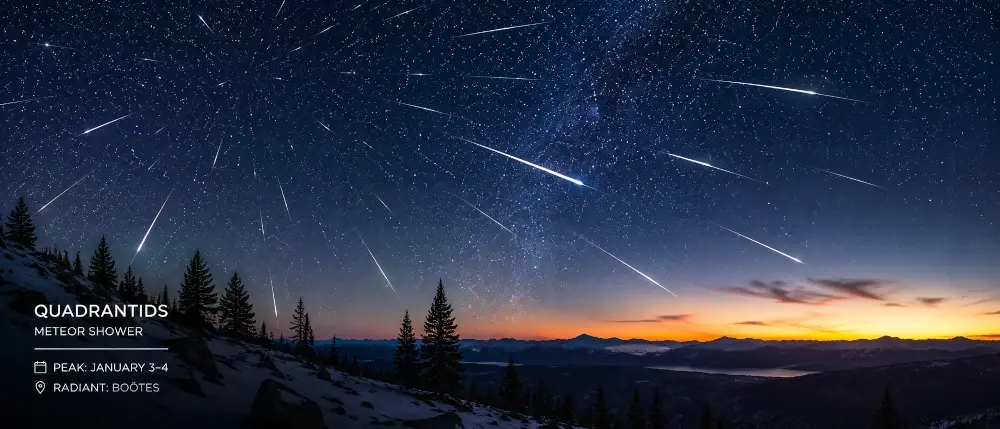
What Is the Quadrantid Meteor Shower?
The Quadrantids kick off the meteor shower calendar every January, and on paper they’re one of the strongest showers of the year — the American Meteor Society lists a theoretical Zenithal Hourly Rate of around 120 meteors per hour, on par with the Geminids. In practice, the Quadrantids usually fall short of that promise for a simple reason: their peak is extraordinarily narrow, lasting only about six hours before activity fades rapidly, compared to the day or more that showers like the Perseids or Geminids stay near their best.
The shower takes its name from Quadrans Muralis, an obsolete constellation once charted between Boötes and Draco. The constellation was left off the list of 88 modern constellations the International Astronomical Union agreed on in 1922 and formally adopted in 1930. The name stuck to the meteor shower even after the constellation itself fell out of use, which is why the Quadrantids are sometimes called the Bootids instead, after the modern constellation Boötes where the radiant now falls.
Because the peak is so brief and so sensitive to timing, the Quadrantids reward observers who plan ahead more than almost any other shower — a clear pre-dawn sky at the right hour can mean triple-digit meteor counts, while missing the window by half a day can mean almost nothing at all.
When to Watch Each Year
The Quadrantids are technically active for about two weeks, but nearly all of that window sees only scattered activity. Here’s the timeline that actually matters:
- Active period: roughly December 28 through January 12, with very low background rates detectable a little earlier and later.
- Peak night: typically the night of January 3–4. Unlike showers with a peak spread over several nights, the Quadrantid maximum is a genuinely narrow spike — the American Meteor Society describes it as lasting only about six hours, with activity falling to roughly half its peak value within four hours afterward.
- Timing is everything: because the peak is so brief, whether it’s worth watching in a given year depends heavily on whether that few-hours-wide window happens to fall during your local nighttime. A predicted peak in your afternoon can mean a disappointing night even under otherwise perfect sky conditions.
In 2027, for example, the predicted maximum falls somewhere around 3:30–5:47 UT on January 4 (estimates vary slightly by source), which favors observers in Europe and western Asia; the surrounding hours before dawn are still the best bet for North American observers, even if they miss the exact predicted peak.
The Mystery of Asteroid 2003 EH1
Meteor showers occur when Earth passes through streams of debris shed by a comet or asteroid, and the Quadrantids have one of the more unusual origin stories on the calendar. Their parent body, asteroid 2003 EH1, was discovered in March 2003 by the Lowell Observatory Near-Earth-Object Search. Later that year, meteor astronomer Peter Jenniskens compared its orbit to the Quadrantid meteoroid stream and found them to match — identifying 2003 EH1 as the shower’s source.
That’s unusual because most meteor showers come from active, icy comets, not asteroids. The leading explanation is that 2003 EH1 isn’t a true asteroid at all, but the rocky remnant of a comet that has since lost all its ice — what astronomers sometimes call a “dead” or “rock” comet. One candidate for its former life: the Comet of 1490 (C/1490 Y1), observed and recorded by Chinese, Japanese, and Korean astronomers that year. Astronomer Ichiro Hasegawa proposed the connection in 1979, and dynamical studies building on Peter Jenniskens’s work put the age of the dense, central core of the Quadrantid stream — the part responsible for the shower’s short, sharp peak — at only around 200 to 500 years, remarkably young by meteor-shower standards. That estimate applies specifically to the core, though: the broader, fainter Quadrantid background activity appears to be a separate and much older component, with age estimates running to several thousand years or more.
Finding the Radiant Near the Big Dipper
The Quadrantid radiant sits at roughly right ascension 15h20m, declination +49°, in a sparse patch of northern Boötes near the border with Draco. The American Meteor Society points to Alkaid — the star at the end of the Big Dipper’s handle — as the nearest useful landmark; the radiant sits a little further northeast of it. Arcturus, the bright orange-red star that anchors the rest of Boötes, is on the opposite side of the constellation, roughly 30° away, so it’s a less direct signpost for this particular shower. Because the radiant sits so far north, the shower is very much a Northern Hemisphere event: from mid-northern latitudes the radiant is circumpolar and above the horizon most of the night, while from the Southern Hemisphere it stays low or below the horizon and only a handful of meteors are typically visible.
As with any shower, you don’t need to stare at the radiant to see meteors — they can streak across any part of the sky, and looking directly at the radiant tends to show shorter, more head-on trails. Use the Big Dipper as a signpost to orient yourself, then let your eyes wander across as much open sky as possible rather than fixing on one spot.
Why the Moon Matters Every Year
Moonlight is the single biggest variable in any meteor shower forecast, and for the Quadrantids it’s compounded by the shower’s short peak: a bright moon during that narrow window can wipe out most of an already brief show. Because the peak date is fixed but the lunar cycle isn’t, some years land in dark, moonless skies while others land under a bright gibbous or full moon.
2027 is a good year on the moon front — the American Meteor Society lists the moon at only 13% illuminated, a waning crescent, on the peak night. Other recent years haven’t been as fortunate; the 2026 peak, for instance, coincided with a full moon that the American Meteor Society said would leave the best hourly rates under 10, far below the shower’s usual dark-sky potential.
- New moon or thin crescent near the peak: the best-case scenario — dark skies for the whole narrow peak window.
- Gibbous or full moon near the peak: a rough year for the Quadrantids specifically, since there’s no broad, multi-night window to fall back on the way there is with some other showers.
Quadrantid Peak Schedule: 2027–2036
The Quadrantids peak on almost the same calendar date every year — typically the night of January 3–4. What changes from year to year is the Moon, and, just as importantly for this shower, exactly when within that night the brief maximum falls.
The 2027 row below is cross-checked against the American Meteor Society’s published shower calendar and independent lunar-phase records; the Society doesn’t currently publish shower-specific forecasts further out than that. The 2028–2036 rows are projected from actual published lunar-phase calendars for each January — not a simple fixed-interval estimate — which is more reliable than assuming the Moon shifts by a constant number of days every year, but these rows still haven’t been checked against a shower-specific source this far in advance. Just as important: moon phase alone doesn’t fully determine viewing quality — moonrise/moonset, the Moon’s altitude, and exactly when within the night the brief Quadrantid peak falls all matter too, and none of that is predictable this far out. Treat the viewing outlooks below as rough planning guides, not forecasts, and reconfirm the moon phase and predicted peak time as each date approaches.
| Year | Typical Peak Night | Moon Phase | Moon Illumination | Moon Interference |
|---|---|---|---|---|
| 2027 | Jan 3–4 | Waning Crescent | ~13% | Minimal – confirmed by AMS as unlikely to interfere |
| 2028 | Jan 3–4 | First Quarter (waxing) | ~49% (approx.) | Depends on peak timing – moon up much of the evening |
| 2029 | Jan 3–4 | Waning Gibbous | ~87% (approx.) | Likely significant |
| 2030 | Jan 3–4 | New Moon | ~0–3% (approx.) | Minimal |
| 2031 | Jan 3–4 | Waxing Gibbous | ~79% (approx.) | Potentially significant |
| 2032 | Jan 3–4 | Waning Gibbous | ~64% (approx.) | Significant |
| 2033 | Jan 3–4 | Waxing Crescent | ~12% (approx.) | Minimal |
| 2034 | Jan 3–4 | Full Moon (at or very near peak night) | ~99–100% (approx.) | Severe |
| 2035 | Jan 3–4 | Waning Crescent | ~23% (approx.) | Limited |
| 2036 | Jan 3–4 | Waxing Crescent | ~28% (approx.) | Limited |
Best Time and Viewing Strategy
Put the pieces together — radiant height, moon phase, and the shower’s unusually brief maximum — and the optimal plan looks like this:
- Check the predicted peak time for the current year before you commit to a viewing plan; this matters more for the Quadrantids than almost any other shower.
- Skip the early evening. The radiant is low in the northeast for much of the night and only climbs to a useful elevation later on.
- Watch from midnight until the sky starts to brighten. The pre-dawn hours, when the radiant is highest, are generally your best bet regardless of the exact predicted peak.
- Get away from significant light pollution. A darker sky can dramatically increase the number of meteors you’re able to see, though exactly how much depends on your starting point, the direction you’re facing, and the Moon.
- Dress for genuinely cold conditions. Early January nights are among the coldest of the year for most Northern Hemisphere observers; plan to watch in short stretches with breaks to warm up rather than one long sit.
- Give your eyes time. Full dark adaptation takes 20–30 minutes, and a bright phone screen can significantly set it back — use a dim red light if you need one.
How to Photograph the Quadrantids
Meteor photography is really wide-field night sky photography with patience layered on top — you’re not tracking a single fast-moving subject so much as leaving your shutter open on a big patch of sky and hoping something streaks through the frame. The Quadrantids add one extra wrinkle: because the peak is so short, timing your shooting window around the predicted maximum matters more here than for most showers.
Gear
- A camera capable of manual exposure control (mirrorless or DSLR).
- A wide-angle lens, ideally 14–24mm, with the widest available aperture (f/1.8–f/2.8).
- A sturdy tripod — nothing else matters if the camera moves.
- An intervalometer or built-in interval timer, so the camera fires continuously without you touching it.
- Spare, fully charged batteries — cold weather drains them fast, and January nights are typically the coldest shooting conditions of the meteor calendar.
Camera Settings
- Focus: manual, set to infinity, checked visually on a bright star or planet at full zoom in live view.
- Aperture: as wide as your lens allows — f/2.8 or faster if possible.
- Shutter speed: start around 10–20 seconds and adjust from there based on your focal length and how much star trailing you see in test shots.
- ISO: start around 1600–3200 as a baseline and adjust based on your test shots.
- Shooting mode: continuous interval shooting with a 1–2 second gap between frames, timed to cover the predicted peak window for the current year.
Composition
Frame well away from the radiant near the Big Dipper rather than centered on it, and include an interesting foreground — a horizon, treeline, or silhouette — to give any captured meteor a sense of scale. Because you can’t predict exactly where a meteor will appear, plan to shoot continuously through the predicted peak window and sort through the frames afterward rather than trying to time an individual shot.
What to Expect: Speed, Fireballs & the Sharp Peak
Quadrantid meteors travel at about 41 kilometers (25 miles) per second — a medium pace, faster than the Geminids but slower than fast showers like the Orionids or Leonids. NASA notes that Quadrantid fireballs originate from larger particles of debris than an average meteor, which is part of why the shower has a solid reputation for producing bright fireballs — explosions of light and color that persist noticeably longer than an average meteor streak.
The defining feature of the Quadrantids, though, is timing rather than brightness. The American Meteor Society puts the typical observed rate under dark skies at around 25 meteors per hour — well below the shower’s 120 ZHR ceiling — precisely because that ceiling only applies during the few hours of true maximum, and most observers simply aren’t watching at the exact right moment. Get the timing right, under a dark sky, and the Quadrantids can briefly rival any shower of the year; get it wrong, and you may see very little at all.
Quadrantids vs. Other Meteor Showers
Here’s how the Quadrantids stack up against the year’s other headline showers. Rates below are the Zenithal Hourly Rate (ZHR) — a theoretical ceiling under a perfectly dark sky with the radiant directly overhead — not what a typical observer actually sees, which is usually lower, and for the Quadrantids specifically, lower by an unusually wide margin because of the short peak:
| Shower | Typical Peak | ZHR (ceiling) | Speed | Parent Body |
|---|---|---|---|---|
| Quadrantids | Jan 3–4 | ~120/hr | Medium | Asteroid 2003 EH1 |
| Lyrids | Apr 21–22 | ~18/hr | Medium-fast | Comet C/1861 G1 (Thatcher) |
| Perseids | Aug 12–13 | ~100/hr | Fast | Comet 109P/Swift-Tuttle |
| Orionids | Oct 21–22 | ~20/hr | Very fast | Comet 1P/Halley |
| Geminids | Dec 13–14 | ~150/hr | Medium | Asteroid 3200 Phaethon |
On paper, the Geminids and Quadrantids have the two highest ZHRs of the year’s major showers, at around 150 and 120 respectively — and both, notably, come from asteroids rather than comets. In practice, though, the Quadrantids are the outlier of the group: their maximum is far narrower than the Geminids’ broad, roughly day-long plateau, which is why the Quadrantids are grouped with the Lyrids, Leonids, and Ursids as one of the year’s sharp-peaked showers, in contrast to the Perseids’ or Geminids’ multi-night activity.
Viewing Night Checklist
Check the current year’s predicted peak time and moon phase before you pick a night — for the Quadrantids specifically, timing matters more than for almost any other shower.
Pick the darkest accessible location you can, away from direct artificial lights and major urban light domes, with a wide, unobstructed view of the sky.
Dress for real cold. Early January nights are among the coldest of the year for Northern Hemisphere observers; layer up, bring hand warmers, and plan for shorter watching stretches with breaks.
Bring a reclining chair or mat so you can look straight up without neck strain for an extended stretch.
Leave the binoculars at home. Meteors move fast and unpredictably across a wide area, so unaided eyes give you a much better field of view than magnified optics.
Plan your watch around the predicted peak window rather than just “sometime on the night of January 3–4” — with a maximum this narrow, timing is the difference between an excellent show and almost nothing.