

It takes astronauts about three days to reach the Moon, and robotic probes anywhere from about a day and a half to more than a year. The difference is how fast you go, what route you take and whether you plan to stop.
Real travel times for Apollo, Artemis II and robotic missions, the physics that sets the schedule, and how long the trip would take by car, plane or on foot.
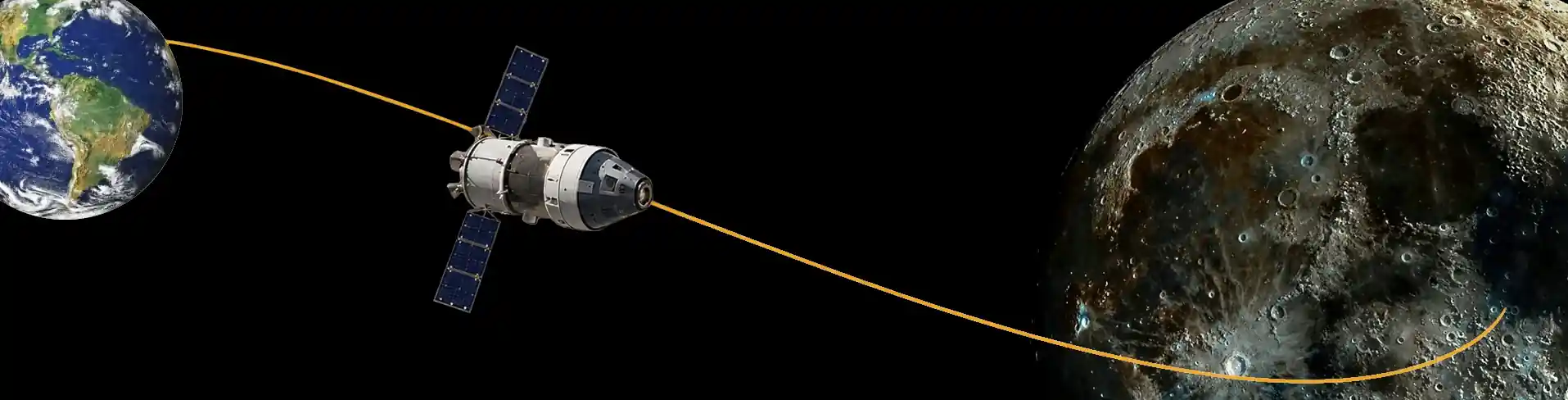
The short answer
For a crewed mission, plan on about three days of travel to lunar orbit and a little over four days to land. Artemis II reached its closest approach to the Moon about five days after launch in April 2026, including a day spent checking Orion in Earth orbit. Robotic missions vary widely because they trade time for fuel and cost.
| Mission | Milestone measured | Elapsed time from launch |
|---|---|---|
| New Horizons (2006) | Crossed the Moon’s orbital distance on the way to Pluto; not a lunar encounter | About 9 hours |
| Luna 1 (1959) | Closest approach, a flyby that missed by about 6,000 km | About 34 hours |
| Luna 2 (1959) | Impact, the first to reach the Moon | About 38 hours |
| Apollo 8 (1968) | Lunar orbit insertion | About 69 hours |
| Apollo 11 (1969) | Lunar orbit insertion, then touchdown | About 76 hours, then about 103 hours |
| Artemis II (2026) | Closest approach on a flyby (mission lasted about 9 days) | About 5 days |
| Chandrayaan-3 (2023) | Landing | 40 days |
| GRAIL (2011) | Lunar orbit insertion (Ebb) | Nearly 4 months |
| SMART-1 (2003) | Capture into lunar orbit | About 13 months |
What counts as reaching the Moon
“How long to get there” depends on the finish line, so this article labels every time with what it measures. All times are elapsed time from launch.
- Crossing the Moon’s orbital distance. Passing the distance of the Moon’s orbit from Earth, wherever the Moon happens to be.
- Lunar encounter. Passing near the Moon, as in a flyby, or hitting it.
- Lunar orbit insertion. Firing an engine to be captured into orbit around the Moon.
- Landing. Touching down on the surface.
How far away the Moon is
The Moon averages about 384,400 km (238,855 miles) from Earth, roughly 30 Earth diameters. Its orbit is an ellipse perturbed by the Sun and other bodies, so the distance changes from one orbit to the next. Typical perigee and apogee values are about 363,000 km and 405,000 km. You can follow those swings in our guide to how far the Moon is from Earth. The Moon is also slowly drifting away, by a few centimeters per year, which we cover in how fast the Moon is moving away from Earth.
Light and radio waves cover the average distance in about 1.28 seconds (384,400 km divided by 299,792 km/s), which is why conversations with astronauts on the Moon had a noticeable pause.
Travel time calculator
Enter a speed to see an idealized travel time: the average distance divided by a speed that never changes. Real spacecraft speed up, slow down, follow curved paths and brake on arrival, so treat the result as a sense of scale, not a mission estimate.
| Hypothetical comparison | Constant speed | Idealized time to the Moon |
|---|---|---|
| Walking | 5 km/h | About 8.8 years |
| Driving | 100 km/h (62 mph) | About 160 days |
| Commercial jet | 900 km/h (560 mph) | About 18 days |
| Real spacecraft | Changes throughout the trip | About 3 to 5 days for typical chemical-rocket transfers |
Why it takes days, not hours
The Moon is a moving target
The Moon moves around Earth at about 1 km/s on average. Mission planners calculate a trajectory that brings the spacecraft to the Moon’s future position at the required time, not to where it is at launch.
Climbing out of Earth’s gravity costs speed
After the translunar injection burn, the spacecraft coasts. As it moves away from Earth, it converts kinetic energy into gravitational potential energy, so its speed relative to Earth falls steadily. Near the end of the trip the Moon’s gravity becomes increasingly important and shapes the arrival.
Why arriving safely takes more than speed
A faster arrival generally means more speed to remove. Entering lunar orbit needs a braking burn, and landing needs more energy management and a controlled descent. Among the quickest lunar-distance crossings are high-speed flybys, which avoid the large braking maneuver. How much extra fuel a faster trip costs depends on the trajectory and the arrival goal.
A five-day transfer is a useful benchmark
Starting from low Earth orbit, a minimum-energy transfer out to the Moon’s distance takes about five days, which is half of a long elliptical orbit. The exact time depends on the trajectory and the arrival requirements. Apollo used extra energy to cut that to about three days.
Apollo: the three-day trip
Apollo lunar missions followed a broadly similar sequence, though objectives and trajectories differed and not every mission landed. Here is Apollo 11, using NASA’s mission report.
- Launch, July 16, 1969. The Saturn V placed the spacecraft in Earth orbit about 12 minutes later.
- Translunar injection, about 2 hours 44 minutes after launch. The third stage fired to send the crew toward the Moon.
- Coast. About three days of travel with a single midcourse correction, performed about 27 hours into the flight.
- Lunar orbit insertion, about 75 hours 50 minutes after launch. A burn behind the Moon slowed the spacecraft into lunar orbit. This is the “about 76 hours” figure.
- Landing, July 20. Touchdown came at 102 hours 45 minutes 40 seconds, in the Sea of Tranquility.
Apollo 8, which only orbited, reached lunar orbit insertion at about 69 hours. See where each landing took place in our guide to the Apollo landing sites.
Artemis II in 2026
Artemis II lifted off on April 1, 2026 with four astronauts aboard Orion. The crew spent about a day in Earth orbit checking the spacecraft, then fired toward the Moon. Orion entered the Moon’s sphere of influence about four days and six hours into the mission and reached its closest approach, about 4,067 miles above the surface, on April 6, roughly five days after launch. Splashdown came on April 10 (local time in the Pacific), after a mission of about nine days. It was the first crewed trip to the Moon since Apollo 17 in 1972.
The mission flew a free-return trajectory, designed so that the Moon’s gravity swings the spacecraft back toward Earth under the planned conditions. That does not mean no engine firings or course corrections are needed. NASA’s overview, NASA Answers Your Most Pressing Artemis II Questions, covers the mission plan.
For the launch and crew see our Artemis II guide, and for what comes next see the Artemis III timeline.
Crewed vs robotic trips
Crew safety shapes human missions: life support has to last, radiation exposure has to be limited, and there should be a way home if something fails. That favors shorter transits and trajectories that return to Earth on their own. Robotic missions can accept long trips to save propellant, launch mass or money.
- Chandrayaan-3 (40 days). ISRO’s timeline shows several orbit-raising burns around Earth after launch on July 14, a translunar injection on August 1, lunar orbit insertion on August 5, and landing on August 23. Staged orbit raising builds up the trajectory in steps, trading elapsed time and operational complexity against what the launch vehicle and spacecraft could do.
- GRAIL (nearly 4 months). Each twin spacecraft flew a low-energy cruise that passed near the Sun-Earth L1 region before returning to the Moon. NASA’s mission documents say this reduced fuel needs by about 130 m/s compared with a direct trajectory, allowed more time for checkout and widened the launch window. It is a design chosen for GRAIL’s needs, not a generic route.
- SMART-1 (about 13 months to lunar capture). ESA’s spacecraft used a solar-electric ion engine to spiral outward from Earth. Ion engines are very propellant-efficient, but their thrust is low, so changing a spacecraft’s orbital energy takes a long time.
Launch windows and arrival timing
Travel time is only one part of a lunar mission’s schedule. A spacecraft must depart when the geometry of Earth, the Moon and its destination allows the planned trajectory. For a lander, the team must also consider sunlight, surface lighting, thermal limits, navigation and communications.
Launch opportunities depend on the mission’s trajectory and operational constraints. They may occur on several dates within a launch period or be limited to narrow windows. The Moon’s roughly 29.5-day cycle of phases, explained in how long a lunar day lasts, helps explain changing illumination at a landing site. It differs from the Moon’s 27.3-day orbit relative to the stars and does not by itself set when a spacecraft can launch. Surface conditions vary too: low-latitude ground can swing by about 300°C between sunlight and darkness, as covered in Moon temperature, day vs night, and the poles behave very differently.
Could we go faster?
Yes, but it gets expensive quickly. A faster crewed trip needs a bigger rocket to provide more speed and more propellant on board to brake at the Moon. Today’s chemical rockets make a transit of about three to five days practical. Among the quickest lunar-distance crossings are high-speed flybys, but those cannot stop or return. Plans for a permanent base, described in how NASA plans to build a lunar base, are more likely to favor reliable, repeatable trips than record speed.
Why there is no single “fastest”
The fastest crossing of the Moon’s orbital distance (New Horizons), the fastest lunar encounter or impact, the fastest arrival in lunar orbit and the fastest crewed trip are different records, held by different missions with different goals.
Common misconceptions
- “Apollo 11 took three days to land.” It took about three days to begin lunar orbit insertion and about four and a quarter days to touch down.
- “The ship flies straight there.” It follows a curved path set by gravity, aimed at where the Moon will be.
- “Faster rockets would make it hours.” Extra speed must usually be removed again to stop at the Moon, which costs fuel.
- “Artemis II landed on the Moon.” It was a flyby that looped around the far side and returned home.
Frequently asked questions
How long does it take to get to the Moon?
Apollo astronauts took about three days to reach lunar orbit (about 69 hours for Apollo 8 and 76 hours for Apollo 11). Artemis II reached its closest approach about five days after launch in April 2026, including a day in Earth orbit. Robotic missions range from about a day and a half to more than a year, depending on the route and on what they must do when they arrive.
How long did Apollo 11 take to reach the Moon?
Apollo 11 launched on July 16, 1969, began lunar orbit insertion at about 75 hours 50 minutes after launch, and touched down at 102 hours 45 minutes 40 seconds, on July 20.
How quickly has a spacecraft crossed the distance to the Moon?
NASA’s New Horizons crossed the Moon’s orbital distance about nine hours after launch in 2006, but it was bound for Pluto and did not stop. Early Soviet probes reached the Moon itself in about 34 hours (Luna 1 flyby) and about 38 hours (Luna 2 impact). These are different milestones, so there is no single fastest trip.
How long did Artemis II take to reach the Moon?
Artemis II launched on April 1, 2026, spent about a day in Earth orbit checking Orion, and reached its closest approach to the Moon on April 6, a mission elapsed time of about five days. The whole mission lasted about nine days and ended in a Pacific splashdown.
Why does it take days when the Moon is only 384,400 km away?
A spacecraft leaving Earth trades speed for height as it climbs out of Earth’s gravity, and it must be aimed at where the Moon will be on arrival. Going faster is possible, but a spacecraft that wants to enter lunar orbit or land has to shed that extra speed, which takes more fuel.
How long would it take to drive to the Moon?
As a hypothetical comparison, a car at a steady 100 km/h (62 mph) would take about 160 days to cover the average distance of 384,400 km, and a jet at 900 km/h would take about 18 days. Neither is a real trip, because there is no road or air.
Why did Chandrayaan-3 take 40 days?
India’s mission raised its orbit around Earth in stages, fired toward the Moon on August 1, entered lunar orbit on August 5 and landed on August 23, 2023. The staged route reflects the mission’s launch vehicle, spacecraft and budget, trading elapsed time for what the hardware could do.
How long does light take to reach the Moon?
About 1.28 seconds. Dividing the average distance of 384,400 km by the speed of light, 299,792 km/s, gives that figure, so radio signals take roughly 1.3 seconds each way.
Key takeaways
- Apollo took about three days to begin lunar orbit insertion and about four and a quarter days to land.
- Artemis II reached closest approach about five days after launch and flew for about nine days in total.
- Robotic missions range from about a day and a half to over a year, depending on route and goal.
- “Reaching the Moon” can mean crossing its distance, a flyby, orbit capture or landing, and each takes a different time.
- Faster arrival generally means more fuel to shed speed, so slower routes are often chosen.
Sources
- Apollo 11 times (launch, translunar injection, lunar orbit insertion at 75:50, touchdown at 102:45:40): NASA, Apollo 11 Mission Report and NASA, Apollo 11 Mission Overview. Apollo 8’s roughly 69-hour figure is from NASA’s Apollo 8 mission records.
- Artemis II flyby timing and distance: NASA, Artemis II Flight Day 6.
- Chandrayaan-3 dates and orbit sequence: ISRO, Chandrayaan-3.
- GRAIL low-energy route: NASA, GRAIL mission page and the GRAIL navigation paper, ISSFD 2012.
- SMART-1 cruise and propulsion: ESA, SMART-1 overview.
- New Horizons crossing the Moon’s orbit: NASA, Astronomy Picture of the Day.
- Luna 1 flyby at about 34 hours: NASA, 60 Years Ago: Luna 2 Makes Impact. Luna 2’s roughly 38-hour flight is from its launch (September 12, 1959, 06:39:42 UTC) and impact (September 13, 21:02:24 UTC) times.
- Average Earth-Moon distance and orbit: NASA, Moon Fact Sheet. The 1.28-second light time is 384,400 km divided by 299,792 km/s.