

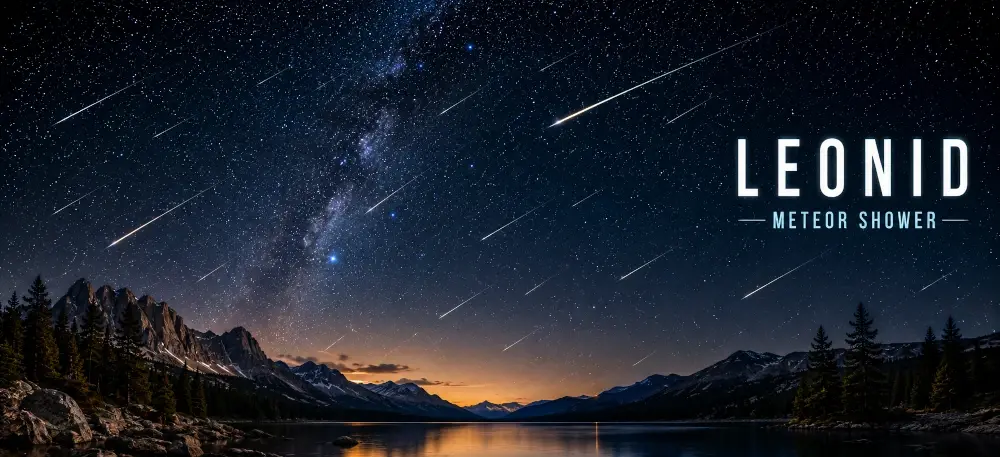
Leonid Meteor Shower: Peak Dates, Radiant & How to Watch
A reference guide to the Leonids: when they peak, why this is the shower behind history’s most famous meteor storms, and how to get the most out of the fastest annual meteor shower in the sky.
What Is the Leonid Meteor Shower?
The Leonids are an annual meteor shower that streaks across the pre-dawn sky every mid-November. They’re named for their radiant — the point in the sky the meteors appear to shoot from — which sits inside the “Sickle,” the backward-question-mark of stars that forms the head and mane of the constellation Leo. Like every meteor shower, the “shooting stars” have nothing to do with the stars they seem to fly past; they’re grain-of-sand-sized fragments of comet debris burning up tens of miles above Earth’s surface, in the upper atmosphere.
What sets the Leonids apart is speed and history. They’re produced by Comet 55P/Tempel-Tuttle, and they hit the atmosphere at nearly 71 kilometers per second — making them the fastest of any annual meteor shower. That same comet is responsible for some of the most spectacular meteor displays ever recorded, including a storm in 1833 so intense that observers described the sky “raining fire.”
In a typical year the Leonids are a modest shower, producing around 15 meteors per hour at best — nothing close to the Perseids or Geminids. But roughly every 33 years, when the parent comet swings back through the inner solar system, the Leonids have the potential to erupt into a true meteor storm, which is part of what makes this shower worth knowing even in its quiet years.
When to Watchthe Leonid Meteor Shower Each Year
The Leonids are active for about a month every year, but almost all of that activity is too sparse to notice. Here’s the timeline that actually matters:
- Active period: November 6 through November 30, with visual observers rarely noticing anything until the third week of November.
- Peak night: generally around November 17–18, but the exact date and hour of maximum shift somewhat from year to year and are pinned down more precisely as the date approaches. NASA and the American Meteor Society list the 2026 peak specifically as the night of November 16–17.
- Broad maximum: rates build for a few nights before the peak and fall off within about a week after. Occasional encounters with older debris filaments have also produced small secondary peaks a few days after the main maximum in some past years.
Exact peak timing can shift depending on the year, so it’s worth confirming the current year’s predicted peak with a meteor-shower calendar shortly before you plan to watch.
The Tempel-Tuttle Connection & Historic Meteor Storms
Every meteor shower is Earth passing through the debris trail of a comet or asteroid. For the Leonids, that parent body is Comet 55P/Tempel-Tuttle, discovered independently by Ernst Tempel and Horace Tuttle in the winter of 1865–66. The comet orbits the Sun roughly every 33 years, and each close pass sheds a fresh ribbon of dust along its path.
Most years, Earth only grazes older, well-spread-out debris from that trail, which is why a typical Leonid shower produces just 10–15 meteors per hour. But in the years around the comet’s perihelion passages, Earth can plow through a much denser filament of debris — and when that happens, the Leonids can erupt into a genuine meteor storm, with rates reaching thousands of meteors per hour. That dense filament isn’t necessarily fresh material from the comet’s most recent pass, either: the 1966 storm, for instance, is now understood to have come from debris the comet shed on an earlier orbit decades before, which had drifted into Earth’s path by the time of the encounter.
The Leonids have produced storms in 1833, 1866, 1966, 1999, 2001, and 2002. The 1833 storm is the most famous: observers across North America described meteors falling “like snowflakes,” an event vivid enough to inspire folk songs and, for some at the time, to be read as an omen. The 1966 storm briefly produced rates equivalent to thousands of meteors per minute.
Finding the Radiant in Leo
The Leonid radiant sits at roughly right ascension 10h08m, declination +21.8°, inside the Sickle — the curved hook of stars that traces Leo’s head and mane, anchored at its base by the bright star Regulus. The radiant sits close to Algieba, a bright double star partway up the hook. Leo is a Northern Hemisphere constellation, but its position keeps the Leonids reasonably visible from much of the Southern Hemisphere as well, just lower in the sky and at somewhat reduced rates.
You don’t need to find Leo precisely to enjoy the shower. Meteors can appear anywhere across the sky, not just near the radiant. In fact, staring directly at the radiant is the least effective strategy: meteors near their point of origin appear short and stubby, almost head-on. For longer, more dramatic streaks, look well away from the radiant — roughly 40–60 degrees is a useful rule of thumb, not a strict target. The simplest approach is to find Regulus, the brightest star in Leo, trace the backward question mark of the Sickle up from it, and then look at a comfortable patch of dark sky some distance away.
Why the Moon Matters Every Year
Moonlight is the single biggest variable in any meteor shower forecast, and it changes completely from one year to the next. Because the Leonids fall on roughly the same calendar date annually while the lunar cycle doesn’t, some years line up with a new moon and dark skies all night, while others land close to a bright gibbous or full moon that washes out all but the brightest meteors.
It also changes within a single peak night. A moon that’s up at nightfall may set well before the best pre-dawn viewing window opens, or vice versa — which is one more reason the after-midnight stretch tends to be the best time to check conditions for yourself rather than relying on the evening sky alone.
Before you plan a viewing night, check the current year’s moon phase and moonset time for the peak date. A quick lunar calendar lookup tells you what you need:
- New moon or thin crescent near the peak: you’re in for a great year — dark skies all night, so any time after full darkness works.
- Gibbous or full moon near the peak: plan around it. Find local moonset time and concentrate your viewing in the dark window between moonset and dawn.
Leonid Peak Schedule: 2026–2035
The Leonids peak on almost the same calendar date every year — generally around November 17–18, though the specific night shifts slightly year to year as NASA and AMS refine their forecasts (2026’s officially designated peak night is November 16–17). What actually changes more dramatically from year to year is the Moon. Because the shower’s date is fixed but the 29.5-day lunar cycle isn’t, some years land in dark, moonless skies while others land under a washed-out gibbous or full moon.
The 2026 and 2027 rows below are cross-checked against the American Meteor Society and International Meteor Organization’s published shower calendars, plus independent lunar-phase records — those two organizations don’t currently publish shower-specific forecasts further out than that. The 2028–2035 rows are projected from lunar-cycle math alone, which is reliable for moon phase itself but hasn’t been checked against a shower-specific source this far in advance. Treat those years as a useful planning guide, and reconfirm the moon phase and local moonset time as the date approaches.
| Year | Typical Peak Night | Moon Phase | Moon Illumination | Viewing Outlook |
|---|---|---|---|---|
| 2026 | Nov 16–17 | First Quarter | ~45% | Good – moon sets before midnight, leaving dark skies for the best after-midnight hours |
| 2027 | Nov 17–18 | Waning Gibbous, near Full | ~85–90% | Poor – a nearly full moon washes out all but the brightest meteors most of the night |
| 2028 | Nov 17–18 | New Moon | ~0–5% (approx.) | Excellent – dark skies essentially all night |
| 2029 | Nov 17–18 | Waxing Gibbous | ~75–80% (approx.) | Poor – bright moon up for much of the night |
| 2030 | Nov 17–18 | Waning Gibbous | ~55–60% (approx.) | Mixed – moonlight eases off as the night wears on |
| 2031 | Nov 17–18 | Waxing Crescent | ~5–10% (approx.) | Excellent conditions, and a comet-perihelion year – worth extra attention |
| 2032 | Nov 17–18 | Waxing Gibbous, near Full | ~95–100% (approx.) | Poor – near-full moon washes out the shower |
| 2033 | Nov 17–18 | Waning Crescent | ~25–30% (approx.) | Good – mostly dark skies, thin moon rises late |
| 2034 | Nov 17–18 | Waxing Crescent | ~30–35% (approx.) | Good – dark skies for most of the night |
| 2035 | Nov 17–18 | Waning Gibbous, near Full | ~95–100% (approx.) | Poor – bright moon most of the night |
Best Time and Viewing Strategy
Put the pieces together — radiant height, moonset, and morning twilight — and the optimal plan looks like this:
- Skip the early evening. The radiant is still low or hasn’t fully cleared the horizon; you’ll see almost nothing.
- Check moonset for the current year and, if the moon is a factor, head out within 15–20 minutes of it.
- Watch until the sky starts to brighten. The hours before dawn, when the radiant is highest, are consistently the best stretch of the night.
- Get away from significant light pollution. A darker sky can dramatically increase the number of meteors you’re able to see, though exactly how much depends on your starting point, the direction you’re facing, and the Moon.
- Give your eyes time. Full dark adaptation takes 20–30 minutes, and a bright phone screen can significantly set it back — use a dim red light if you need one.
- Lie back and look up. A reclining chair or blanket on the ground, facing away from the Moon and any residual light domes, beats standing and craning your neck.
How to Photograph the Leonids
Meteor photography is really wide-field night sky photography with patience layered on top — you’re not tracking a single fast-moving subject so much as leaving your shutter open on a big patch of sky and hoping something streaks through the frame. Because Leonids are unusually fast, individual streaks tend to be brief, so a wide field of view and a steady sequence of frames matter more than any single perfectly timed shot.
Gear
- A camera capable of manual exposure control (mirrorless or DSLR).
- A wide-angle lens, ideally 14–24mm, with the widest available aperture (f/1.8–f/2.8).
- A sturdy tripod — nothing else matters if the camera moves.
- An intervalometer or built-in interval timer, so the camera fires continuously without you touching it.
- A spare battery; cold mid-November nights drain batteries fast.
Camera Settings
- Focus: manual, set to infinity, checked visually on a bright star or planet at full zoom in live view.
- Aperture: as wide as your lens allows — f/2.8 or faster if possible.
- Shutter speed: start around 10–15 seconds and adjust from there based on your focal length and how much star trailing you see in test shots.
- ISO: start around 1600–3200 as a baseline and adjust based on your test shots.
- Shooting mode: continuous interval shooting with a 1–2 second gap between frames, for as long as your battery and card allow.
Composition
Frame roughly 40–60 degrees away from the radiant rather than centered on Leo itself, and include an interesting foreground — a horizon, treeline, or silhouette — to give any captured meteor a sense of scale. Because you can’t predict exactly where a meteor will appear, plan to shoot for at least an hour and sort through the frames afterward rather than trying to time an individual shot.
Leonid Meteor Shower – What to Expect: Speed, Trains & Fireballs
Leonid meteors are the fastest of any annual shower — they hit the atmosphere at about 71 kilometers (44 miles) per second. That speed gives them a distinctive character: quick, often bright streaks that can be trickier to catch on camera than slower showers, but rewarding for visual observers.
Many Leonids leave persistent trains — glowing trails of ionized gas that can remain visible for several seconds after the meteor itself has vanished, and occasionally much longer. Watch the afterglow; it’s one of the shower’s signature features.
The Leonids can also produce occasional bright meteors, including fireballs — meteors dramatically brighter than the planet Venus. They’re not guaranteed on any given night, but the shower has a strong reputation for them, especially in years closer to the comet’s perihelion passages.
Leonids vs. Other Meteor Showers
Here’s how the Leonids stack up against the year’s other headline showers. Rates below are the Zenithal Hourly Rate (ZHR) — a theoretical ceiling under a perfectly dark sky with the radiant directly overhead — not what a typical observer actually sees, which is usually lower:
| Shower | Typical Peak | ZHR (ceiling) | Speed | Parent Body |
|---|---|---|---|---|
| Leonids | Nov 17–18 | ~15/hr | Fastest annual shower | Comet 55P/Tempel-Tuttle |
| Eta Aquariids | Early May | ~50/hr | Very fast | Comet 1P/Halley |
| Orionids | Oct 21–22 | ~20/hr | Very fast | Comet 1P/Halley |
| Perseids | Aug 12–13 | ~100/hr | Fast | Comet 109P/Swift-Tuttle |
| Geminids | Dec 13–14 | ~120/hr | Medium | Asteroid 3200 Phaethon |
The Leonids will never out-count the Perseids or Geminids in an ordinary year, but their extreme speed, their tie to one of history’s most storied comets, and their track record of producing genuine meteor storms make them one of the most historically significant showers on the calendar.
Viewing Night Checklist
Check the current year’s predicted peak, moon phase, and moonset time before you pick a night, not just the general mid-November date.
Pick a dark-sky location at least 30 minutes from significant city lighting, with a wide, unobstructed view of the sky.
Dress for it. Mid-November pre-dawn temperatures drop fast; layers, a hat, and a blanket matter more than any piece of gear.
Bring a reclining chair or mat so you can look straight up without neck strain for an extended stretch.
Leave the binoculars at home. Meteors move fast and unpredictably across a wide area, so unaided eyes give you a much better field of view than magnified optics.
Plan for at least 45–60 minutes of continuous watching. Meteor rates are uneven; long gaps are normal.
Frequently Asked Questions
Plan Your Leonid Watch
The Leonids peak in mid-November each year, but exact timing and moon conditions shift annually. Check the full shower calendar for this year’s peak night, or go straight to NASA’s official page on the Leonids for the science behind the shower.