

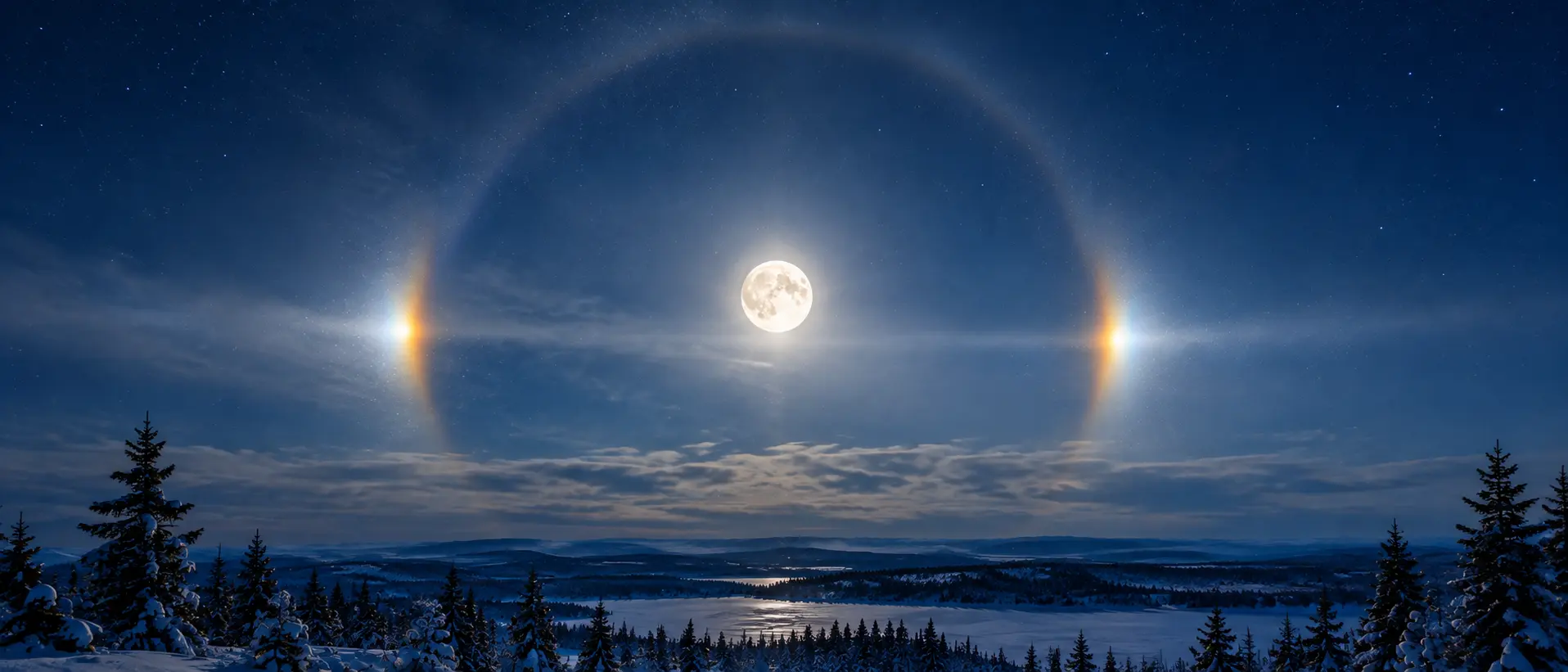
A moon dog is a faint spot of light beside the moon, made when moonlight bends through flat ice crystals in the air. This guide covers how they form, why they are so faint, when to look, and how to tell them from other lunar halos.
- What a moon dog is
- What a moon dog looks like
- How moon dogs form
- Why moon dogs are faint and rare
- When and where to see them
- Moon dogs near the ground
- Moon dogs and other lunar halos
- Moon dogs and weather
- How to photograph a moon dog
- Observing checklist
- Frequently asked questions
What a moon dog is
A moon dog, also called a paraselene or mock moon, is a faint patch of light that appears on one or both sides of the moon, at the same height above the horizon and about 22 degrees away from it when the moon is low. It is an atmospheric optical effect, not a second moon. The light comes from the moon itself, which is reflecting sunlight, bent by millions of tiny ice crystals floating in thin cloud.
The scientific name comes from Greek words meaning “beside the moon,” and the plural is paraselenae. A moon dog is the lunar counterpart of a sun dog, and it uses the same physics.
What a moon dog looks like
A typical moon dog is a soft, slightly elongated glow beside the moon. Some are bright enough to look like a smeared copy of the moon, but most are faint, and they are easy to mistake for a thin patch of cloud lit by moonlight.
To the eye, moon dogs usually look white or very pale. If a display is strong enough, you may notice a reddish tint on the side nearest the moon, with a paler outer edge, just as in a sun dog. Moon dogs frequently appear as a pair, but one side is often brighter, and sometimes only one is visible.
How moon dogs form
Moon dogs are a refraction effect. Refraction is the bending of light as it passes from one material into another, and ice bends light more than air does. To make a moon dog, the ice has to be in the right shape and the right orientation.
Plate crystals and how they fall
High, cold cloud is made of ice rather than water droplets. Some of those crystals grow as thin, flat, six-sided plates. Thin plates often fall with their broad faces approximately horizontal, although their orientations vary and they wobble as they fall. That preferred alignment is what lets them produce concentrated moon dogs rather than only a diffuse ring. It takes a population of crystals with a preferred orientation, not perfectly aligned ones.
The 60 degree prism and the 22 degree angle
Moonlight entering and leaving two suitable side faces of a hexagonal ice crystal passes through a prism angle of 60 degrees. For the relevant ray paths, the minimum deviation is approximately 22 degrees, measured between the direction of the incoming ray and the direction of the outgoing ray. When many plate-shaped crystals have their faces roughly horizontal, they concentrate refracted moonlight into patches on either side of the moon. Rays near minimum deviation contribute strongly to the inner edge of each moon dog, but the display spans a range of angles rather than forming a point exactly 22 degrees from the moon.
Side-on view of one ray through a 60° prism at minimum deviation. The dashed line continues the incoming ray, and the angle to the outgoing ray is the deviation, about 22°. The moon, crystal and observer are not to scale, and a real display combines rays from millions of crystals.
The angle grows with the moon’s height. The 22 degree figure applies when the moon is low. As the moon climbs, the angular distance between the moon and each moon dog increases and the display usually fades. A moon dog always sits at the same height above the horizon as the moon, so scan sideways along that level. At arm’s length, 22 degrees is roughly two fists on either side of the moon.
Why moon dogs are faint and rare
The physics is the same as for a sun dog, but the light source is very different. Moonlight is hundreds of thousands of times dimmer than direct sunlight, and a moon dog gets only a small share of that light. The effect is therefore faint even in a good display.
Your eyes make it worse. In dim light, vision relies on cells that detect brightness but not color, which is why moon dogs usually look white. A camera on a long exposure collects light for seconds at a time and often shows a display that is barely visible by eye, with colors you could not see.
You also need two things at once: a bright moon and the right ice cloud. Many nights have one without the other, and few people are outside scanning the sky.
When and where to see them
Look when the moon is bright, usually within a few days of full, and thin, high cloud covers part of the sky. The cloud should look like a pale veil or fine wispy streaks, and the moon often looks milky or hazy through it. A supermoon is a little brighter than an average full moon, but you do not need one, and the supermoon guide explains what the term means.
Check the phase on the Moon Phase Today widget and plan around the full moon dates on the monthly moon phase pages. A fairly low moon gives the standard 22 degree spacing, so the hours after moonrise are a good window. Get away from bright lights, and give your eyes about 20 minutes to adjust to the dark.
Moon dogs can appear anywhere in the world and in any season, because ice crystals form in high cloud even in summer. They are noticed more often in cold regions, where ice cloud can form lower.
Moon dogs near the ground
Moon dogs are not restricted to high cloud. In very cold, calm conditions, tiny ice crystals can hang in the air close to the surface in a glittering haze called diamond dust. If those crystals are plates, they can produce moon dogs and other halos in a sky that looks clear or nearly clear. That is why a display can appear on a frigid night with a bright moon and no obvious high cloud.
Moon dogs and other lunar halos
Moon dogs are one member of a family of lunar optical effects. If you see one, scan the sky for others, because the same cloud often produces several at once. Here is how the common ones compare.
| Lunar effect | What it looks like | Where it appears | What forms it | How to tell it apart |
|---|---|---|---|---|
| Moon dog (paraselene) | Faint spot of light, usually white | Level with the moon, usually near 22° when the moon is low | Plate crystals with faces roughly horizontal | A spot, not a ring, beside the moon |
| 22° lunar halo | Complete or partial ring around the moon | About 22° from the moon in every direction | Randomly oriented hexagonal ice crystals | A large ring with a sharp inner edge |
| Lunar corona | Small colored rings tight around the moon | Within a few degrees of the moon | Water droplets in thin cloud, by diffraction | Much smaller than a halo, with red on the outside |
| Moonbow | Faint, usually white arc | Opposite the moon, in the direction away from it | Rain or mist droplets, by refraction and reflection | Needs rain or mist, and the moon is behind you |
| Moon pillar | Vertical column of light | Above or below a low moon | Plate crystals reflecting light | A vertical shaft, not a ring or spot |
The quickest test: a moon dog is a spot at the moon’s height, a 22 degree halo is a large ring, and a corona is a small colored ring close to the moon. In a halo, red is on the inside. In a corona, red is on the outside. When a halo is complete, moon dogs sit on or just outside the ring, depending on the moon’s height.
Moon dogs and weather
An old saying links a ring around the moon to coming rain or snow. There is a loose basis for it. The ice-crystal cloud that makes halos and moon dogs, cirrus and cirrostratus, often spreads ahead of an approaching warm front, where weather can turn within a day or so.
But the link is weak. Thin ice cloud also forms without any front behind it, and a front can bring weather with no halo display. Treat a moon dog as a reason to check a forecast, not as a forecast.
How to photograph a moon dog
A camera often shows a moon dog better than your eyes, because a long exposure gathers light your eyes cannot. Moonlight is safe to look at and to photograph, so no filter is needed.
- Use a tripod, or rest your phone or camera on something solid. You will be using long exposures.
- Use a wide-angle lens. You need to capture the moon, both sides of it, and some sky.
- Start with a high ISO, a wide aperture, and an exposure of a few seconds, then adjust. Expect the moon itself to overexpose, which is acceptable if the moon dog is visible.
- On a phone, use night mode and hold still until it finishes.
- Add a foreground such as a tree line, a building, or a person. It gives the moon dog scale.
- Check the result for a pale ring and for faint color, which long exposures often reveal.
Observing checklist
Frequently asked questions
What is a moon dog?
A moon dog, or paraselene, is a bright spot of light that appears beside the moon, level with it and usually about 22 degrees away when the moon is low. It is caused by moonlight refracting through flat, plate-shaped ice crystals, and it is the moonlight version of a sun dog.
What causes a moon dog?
Moonlight enters one side face of a hexagonal ice plate and leaves through another face tilted 60 degrees from the first. That path bends the light by a minimum of about 22 degrees, so light piles up near that angle from the moon. The plates must be falling with their broad faces roughly horizontal, though not perfectly so.
Are moon dogs rare?
They are seen far less often than sun dogs. A moon dog needs a bright moon and the right ice crystals at the same time, and the display is faint enough that many people miss it or never look. Lunar halos, the rings around the moon, are much more common.
Do moon dogs have color?
Usually they look white or very pale to the eye. Ice does separate moonlight into colors the same way it does with sunlight, but in dim light your eyes rely on cells that do not see color well. A long-exposure photograph often shows faint color that you cannot see.
What is the difference between a moon dog and a sun dog?
They are the same optical effect. A sun dog is made by sunlight and a moon dog is made by moonlight, and both come from plate-shaped ice crystals bending light by about 22 degrees. Sun dogs are brighter and often colored, while moon dogs are faint and usually white.
What is the difference between a moon dog and a lunar halo?
A lunar halo is a ring of light around the moon, usually at about 22 degrees, formed mainly by randomly oriented ice crystals. A moon dog is a spot beside the moon, formed by plates with a preferred orientation. The ring and the spots often appear together, and the moon dogs can sit on or just outside the ring.
When is the best time to see a moon dog?
Look when the moon is bright, usually within a few days of full, and thin ice-crystal cloud covers part of the sky. A moon that is fairly low gives the standard 22 degree spacing. A dark site and about 20 minutes for your eyes to adjust will help.
Why do I only see one moon dog?
Displays are often lopsided. Cloud may cover one side, the suitable plates may not be spread evenly, or their orientation may favor one side. Check the other side of the moon at the same height, and try a long-exposure photo, which may reveal a fainter one.
Do moon dogs mean rain or snow is coming?
Not reliably. Moon dogs form in thin ice-crystal cloud, and cirrus and cirrostratus often spread ahead of an approaching warm front, which can bring rain or snow within a day or so. But the same cloud sometimes forms with no weather behind it, so a moon dog is a hint, not a forecast.
Is it safe to look at a moon dog?
Yes. Moonlight is safe to look at, so you do not need eye protection or a way to hide the moon. This is different from sun dogs, where you must never look at the sun itself.
Can I photograph a moon dog with my phone?
Often, yes. Use night mode, steady the phone on a tripod or a solid surface, and include a wide view of the sky. A phone’s long exposure can pick up a moon dog and its color better than your eyes can see.