

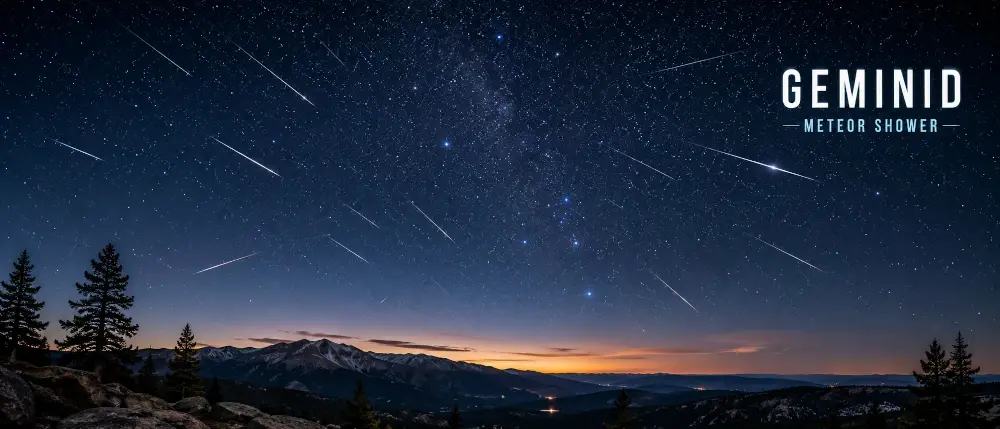
Geminid Meteor Shower: Peak Dates, Radiant & How to Watch
A reference guide to the Geminids: when they peak, why they’re the strongest meteor shower of the year, and how to get the most out of a December night under the shooting stars of an asteroid, not a comet.
What Is the Geminid Meteor Shower?
The Geminids are an annual meteor shower that lights up the December sky — and unlike most showers, it doesn’t require a pre-dawn alarm. They’re named for their radiant — the point in the sky the meteors appear to shoot from — which sits in the constellation Gemini, close to the bright star Castor. Like every meteor shower, the “shooting stars” themselves have nothing to do with the stars they seem to fly past; they’re small fragments of debris burning up roughly 45–55 miles above Earth’s surface.
What sets the Geminids apart is their source. Almost every other major shower comes from comet debris, but the Geminids are shed by 3200 Phaethon, an object NASA describes as “an asteroid or a possible ‘rock comet'” — scientists aren’t actually certain how to classify it. At about 35 kilometers (22 miles) per second, Geminids are slower than fast showers like the Perseids and Orionids; NASA nonetheless describes them as bright, fast meteors that tend toward yellow, with an unusually high share of green fireballs.
NASA considers the Geminids one of the best and most reliable annual showers, often rivaling the more famous Perseids. Under perfect conditions — a perfectly dark sky with the radiant directly overhead — NASA puts the peak rate at up to 120 meteors per hour; in a real dark-sky location, its own guidance is closer to 40–50 per hour. They also start putting on a show earlier in the evening than almost any other shower, making them one of the more accessible displays for casual, non-nocturnal observers.
When to Watch Each Year
The Geminids have a fairly compact active window compared to some showers, and the activity ramps up quickly toward peak. Here’s the timeline that actually matters:
- Active period: roughly December 4 through December 17, with very low background rates detectable from late November into the days after peak.
- Peak night: typically the night of December 13–14, holding fairly steady from year to year, though the shower’s exact strength and timing can shift somewhat — historical records show real year-to-year variation in how strong the peak actually is.
- Broad maximum: the Geminids sustain strong rates for roughly a full 24 hours around peak, and elevated activity is noticeable for a couple of nights on either side — useful insurance if the exact peak night is clouded out.
Exact peak timing can shift by a day in either direction depending on the year, so it’s worth confirming the current year’s predicted peak with a meteor-shower calendar shortly before you plan to watch.
The Phaethon Connection: Asteroid or “Rock Comet”?
Every meteor shower is Earth passing through the debris trail of a comet or asteroid. In the case of the Geminids, that parent body is 3200 Phaethon, a rocky object about 5.10 kilometers (3.17 miles) across, discovered on October 11, 1983, by the Infrared Astronomical Satellite. It orbits the Sun once every 1.4 years on a highly elliptical path that swings closer to the Sun than any other named asteroid, well inside Mercury’s orbit at closest approach — which is how it got its name, after the mythical son of the Greek sun-god Helios.
Exactly how Phaethon supplies enough material to feed one of the year’s strongest showers is a genuinely open question. NASA notes that Phaethon doesn’t develop the kind of dusty tail typical comets do, and that the debris making up the Geminids is two to three times denser than ordinary cometary dust — evidence that cuts against a simple ice-driven origin. In 2023, NASA-funded researchers using the SOHO and STEREO solar observatories found that the faint tail Phaethon does grow near the Sun is made of sodium gas, not dust, deepening the mystery of where the Geminid stream’s dust actually came from. That same year, scientists using data from NASA’s Parker Solar Probe reported evidence that a violent, catastrophic event — possibly a collision with another body — created the Geminid stream in the first place, rather than the gradual solar heating once assumed. NASA’s own material leaves the object’s classification unsettled, describing it as “an asteroid or a possible ‘rock comet.'”
The Geminids are also a comparatively young shower: NASA dates their first appearances to the mid-1800s, when they were a minor performer producing only 10–20 meteors per hour. Since then they’ve grown into one of the year’s major showers.
Finding the Radiant in Gemini
The Geminid radiant lies in the constellation Gemini, close to the twin stars Castor and Pollux — a chance alignment rather than any physical connection between the stars and the shower. The shower favors the Northern Hemisphere, particularly mid-northern latitudes, though it remains visible at reduced rates from southern latitudes during the middle of the night.
You don’t need to find Gemini precisely to enjoy the shower. Meteors can appear anywhere across the sky, not just near the radiant. In fact, staring directly at the radiant is the least effective strategy: meteors near their point of origin appear short and stubby, almost head-on. For longer, more dramatic streaks, look well away from the radiant — roughly 40–60 degrees is a useful rule of thumb, not a strict target. The simplest approach is to face a dark patch of sky partway between the radiant and the horizon and take in as much of the sky as possible.
Why the Moon Matters Every Year
Moonlight is the single biggest variable in any meteor shower forecast, and it changes completely from one year to the next. Because the Geminids fall on roughly the same calendar date annually while the lunar cycle doesn’t, some years line up with a new or thin crescent moon and dark skies all night, while others land close to a full moon that washes out all but the brightest meteors.
Because Geminids can produce many bright meteors, a moonlit night can still deliver a worthwhile display, just at a fraction of the dark-sky count. NASA’s own year-to-year reporting shows real examples of the swing: in one recent bright-moon year NASA advised observers to expect roughly 30 meteors per hour instead of the usual 120, and in another, rates that would normally run 50 or more per hour under dark skies dropped to around 15 with a bright moon up all night.
Before you plan a viewing night, check the current year’s moon phase and moonset (or moonrise) time for the peak date. A quick lunar calendar lookup tells you what you need:
- New moon or thin crescent near the peak: you’re in for a great year — dark skies all night, so any time after full darkness works, and the earlier-evening rates become well worth catching too.
- Gibbous or full moon near the peak: plan around it. Find local moonset (or moonrise) time and concentrate your viewing in the darkest window you can find — face away from the Moon if it’s up.
Geminid Peak Schedule: 2026–2035
The Geminids peak on almost the same calendar date every year — typically the night of December 13–14, occasionally shifting a day earlier or later. What actually changes from year to year is the Moon. Because the shower’s date is fixed but the 29.5-day lunar cycle isn’t, some years land in dark, moonless skies while others land under a washed-out gibbous or full moon.
The 2026 and 2027 rows below are cross-checked against the American Meteor Society and International Meteor Organization’s published shower calendars, plus independent lunar-phase records — those two organizations don’t currently publish shower-specific forecasts further out than that. The 2028–2035 rows are projected from lunar-cycle math alone, which is reliable for moon phase itself but hasn’t been checked against a shower-specific source this far in advance. Treat those years as a useful planning guide, and reconfirm the moon phase and local moonset/moonrise time as the date approaches.
| Year | Typical Peak Night | Moon Phase | Moon Illumination | Viewing Outlook |
|---|---|---|---|---|
| 2026 | Dec 13–14 | Waxing Crescent | ~21% | Excellent – thin crescent sets in early evening, leaving dark skies for the whole peak |
| 2027 | Dec 13–14 | Full Moon (just past full) | ~96–99% | Poor – moon essentially full and up all night, washing out all but the brightest meteors |
| 2028 | Dec 13–14 | Waning Crescent | ~10–15% (approx.) | Good to excellent – dark skies for most of the night |
| 2029 | Dec 13–14 | Waxing, near First Quarter | ~45–50% (approx.) | Mixed – moon up during the evening, easing off later |
| 2030 | Dec 13–14 | Waning Gibbous | ~85–90% (approx.) | Poor – bright moon most of the night |
| 2031 | Dec 13–14 | New Moon | ~0–5% (approx.) | Excellent – dark skies all night |
| 2032 | Dec 13–14 | Waxing Gibbous | ~80–85% (approx.) | Poor – bright moon most of the night |
| 2033 | Dec 13–14 | Waning Gibbous | ~65–70% (approx.) | Mixed to poor – moonlight for much of the night |
| 2034 | Dec 13–14 | Waxing Crescent | ~5–10% (approx.) | Excellent – dark skies nearly all night |
| 2035 | Dec 13–14 | Waxing Gibbous, near Full | ~95–100% (approx.) | Poor – near-full moon washes out the shower |
Best Time and Viewing Strategy
Put the pieces together — radiant height, moon conditions, and how the night progresses — and the optimal plan looks like this:
- Don’t wait for the middle of the night. Unlike most showers, the Geminid radiant is already usable by 9–10 p.m., so a worthwhile show can start well before midnight.
- Check the moon for the current year and, if it’s a factor, plan your darkest viewing window around moonset or moonrise.
- Watch until the sky starts to brighten, if you can. Rates keep climbing toward the pre-dawn hours, when the radiant is highest, roughly around 2 a.m. local time.
- Get away from significant light pollution. A darker sky can dramatically increase the number of meteors you’re able to see, though exactly how much depends on your starting point, the direction you’re facing, and the Moon.
- Give your eyes time. Full dark adaptation takes 20–30 minutes, and a bright phone screen can significantly set it back — use a dim red light if you need one.
- Dress for real cold. NASA specifically recommends coming prepared for winter temperatures with a sleeping bag, blanket, or lawn chair — insulated layers and hand warmers make the difference between a short look and a full night out.
How to Photograph the Geminids
Meteor photography is really wide-field night sky photography with patience layered on top — you’re not tracking a single fast-moving subject so much as leaving your shutter open on a big patch of sky and hoping something streaks through the frame.
Gear
- A camera capable of manual exposure control (mirrorless or DSLR).
- A wide-angle lens, ideally 14–24mm, with the widest available aperture (f/1.8–f/2.8).
- A sturdy tripod — nothing else matters if the camera moves.
- An intervalometer or built-in interval timer, so the camera fires continuously without you touching it.
- Spare, well-insulated batteries; freezing December nights drain batteries fast.
Camera Settings
- Focus: manual, set to infinity, checked visually on a bright star or planet at full zoom in live view.
- Aperture: as wide as your lens allows — f/2.8 or faster if possible.
- Shutter speed: start around 10–20 seconds and adjust from there based on your focal length and how much star trailing you see in test shots.
- ISO: start around 1600–3200 as a baseline and adjust based on your test shots.
- Shooting mode: continuous interval shooting with a 1–2 second gap between frames, for as long as your battery and card allow.
Composition
Frame roughly 40–60 degrees away from the radiant rather than centered on Gemini itself, and include an interesting foreground — a horizon, treeline, or silhouette — to give any captured meteor a sense of scale. Because you can’t predict exactly where a meteor will appear, plan to shoot for at least an hour and sort through the frames afterward rather than trying to time an individual shot.
What to Expect: Speed, Color & Fireballs
Geminid meteors travel at about 35 kilometers (22 miles) per second — slower than very fast showers like the Orionids or Perseids, even though NASA’s own descriptive language calls them “bright and fast.” NASA specifically notes they tend toward yellow in color, and its outreach material describes the shower as producing an unusually high number of green fireballs.
According to the American Meteor Society, the Geminids’ medium-slow velocity means they don’t typically leave the glowing persistent trains — brief, glowing afterimages — that faster showers like the Orionids or Perseids sometimes produce. What they’re known for instead is bright, often colorful meteors, generally yellow with a share of green fireballs mixed in.
The Geminids can also produce occasional bright meteors, including fireballs — meteors dramatically brighter than the planet Venus. They’re not guaranteed on any given night, but NASA describes the shower as rich in green fireballs, so a night of watching has a genuine shot at one.
Geminids vs. Other Meteor Showers
Here’s how the Geminids stack up against the year’s other headline showers. Rates below are the Zenithal Hourly Rate (ZHR) as published by the American Meteor Society and International Meteor Organization — a theoretical ceiling under a perfectly dark sky with the radiant directly overhead, not what a typical observer actually sees. NASA’s own public guidance for the Geminids specifically is more conservative than the AMS/IMO ZHR: up to 120 meteors per hour under perfect conditions, and 40–50 per hour under real dark skies.
| Shower | Typical Peak | ZHR (ceiling) | Speed | Parent Body |
|---|---|---|---|---|
| Geminids | Dec 13–14 | ~150/hr | Medium | Asteroid 3200 Phaethon |
| Quadrantids | Jan 3–4 | ~80–120/hr | Fast | Asteroid 2003 EH1 |
| Perseids | Aug 12–13 | ~100/hr | Fast | Comet 109P/Swift-Tuttle |
| Orionids | Oct 21–22 | ~20/hr | Very fast | Comet 1P/Halley |
| Leonids | Nov 17–18 | ~15/hr | Very fast | Comet 55P/Tempel-Tuttle |
By the AMS/IMO ZHR measure, the Geminids top this list; NASA’s more conservative public figures still place them among the year’s best. Either way, the combination of a broad, forgiving peak, a radiant that’s usable from early evening rather than only after midnight, and an unusual asteroid pedigree sets them apart from every comet-fed shower on the calendar. The main trade-off is timing — December cold keeps a lot of casual observers indoors, which is exactly why the Geminids reward the ones willing to bundle up.
Viewing Night Checklist
Check the current year’s predicted peak, moon phase, and moonset/moonrise time before you pick a night, not just the general mid-December date.
Pick a dark-sky location. NASA’s advice is simply to find an area well away from city lights or street lights, with a wide, unobstructed view of the sky.
Dress for real cold. Mid-December temperatures can drop well below freezing; insulated boots, hand warmers, and a blanket or sleeping bag matter more than any piece of gear.
Bring a reclining chair or mat so you can look straight up without neck strain for an extended stretch.
Skip the telescope and binoculars. NASA notes no special equipment is needed — unaided eyes give you a much wider field of view, which suits meteors moving fast and unpredictably across a wide area.
Plan for at least 45–60 minutes of continuous watching. Meteor rates are uneven; long gaps are normal.
Frequently Asked Questions
Plan Your Geminid Watch
The Geminids peak in mid-December each year and are one of the most reliable showers on the calendar. Check the full shower calendar for this year’s peak night and moon conditions, or go straight to NASA’s official page on the Geminids for the science behind the shower.