

A lunar tetrad is a run of four total lunar eclipses in a row, each about six months apart. The next one begins on April 25, 2032 and ends on October 8, 2033. This guide explains what a tetrad is, why it happens, when the next one occurs, and what the so-called “blood moon tetrad” does and doesn’t mean.
What Is a Lunar Tetrad?
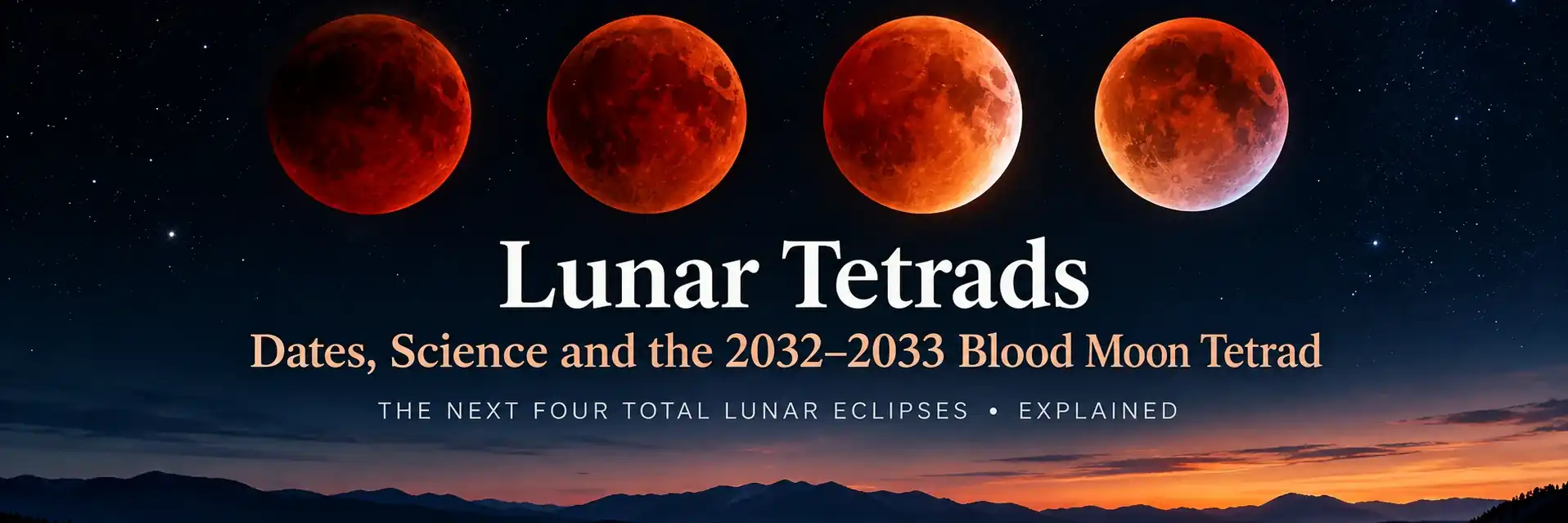
A lunar tetrad is a set of four consecutive total lunar eclipses with no partial or penumbral lunar eclipse between them. Because a total lunar eclipse turns the Moon a coppery red, a tetrad is often called a blood moon tetrad. “Blood moon” is a popular nickname for a total lunar eclipse, not a separate type of eclipse.
To qualify, the four eclipses must fall in four consecutive eclipse seasons, each separated by six synodic months (about 177 days). Solar eclipses can occur between them without breaking the sequence. A partial or penumbral lunar eclipse in the chain does.
Next Lunar Tetrad: Dates for 2032 and 2033
The next lunar tetrad runs from April 2032 to October 2033. The four total lunar eclipses are:
| Eclipse | Date (UT) | Umbral magnitude | Totality | Gamma | Lunar Saros |
|---|---|---|---|---|---|
| First | April 25, 2032 | 1.192 | 66 min | -0.3558 | 122 |
| Second | October 18, 2032 | 1.104 | 48 min | 0.4169 | 127 |
| Third | April 14, 2033 | 1.096 | 50 min | 0.3954 | 132 |
| Fourth | October 8, 2033 | 1.351 | 79 min | -0.2889 | 137 |
Dates are the date at the moment of greatest eclipse in Universal Time (UT). In your time zone, the local date can differ, especially in Asia, Australia, and the Pacific.
Three measurements in the table are worth knowing:
- Umbral magnitude is how much of the Moon’s diameter is inside Earth’s darkest shadow (the umbra) at greatest eclipse. A value of 1.0 means the Moon is just fully covered. Higher values mean a deeper eclipse.
- Totality is how long the Moon stays completely inside the umbra.
- Gamma is the distance from the center of the Moon to the axis of Earth’s shadow at greatest eclipse, measured in Earth radii. The closer to zero, the more central the pass. The sign shows which side of the axis the Moon passes: positive is north, negative is south.
The Saros number identifies the series of eclipses each one belongs to. Eclipses in the same Saros series repeat about every 18 years.
Timetable and Visibility for Each Eclipse
All times are Universal Time (UT). P1 and P4 mark the start and end of the penumbral phase, U1 and U4 the partial phase, and U2 and U3 totality.
| Eclipse | P1 | U1 | U2 (total begins) | Greatest | U3 (total ends) | U4 | P4 |
|---|---|---|---|---|---|---|---|
| April 25, 2032 | 12:22 | 13:28 | 14:40 | 15:14 | 15:47 | 17:00 | 18:05 |
| October 18, 2032 | 16:24 | 17:24 | 18:38 | 19:02 | 19:26 | 20:41 | 21:41 |
| April 14, 2033 | 16:12 | 17:25 | 18:48 | 19:13 | 19:38 | 21:01 | 22:14 |
| October 8, 2033 | 08:18 | 09:14 | 10:16 | 10:55 | 11:35 | 12:37 | 13:32 |
Each eclipse is visible, at least in part, from these regions:
| Eclipse | Visible from |
|---|---|
| April 25, 2032 | Eastern Africa, Asia, Australia, Pacific |
| October 18, 2032 | Africa, Europe, Asia, Australia |
| April 14, 2033 | Europe, Africa, Asia, Australia |
| October 8, 2033 | Asia, Australia, Pacific, Americas |
A region listed here can see some phase of the eclipse. It does not guarantee that you will see all of totality, because the Moon may be below your horizon for part of it. Check the times above against your own time zone and sunrise or sunset.
Optional: add a link to your own eclipse visibility map or local-times guide for each date here.
Why Tetrads Happen
The Moon’s orbit is tilted by about 5 degrees to Earth’s orbit around the Sun. A lunar eclipse can only happen when a full Moon falls close to one of the two points where the orbits cross, called the nodes. That limits eclipses to eclipse seasons, which come about every six months.
Within a tetrad, the eclipses alternate between the two nodes. The 2032 to 2033 sequence shows this: Saros 122 and 132 eclipses occur at the Moon’s ascending node, and Saros 127 and 137 at the descending node.
What makes four total eclipses in a row possible is a matter of timing. Six synodic months are slightly longer than the gap between eclipse seasons, and the mechanism that lets four in a row stay total involves the eccentricity of Earth’s orbit in combination with the timing of those seasons. That is why tetrads cluster in some eras and vanish in others.
The eclipses in a tetrad also tend to be shallow totals. The umbral magnitudes of tetrad eclipses are all relatively small. The largest in the 300 years from 1901 to 2200 is 1.4251, on April 13, 1949. For comparison, the total eclipses of July 16, 2000 and June 26, 2029 reach 1.7684 and 1.8436. Shallow does not mean partial. All four 2032 to 2033 eclipses are fully total, but the Moon crosses the edge of the umbra rather than its center, so totality is shorter than in the deepest eclipses.
Why Tetrads Are Rare
Tetrads come in clusters. There were no tetrads at all between 1582 and 1908, a gap of more than 300 years, then 17 between 1909 and 2156. The pattern follows an approximate cycle of about 565 years, tied to the slowly decreasing eccentricity of Earth’s orbit. Because that eccentricity is shrinking, the period itself is slowly getting shorter, so it is not a fixed interval. In the distant future, when Earth’s orbit becomes perfectly circular, tetrads will no longer be possible.
The 21st century is an unusually rich period, with eight tetrads in total.
Past and Future Tetrads
These are all eight tetrads of the 21st century:
| Tetrad | Eclipse Dates (UT) |
|---|---|
| 2003 to 2004 | May 16, 2003; November 9, 2003; May 4, 2004; October 28, 2004 |
| 2014 to 2015 | April 15, 2014; October 8, 2014; April 4, 2015; September 28, 2015 |
| 2032 to 2033 (next) | April 25, 2032; October 18, 2032; April 14, 2033; October 8, 2033 |
| 2043 to 2044 | March 25, 2043; September 19, 2043; March 13, 2044; September 7, 2044 |
| 2050 to 2051 | May 6, 2050; October 30, 2050; April 26, 2051; October 19, 2051 |
| 2061 to 2062 | April 4, 2061; September 29, 2061; March 25, 2062; September 18, 2062 |
| 2072 to 2073 | March 4, 2072; August 28, 2072; February 22, 2073; August 17, 2073 |
| 2090 to 2091 | March 15, 2090; September 8, 2090; March 5, 2091; August 29, 2091 |
The first tetrad of the 22nd century begins on February 14, 2101.
The 2043 to 2044 tetrad is especially notable. Each of its four eclipse seasons also includes a total or annular solar eclipse, which makes it an unusually rich run of eclipses.
The Last Tetrad: 2014 and 2015
The most recent tetrad ran from April 2014 to September 2015, and it drew far more public attention than usual. It also helped popularize the phrase “blood moon tetrad,” largely because of its connection to the Blood Moon Prophecy, covered below.
Why the Moon Turns Red
During a total lunar eclipse, Earth blocks direct sunlight from reaching the Moon. Some sunlight still passes through Earth’s atmosphere, which refracts it into the planet’s shadow. The atmosphere scatters blue light away far more strongly than red, so the light that reaches the Moon is mostly red and orange. It is the same effect that colors sunsets. The result is a coppery glow.
The exact shade depends on dust, clouds, and volcanic aerosols in Earth’s atmosphere at the time, and on how deep into the shadow the Moon travels.
The Blood Moon Prophecy
The 2014 to 2015 tetrad coincided with the Jewish holidays of Passover and the Feast of Tabernacles. Pastors John Hagee and Mark Biltz built on this to claim the eclipses signaled major biblical events. The dates of the eclipses are a matter of astronomical record. The meaning attributed to them is a religious interpretation, and astronomy cannot confirm or refute it. The alignment with the holidays follows from the lunar calendar and eclipse geometry.
Does the 2032 to 2033 tetrad line up with the same holidays?
Only half of it does. Passover begins on the 15th of Nisan and Sukkot (the Feast of Tabernacles) on the 15th of Tishrei, and both fall near the full Moon. Whether a total lunar eclipse lands on one depends on where the eclipse season falls in the Hebrew calendar. In 2014 to 2015 all four eclipses did. In 2032 to 2033 only the last two do:
| Eclipse (UT) | Holiday | Dates (sundown to nightfall) | Coincides? |
|---|---|---|---|
| April 25, 2032 | Passover | March 26 to April 3, 2032 | No |
| October 18, 2032 | Sukkot | September 19 to 26, 2032 | No |
| April 14, 2033 | Passover | April 13 to 21, 2033 | Yes |
| October 8, 2033 | Sukkot | October 7 to 14, 2033 | Yes |
Jewish holidays begin at sundown on the evening before the date shown on a standard calendar, so each range starts the evening before the first full day. Passover dates above are the schedule outside Israel, which runs one day longer. In Israel, Passover 2032 ends April 2 and Passover 2033 ends April 20. The holiday day also changes at sunset, which matters for the time of day. The April 14, 2033 eclipse peaks at 19:13 UT, which is 22:13 in Jerusalem, after nightfall and therefore already the 16th of Nisan. The October 8, 2033 eclipse peaks at 10:55 UT, which is the first full day of Sukkot.
As with 2014 to 2015, this is a calendar coincidence, not an astronomical one. The 2032 to 2033 tetrad has no scientific significance beyond being a rare and beautiful sequence of eclipses.
How to Watch a Tetrad
Total lunar eclipses are safe to view with the naked eye. No filters are needed, unlike solar eclipses.
- Check whether each eclipse is visible from your location, as each one favors different parts of the world.
- Find a spot with a clear view of the Moon’s position in the sky at eclipse time.
- Binoculars or a small telescope show the color gradations in the shadow.
- For photos, use a tripod and a long exposure once the Moon darkens.
The tetrad is still years away, but you don’t have to wait to see a blood moon. Our blood moon schedule for 2025 to 2030 covers the total lunar eclipses coming before it begins.
Frequently Asked Questions
What is a lunar tetrad?
A lunar tetrad is a series of four consecutive total lunar eclipses, each about six months apart, with no partial or penumbral eclipses in between.
When is the next lunar tetrad?
The next lunar tetrad begins on April 25, 2032 and ends on October 8, 2033. The four total lunar eclipses fall on April 25, 2032, October 18, 2032, April 14, 2033, and October 8, 2033. These are Universal Time dates, so the local date can differ.
When was the last lunar tetrad?
The last lunar tetrad ran from April 15, 2014 to September 28, 2015.
Can I see all four eclipses of the 2032 to 2033 tetrad from one place?
Not necessarily. Asia and Australia are listed among the visibility regions for all four eclipses, but that means some part of each eclipse is visible, not always the full event. Visibility depends on whether the Moon is above the horizon during each phase, so check the times for your location.
Does the 2032 to 2033 tetrad coincide with Passover and Sukkot like the 2014 to 2015 tetrad?
Only partly. The last two eclipses, April 14, 2033 and October 8, 2033, fall during Passover and Sukkot. The first two, April 25, 2032 and October 18, 2032, do not. In 2014 to 2015, all four eclipses coincided with those holidays.
Is a blood moon tetrad dangerous or a sign of anything?
No. A lunar tetrad is a natural result of the Moon’s and Earth’s orbital geometry. Claims that tetrads predict world events are religious or cultural interpretations with no basis in astronomy.
Why is the Moon red during a lunar eclipse?
Earth’s atmosphere refracts sunlight into the planet’s shadow. Blue light is scattered away more strongly, so the light that reaches the Moon is mostly red and orange, giving it a coppery color.
Will the Moon be equally red at every eclipse in a tetrad?
No. Every total lunar eclipse turns the Moon some shade of red or orange, but the exact color and brightness depend on the dust, clouds, and volcanic aerosols in Earth’s atmosphere and on how deep the Moon passes into the shadow. It cannot be predicted precisely in advance.
How often do lunar tetrads happen?
Tetrads are irregular. There were none between 1582 and 1908, then 17 between 1909 and 2156. The 21st century has eight. They follow an approximate cycle of about 565 years that is slowly shortening as Earth’s orbital eccentricity decreases.