

Lunar Occultations: When the Moon Hides a Planet or Star
For a few moments, the Moon can make a star, or even a planet, vanish from the sky. These fleeting alignments are both spectacular observing events and precision astronomical measurements.
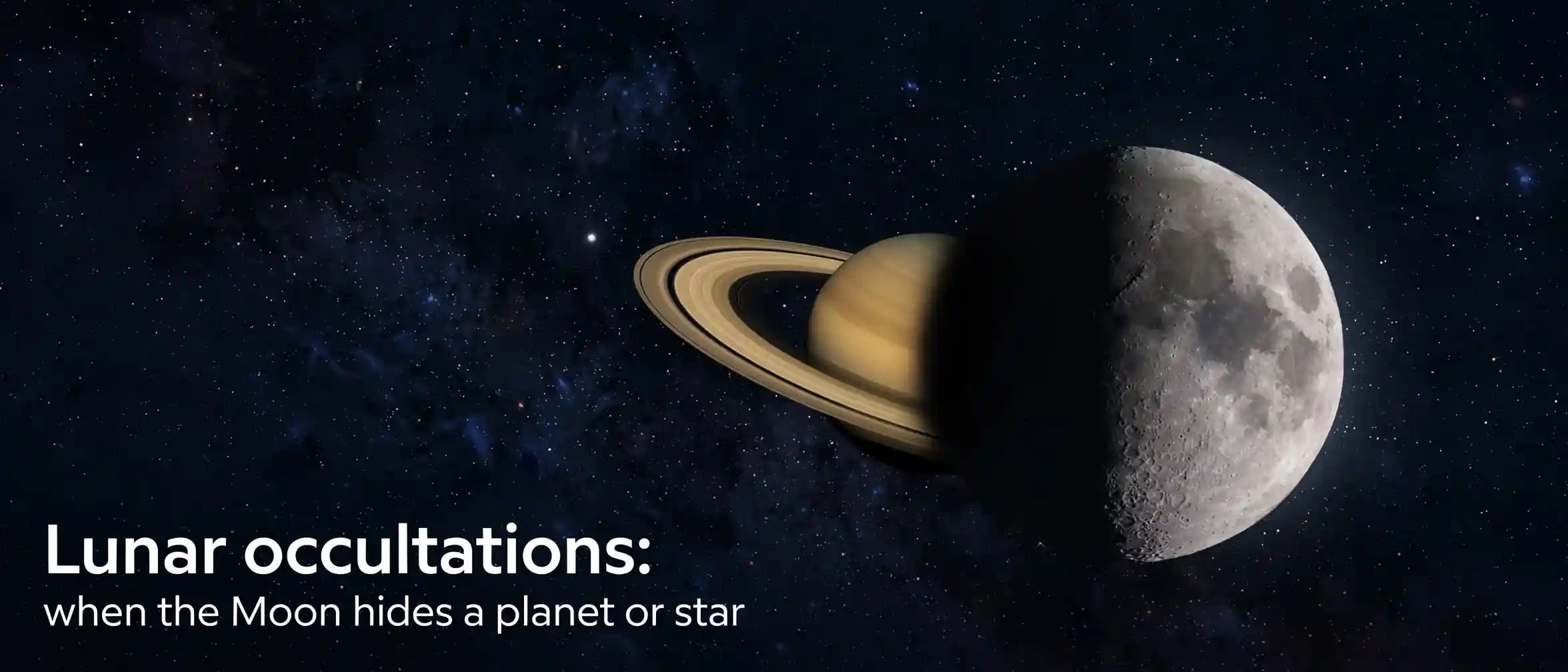
- A lunar occultation happens when the Moon passes between an observer and a more distant object, hiding it for a time.
- The disappearance is immersion; the reappearance is emersion.
- The Moon and the star are not physically close. The occultation is a line-of-sight alignment.
- Because the Moon is close, an occultation is visible only from a limited region of Earth.
- Stellar events are generally total or grazing. Planets have disks, so they can also be partially occulted.
- The lunar limb is a diffraction edge. Timed precisely, the resulting light curve reveals double stars, stellar diameters, the Moon's motion and the profile of the limb.
The Moon crosses the stars every month
The Moon drifts steadily eastward against the background stars. Occasionally its disk passes directly in front of a distant star or Solar System object. From Earth, the object slides up to the lunar edge, winks out, stays hidden, and later reappears on the other side. This is a lunar occultation.
The Moon and star are not physically close; the occultation is a line-of-sight alignment. And because the Moon is so near to us, the same event can look completely different from different places on Earth. One observer sees a star vanish; another, a few hundred kilometers away, sees the star pass just above the lunar limb.
What is a lunar occultation?
A lunar occultation occurs when the Moon passes between an observer and a more distant astronomical object, temporarily blocking that object's light. There are three players:
- Foreground object: the Moon
- Background object: a star, planet, or another Solar System body
- Observer: usually on Earth
For stellar lunar occultations, IOTA commonly distinguishes total and grazing events. Because planets have measurable angular diameters, lunar occultations of planets can also be partial. We cover all three below.
What actually happens
- Moon approaches
- Object reaches the limb
- Immersion
- Hidden
- Emersion
Immersion and emersion are the preferred technical terms, and you will see them throughout the observing literature.
Occultation vs. eclipse vs. transit
NASA groups occultations, eclipses and transits as related but distinct alignment phenomena.
| Phenomenon | What happens? | Example |
|---|---|---|
| Occultation | A foreground object blocks a more distant object | The Moon hides a star |
| Solar eclipse | The Moon passes between Earth and Sun | Total solar eclipse |
| Lunar eclipse | The Moon enters Earth's shadow | Total lunar eclipse |
| Transit | A smaller apparent disk crosses a larger apparent disk | Mercury across the Sun |
For the Moon specifically the distinction is clear: in a lunar occultation, the Moon is the object doing the hiding; in a lunar eclipse, the Moon is the object entering a shadow. In wider astronomy the word eclipse is used somewhat more broadly (NASA uses it for both obscuration and shadow), so these categories are not mutually exclusive in every context.
The geometry of an occultation
The basic alignment is simple: observer → Moon → background object. The Moon does not need to be near the star in space. It only needs to sit on the same line of sight.
Why only part of Earth sees it
Because the Moon is relatively close, observers at different locations see it projected against slightly different positions on the distant sky. This effect is lunar parallax, and it is on the order of a degree, roughly twice the Moon's own apparent width. As a result, an occultation visible from one region can miss another entirely. IOTA emphasizes that an occultation can be seen only at the correct time and from a limited region of Earth.
The occultation path
For any given event, the map of Earth divides into zones:
- Central or total path: where a point-like object is fully hidden.
- Northern and southern limits: the edges of the region where the occultation occurs.
- Grazing zone: along a limit, where the object skims the lunar edge.
- Partial-occultation zone (extended objects): for a planet, the Moon's limb covers part of the disk without hiding all of it. Because a planet is not a point, IOTA's planetary predictions describe inner and outer boundaries for this zone rather than a single line.
- Everywhere else: observers see no occultation at all.
A map of Earth showing these zones is the most helpful way to picture an event, and the best occultation predictions are published as exactly such maps.
Why the Moon can hide some objects but not others
The Moon is always moving against the stars
The Moon moves eastward against the background stars, completing a circuit in about 27.3 days (its sidereal period). Its apparent drift is roughly half a degree per hour on average, about its own diameter every hour. That is fast enough for the lunar limb to sweep across a star during a single observing session.
Why not every night, and why about 6.5°?
The Moon's orbit is inclined by about 5° to the ecliptic, the path the Sun and planets trace across the sky. So the Moon does not follow exactly the same strip of sky each month, and only objects close enough to its path can be occulted.
The often-quoted limit of roughly 6.5° from the ecliptic is larger than the inclination because it adds two things. The Moon's disk has an angular radius of about a quarter of a degree, so it can cover objects slightly off its center line. And parallax, up to about a degree, shifts the Moon's apparent position for observers at different places on Earth. Roughly: 5° + 0.25° + 1° lands near 6.5°. Historical NASA-hosted literature gives that figure as the broad range within which objects can be occulted by the Moon at some time, for some observer.
Total, grazing and partial occultations
Total occultation
From the observer's position, the Moon's disk passes completely in front of the object. The sequence is clean:
- Star visible
- Immersion
- Star hidden
- Emersion
- Star visible
The hidden interval can last from a few minutes to around an hour, depending on how centrally the star crosses the lunar disk.
Grazing occultation
In a graze, the star passes almost exactly along the lunar limb. Instead of one clean disappearance, the star may disappear, reappear, disappear again, and reappear again. This happens because the lunar edge is not smooth: mountains, crater rims and valleys alternately block and expose the star. IOTA notes that a graze can produce many disappearance and reappearance events as the star meets individual peaks and valleys.
A graze effectively turns the Moon's edge into a measuring instrument. Observers spread across the grazing path sample different parts of the limb, and their timings can be combined to reconstruct its profile.
Partial occultation (planets)
For ordinary occultation geometry, stars are effectively point sources, so a stellar event is treated as total or grazing. A planet has a disk, so the lunar limb can cover only part of it and then move away. IOTA treats these partial planetary occultations separately from total ones, as discussed in the planets section below.
The uneven lunar limb
Popular articles often skip over this, but it is central to the whole subject.
The limb is not a perfect circle
The Moon looks circular from Earth, but its edge is a landscape in profile: mountains, crater walls, valleys, ridges and depressions. When a star passes behind the limb, these features decide exactly when its light vanishes and returns. Two observers a short distance apart can record different times for the same star, simply because the star crossed different terrain.
Libration changes which terrain is at the edge
The Moon rocks slightly as it orbits (libration), so the terrain sitting on the limb is different from one event to the next. Accurate predictions therefore need the limb profile for the specific viewing geometry of that moment, not a single fixed outline.
Modern limb models
Spacecraft laser altimetry and imaging have mapped lunar elevations in great detail, and modern prediction software uses limb models derived from missions such as Kaguya and LRO. That is why a predicted contact time depends not only on the Moon's orbit, the star's position and your location, but also on which piece of lunar terrain actually crosses the star's line of sight. It helps to separate three things:
- Historical occultation-derived profiles: valuable in their time, now largely superseded for limb shape.
- Modern spacecraft topography: the standard for the shape of the limb.
- The continuing value of occultations: timings still deliver stellar and lunar-motion information that topography alone cannot.
Why stars seem to vanish instantly
For ordinary visual observing, a distant star is effectively a point source, so it appears to switch off almost instantly as the limb covers it. That abruptness is a large part of why occultations are timeable at all.
At high temporal resolution, however, the picture is richer. A star's finite angular size, any close companion, and diffraction at the lunar edge all shape how the light falls. The recorded light curve can also be affected by the observing wavelength and bandwidth, the detector response, atmospheric scintillation, the timing resolution, and the limb topography. So the star does not simply drop as a perfect step, and that detail is where the science sits.
The lunar limb as a diffraction edge
Light does not stop geometrically at the lunar limb. It diffracts around the edge, producing a Fresnel diffraction pattern: a series of fringes in brightness, a few of which appear just before the geometric disappearance. The pattern depends on the angular structure of the source:
- a point-like star produces a characteristic, sharp fringe pattern;
- a star with measurable angular size smooths and washes out that pattern;
- a close binary produces a superposition of two patterns, offset in time;
- high-speed photometry or video can record these changes.
The chain runs: lunar limb → diffraction → Fresnel scale → time-dependent light curve → angular information.
The characteristic Fresnel scale depends on the wavelength of light and the Earth–Moon distance. For visible light and the Moon's distance it comes to roughly ten meters. As the limb sweeps across the star at about a kilometer per second, those fringes are crossed in on the order of hundredths of a second. Ten meters at the Moon's distance subtends only a few milliarcseconds, which is why lunar occultations have historically provided milliarcsecond-scale information on stellar diameters and close binaries, far below what direct imaging could easily separate. (These figures are approximate; the exact values depend on wavelength, distance and relative velocity.)
The Fresnel scale sets the natural diffraction scale of the event; it is not the final angular resolution. The resolution actually achieved also depends on wavelength, Earth–Moon distance, the limb's relative velocity, signal-to-noise, sampling rate, bandwidth, telescope aperture and the quality of the model used to fit the light curve.
A one-dimensional measurement
The lunar limb scans the source along essentially one direction, so an occultation does not produce a conventional two-dimensional image. That is why it can detect a binary or measure an angular diameter along the scan direction, but cannot by itself reconstruct a star's full two-dimensional structure.
When the Moon hides a star
What the observer sees
A typical visual sequence: the bright Moon sits nearby; a target star creeps toward the limb; it disappears suddenly; it stays invisible; then it reappears just as suddenly at the opposite edge.
The "step" effect
If the brightness falls in two stages, the source may be a close double star: the two components disappear one after the other. IOTA specifically notes that step events can signal a double star. A gradual fade, by contrast, has several possible explanations; see What can go wrong.
Dark-limb vs. bright-limb events
The Moon moves eastward against the stars, so objects disappear at its eastern (leading) limb and reappear at its western (trailing) limb. Whether that limb is lit or dark depends on the phase:
- Waxing Moon: the eastern, leading limb is dark. Stars generally disappear at the dark limb, which makes disappearances easier to observe.
- Waning Moon: the western, trailing limb is dark. Stars generally reappear at the dark limb, which makes reappearances easier to observe.
The reverse events happen at the bright limb, where a star vanishes into or emerges from intensely lit terrain and is easy to miss. IOTA recommends beginners start with total occultations.
When the Moon hides a planet
Why planetary occultations are different
A star is essentially point-like and can disappear in a very short interval. A planet has a finite angular diameter, may be only partly covered, and can show a measurable progression across the lunar limb. Its disk can take noticeable time to pass behind the edge, depending on the planet's apparent size and the Moon's relative motion. For grazing planetary events the "path" is therefore not a single line but a zone with inner and outer boundaries.
Practical visibility varies enormously from planet to planet, and none of these events is routine. They are possible when the geometry works, and that is all.
| Planet | What to expect |
|---|---|
| Venus | Extremely bright, and visible even in a bright sky, so occultations can be spectacular and may be seen in daylight. NASA documented the June 17, 2026 daytime lunar occultation of Venus and noted additional 2026 opportunities. |
| Jupiter | A large disk, so the disappearance is gradual, and the disk can be partially covered. Its Galilean moons are not just scenery: they can themselves be occulted by the Moon, in events separate from the planet's. |
| Saturn | The rings have their own apparent extent, so the ring system and the globe can disappear and reappear at different moments. One event can therefore involve several distinct contacts. |
| Mars | Notable for its reddish color but small in angular size, so the event is quick compared with Jupiter or Saturn. |
| Mercury | Rarely easy, because it stays close to the Sun in the sky. |
| Uranus and Neptune | Possible, but much more challenging: small, faint disks that need a telescope. |
| Pluto | Far too faint for ordinary lunar-occultation observing (see the sidebar below). |
Occultation astronomy is not limited to the Moon. When a Solar System body passes in front of a background star, the star can be occulted directly. If the occulting body has an atmosphere, absorption and refraction can make the star's light fade gradually as it passes through that atmosphere. The famous 1988 stellar occultation by Pluto provided evidence for Pluto's atmosphere. Same technique, a Solar System body in front of a star instead of the Moon.
How often do lunar occultations happen?
There are several answers, depending on what you mean by "how often", and there is no single useful universal number. The count depends on the limiting magnitude, your location, the star catalog, the Moon's phase, daylight, your horizon and how you define an event.
- Somewhere on Earth. Catalog-level predictions that include faint stars contain very many events.
- From one location. Far fewer, and the rate depends on your latitude and longitude, the lunar orbital geometry, star brightness, the phase, your local horizon, daylight and weather.
- Bright stars and planets. Much rarer. IOTA's published standard tables are limited to relatively bright objects, while far larger numbers of events appear once predictions extend to fainter stars.
Don't confuse "possible" with "observable"
An occultation can technically occur while the Sun is above the horizon, while the Moon is below your horizon, while the star is too faint to see, or while the Moon's glare makes the event impractical. Prediction software will list events that are real but unobservable from your site, so always check the local circumstances.
Why lunar occultations matter scientifically
Measuring the Moon's motion and Earth's rotation
Accurately timed occultations pin down where the Moon actually is. Observations have been used to determine corrections to lunar ephemerides and to investigate variations in Earth's rotation and Universal Time.
Measuring stellar positions
Because the star's position can be compared with a precisely timed limb crossing, occultations yield astrometric information about the star as well.
Finding double stars
Two stars too close together to be separated visually can produce separate disappearance events, or a combined diffraction pattern that can be modeled. The technique has been used systematically to study stellar multiplicity.
Measuring stellar angular diameters
Because the moving limb produces a predictable diffraction pattern, astronomers can extract information about sources far smaller in angular size than ordinary direct imaging would easily resolve. Lunar occultations have been used to study stellar angular diameters, close binaries, circumstellar structures and compact astronomical sources, with modern observations reaching milliarcsecond-level resolution.
Mapping the lunar limb
Grazing occultations can reveal mountain heights, valley depths and the detailed shape of the limb. IOTA describes this as an important scientific application of grazing observations.
From visual event to precision measurement
The same event can be enjoyed visually or recorded as a precision measurement. There is a continuum:
- Visual observation
- Timed video
- Calibrated photometry
- Scientific analysis
Amateurs can contribute scientifically useful video and photometry, and IOTA encourages observation and reporting, including of grazes. For the light curve itself, the diffraction fringes can be modeled to estimate source properties.
What occultations revealed about the Moon's atmosphere
The abrupt extinguishing of starlight at the lunar limb was historically principal evidence that the Moon lacks a dense atmosphere. A dense atmosphere would be expected to refract and attenuate starlight before the solid limb was reached, potentially producing a measurable gradual decline. Instead, stars wink out. Astronomers including Bessel in the 19th century used occultation observations in this argument.
The modern statement needs one nuance. The Moon has a very tenuous exosphere, so the accurate description is that it lacks a dense atmosphere, not that nothing at all surrounds it.
History of lunar occultation astronomy
Ancient observations
One of the earliest recorded planetary occultations is Aristotle's description of Mars passing behind the Moon, disappearing behind the dark part and emerging from the bright part. The observation is ancient, although its exact historical date has been debated.
Before modern precision timekeeping
Early on, occultations were practical tools of positional astronomy, contributing to lunar-position measurements and, more broadly, the celestial measurements used in attempts to determine longitude. Their strongest long-term applications turned out to be lunar ephemerides, star positions, Earth's rotation and Universal Time, and lunar limb profiles. For example, tens of thousands of occultations from the mid-20th century were analyzed for corrections to the lunar ephemeris and to the fundamental star system.
The evolution of observing technology
Their scientific value changed as the way events were recorded improved:
- Eye
- Stopwatch
- Chronograph
- Photographic or visual recording
- Photoelectric detector
- High-speed digital detector
- GPS/UTC-synchronized video
The 20th century and the modern era
- systematic photographic and photoelectric observations, double-star work, lunar ephemeris improvement and high-speed photometry;
- CCD and video recording, GPS timing, Gaia stellar positions, spacecraft-derived lunar topography and sophisticated prediction software.
The thread running through all of this is continuity. The basic event is the same one people watched centuries ago; what has transformed is the precision with which it can be measured.
How to predict a lunar occultation
What you need
- your observing location, including elevation,
- the date and exact time,
- the target star or object,
- the lunar phase,
- predicted immersion and emersion times,
- position angle and cusp information where applicable.
Prediction resources
For a quick look at what is happening now, check our current Moon conjunctions and occultations page.
IOTA offers lunar occultation predictions, grazing occultation predictions and observing guidance.
Occult is detailed prediction software covering lunar occultations, grazing occultations, and planetary and other occultation calculations. IOTA identifies it as its primary software for predicting lunar and other occultations.
Why your location matters
A prediction made for one city can be wrong for another. The astronomical event is not wrong; lunar parallax simply changes the geometry from place to place. Always generate predictions for your own coordinates.
How to observe a lunar occultation
| Equipment | Best for |
|---|---|
| Naked eye | Very bright stars, bright planets and favorable lunar geometry. The Moon's glare puts many events out of reach without optics. |
| Binoculars | Bright events, and finding the target. |
| Small telescope | An excellent entry point. IOTA notes that lunar occultations are well suited to small telescopes. |
| Larger telescope | Fainter stars, difficult bright-limb events, high-resolution video and scientific timing. |
Recording. Modern occultation work favors video, which preserves the exact sequence for later analysis and removes the guesswork of reaction time.
Timing and recording
Timing is the heart of the measurement.
- Record the event against a precisely synchronized UTC time reference. Occultation reports and predictions may express the corresponding event times in UT/UT1 terminology, depending on the system and era.
- Don't rely on a casual clock reading; use a UTC-synchronized time signal.
- Synchronize recording equipment beforehand.
- Record the entire event, not just the disappearance.
- Know your latitude, longitude and elevation accurately.
How much accuracy you need depends on what you are doing:
| Approach | Typical goal |
|---|---|
| Casual visual observation | Enjoy the event; timing is approximate. |
| Timed visual observation | Useful timings, limited by human reaction. |
| Video | Preserves the event for later timing against a UTC signal. |
| High-speed photometry | Resolves light-curve detail, including diffraction structure. |
For precision scientific observations, IOTA's guidance suggests timing on the order of 0.1 second or better can be desirable, and it stresses accurate observer position. Not every visual observer needs that.
Why such precision?
Because the Moon moves so fast against the sky. At roughly half a degree per hour, it shifts by about half an arcsecond every second, so a tenth of a second corresponds to a measurable, tiny shift in position. Small timing errors translate directly into positional errors.
Grazing occultations: the advanced challenge
What makes a graze different?
- The observing zone is very narrow.
- There are multiple disappearance and reappearance events.
- Lunar mountains and valleys become the measuring instrument.
Why multiple observers?
Observers spaced across the predicted grazing path sample different lunar elevations, and together they can reconstruct the limb profile. A single observer sees only one slice.
The modern change
Historically, grazes were especially valuable for mapping the lunar limb. Spacecraft and lunar topographic data have greatly reduced that particular need, though grazing observations still have scientific value, including for double-star and astrometric work.
What can go wrong?
The star didn't disappear
Possible reasons include a wrong location, a wrong time, an inaccurate prediction, a misidentified target, an event outside your local path, cloud or haze, or lunar glare.
It disappeared early or late
Consider your observer position and elevation, lunar parallax and libration, stellar-position uncertainties, the lunar limb's topography, and your timing accuracy.
It faded instead of vanishing instantly
Possible causes include a close double star, a measurable stellar angular diameter, diffraction, atmospheric scintillation, or optical issues. A gradual fade is a diagnostic possibility, not a conclusion: don't announce a binary on that evidence alone.
Notable lunar occultations
- Venus. Spectacular because Venus is so bright, and able to occur in daylight, as with the June 17, 2026 event noted above.
- Jupiter. A large disk, partial coverage, and the chance of its moons being occulted separately.
- Saturn. The rings make these events visually distinctive, with several separate contacts.
- Stars during lunar eclipses. An especially beautiful combination: ESA has documented observations of stars being occulted by the Moon during a total lunar eclipse, when the dimmed Moon no longer drowns out nearby stars.
- Rare multiple-object events. Occasionally the Moon successively occults more than one bright object. IOTA records a 1998 event involving lunar occultations of both Venus and Jupiter, as seen from the South Atlantic region.
The Moon as a natural high-resolution scanner
The lunar limb sweeps across the background sky like a moving edge. Because that edge produces a predictable diffraction pattern as it moves, astronomers can extract information about sources far smaller in angular size than ordinary direct imaging would easily resolve. The pieces fit together: lunar motion, the diffraction edge, precise timing, stellar angular structure, binary stars and lunar topography.
That is why something that looks like a simple disappearance can become a scientific measurement.
Science in one sentenceA lunar occultation turns the moving edge of the Moon into a natural measuring instrument, allowing astronomers to learn about the Moon, stars and their relative positions by precisely timing the moment one disappears behind the other.
What has changed in modern astronomy
- Gaia: greatly improved stellar astrometry, providing much more accurate positions and motions for many occultation targets.
- Lunar spacecraft: detailed mapping of lunar topography, feeding modern limb models.
- Digital video: high temporal resolution recording of events.
- GPS: precise observer coordinates and timing, transforming amateur work.
- Citizen science: IOTA continues to collect observations and provides prediction, observing and reporting infrastructure.
What it looks like from Earth
Total event
- Approach
- Contact
- Immersion
- Hidden
- Emersion
- Departure
Grazing event
- Approach
- Blink
- Reappearance
- Blink
- Reappearance
- Final disappearance or reappearance
The exact sequence depends on the topography of the limb, your location, the target's position, and the direction of the Moon's motion.
Observer field card
Before the event
- Confirm your exact observing location and elevation
- Check local circumstances
- Identify the target
- Check Moon and Sun altitude
- Check the weather
- Synchronize clock and video to UTC
- Locate the target before the event
During
- Keep optics away from the Sun
- Start recording early
- Don't stop right after the disappearance
- Record both immersion and emersion
- Note clouds or interruptions
After
- Preserve the original recording
- Record exact location and elevation
- Determine the event times
- Report useful observations through the appropriate IOTA channel
IOTA emphasizes that even a "miss" can be scientifically valuable. A precisely documented miss helps constrain the actual boundary of the occultation path, and therefore the lunar limb profile.
Technical reference
| Primary occulting body | Moon |
| Typical background objects | Stars; occasionally planets and other Solar System bodies |
| Sidereal orbital period | About 27.3 days |
| Average eastward motion against stars | About 0.5° per hour |
| Orbital inclination to ecliptic | About 5° |
| Main occultation types | Total and grazing (stars); also partial (extended objects such as planets) |
| Primary events | Immersion and emersion |
| Visibility | Location-dependent |
| Key variables | Lunar parallax, lunar libration, limb topography, target position, observer latitude/longitude/elevation, relative velocity, timing |
| Fresnel scale (visible light, approx.) | About 10 m at the Moon's distance, a few milliarcseconds |
Values are rounded. Source-check against current references before publishing.
Frequently asked questions
What is a lunar occultation?
It is the Moon passing in front of a more distant object, such as a star or planet, and hiding it from view for a time.
What is the difference between an occultation and an eclipse?
In an occultation, one object hides another. In an eclipse, one body generally enters another's shadow, although the word eclipse is also used more broadly. For the Moon specifically, a lunar occultation is the Moon doing the hiding, while a lunar eclipse is the Moon entering Earth's shadow.
Can the Moon occult a planet?
Yes, when the geometry works. Because planets have measurable angular diameters, they can be totally, partially or grazingly occulted. Venus, Jupiter and Saturn make the most visible examples, though practical visibility varies widely.
Can the Moon occult the Sun?
In the strict geometric sense, yes, but we call it a solar eclipse.
How often do lunar occultations happen?
Somewhere on Earth, frequently, especially if faint catalog stars are included. From any one location, far less often, and it depends on star brightness, phase, daylight, horizon and weather.
Why can I see an occultation but someone nearby cannot?
Lunar parallax: observers in different places see the Moon projected against slightly different parts of the sky, so the path of an occultation is limited.
What are immersion and emersion?
Immersion is the disappearance of the object behind the lunar limb; emersion is its reappearance.
What is a grazing occultation?
An event in which a star skims the lunar limb, disappearing and reappearing as it meets mountains and valleys.
Can I see a lunar occultation without a telescope?
Often yes for bright stars and planets, but the Moon's glare makes many events hard without optics. Small telescopes are an excellent entry point. Never point optics near the Sun to look for a daytime event without proper solar filters.
Does a star really disappear instantly?
To the eye, almost. At high time resolution the light does not drop as a perfect step: it diffracts around the lunar limb and produces a Fresnel diffraction pattern that depends on the star's angular structure.
Can occultations reveal double stars?
Yes. A close pair can disappear in two steps, one component after the other, or produce a combined diffraction pattern that can be modeled.
Can lunar occultations tell us anything about the Moon?
Yes: its motion, the profile of its limb, and historically, evidence that it lacked a dense atmosphere.
How accurate do occultation predictions have to be?
Very. The Moon moves so quickly that small errors in position, time, star coordinates or limb model shift the event noticeably, which is why accurate observer coordinates and elevation matter.
Where can I find upcoming lunar occultations?
IOTA publishes predictions, and the Occult software can generate predictions for your own location.
References
Primary and authoritative
- International Occultation Timing Association (IOTA), occultations.org: definitions, observing methods, predictions, partial planetary occultations, grazing occultations, equipment, UTC timing guidance and reporting.
- NASA: occultation science and contemporary examples, including the 2026 Venus occultation and its solar-safety guidance.
- NASA Technical Reports Server: historical scientific literature and occultation methodology.
- ESA: stellar-occultation examples and applications.
Scholarly literature
- Richichi, A. (1994). “Lunar Occultations: From Past to Future Achievements.” IAU Symposium 158: Very High Angular Resolution Imaging, 71–81. DOI: 10.1017/S0074180900107338
- White, N. M. (1983). “Review of the Occultation Technique for the Study of Binaries.” IAU Colloquium 62: Current Techniques in Double and Multiple Star Research, 60–62. DOI: 10.1017/S0252921100009830
- White, N. M. (1987). “Lunar Occultations: From Conjecture to Results.” Vistas in Astronomy, 30, 13–25. DOI: 10.1016/0083-6656(87)90017-1
- Morrison, L. V., & Sadler, D. H. (1969). “An Analysis of Lunar Occultations 1960–66.” Monthly Notices of the Royal Astronomical Society, 144(1), 129–141. DOI: 10.1093/mnras/144.1.129
- Morrison, L. V. (1979). “An Analysis of Lunar Occultations in the Years 1943–1974 for Corrections to the Constants in Brown's Theory, the Right Ascension System of the FK4, and Watts' Lunar-Profile Datum.” Monthly Notices of the Royal Astronomical Society, 187(1), 41–82. DOI: 10.1093/mnras/187.1.41
- Smart, W. M., revised by R. M. Green (1977). Textbook on Spherical Astronomy, 6th ed. Cambridge University Press. DOI: 10.1017/CBO9781139167574
- Savoie, D. (2003). “Problèmes de datation d'une occultation observée par Aristote” [“Problems of dating an occultation observed by Aristotle”]. Revue d'histoire des sciences, 56(2), 493–504. DOI: 10.3406/rhs.2003.2199
- Stern, S. A. (1999). “The Lunar Atmosphere: History, Status, Current Problems, and Context.” Reviews of Geophysics, 37(4), 453–491. DOI: 10.1029/1999RG900005
- Hubbard, W. B., Hunten, D. M., Dieters, S. W., Hill, K. M., & Watson, R. D. (1988). “Occultation Evidence for an Atmosphere on Pluto.” Nature, 336(6198), 452–454. DOI: 10.1038/336452a0
- Richichi, A., Sharma, S., Sinha, T., Pandey, R., Ghosh, A., Ojha, D. K., Pandey, A. K., & Naik, M. B. (2020). “Further Milliarcsecond Resolution Results on Cool Giants and Binary Stars from Lunar Occultations at Devasthal.” Monthly Notices of the Royal Astronomical Society, 498(2), 2263–2269. DOI: 10.1093/mnras/staa2403