

Why Do Eclipses Repeat Every 18 Years? The Saros Cycle Explained
Every eclipse belongs to a family. Roughly 18 years, 11 days, and 8 hours after a solar or lunar eclipse, a near-twin occurs — same node, similar geometry, similar duration. Astronomers call this repeating interval the saros, and it was tracked by Babylonian skywatchers long before anyone understood why it worked. The reason comes down to a much slower, less obvious motion: the Moon’s orbital nodes are slowly regressing, a phenomenon formally known as lunar nodal precession. Understanding that drift is the key to understanding why the saros exists at all, and why it isn’t simply “18.6 years” under a different name.
The wobble you can’t see
The Moon’s orbit is tilted about 5° relative to the ecliptic, the plane Earth traces around the Sun. The two points where the Moon’s path crosses that plane — its ascending and descending nodes — don’t stay fixed. They regress westward, opposite the Moon’s direction of travel, completing a full 360° loop about every 18.6 years.
That regression has a direct consequence: a draconic month (the time for the Moon to return to the same node) comes out a bit shorter than a sidereal month (the time to return to the same position against the background stars). Because the node itself has shifted backward, the Moon reaches it again before completing one full orbit relative to the stars. The relationship is direct enough to write as an equation:
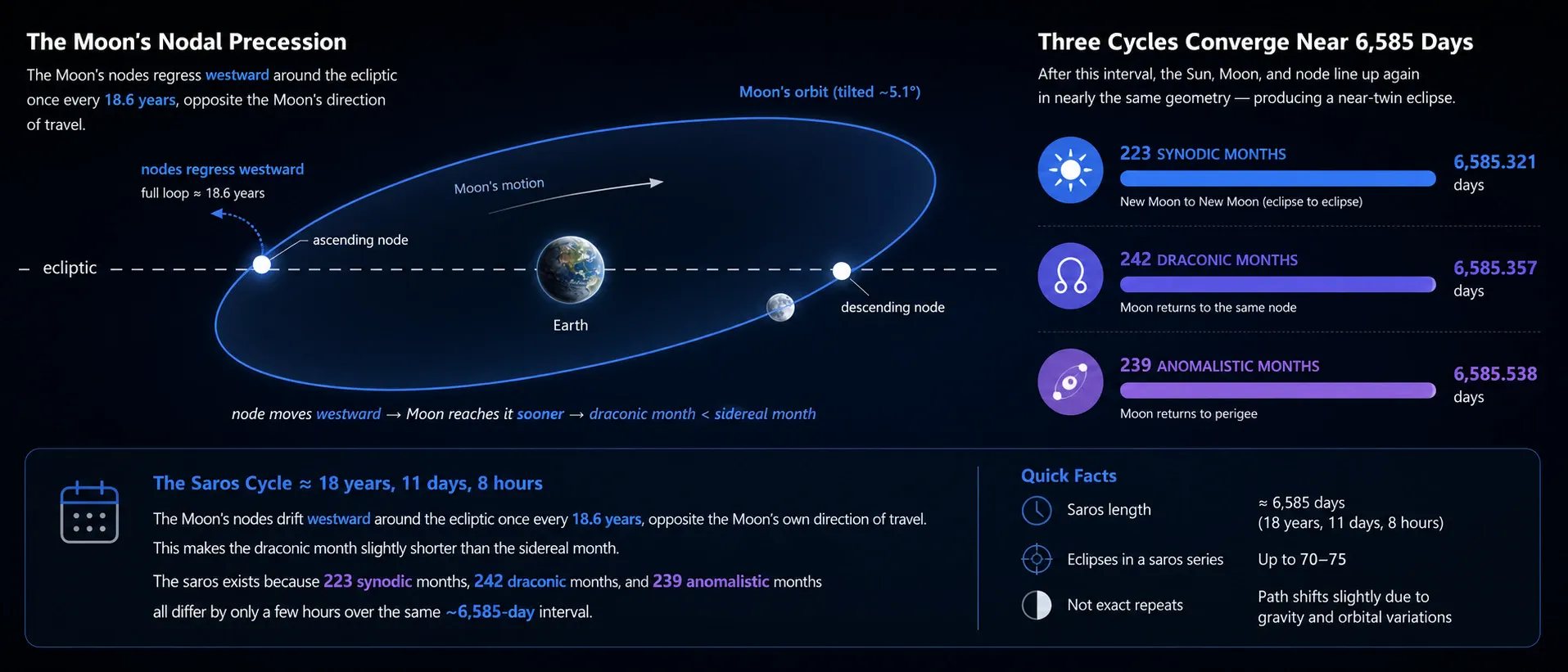
The Moon’s nodes drift westward around the ecliptic once every 18.6 years, opposite the Moon’s own direction of travel, which is why the draconic month is slightly shorter than the sidereal month. The saros exists because 223 synodic months, 242 draconic months, and 239 anomalistic months all differ by only a few hours over the same ~6,585-day interval.
How the saros comes from that
Eclipses only happen when the Moon is new or full and occurring near a node at the same time. So the saros isn’t a simple fraction or integer multiple of the 18.6-year nodal period — it’s the answer to a different question: over what stretch of time do the Moon’s phase, node-crossing, and orbital-distance cycles nearly repeat together?
It turns out that stretch is about 6,585.3 days — 18 years, 11 days, and 8 hours — where 223 synodic months and 242 draconic months (whose length is set by nodal precession) both land within hours of each other. Include the anomalistic month as well: 239 of those land in the same window, which is why the Moon sits at nearly the same distance from Earth at each eclipse in a series, not just the same node and phase.
| Lunar cycle | Length | Count in one saros | Total span |
|---|---|---|---|
| Synodic month (new moon to new moon) | 29.53 days | 223 | 6,585.32 days |
| Draconic month (node to node) | 27.21 days | 242 | 6,585.36 days |
| Anomalistic month (perigee to perigee) | 27.55 days | 239 | 6,585.54 days |
Figures for the year 2000 CE, via NASA/Fred Espenak, “Eclipses and the Saros”. All three lunar month lengths change gradually over long timescales due to the same orbital dynamics.
Why 223, specifically?
It’s fair to ask why the saros lands on 223 synodic months rather than some other number. In modern mathematical terms, this is equivalent to finding a whole number of synodic months that comes unusually close to a whole number of draconic months — a continued-fraction approximation to two incommensurate periods, using the smallest numbers that would work. Try a handful of synodic months against draconic months and the match is poor. Try enough, and eventually a remarkably close fit turns up — and 223 against 242 is that fit, matching to a matter of hours rather than days.
This is the same kind of relationship that shows up whenever two incommensurate cycles are forced to line up approximately — it is the same logic used to design gear ratios in mechanical calendars, most famously the Antikythera mechanism, whose gearing physically encodes the saros ratio in bronze. The Astronomical League’s guide to determining the saros walks through how an amateur observer can rediscover this same 223:242 ratio using nothing more than careful naked-eye timing over a few months, the same way ancient skywatchers first noticed the pattern empirically, long before anyone had a model of *why* it worked.
The saros isn’t the only cycle like this
The saros is the most famous eclipse period, but it isn’t the only near-commensurability lurking in these numbers. A longer cycle, called the Inex, spans 358 synodic months — about 29 years — and represents a different near-alignment between synodic and draconic months. Where the saros shifts the Moon’s node position by roughly half a degree per cycle, the Inex shifts it much less, which is why Inex-related eclipse families can persist for far longer than any single saros series before the geometry finally drifts out of range. Eclipse researchers sometimes plot eclipses across both the saros and Inex periods simultaneously — a “saros-inex panorama” — to track how eclipse families are born, mature, and eventually die out over thousands of years.
Not a coincidence — a near-commensurability
It’s tempting to call this a lucky accident, but it’s more accurate to say these three lunar cycles happen to be unusually close to commensurate — close enough that 223, 242, and 239 whole months land almost on top of each other. Nodal precession is what determines the draconic month’s length in the first place; the saros is the consequence of that length nearly matching the synodic and anomalistic months over the same interval.
“Nearly” is the operative word, though. Because the match isn’t exact, the Moon’s node shifts by about half a degree with each successive eclipse in a saros series. That drift accumulates, and eventually the geometry no longer supports an eclipse — which is why any single saros series runs for 12 to 15 centuries and then ends.
How this becomes a practical eclipse catalog
Because saros series are so long-lived, astronomers organize eclipses into numbered series rather than tracking individual events. NASA’s saros catalogs label each family with a series number — Saros 136, for instance, is the series that produced the well-known total solar eclipses of the late 20th and early 21st centuries. A typical series contains 70 or more eclipses spread across a millennium or more, beginning as a marginal partial eclipse near one edge of the Moon’s shadow, strengthening into full totality for its middle centuries as the geometry becomes more favorable, and fading back out the opposite edge as nodal drift finally pushes the Moon too far from the node.
Because the saros isn’t a whole number of days — it runs about 6,585 days plus a third — each successive eclipse in a series lands roughly 8 hours later in the day and about 120° farther west in longitude. Three saroses bring an eclipse back to nearly the same part of the globe, a span of just over 54 years sometimes called an exeligmos. This is part of why solar eclipse paths visible from any single location are comparatively rare, even though solar eclipses happen somewhere on Earth several times a year.
Why eclipse type changes across a series
One consequence of the anomalistic month’s near-alignment is that a single saros series doesn’t produce the same kind of solar eclipse every time. Because the Moon’s distance from Earth varies over an anomalistic cycle, and because 239 anomalistic months only nearly matches the saros rather than matching it exactly, the Moon’s apparent size at each eclipse in a series drifts slowly over the centuries. A series can begin with partial eclipses, mature into total eclipses once the Moon is close enough to fully cover the Sun’s disk, and later shift toward annular eclipses as the drift moves the Moon toward apogee at eclipse time, before the series ends entirely. Solar eclipse hunters who track a specific series over many decades are, in effect, watching this century-scale drift play out one eclipse at a time.
The same reasoning explains why two eclipses only a single saros apart can still differ slightly in duration and path width, even though they share a series and a node. The geometry is close enough to look like a repeat, but never quite exact — which is the whole story of the saros in miniature: three independent lunar rhythms, nearly but not perfectly in step, producing a cycle that looks deceptively simple from the outside and rewards a closer look every time.
Frequently asked questions
Is the saros cycle the same as the 18.6-year nodal precession?
No. The nodal precession (about 18.6 years) is the time for the Moon’s orbital nodes to complete one full backward loop around the ecliptic. The saros (about 18.03 years) is a different, shorter interval where the synodic, draconic, and anomalistic months happen to nearly realign. Nodal precession determines the draconic month’s length; the saros is built from that length matching the other lunar cycles.
Why is the draconic month shorter than the sidereal month?
Because the Moon’s nodes regress westward, opposite the Moon’s direction of orbit. The Moon reaches the same node again slightly before it completes one full orbit relative to the fixed stars, since the node has moved backward to meet it partway.
Why does a saros eclipse series eventually end?
The 223 synodic months and 242 draconic months in one saros don’t match perfectly — they’re close but not equal. Each eclipse in a series shifts the Moon’s position relative to the node by about half a degree. After enough repetitions, spanning 12 to 15 centuries, that drift becomes large enough that the Moon is no longer close enough to the node for an eclipse to occur.
Who first discovered the saros cycle?
Babylonian (Chaldean) astronomers identified the roughly 18-year recurrence of lunar eclipses centuries before the underlying orbital mechanics were understood. The word “saros” entered eclipse terminology through Edmond Halley in 1686, borrowed from a Byzantine source — though the term wasn’t firmly attached to this specific eclipse cycle in the modern sense until the 19th century, through the astronomer John Russell Hind.
What is the Inex cycle, and how is it different from the saros?
The Inex is a longer eclipse cycle of 358 synodic months, roughly 29 years, based on a different near-alignment between synodic and draconic months. It shifts the Moon’s node position by a smaller amount per cycle than the saros does, which lets Inex-related eclipse families persist for much longer stretches of time. Researchers often study the saros and Inex together to map how eclipse families emerge and eventually fade over thousands of years.
Why do eclipses in the same saros series shift westward each time?
Because one saros isn’t a whole number of days — it runs about 6,585 days plus a third of a day. That extra eight hours means Earth has rotated an additional third of a turn by the time the next eclipse in the series arrives, shifting the visibility path roughly 120° farther west. After three saroses, about 54 years, the path returns to nearly the same longitude, an interval sometimes called an exeligmos.