

Lyrid Meteor Shower: Peak Dates, Radiant & How to Watch
A reference guide to the Lyrids: when they peak, what determines whether it’s a good year or a washed-out one, and how to get the most out of one of the oldest meteor showers on record.
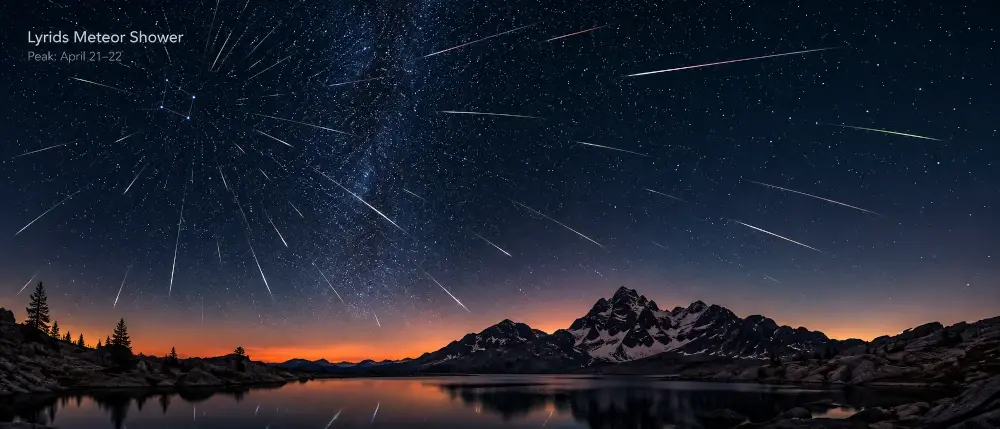
What Is the Lyrid Meteor Shower?
The Lyrids are an annual meteor shower that lights up the mid-April sky. They take their name from Lyra, the small constellation next to the bright star Vega, but their actual radiant — the point in the sky the meteors appear to shoot from — sits just across the border in eastern Hercules, roughly 8 degrees southwest of Vega. As with every meteor shower, the “shooting stars” have nothing to do with the stars they appear to fly past; they’re tiny fragments of comet debris burning up in Earth’s upper atmosphere.
What makes the Lyrids historically remarkable is their age. Chinese records describe meteors falling like rain during a Lyrid display in 687 BCE, making this one of the oldest meteor showers with a recorded observational history — roughly 2,700 years and counting. Modern Lyrid nights are usually modest, with the American Meteor Society putting typical peak rates around 10–15 meteors an hour under dark skies, but the shower has a reputation for the occasional surprise: unpredictable outbursts, decades apart, that briefly push rates far higher than normal.
The Lyrids aren’t the year’s most prolific shower — they won’t rival the Perseids or Geminids on a typical night — but their long history, a reasonable shot at a bright fireball, and a debris source distinct from every other major shower make them worth watching every spring.
When to Watch Each Year
The Lyrids are active for about ten days every year, but nearly all of the meaningful activity is packed into one night. Here’s the timeline that actually matters:
- Active period: roughly April 14 through April 30, though the great majority of that window sees only trace activity.
- Peak night: typically the night of April 21–22, running into the pre-dawn hours of the 22nd. This date holds fairly steady from year to year, though it can shift a day later — as it does in 2027, when the peak falls the night of April 22–23.
- Concentrated peak: the American Meteor Society describes the Lyrids as usually producing good rates for about three nights centered on the maximum, with the peak night itself — often sharp, lasting only a few hours — the strongest of the three.
Exact peak timing can shift by a day depending on the year, so it’s worth confirming the current year’s predicted peak with a meteor-shower calendar shortly before you plan to watch. The peak’s few-hours-wide window can also fall at an inconvenient time of day for a given region — in 2026, for instance, the American Meteor Society’s predicted maximum falls around 19:40–20:00 UT on April 22, which is afternoon in North America, making both the nights of April 21–22 and April 22–23 worth watching there.
The Comet Thatcher Connection
Every meteor shower is Earth passing through the debris trail of a comet or asteroid. For the Lyrids, that parent body is the long-period Comet C/1861 G1 (Thatcher), discovered in April 1861 and named for the American astronomer who found it. Thatcher’s orbit is enormous — it takes roughly 415 years to complete, and the comet won’t return to the inner solar system until around the 23rd century.
Unlike Halley’s Comet, which produces two annual showers (the Eta Aquariids and the Orionids), Thatcher’s debris trail only intersects Earth’s orbit once a year, in mid-April, which is why the Lyrids stand alone rather than having a sibling shower elsewhere on the calendar.
The debris stream also isn’t perfectly uniform. Most years, Earth passes through a relatively thin part of the trail, producing the shower’s usual modest rates. Occasionally, though, Earth crosses a denser filament of material, and rates spike into an outburst — this is the mechanism behind the shower’s occasional, unpredictable strong years.
Finding the Radiant Near Vega
The Lyrid radiant sits at roughly right ascension 18h04m, declination +34° — a spot that modern star charts place among the stars of eastern Hercules, about 8 degrees southwest of Vega, one of the brightest stars in the entire night sky. Vega makes the general area easy to locate even from a light-polluted yard, even though the radiant itself technically falls just across the border in the neighboring constellation, which is why the shower is named for Lyra even though its radiant isn’t quite inside it. The shower favors the Northern Hemisphere, where the radiant climbs high overhead before dawn; it’s still visible farther south, but at reduced rates since the radiant never gets very high above the horizon there.
As with any shower, you don’t need to stare at the radiant to see meteors — they can streak across any part of the sky. In fact, looking directly at the radiant is the least effective strategy: meteors near their point of origin appear short and stubby, almost head-on. For longer, more dramatic streaks, look well away from the radiant — roughly 40–60 degrees is a useful rule of thumb, not a strict target. The simplest approach is to face a dark patch of sky partway between the radiant and the horizon and take in as much of the sky as possible.
Why the Moon Matters Every Year
Moonlight is the single biggest variable in any meteor shower forecast, and it changes completely from one year to the next. Because the Lyrids fall on roughly the same calendar date annually while the lunar cycle doesn’t, some years line up with a new or thin-crescent moon and dark skies all night, while others land close to a bright gibbous or full moon that washes out all but the brightest meteors.
2026 and 2027 make the contrast obvious. In 2026, the moon is a thin waxing crescent that, per the American Meteor Society, sets in the early morning hours right around the time the radiant climbs to a favorable elevation — leaving the best part of the night largely free of moonlight, one of the better Lyrid years in recent memory. In 2027, the peak falls just two to three days after a full moon, so a bright, high moon is up for most of the night.
- New moon or thin crescent near the peak: you’re in for a great year — dark skies all night, so any time after full darkness works.
- Gibbous or full moon near the peak: plan around it. Find local moonset time (or moonrise, if the moon is waning) and concentrate your viewing in the darkest window you can get.
Lyrid Peak Schedule: 2026–2035
The Lyrids peak on almost the same calendar date every year — typically the night of April 21–22, occasionally shifting a day later. What actually changes from year to year is the Moon. Because the shower’s date is fixed but the 29.5-day lunar cycle isn’t, some years land in dark, moonless skies while others land under a washed-out gibbous or full moon. Note also that the Lyrid maximum itself is unusually sharp — often just a few hours wide — so the exact predicted UT time can fall in daylight for a given region even when the surrounding night is a good one to watch.
The 2026 and 2027 rows below are cross-checked against the American Meteor Society’s published shower calendar, NASA’s seasonal skywatching guidance, and independent lunar-phase records — these sources don’t currently publish shower-specific forecasts further out than that. The 2028–2035 rows are projected from lunar-cycle math alone, which is reliable for moon phase itself but hasn’t been checked against a shower-specific source this far in advance. Treat those years as a useful planning guide, and reconfirm the moon phase and local moonset time as the date approaches.
| Year | Typical Peak Night | Moon Phase | Moon Illumination | Viewing Outlook |
|---|---|---|---|---|
| 2026 | Apr 21–22 | Waxing Crescent | ~27% | Good to excellent – crescent sets before the radiant reaches a favorable elevation, so interference is minimal |
| 2027 | Apr 22–23 | Waning Gibbous (3 days past full) | ~95% | Poor – bright moon up most of the night |
| 2028 | Apr 21–22 | Waning Crescent | ~9–10% (approx.) | Good to excellent – dark skies most of the night |
| 2029 | Apr 21–22 | Waxing Gibbous | ~55–60% (approx.) | Mixed – moon up through the evening, thins out approaching dawn |
| 2030 | Apr 21–22 | Waning Gibbous | ~80–83% (approx.) | Poor to mixed – moonlight for much of the night |
| 2031 | Apr 21–22 | New Moon | ~0–2% (approx.) | Excellent – dark skies all night |
| 2032 | Apr 21–22 | Waxing Gibbous | ~85–88% (approx.) | Poor – near-full moon washes out the shower |
| 2033 | Apr 21–22 | Waning Gibbous, near Last Quarter | ~48–50% (approx.) | Mixed – moon rises around midnight, dark early evening |
| 2034 | Apr 21–22 | Waxing Crescent | ~9–10% (approx.) | Good – dark skies most of the night |
| 2035 | Apr 21–22 | Waxing Gibbous (1 day before full) | ~99% (approx.) | Poor – near-full moon washes out the shower |
Best Time and Viewing Strategy
Put the pieces together — radiant height, moon timing, and morning twilight — and the optimal plan looks like this:
- Skip the early evening. Rates are much lower before the radiant near Vega has climbed well up into the sky.
- Check moonset (or moonrise) for the current year and, if the moon is a factor, plan your darkest window around it.
- Watch from midnight until the sky starts to brighten. This stretch, when the radiant is highest, is consistently the best part of the night.
- Get away from significant light pollution. A darker sky can dramatically increase the number of meteors you’re able to see, though exactly how much depends on your starting point, the direction you’re facing, and the Moon.
- Give your eyes time. Full dark adaptation takes 20–30 minutes, and a bright phone screen can significantly set it back — use a dim red light if you need one.
- Lie back and look up. A reclining chair or blanket on the ground, facing away from the Moon and any residual light domes, beats standing and craning your neck.
How to Photograph the Lyrids
Meteor photography is really wide-field night sky photography with patience layered on top — you’re not tracking a single fast-moving subject so much as leaving your shutter open on a big patch of sky and hoping something streaks through the frame.
Gear
- A camera capable of manual exposure control (mirrorless or DSLR).
- A wide-angle lens, ideally 14–24mm, with the widest available aperture (f/1.8–f/2.8).
- A sturdy tripod — nothing else matters if the camera moves.
- An intervalometer or built-in interval timer, so the camera fires continuously without you touching it.
- A spare battery; chilly April nights drain batteries faster than you’d expect.
Camera Settings
- Focus: manual, set to infinity, checked visually on a bright star or planet at full zoom in live view.
- Aperture: as wide as your lens allows — f/2.8 or faster if possible.
- Shutter speed: start around 10–20 seconds and adjust from there based on your focal length and how much star trailing you see in test shots.
- ISO: start around 1600–3200 as a baseline and adjust based on your test shots.
- Shooting mode: continuous interval shooting with a 1–2 second gap between frames, for as long as your battery and card allow.
Composition
Frame roughly 40–60 degrees away from the radiant rather than centered on Lyra itself, and include an interesting foreground — a horizon, treeline, or silhouette — to give any captured meteor a sense of scale. Because you can’t predict exactly where a meteor will appear, plan to shoot for at least an hour and sort through the frames afterward rather than trying to time an individual shot.
What to Expect: Speed, Trains & Outbursts
Lyrid meteors travel at about 49 kilometers (30 miles) per second — a medium-fast pace, quicker than the Geminids but noticeably gentler than the Orionids or Leonids, which meet Earth’s orbit closer to head-on. That gives Lyrid meteors a slightly less streaky, more measured look than some of the year’s fastest showers.
Persistent trains — glowing afterglows left behind by a meteor — are less common with the Lyrids than with Halley-family showers like the Orionids. NASA meteor researchers have described Lyrid meteors as typically faint compared to a shower like the Perseids, though the American Meteor Society notes they can still produce fireballs, so a bright one is possible without being guaranteed on any given night.
The Lyrids’ real claim to fame is their unpredictable outburst potential. In most years, observed rates under dark skies run around 10–15 per hour at the peak — on top of the ordinary sporadic background of roughly 5 meteors an hour that has nothing to do with the shower — but every few decades Earth passes through an unusually dense filament of Comet Thatcher’s debris and rates spike dramatically. Nineteenth-century observers in Virginia described meteors falling from every part of the sky during the 1803 outburst, and a 1982 outburst pushed rates to roughly 90 per hour. There’s no reliable way to predict exactly when the next one will happen, which is part of what keeps experienced meteor watchers coming back to this shower every April.
Lyrids vs. Other Meteor Showers
Here’s how the Lyrids stack up against the year’s other headline showers. Rates below are the Zenithal Hourly Rate (ZHR) — a theoretical ceiling under a perfectly dark sky with the radiant directly overhead — not what a typical observer actually sees, which is usually lower:
| Shower | Typical Peak | ZHR (ceiling) | Speed | Parent Body |
|---|---|---|---|---|
| Lyrids | Apr 21–22 | ~18/hr | Medium-fast | Comet C/1861 G1 (Thatcher) |
| Eta Aquariids | Early May | ~50/hr | Very fast | Comet 1P/Halley |
| Perseids | Aug 12–13 | ~100/hr | Fast | Comet 109P/Swift-Tuttle |
| Orionids | Oct 21–22 | ~20/hr | Very fast | Comet 1P/Halley |
| Geminids | Dec 13–14 | ~150/hr | Medium | Asteroid 3200 Phaethon |
In normal years, the Lyrids produce substantially fewer meteors than the Perseids or Geminids, but their long observational history, their unmatched (if unpredictable) outburst potential, and a debris source shared with no other major shower make them a distinctive entry on the annual calendar.
Viewing Night Checklist
Check the current year’s predicted peak, moon phase, and moon timing before you pick a night, not just the general late-April date.
Pick the darkest accessible location you can, away from direct artificial lights and major urban light domes, with a wide, unobstructed view of the sky.
Dress for it. Mid-April nights can still get cold, especially after midnight; layers, a hat, and a blanket matter more than any piece of gear.
Bring a reclining chair or mat so you can look straight up without neck strain for an extended stretch.
Leave the binoculars at home. Meteors move fast and unpredictably across a wide area, so unaided eyes give you a much better field of view than magnified optics.
Plan for at least 45–60 minutes of continuous watching. Meteor rates are uneven; long gaps are normal.