

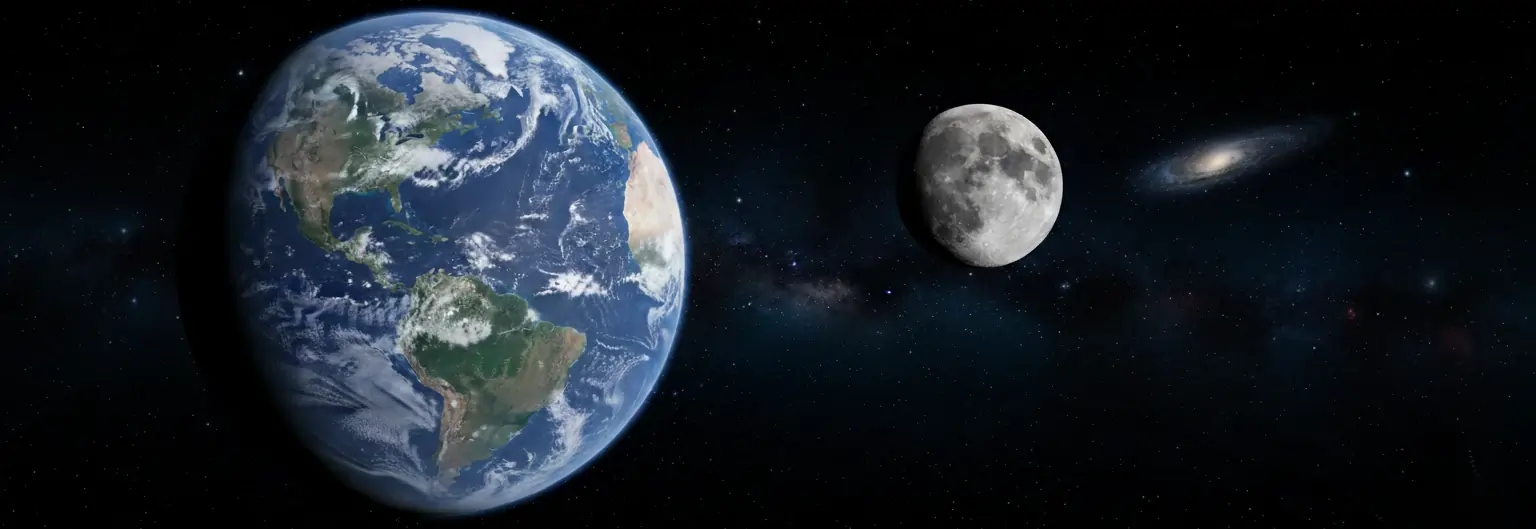
How big is the Moon compared to Earth?
It looks massive in our sky. It has shaped the tides, the calendar, and perhaps life itself. But the Moon is far smaller — and far further away — than almost anyone imagines.
When you look up at the Moon, it fills your field of view with authority. It seems enormous — a world unto itself, commanding the night sky. And yet the Moon is, by the standards of the solar system, a surprisingly modest object: a rocky sphere just over a quarter the width of Earth, containing barely 1.2% of Earth's mass and roughly 2% of Earth's volume.
That gulf between apparent size and actual size is one of the most instructive illusions in astronomy. Understanding it changes how you see the night sky — and how you understand our place in the solar system.
Size comparison: the true scale
The Moon has a mean diameter of 3,474 km (2,159 miles). Earth's diameter is 12,742 km (7,918 miles). That makes the Moon about 27.3% as wide as Earth — just over a quarter.
True scale comparison — circles drawn proportionally
Circles are drawn to true scale
27.3% of Earth's diameter
NASA's own memorable comparison: if Earth were the size of a nickel, the Moon would be about as big as a coffee bean. It is a small companion — but as we will see, a uniquely consequential one.
Another way to frame it: Earth is about four times wider than the Moon. The Moon is proportionally larger relative to its host planet than any other major moon in the solar system — a fact with profound consequences for Earth's geology, climate, and the evolution of life.
Key numbers at a glance
| Measurement | Earth | Moon | Ratio (Earth : Moon) |
|---|---|---|---|
| Mean diameter | 12,742 km | 3,474 km | 3.67 : 1 |
| Equatorial radius | 6,371 km | 1,737 km | 3.67 : 1 |
| Surface area | 510,072,000 km² | 37,932,000 km² | 13.4 : 1 |
| Volume | 1.083 × 10¹² km³ | 2.196 × 10¹⁰ km³ | 49.3 : 1 |
| Mass | 5.972 × 10²⁴ kg | 7.342 × 10²² kg | 81.3 : 1 |
| Mean density | 5.51 g/cm³ | 3.34 g/cm³ | 1.65 : 1 |
| Surface gravity | 9.81 m/s² | 1.62 m/s² | 6.05 : 1 |
| Escape velocity | 11.2 km/s | 2.38 km/s | 4.7 : 1 |
Surface area in context
- The Moon's total surface area is about 37.9 million km² — slightly less than the continent of Asia (44.5 million km²).
- You could fit Europe, the United States, China, Brazil, and South Africa combined onto the Moon's surface — but very little else.
- The Moon is also narrower in diameter than the continental United States measured east to west (about 4,500 km).
The distance reality check
Size comparisons only tell part of the story. The distance between Earth and Moon is almost as disorienting as the size difference itself. On average, the Moon is 384,400 km away — a gap so vast that all seven other planets in the solar system fit within it, with room to spare.
Distance to scale — the Moon is far off the right edge of your screen
On a true-scale diagram at this page width, the Moon would sit roughly 30 metres to the right.
The distance varies because the Moon's orbit is elliptical, not circular. At its closest point (perigee) it is about 356,500 km away — producing a "supermoon," which appears roughly 14% larger and about 30% brighter than at its furthest. At apogee (farthest) it recedes to around 406,700 km.
The drifting Moon
Tidal friction transfers angular momentum from Earth's rotation to the Moon's orbit, pushing it outward at roughly 3.8 cm per year — approximately the rate fingernails grow. When the Moon first formed it was far closer, the tides were far stronger, and a day on Earth lasted only about six hours. By the age of the dinosaurs, a day had lengthened to roughly 23 hours.
Everyday analogies that make it click
Abstract numbers are hard to internalise. These physical analogies translate the Moon–Earth relationship into something more tangible:
Surface area & volume in context
Diameter ratios can be deceptive, because volume scales with the cube of radius. The Moon is 27.3% as wide as Earth, but that means it contains only about 2% of Earth's volume — or, put another way, you would need nearly 49 Moons to fill Earth's interior.
How many Moons fit inside Earth?
The Moon looks large in our sky — but that's because it's relatively close. In reality it contains just 2% of Earth's volume. You could fit all of Earth's oceans inside the Moon with room to spare — but you would need 49 Moons to fill Earth back up.
Mass is even more lopsided. Because Earth is considerably denser than the Moon (5.51 g/cm³ versus 3.34 g/cm³), it takes 81 Moons to match Earth's mass. A person weighing 80 kg on Earth would weigh just over 13 kg on the Moon — which is why Apollo astronauts could bound across the surface so dramatically despite wearing heavy, cumbersome suits.
"Earth weighs 81 times more than the Moon. In terms of volume, you could fill Earth with 49 Moons and still have room for a little more." — Data derived from NASA planetary fact sheets
The eclipse coincidence
One of the most remarkable consequences of the Moon's size is what it enables: total solar eclipses. The Sun is approximately 401 times larger in diameter than the Moon, but it is also approximately 389 times further away. These two ratios are so nearly equal that both objects appear almost identically sized in our sky — roughly half a degree across.
The numbers behind the coincidence
Sun's diameter: 1,392,000 km. Moon's diameter: 3,474 km. Size ratio: ~401:1. Sun's average distance from Earth: 149,600,000 km. Moon's average distance: 384,400 km. Distance ratio: ~389:1. Because these two ratios are so close, the Moon can almost exactly cover the Sun's disc — making total solar eclipses possible. This coincidence is also a fleeting one: as the Moon drifts away at 3.8 cm per year, in several hundred million years it will be too distant to fully cover the Sun, and total solar eclipses will cease to occur.
No other planet in the known solar system has a moon that so precisely covers its host star from the planet's surface. The fact that we exist during the brief window of geological time when this coincidence holds is, to many astronomers, one of the more poignant facts about our cosmic moment.
How the Moon formed: the giant impact hypothesis
The Moon did not form quietly alongside Earth. The leading scientific explanation — the giant impact hypothesis — holds that approximately 4.5 billion years ago, a Mars-sized protoplanet named Theia struck the young Earth at an oblique angle. The collision vaporised vast quantities of both bodies, ejecting an enormous disc of molten rock and gas into Earth's orbit. The Moon coalesced from that debris.
The evidence is strong. Apollo samples show the Moon's isotopic composition is nearly identical to Earth's mantle — exactly what you would expect if both bodies share a common origin from the same catastrophic collision. The Moon is also notably depleted in volatile compounds such as water and sodium, consistent with the extreme heat of such an impact vaporising them away.
Why the Moon's size matters for life on Earth
The Moon is not merely a passive ornament. Its particular size — disproportionately large relative to Earth by any solar system standard — makes it an active shaper of conditions on our planet. Scientists consider it one of the key reasons Earth became, and remains, habitable.
1. Stabilising Earth's axial tilt
Earth's axis is currently tilted at about 23.5° from vertical, which gives us our seasons. Without the Moon's gravitational stabilisation, computer models suggest that tilt could wobble chaotically over geological time, potentially swinging anywhere between near-zero and 85°. Mars, which has no large moon, has historically seen its axial tilt vary dramatically over millions of years — with severe consequences for climate. Earth's relatively stable tilt is, in significant part, maintained by the Moon acting as a gravitational counterweight on Earth's equatorial bulge.
2. Driving the tides
The Moon's gravity generates the tidal cycles that have shaped Earth's coastlines, ocean chemistry, and ecosystems for billions of years. Tidal pools — alternately flooded and exposed — may have been the environment in which the first complex organic molecules assembled. Today, tidal forces mix ocean nutrients, oxygenate coastal waters, and sustain entire intertidal ecosystems. Without significant lunar tides, Earth's oceans would be far more stagnant and biologically impoverished.
3. Slowing Earth's rotation
Tidal friction between Earth and Moon has gradually lengthened our day from roughly six hours (early Earth) to the 24 hours we have today. This slower rotation means gentler temperature gradients between day and night, contributing to a more stable climate suitable for complex life.
4. Shielding Earth from some impacts
Some planetary scientists propose that the Moon's gravity deflects a fraction of asteroids and comets that might otherwise reach Earth. The extent of this effect is debated, but the Moon's heavily cratered surface records the violence of the early solar system — a visual testament to bombardments that helped shape the inner planets.
The bigger picture
The giant impact that formed the Moon also gave Earth much of its iron core, its current rotation rate, and its axial tilt. It stripped away Earth's primordial atmosphere, and may have delivered volatiles from Theia that became part of our oceans. Without that collision 4.5 billion years ago, Earth today would be a profoundly different — and very likely uninhabitable — world.
Frequently asked questions
Quick reference
- How big is the Moon compared to Earth? The Moon is 27.3% of Earth's diameter, about 2% of its volume, and 1.2% of its mass.
- How many Moons fit inside Earth? Approximately 49.3 by volume.
- What is the Moon's diameter? 3,474 km (2,159 miles). Earth's is 12,742 km (7,918 miles).
- How far away is the Moon? On average, 384,400 km (238,855 miles) — ranging from about 356,500 km (perigee/supermoon) to 406,700 km (apogee).
- Is the Moon bigger than any planet? No. The Moon is smaller than all eight planets, though it is larger than the dwarf planet Pluto.
- Is the Moon the largest moon in the solar system? No — it is the fifth largest. Ganymede (Jupiter) and Titan (Saturn) are both bigger than the Moon, and larger than Mercury.
- Why does the Moon look so large? Primarily because it is close. Near the horizon, the brain compares it to nearby objects and perceives it as bigger — this is the "Moon illusion," and it is entirely psychological.
- What is the Moon's surface gravity? 1.62 m/s², about 16.6% of Earth's. A person weighing 80 kg on Earth weighs about 13.3 kg on the Moon.
- Why is the Moon moving away from Earth? Tidal friction transfers angular momentum from Earth's rotation to the Moon's orbit, pushing it outward at ~3.8 cm per year.
- How was the Moon formed? The leading theory — the giant impact hypothesis — holds that a Mars-sized body named Theia struck the young Earth ~4.5 billion years ago, and the Moon formed from the ejected debris.
- What is tonight's moon phase? Check the current phase at moonphase.today →
Primary source