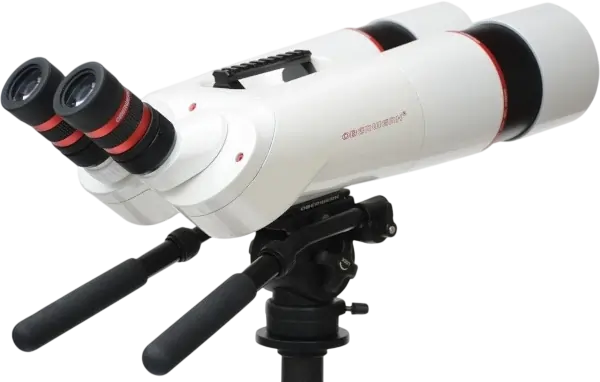
Best Binoculars for Moon Watching

Best Binoculars for Moon Watching

Choosing the best binoculars for moon watching is one of the most rewarding decisions a new astronomer can make — and one of the most confusing. The market is flooded with specs, jargon, and forum arguments that point in every direction. This guide cuts through all of it. Every recommendation here is drawn from thousands of posts across Cloudy Nights, Stargazers Lounge, and real observers reporting what they actually see through real glass on real nights.

You don't need to spend a fortune. A quality 10×50 under $150 will show you craters you didn't know existed, mountain ranges casting long shadows at the terminator, and the classic three-dimensional pop of the lunar surface that no photograph captures. This guide covers every tier from handheld starters to binocular telescopes — so wherever you are, there's a clear next step.

best-binoculars-for-moon-watching

Best binoculars for moon viewing grouped by tier

Entry-level · handheld · under $150–200
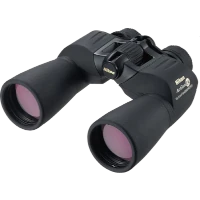
Nikon Action Extreme 7×50 / 10×50

Starter

The most consistently recommended entry-level pick across Cloudy Nights, Reddit, and Stargazers Lounge. The 7×50 delivers a generous 7mm exit pupil making it forgiving to hold and very comfortable for extended lunar sessions. The 10×50 steps up magnification while staying fully handheld. Both show major craters, mountain ranges, and the classic 3D pop along the terminator with minimal chromatic aberration for the price.
Magnification
7× or 10×
Aperture
50mm
Glass type
Standard porro
Exit pupil (7×)
7mm
Mount needed
No
Best for
Casual gazing
Low CA Large exit pupil Handheld steady 3D lunar pop Jupiter's moons too Limited fine crater detail
What forum users say
"Very sharp, not much chromatic aberration — I was blown away by the Moon on the first night." Many users say this is the one they still reach for even after upgrading to larger glass.

Svbony SV202 10×50 ED

Starter

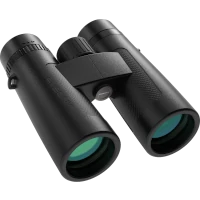
The go-to budget ED glass recommendation on r/Binoculars. As a roof-prism design it's more compact than a porro but still brings ED glass to a price point most beginners can justify. The improved contrast on the terminator over non-ED glass is genuinely noticeable — shadows inside craters look deeper and crisper than you'd expect at this price.
Magnification
10×
Aperture
50mm
Glass type
ED roof-prism
Exit pupil
5mm
Mount needed
No
Best for
Budget ED upgrade
ED glass Compact roof-prism Strong contrast Very affordable Less 3D feel than porro
What forum users say
"Surprised at how good the terminator looks through these for the price. The ED glass makes a real difference over the basic SkyMasters."

Oberwerk 10×50 porro

Starter

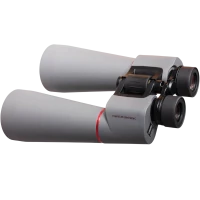
Oberwerk's entry porro is a favourite on Cloudy Nights for those wanting the classic wide, 3D-like binocular astronomy experience without spending big. Porro prisms naturally produce a more immersive depth effect on the lunar surface than roof-prism designs. Recommended specifically for non-glasses wearers who can take full advantage of the eyepiece design.

Magnification
10×
Aperture
50mm
Glass type
Porro
Exit pupil
5mm
Mount needed
No
Best for
3D lunar views
3D lunar terrain effect Clear terminator detail Handheld Not ideal for glasses wearers
What forum users say
"The porro gives it that classic binocular astronomy feel — the Moon looks almost three-dimensional." Praised as a strong step up from generic department-store binoculars.

Mid-range · crater & rille detail · tripod recommended above 12×
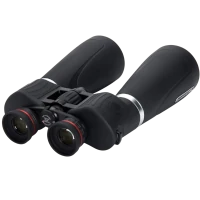
Celestron SkyMaster 15×70

Step up

The most recommended "first tripod binocular" for lunar observing. The jump from 10× to 15× with 70mm aperture is immediately visible — crater floors, shadowed walls, and mountain peaks all become noticeably sharper. Shows up in nearly every Stargazers Lounge thread where someone asks about budget lunar upgrades.
Magnification
15×
Aperture
70mm
Glass type
Standard porro
Exit pupil
4.7mm
Mount needed
Yes — tripod
Best for
Budget crater detail
Great value Visible detail jump Shadowed crater floors Needs tripod Some edge softness
What forum users say
"For the price it's hard to argue with. Put it on a cheap fluid head tripod and the Moon looks incredible — you'll see detail you didn't know was there." — Stargazers Lounge

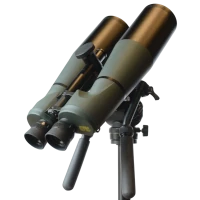
Oberwerk 20×65 ED / 20×70 ED

Sweet spot

The model that comes up again and again on Cloudy Nights as the optimal balance of magnification, aperture, and portability for dedicated lunar observers. ED glass eliminates chromatic aberration entirely — the purple fringing that plagues cheaper optics on the bright lunar limb is completely gone. Rilles, Pico peaks, and shadowed craterlets become genuinely resolvable. Most users pair it with a parallelogram mount for comfortable long sessions.
Magnification
20×
Aperture
65–70mm
Glass type
ED porro
Exit pupil
3.3mm
Mount needed
Yes — parallelogram
Best for
Dedicated lunar obs.
Zero CA Rille detail Pico peaks visible Neutral colour rendering Needs solid mount Seeing-dependent
What forum users say
"Complete lack of CA, neutral and comfortable. This is the sweet spot — more power would just show you more turbulence most nights." Repeatedly voted best value for dedicated lunar use on Cloudy Nights.

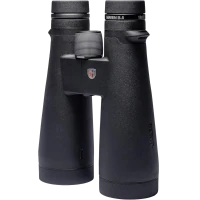
Maven B5 15×56

Step up

Maven's fluorite glass is what sets this apart. Fluorite corrects chromatic aberration more thoroughly than standard ED glass — zero colour fringing on the bright lunar limb, exceptional microcontrast on crater rims, and a noticeably blacker sky background. Slightly smaller than most 15×70s, making it easier to handle on lighter mounts.
Magnification
15×
Aperture
56mm
Glass type
Fluorite
Exit pupil
3.7mm
Mount needed
Recommended
Best for
Premium contrast
Fluorite glass Zero CA Black sky contrast Compact for aperture
What forum users say
"Exceptional contrast and without an iota of CA on the Moon. The sky background looks blacker than anything I've used at this magnification." — Cloudy Nights
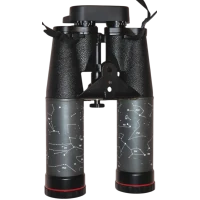
Takahashi Astronomer 22x60

Takahashi Astronomer 22×60

Step up

Takahashi's reputation for optical quality extends to their binoculars. The 22×60 sits in an interesting niche — higher power than most mid-range options but with a compact 60mm aperture keeping weight manageable. Forum users praise the extra resolution particularly for fine crater wall detail and smaller secondary craters. Called the "best trade-off between effort and reward" for observers who want more than 15× without going full giant.

Magnification
22×
Aperture
60mm
Glass type
High-quality porro
Exit pupil
2.7mm
Mount needed
Yes — tripod
Best for
Fine crater resolution
Extra resolution Manageable weight Fine crater walls Takahashi optics quality Needs steady mount
What forum users say
"Best trade-off between effort and reward. That extra power over 15× makes a noticeable difference on the terminator without needing a heavy-duty setup."

High-end · serious lunar observers · sturdy mount essential
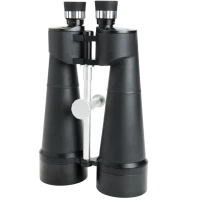
Celestron 20×80 / 25×100

Giant

Entry point into giant binoculars — too heavy to handheld at all, but on a sturdy tripod they reveal lunar detail that genuinely surprises observers who've only used smaller glass. The 25×100 gathers enough light and magnification that secondary crater chains, wrinkle ridges, and isolated mountain peaks all become clearly visible. A real and unmistakable step up from anything in the mid-range tier.
Magnification
20× or 25×
Aperture
80–100mm
Glass type
Standard porro
Exit pupil
4mm
Mount needed
Heavy-duty tripod
Best for
Max detail on budget
Wrinkle ridges visible Mountain peak detail Secondary crater chains Heavy — not portable Needs heavy-duty tripod
What forum users say
"More detail than I have ever seen through a binocular. You need a good tripod or it's useless, but once it's steady the Moon looks incredible." — Cloudy Nights
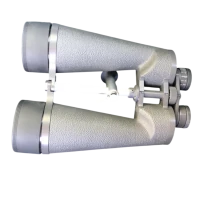
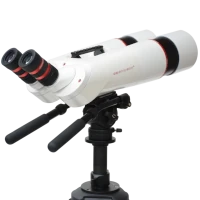
Orion MegaView 30x80

Orion MegaView 30×80

Giant

At 30× the atmosphere itself becomes the limiting factor — on nights with poor seeing you'll know about it. But on steady nights this resolves craterlets and fine surface texture that smaller binoculars simply cannot reach. Not for casual use — this is for observers who've worked through the lower tiers and want to push the absolute limits of what binoculars can show on the Moon.
Magnification
30×
Aperture
80mm
Glass type
Standard porro
Exit pupil
2.7mm
Mount needed
Heavy-duty tripod
Best for
Max binocular resolution
Craterlet resolution Fine surface texture Atmosphere-limited Very heavy Not for beginners
What forum users say
"On a good night of seeing this is jaw-dropping. On a bad night it's a blurry mess. At 30× you're completely at the mercy of the atmosphere."

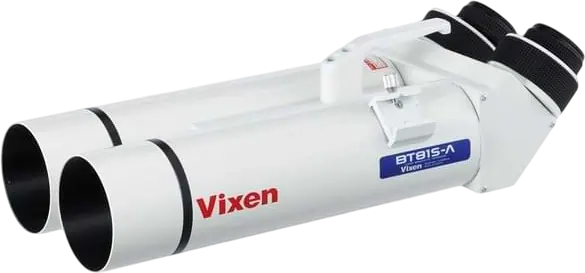
Oberwerk BT-82XL-ED / APM 100mm ED

Best available

Binocular telescopes represent the absolute pinnacle of binocular lunar observing. These are not traditional binoculars — they're two small refractors mounted together with interchangeable eyepieces allowing 50–80×+ magnification with full binocular vision. ED and fluorite glass delivers zero CA at any power. Forum users consistently describe the experience as better than a single-eye telescope of equivalent aperture — the brain processes binocular input differently, and the Moon appears to float in three-dimensional space.
Magnification
50–80×+
Aperture
82–100mm
Glass type
ED / Fluorite
Eyepieces
Interchangeable
Mount needed
Parallelogram essential
Best for
Ultimate lunar experience
Telescope-level detail Zero CA at any power Binocular depth effect Interchangeable eyepieces Moon appears to float Expensive Parallelogram mount required
What forum users say
"Telescope-like but with two eyes. The Moon appears to float in 3D space — no single-eye telescope gives you that. If you can afford it and you love the Moon, there's nothing better in binocular form." — Cloudy Nights
star-gazing-binoculars

Complete buyer's guide to binoculars for moon viewing with accurate interactive FOV calculator

The basics — what those numbers actually mean

Every binocular listing throws specs at you. Here's what actually matters for the Moon, and what you can safely ignore.

Magnification (the first number)
10×

Makes the Moon appear 10× closer. Sounds like more is always better — it isn't. Above 12×, hand tremor ruins the view. Above 20×, the atmosphere itself starts to blur things on all but the steadiest nights.

Sweet spot handheld: 7×–10×. On a mount: 15×–25×.
Aperture (the second number)
50mm

The diameter of the front lenses. More aperture = more light and finer detail. For the Moon — which is very bright — even 40mm is plenty. Aperture matters more for faint deep-sky objects than for lunar work.

For the Moon, aperture above 50mm is about detail, not brightness.
Exit pupil
5mm

Aperture ÷ magnification. The width of the light beam entering your eye. A young dark-adapted eye opens to ~7mm; this shrinks with age — most people over 50 are closer to 5–6mm. An exit pupil larger than your pupil wastes aperture.

Ideal for lunar viewing: 2–5mm. Check your own age — 7mm matters less for older observers.
Chromatic aberration
CA

The purple or colour fringing you see on the bright lunar limb with cheaper glass. ED (extra-low dispersion) or fluorite glass nearly eliminates this. On the Moon it's very obvious because the contrast is so high.

ED glass is a significant and visible upgrade specifically for lunar viewing.
Porro vs roof prism
Type

Porro prisms (the classic wide W-shape body) naturally produce a 3D-like depth effect on the lunar surface. Roof prisms are more compact but require expensive phase coatings to match porro contrast.

Porro gives more visual "pop" per dollar for lunar observing.
True field of view
FOV

How wide a patch of sky you see, in degrees. The Moon averages 0.52° wide. A 7×50 typically shows about 7°, so the Moon is a small disc. A 20×65 shows about 3° — the Moon fills more of the view.

True FOV is printed on most binoculars. It's the number that matters for astronomy.

The rules that actually matter — from forum veterans

01
Stability beats magnification every time

A rock-steady 10× view beats a shaky 20× view on every single night. Handheld is fine up to 10×. Above that, lean against a wall, use a railing, lie back in a recliner, or get a tripod. A parallelogram mount lets you track the Moon comfortably without straining your neck.

02
Observe the terminator, not the full Moon

The terminator is the boundary between lunar day and night — where shadows are longest and crater walls, mountain ranges, and rilles stand out in dramatic relief. The full Moon is actually the worst phase for detail because the light is flat and shadowless.

03
The atmosphere is often the real limiting factor

Astronomical "seeing" — the steadiness of the atmosphere — limits how much magnification is useful on any given night. On poor nights, even the best 20× binoculars look blurry. On excellent nights, a modest 10× shows breathtaking crater detail.

04
Start cheaper than you think you need to

Almost every serious lunar observer says the same: they started with a basic 10×50, got hooked, then upgraded with full knowledge of what they actually wanted. Jumping straight to expensive glass before knowing your preferences is a common and avoidable mistake.

05
Let your eyes adapt — then assess

Your eyes take 20–30 minutes to fully dark-adapt. The first 5 minutes through binoculars always look worse than they eventually will. Also allow optics to reach ambient temperature before observing — temperature-induced tube currents blur the image just like bad seeing.


Which phase is best for binocular observing?

Crescent
★★★★★

Long terminator shadows reveal dramatic crater walls and mountain ranges. The jewel of binocular lunar observing.

First / last quarter
★★★★

Half the Moon in deep shadow. The terminator runs through the middle — excellent for systematic exploration.

Gibbous
★★★★★

Most of the Moon lit. Still good near the terminator edge, but less dramatic contrast than crescent phases.

Full Moon
★★★★

Flat, shadowless light washes out crater depth entirely. Ray systems from young craters are visible, but it's the weakest phase for detail work.


Who is this for? Matching binoculars to experience level

Novice
You've never looked through astronomy binoculars
A 7×50 or 10×50 — Nikon Action Extreme, Svbony SV202 ED, or Oberwerk 10×50 — will genuinely amaze you. You'll see craters you didn't know existed, mountain shadows, and the terminator in a way that's impossible with the naked eye. These are handheld, require no setup, and cost under $150. Start here.
Keen
You've used binoculars and want to go deeper
This is where the 15×70 or 20×65 ED tier lives. You'll need a tripod or parallelogram mount — budget $50–100 for a decent fluid head. The jump to 15×–20× with good ED glass is dramatic: individual rilles become visible, small craterlets appear on the floors of larger ones. The Oberwerk 20×65 ED is where most forum users end up and stay for years.
Expert
You know what you're looking for and want the best
Giant binoculars (25×100, 30×80) and binocular telescopes (BT-82XL-ED, APM 100mm) are for observers who've exhausted the mid-range. Expect $800–$3000+ and a serious mount. On a steady night, the Moon through a binocular telescope is one of the finest astronomical experiences available.

Field of view calculator

Enter your binoculars' magnification, aperture, and apparent FOV (the eyepiece spec — typically 50°–70°, check the box or manual). True FOV is derived automatically. Change any value and the Moon simulation updates instantly.

e.g. 10 for 10×50
e.g. 50 for 10×50
Eyepiece spec. Usually 50°–70°
If printed on box, enter here
Calculated true FOV: 6.5°  ·  Exit pupil: 5.0 mm

Moon fills 8% of field diameter

6.5°True FOV
5.0mmExit pupil
8%Moon fill
65°Apparent FOV
Enter your values — results update live.

Frequently asked questions

What magnification is best for viewing the Moon with binoculars?
For handheld use, 7× to 10× is the sweet spot — enough to see craters and mountain ranges clearly without hand tremor ruining the view. On a tripod or mount, 15× to 25× reveals far more detail including rilles, craterlets, and shadow-filled crater walls. Going above 25× is only worthwhile on nights with excellent atmospheric seeing.
Is a full Moon the best time to use binoculars?
No — the full Moon is actually the worst phase for detail. The light hits the surface straight-on, washing out all shadows and making craters nearly invisible. The best phases are the crescent and quarter Moon, when the terminator (the day-night boundary) creates long dramatic shadows that reveal crater walls, mountain ranges, and valleys in stunning relief.
Do I need a tripod for binocular Moon viewing?
Up to 10× magnification, most people can hold binoculars steady enough for a satisfying view. At 12× and above, hand tremor becomes a serious problem and a tripod is strongly recommended. At 15× and beyond, a tripod is essential — a parallelogram mount is ideal because it lets you follow the Moon comfortably as it moves across the sky without straining your neck.
What does ED glass mean, and is it worth it for Moon viewing?
ED stands for Extra-low Dispersion. It refers to the type of glass used in the lenses, which dramatically reduces chromatic aberration — the purple or coloured fringing you see around the bright edge of the Moon with cheaper binoculars. For lunar viewing specifically, ED glass is a very visible and worthwhile upgrade because the Moon's high contrast makes colour fringing especially obvious. Fluorite glass corrects it even more thoroughly than standard ED.
What is the exit pupil and why does it matter?
Exit pupil is the diameter of the beam of light that exits the eyepiece and enters your eye — calculated by dividing aperture by magnification. A 10×50 binocular has a 5mm exit pupil. Young eyes in the dark can open to around 7mm; most people over 50 are closer to 5–6mm. For Moon viewing, a 2–5mm exit pupil is ideal. A very large exit pupil wastes aperture, while a very small one can make dim objects hard to see (though the Moon is bright enough that this matters less for lunar work).
What is the terminator and why should I observe it?
The terminator is the boundary line between the sunlit and shadowed parts of the Moon. Because the Sun is at a low angle along this line, it casts long shadows that bring mountains, crater walls, and valleys into dramatic three-dimensional relief. Observing along the terminator — especially during crescent and quarter phases — produces the most detailed and visually striking views possible through binoculars.
Can I see anything other than the Moon with astronomy binoculars?
Yes — binoculars are excellent general astronomy tools. A 10×50 or larger will show Jupiter and its four Galilean moons as tiny dots in a line, the Pleiades and other star clusters, the Andromeda Galaxy as a faint smudge, and hundreds of double stars. Many experienced observers prefer binoculars over telescopes for wide-field deep-sky objects like large nebulae and open clusters.
What is the difference between porro and roof prism binoculars for astronomy?
Porro prism binoculars have the classic wide W-shaped body where the eyepieces are offset inward from the objective lenses. They naturally produce a slightly three-dimensional depth effect on the lunar surface and deliver excellent contrast per dollar. Roof prism binoculars are more compact and straight-barrelled, but require expensive phase coatings to match porro contrast. For astronomy on a budget, porro prisms are generally the better choice.
What does "seeing" mean in astronomy, and how does it affect binocular viewing?
Seeing refers to the steadiness of the atmosphere above you. Turbulent air causes stars to twinkle and blurs fine detail through any optical instrument. On nights with poor seeing, even the finest binoculars at high magnification will produce a shimmering, blurry image. On nights with excellent seeing — often signalled by steady, non-twinkling stars — the same binoculars can reveal extraordinary detail. Seeing is often the real limiting factor, not the binoculars themselves.
How much should I spend on binoculars for Moon viewing?
You can have a genuinely impressive lunar experience for under $150 with a quality 10×50 like the Nikon Action Extreme or Svbony SV202 ED. Most experienced observers recommend starting there, getting familiar with what you enjoy, then upgrading purposefully. The mid-range sweet spot — around $400–700 for something like the Oberwerk 20×65 ED on a parallelogram mount — is where many dedicated lunar observers settle permanently. Giant binoculars and binocular telescopes above $1,000 are for serious enthusiasts who have outgrown the mid-range.