

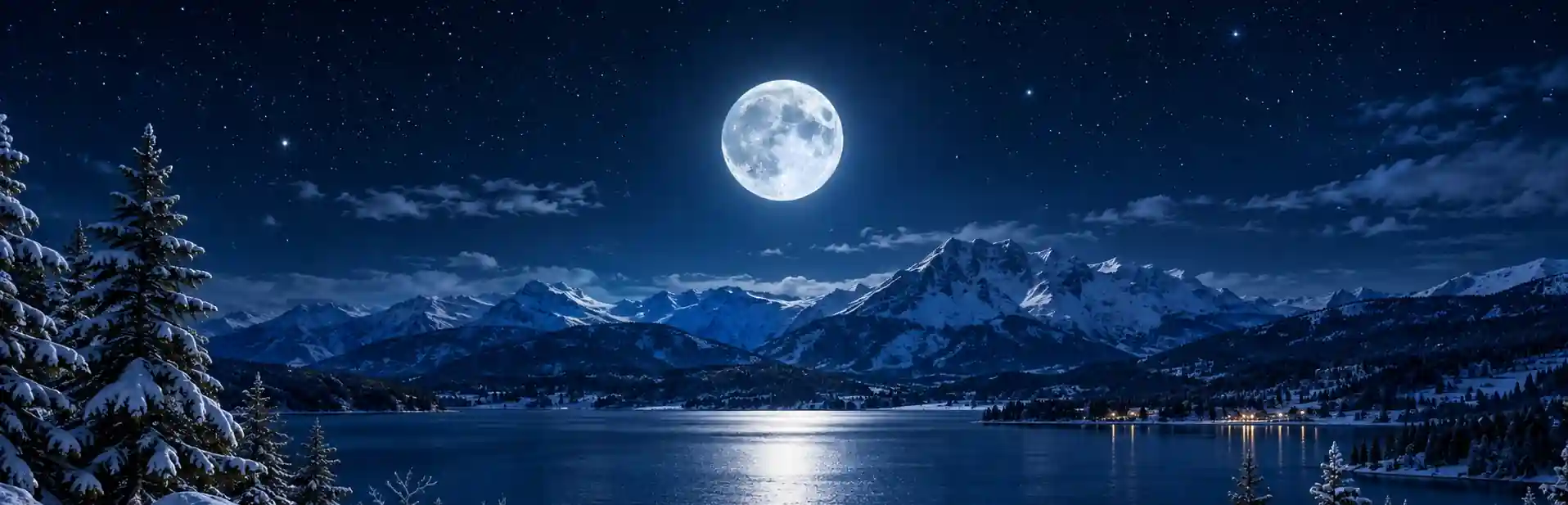
2026 Cold Moon at a Glance
| Peak full Moon | Wednesday, December 23, 8:28 p.m. EST (December 24 at 01:28 UTC) |
| Supermoon? | Yes. The Cold Supermoon is the closest full Moon of 2026, per the Old Farmer’s Almanac |
| Season | Falls after the Dec. 21 solstice, so it is the first full Moon of winter |
| Best viewing | Moonrise on the evenings of Dec. 22, 23 and 24. It looks essentially full on all three, including Christmas Eve |
Cold Moon: Quick Facts
The Cold Moon is the traditional name most commonly used today for December’s full Moon. Like all full-Moon names, it was never formally standardized: some sources apply “Cold Moon” or “Long Nights Moon” slightly differently, and in some years December holds two full Moons.
| What it is | The traditional name for December’s full Moon |
| When it happens | Every December, with the exact date shifting from year to year |
| Also called | Long Night Moon (Mohican), Moon Before Yule (European), Oak Moon (European tradition), Frost Exploding Trees Moon (Cree), as attributed by the Old Farmer’s Almanac; attributions vary by source |
| Position in the sky | Opposite the Sun, so the backdrop constellation varies from year to year |
| Signature trait | Rides high in the Northern Hemisphere sky and stays up for most of the long winter night |
| Supermoon? | Depends on the year. It counts only if the full Moon falls near perigee, the closest point in the Moon’s elliptical orbit around Earth. The 2026 Cold Moon is a supermoon |
| First full Moon of winter? | Usually, but not always. When December’s full Moon lands before the solstice (around Dec. 21), as in 2027, it is technically still an autumn Moon |
What Is the Cold Moon?
The name is a plain seasonal label: by December, the cold has truly set in across much of the Northern Hemisphere. The Old Farmer’s Almanac lists Cold Moon as a Mohawk name, though Moon-name traditions varied considerably among Indigenous nations and sources don’t always agree.
When Is the Cold Moon?
The lunar cycle averages about 29.5 days, so the date drifts each year even though the month stays the same.
- 2026Wednesday, December 23, 8:28 p.m. EST (December 24 at 01:28 UTC), a supermoon
- 2027Monday, December 13, around 16:10 UTC (before the solstice, so technically an autumn Moon)
- 2028Saturday, December 2, followed by a second full Moon on Dec. 31
- 2029Thursday, December 20, around 22:46 UTC (the date can differ by time zone)
- 2030Monday, December 9, around 22:40 UTC (near apogee, with a subtle penumbral lunar eclipse)
Dates are in UTC unless noted; the local date can differ by time zone.
Check moonphase.today’s daily Moon phase calendar for the precise moment in your location.
Notable Cold Moons
Most Cold Moons pass quietly, but December’s full Moon has a few standout moments, many tied to its closeness to the winter solstice.
| Year | Event | Why it stands out |
|---|---|---|
| 2010 | Total lunar eclipse on the solstice | On Dec. 21, a total lunar eclipse coincided with the winter solstice, the first time in roughly 372 years |
| 2015 | Christmas Day full Moon | A full Moon on Dec. 25 was the first since 1977, and the next is due in 2034 |
| 2026 | Cold Supermoon before Christmas | Peak fullness comes the evening of Dec. 23 in North America, and the Moon still looks essentially full on Christmas Eve. It is the closest full Moon of 2026 |
| 2028 | Two full Moons in December | Dec. 2 and Dec. 31, with the second counting as a blue Moon |
Names & Folklore of the Cold Moon
Many traditions named this stretch of the calendar for the long dark and the cold. These are seasonal labels, not physical differences in the Moon. Modern lists mix Indigenous, colonial, Anglo-Saxon and neopagan sources, and the attributions here follow the Old Farmer’s Almanac.
🌕 Long Night Moon
Mohican, per the Old Farmer’s AlmanacNamed for the year’s longest nights, since this Moon rises close to the winter solstice and spends more time in the sky than any other full Moon.
🌕 Moon Before Yule
Anglo-Saxon / European TraditionA traditional European name, often described as Anglo-Saxon, for the full Moon leading into the midwinter feast of Yule. It was not part of one documented naming system.
🌕 Oak Moon
European Folk TraditionLinked to the oak and often connected to the Yule log. This is a folkloric attribution, and the evidence for ancient Druid use of such names is uneven.
🌕 Frost Moon & Frost Exploding Trees Moon
Colonial & CreeFrost Moon is also used for November in some sources. The Old Farmer’s Almanac gives the Cree name as “Frost Exploding Trees Moon,” a reference to trees cracking in extreme cold.
Science & The Cold Moon
A High, Long-Lasting Moon
A full Moon sits opposite the Sun. In December the Sun is low in the Northern Hemisphere sky, so the full Moon rides high, much as the summer Sun does in June. That means a longer path across the sky and, for Northern Hemisphere observers, more hours above the horizon, an effect that grows stronger at higher latitudes.
First of Winter, Most Years
The winter solstice falls around December 21. When the Cold Moon comes after it, it is winter’s first full Moon. When it comes before, as in 2027, it is still technically an autumn Moon.
Sometimes a Supermoon
The Cold Moon is a supermoon only when it happens to fall near perigee. The two labels are independent. The 2026 Cold Moon is a supermoon, and the closest full Moon of the year.
Viewing the Cold Moon
- Bundle UpDecember nights are cold. Dress for the temperature, and bring a hot drink if you plan to stay out.
- Use the SnowSnow reflects a lot of moonlight and can noticeably brighten the landscape.
- Watch It ClimbBecause it rises early and stays high, the Cold Moon is easy to catch even after a long winter evening.
- No Equipment RequiredThe naked eye is enough. Full Moon is a poor time to see crater shadows. For relief through binoculars, look near first or last quarter, along the terminator.
A Year of Moons: Names & Meanings
These are traditional, popular names rather than official astronomical designations. December’s Cold Moon is highlighted below.

🌕 Wolf Moon (January)
Echoes of wolf packs calling through the frozen wilds.

🌕 Snow Moon (February)
Named for the heavy snowfall typical of the month.

🌕 Worm Moon (March)
The soil stirs as the ground thaws after winter.

🌕 Pink Moon (April)
Named for the pink spread of early spring phlox.

🌕 Flower Moon (May)
A riot of blossoms at the peak of spring.

🌕 Strawberry Moon (June)
Tied to the ripening of wild strawberries.

🌕 Buck Moon (July)
Named for bucks growing new antlers.

🌕 Sturgeon Moon (August)
Named for the giant lake sturgeon of the Great Lakes.

🌕 Corn Moon (September)
The ripening corn harvest, and often the Harvest Moon.

🌕 Hunter’s Moon (October)
Game revealed in cleared fields under crisp skies.

🌕 Beaver Moon (November)
Beavers fortify their dams before the ice sets in.

🌕 Cold Moon (December), You Are Here
Named for the arrival of deep cold and the year’s longest nights. Usually the first full Moon of winter, though in some years it still falls before the solstice.
Frequently Asked Questions
What is the Cold Moon?
The Cold Moon is the traditional name most commonly used for December’s full Moon, named for the arrival of deep cold across the Northern Hemisphere.
When is the Cold Moon?
It falls once a year in December. In 2026 it peaks on Wednesday, Dec. 23 at 8:28 p.m. EST (Dec. 24 at 01:28 UTC), and in 2027 on Dec. 13. Check a current Moon phase calendar for the exact time in your area.
Why is it called the Cold Moon?
The name reflects the season. December brings the first hard cold of winter in much of the Northern Hemisphere, and the full Moon of that month took the label.
What other names does December’s full Moon have?
Alternatives include the Long Night Moon (Mohican), Moon Before Yule (European), Oak Moon (European tradition) and the Cree Frost Exploding Trees Moon, as attributed by the Old Farmer’s Almanac. Sources vary.
Is the Cold Moon a supermoon?
It depends on the year, because the two labels are independent. It counts only when the full Moon falls close enough to perigee, the closest point in its orbit around Earth. The 2026 Cold Moon is a supermoon, and the closest full Moon of the year.
Why does the Cold Moon ride so high in the sky?
A full Moon sits opposite the Sun. In winter the Sun is low in the Northern Hemisphere sky, so the full Moon is high, which gives it a long path and, in the Northern Hemisphere, more hours above the horizon, especially at higher latitudes.
Is the Cold Moon the first full Moon of winter?
Usually, but not always. When December’s full Moon falls before the solstice, as in 2027, it is technically still an autumn Moon, and January’s Wolf Moon becomes winter’s first.
Can December have two full Moons?
Occasionally. In 2028 the full Moons fall on Dec. 2 and Dec. 31, and the second counts as a blue Moon by the monthly definition.