

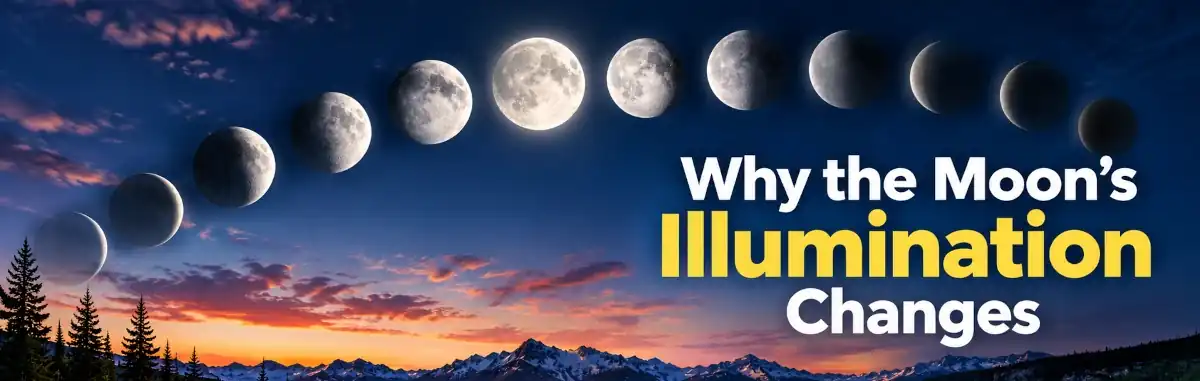
Why the Moon's Illumination Changes
Half of the Moon is always lit. What changes is how much of that lit half faces Earth. The cause is geometry, not Earth's shadow, and it also explains why the Moon's brightness changes faster than its lit fraction.
The short answer. The Sun lights about one hemisphere of the Moon at a time, the side facing it. As the Moon orbits Earth, the angle between the Sun, Moon and Earth changes, so we see more or less of that lit hemisphere. The illuminated fraction quoted for the Moon is the fraction of the visible disc that is lit, not the share of the whole sphere. At new Moon we see almost none of it, at first and last quarter we see half of it, and at full Moon we see all of it. Earth's shadow is not involved in phases. It only matters during a lunar eclipse.
The geometry
Two angles describe everything. The elongation is the angle between the Sun and the Moon as seen from Earth. The phase angle, i, is the angle at the Moon between the Sun and Earth. They add up to very nearly 180°, because the Sun is so far away (the difference is a fraction of a degree), so a small elongation means a large phase angle, and the other way round. At new Moon the Moon lies between us and the Sun, so we look at its unlit side. At full Moon Earth lies between the Sun and Moon, so the lit side faces us.
The terminator. The line between day and night on the Moon is called the terminator. It is sharp because the Moon has almost no atmosphere to scatter light across it. The terminator is not fixed relative to the lunar surface. As the Moon rotates relative to the Sun, it advances across the terrain over a lunar solar day, which lasts about 29.53 Earth days from one lunar noon to the next (more on the length of a lunar day). The changing light is why a crater near the terminator can look completely different from one night to the next.
Quarter does not mean a quarter of the disc. First and last quarter get their names from the Moon being a quarter and three quarters of the way through its orbit, respectively. At those points we see half of the disc lit.
The cycle, phase by phase
The table gives approximate values for an average lunation. Here E is the Moon-Sun angle measured eastward from the Sun, running from 0° to 360° over the cycle. Astronomers often quote elongation only from 0° to 180°, so values past 180° are shown with the equivalent angle on the other side. The lit fraction follows k = (1 − cos E) / 2. These are approximate patterns for mid-latitude observers, not location-specific predictions. Actual rise and set times depend on date, latitude, longitude, the Moon's orbital position and the local horizon.
| New Moon | Elongation ~0°, age 0 d, lit ~0%. Rises and sets about with the Sun, so it is usually difficult or impossible to see. The exception is a solar eclipse, when the Moon's dark silhouette crosses the Sun. |
|---|---|
| Waxing crescent | Elongation ~45°, age ~3.7 d, lit ~15%. Visible low in the west after sunset. |
| First quarter | Elongation 90°, age ~7.4 d, lit 50%. Rises about midday, highest at sunset, sets about midnight. |
| Waxing gibbous | Elongation ~135°, age ~11 d, lit ~85%. Rises in the afternoon, sets after midnight. |
| Full Moon | Elongation 180°, age ~14.8 d, lit ~100%. Rises near sunset, sets near sunrise. |
| Waning gibbous | Elongation ~225° (135° on the other side), age ~18 d, lit ~85%. Rises in the evening, sets after sunrise. |
| Last quarter | Elongation 270° (90° on the other side), age ~22 d, lit 50%. Rises about midnight, highest at sunrise, sets about midday. |
| Waning crescent | Elongation ~315° (45° on the other side), age ~26 d, lit ~15%. Low in the east before sunrise. |
Ages and times are averages. The Moon's orbit is elliptical and perturbed by the Sun, so its speed varies and the real timing differs from the average. Each phase has its own guide: new Moon, crescents, first and third quarter, gibbous phases and full Moon. See also waxing vs waning and the Moon phases overview.
The numbers
Illuminated fraction
The fraction of the visible disc that is lit is k = (1 + cos i) / 2, where i is the phase angle. This is the ideal geometric fraction for a spherical Moon lit by a distant Sun. The U.S. Naval Observatory's tabulated fraction is geocentric, computed for an observer at Earth's center. It describes the disc, not the Moon's photometric brightness, which the next section covers. Worked example: when the elongation is 60°, the phase angle is about 120°, so k = (1 + cos 120°) / 2 = (1 − 0.5) / 2 = 0.25, or about 25%. The same formula gives 0% at i = 180° (new Moon), 50% at i = 90° and 100% at i = 0° (full Moon).
With respect to phase angle, the lit fraction changes slowly near new and full Moon, because cos i is flat near 0° and 180°, and fastest around the quarters. The Moon's actual angular motion is not uniform either, so the day-to-day change differs from a simple cosine curve.
Two kinds of month
| Synodic month | 29.53059 days on average, from one new Moon to the next. This is the cycle of phases. |
|---|---|
| Sidereal month | About 27.32 days, the time for one orbit relative to the stars. |
| Why they differ | While the Moon orbits, Earth moves along its own orbit around the Sun, so after one orbit relative to the stars the Moon needs about 2.2 more days to return to the same Sun-Earth-Moon alignment and repeat its phase. The synodic month is about 2.2 days longer than the sidereal month (Espenak). |
| Variation | Individual lunations vary from the mean by up to about 7 hours because the Moon's orbit is elliptical and the Sun perturbs it. Lunations are shorter when new Moon is near perigee and longer when it is near apogee (Espenak). |
To find the Moon's age on any date, use the Moon age calculator. For why the pace of the phases is not constant, see why the Moon's phases change at different rates.
Illumination is not brightness
Three different things are easy to confuse. The illuminated fraction is the share of the visible disc that is lit. The total apparent brightness is the light we receive from the whole Moon. Albedo is how reflective the surface is. The Moon's bolometric Bond albedo is about 0.11 (Buratti et al. 1996), so it is a dark surface.
You might expect a half-lit Moon to give half the light of a full Moon. In total apparent brightness it is substantially dimmer than that, because of the Moon's phase-dependent scattering and the shadows cast by its rough surface. Popular summaries commonly quote first quarter at roughly a tenth of full Moon brightness, but the exact ratio depends on the phase angle and the photometric comparison being made, so treat that figure as approximate.
- Shadows. At quarter phase the Sun is to the side, so countless small shadows cover the rough, powdery surface. Near full Moon those shadows are hidden.
- Opposition surge. Very near full Moon the brightness rises non-linearly as the phase angle approaches zero. Shadow hiding and coherent backscatter have both been proposed as causes. Buratti et al. (1996) concluded that shadow hiding is the principal cause, with coherent backscatter, if present, making only a minor contribution, while other studies have found a larger role for coherent backscatter, so the relative contributions remain a subject of research. Clementine measured a brightness increase of more than 40% between phase angles of about 4° and 0°.
Distance matters too
The Moon's orbit is elliptical, with mean center-to-center distances of about 363,400 km at perigee and 405,500 km at apogee (Espenak). A full Moon near perigee, a "supermoon", can look up to 14% larger in diameter and 30% brighter than the smallest full Moon of the year (NASA/JPL). The supermoon and micromoon calendar lists the extremes. To estimate moonlight for a given night, try the moonlight brightness calculator. These figures compare the two extremes, the closest and farthest full Moons, not a supermoon with an average full Moon, and the size difference is hard to notice by eye.
What the light does to the surface
When the Sun is low, as near the terminator, relief throws long shadows and craters, ridges and domes stand out. When the Sun is high, shadows nearly vanish, and what shows instead is albedo: bright rays, dark maria and swirls. This is why many Lunar 100 targets are best near the terminator and a few are best under high Sun.
Colongitude. Observers locate the terminator with the Sun's selenographic colongitude, the longitude of the morning terminator expressed as 90° minus the longitude of the subsolar point. Roughly, colongitude is 0° near first quarter, 90° near full Moon, 180° near last quarter and 270° near new Moon. These are approximate guides, and the exact relation depends on the actual solar geometry. Observers use tables of colongitude (see Meeus, ch. 53) to find which features are near sunrise on a given night.
The far side is not dark. (See also is there really a dark side of the Moon? and the far side of the Moon.) Both the near and far sides get about two weeks of continuous daylight followed by about two weeks of night. The far side is only "dark" in the sense that it is not visible from Earth. The exception is some polar crater floors (see the lunar south pole), which are permanently shadowed because the Sun stays very low there.
Common misconceptions
| "Earth's shadow causes phases" | No. Phases come from our changing view of the lit half. Earth's shadow only falls on the Moon during a lunar eclipse. |
|---|---|
| "The Moon turns to show different faces" | No (see why we only see one side and whether the Moon rotates). The Moon keeps nearly the same side toward Earth. The lit portion shifts because the Sun's direction changes. |
| "There is a permanently dark side" | No. There is no permanently dark hemisphere. Both the near and far sides have day and night, although the floors of some polar craters stay permanently shadowed. |
| "Every full Moon brings an eclipse" | No. The Moon's orbit is tilted about 5° to Earth's orbit around the Sun, so most full Moons pass above or below Earth's shadow. Eclipses happen only when full Moon occurs near the nodes (see Moon phases and lunar eclipses and eclipses), where the orbits cross (Espenak). |
| "Phases look the same everywhere" | Not quite. In the northern hemisphere the waxing Moon is lit on the right, while in the southern hemisphere it is lit on the left (why the Moon looks different in the southern hemisphere). The tilt of a crescent also depends on latitude and the Moon's position in the sky, and near the tropics a crescent can look nearly horizontal. |
Illumination from the observer's side
Libration. Libration is a slow rocking of the Moon that lets us see about 59% of its surface over time. It is separate from phase: it changes which part of the surface faces us, while phase changes how much of it is lit. Near-limb Lunar 100 targets need favorable libration and suitable lighting together.
Earthshine. The faint glow on the unlit part of a crescent is sunlight reflected from Earth. It is easiest to see near thin crescents, when Earth as seen from the Moon is close to full. See what causes earthshine and the Lunar 100 target L2 Earthshine.
Local conditions. The Moon's phase is essentially the same for everyone on Earth at a given instant. What differs is the apparent orientation, altitude, rise and set times, and atmospheric extinction, which dims and reddens the Moon near the horizon (why the Moon turns orange at moonrise). For rise and set patterns, see why the Moon rises and sets.
Daytime Moon. The Moon is visible in daylight (see why you can see the Moon during the day) whenever it is above the horizon and bright enough, which is common around the quarters.
Reading the sky. The lit side always points toward the Sun. A crescent in the west after sunset is waxing, and one in the east before sunrise is waning. If the Moon is half lit and highest around sunset, it is first quarter.
Frequently asked questions
Why does the Moon change shape?
The Sun lights about one hemisphere of the Moon at a time. As the Moon orbits Earth, we see different amounts of that lit hemisphere. The shape we see is the part of it that faces us.
Is the phase caused by Earth's shadow?
No. Earth's shadow only falls on the Moon during a lunar eclipse. Phases happen every month without it.
Why is the half Moon so much dimmer than half the full Moon?
At half phase the Sun lights the surface from the side, so many small shadows cover it, and the opposition surge near full Moon is missing. In total apparent brightness a half Moon is far less than half as bright as a full Moon, and the exact ratio depends on the phase angle and the surface's scattering properties.
How long does a full cycle of phases take?
On average 29.53 days, called the synodic month. Individual cycles vary by up to about 7 hours from that average.
Why can I see the Moon during the day?
Whenever the Moon is above the horizon and reflects enough sunlight, it can be seen against the daytime sky. This is common around the quarter phases.
References
- Espenak, F. Eclipses and the Moon's Orbit. NASA Goddard Space Flight Center eclipse site: eclipse.gsfc.nasa.gov/help/moonorbit.html. (Mean synodic month, variation of lunation length, orbital eccentricity and distances.)
- Lane, A. P., Irvine, W. M. (1973). Monochromatic phase curves and albedos for the lunar disk. Astronomical Journal 78, 267–277.
- Buratti, B. J., Hillier, J. K., Wang, M. (1996). The lunar opposition surge: Observations by Clementine. Icarus 124(2), 490–499. doi:10.1006/icar.1996.0225. NASA NTRS record 19990098019.
- Hapke, B., Nelson, R., Smythe, W. (1998). The opposition effect of the Moon: Coherent backscatter and shadow hiding. Icarus 133, 89–97.
- NASA/JPL. What's a supermoon and just how super is it? jpl.nasa.gov. (Up to 14% larger in diameter than the smallest full Moon.)
- Meeus, J. Astronomical Algorithms, chs. 48 (illuminated fraction), 49 (phases) and 53 (physical ephemeris of the Moon, including colongitude).
- NASA Science. Moon Phases.
- U.S. Naval Observatory. Phases of the Moon and Percent of the Moon Illuminated, and Fraction of the Moon Illuminated.