Moon
Facts, Formation & Exploration Guide
Earth's only natural satellite, our Moon, has shaped tides, seasons, and the length of our days for over four billion years — and it's the only place beyond Earth where humans have set foot. From its violent birth in a planet-sized collision to the water ice hiding in its permanently shadowed craters, the Moon holds a record of the solar system's early history that Earth's own geology has long since erased.
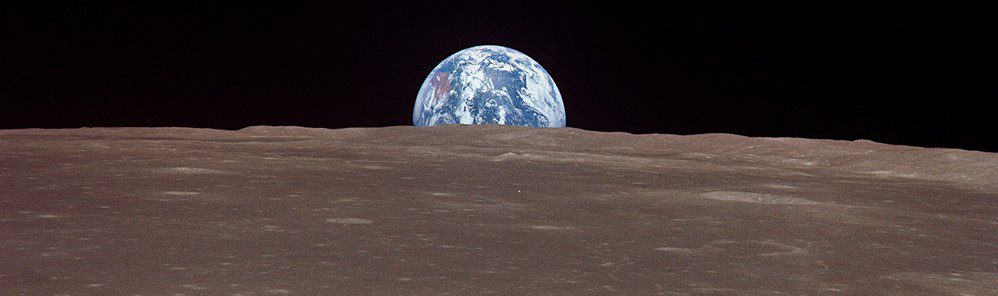
Earthrise, seen from the Moon
Explore the Moon

Moon phase today
Tonight's exact phase, illumination, and moonrise/moonset for your location.

Next lunar eclipse
Upcoming eclipse dates through 2035, with hemisphere-specific viewing guides.

Meteor shower calendar
Every major shower this year, rated by how much moonlight will wash it out.

Artemis III
Timeline, crew, and science goals for NASA's return to the lunar surface.
01 · Origins
How the Moon formed
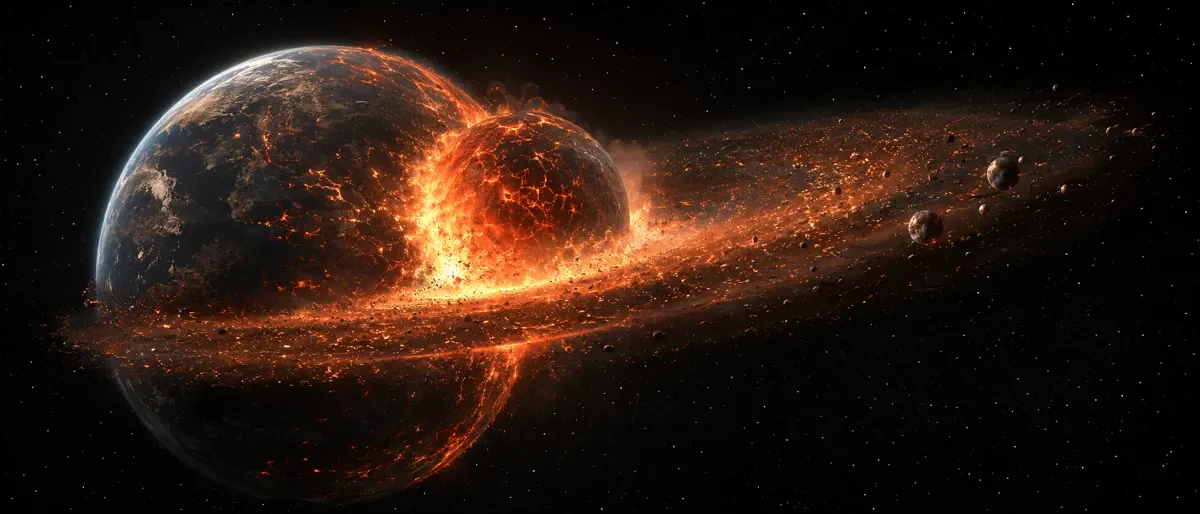
The leading explanation for the Moon's birth is the giant-impact hypothesis. Around 4.5 billion years ago, when the solar system was still a chaotic construction site, a Mars-sized protoplanet often called Theia is thought to have collided with the young Earth at a glancing angle. The impact vaporized rock and blasted a ring of molten and gaseous debris into orbit, which cooled, clumped, and accreted into the Moon over a timescale scientists are still working to pin down.
This theory explains several puzzles that other models can't: the Moon's much smaller iron core relative to its size compared with Earth's is consistent with it forming from material that was relatively depleted in metallic iron; Earth and Moon rocks share nearly identical oxygen isotope ratios; and the early Moon was hot enough to be covered in an ocean of molten magma.
Alternative ideas
- Co-formation — the Moon accreted alongside Earth from the same material, like a binary planet. This struggles to explain the Moon's low iron content.
- Capture — the Moon formed elsewhere and was later caught by Earth's gravity. Orbital mechanics make a clean capture of a body this large very unlikely.
- Fission — an early, fast-spinning Earth flung off a piece of itself. Largely abandoned once isotope and angular-momentum data came in.
Still evolving: some simulations suggest a Moon-sized body could emerge from the impact debris within hours rather than centuries — but that doesn't mean the Moon's full formation and cooling history is settled science. The giant-impact framework holds; the exact timeline is still active research.
02 · Structure
Composition & internal structure
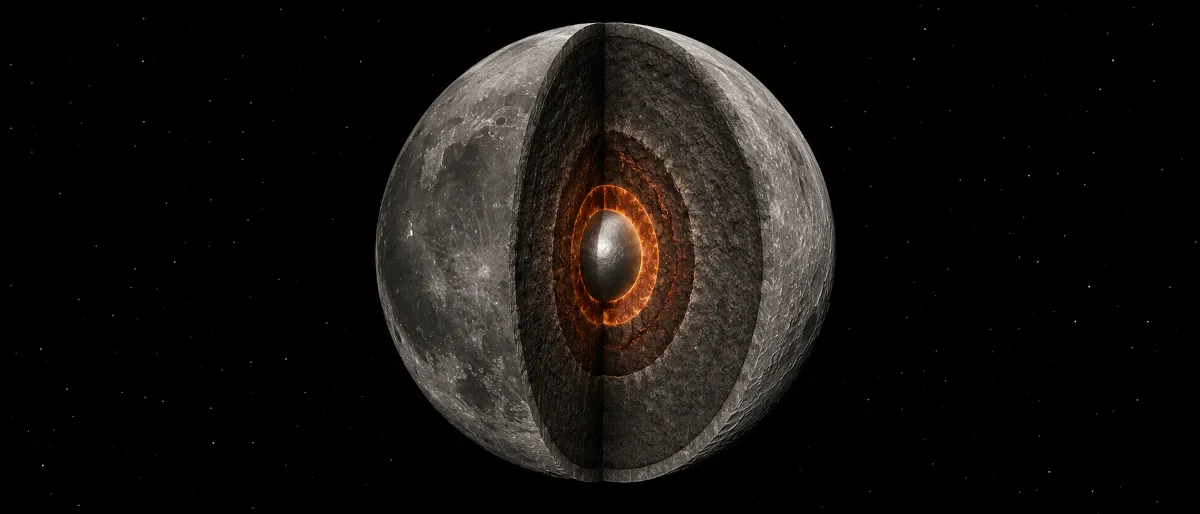
The Moon is layered much like Earth, but its smaller size has allowed it to cool and evolve very differently. At the center is a solid, iron-rich inner core with a radius of about 240 km, surrounded by a liquid iron outer core extending out to roughly 330 km, and then a partially molten boundary layer reaching about 480 km — together spanning just over a quarter of the Moon's total radius, far smaller proportionally than Earth's core. Around that sits a thick, mostly solid mantle of iron- and magnesium-rich silicate rock, topped by a crust that's thinner on the near side (roughly 40 km) and noticeably thicker on the far side (up to 60 km).
The surface itself splits into two visibly different terrains: the dark, smooth lunar maria — ancient basaltic lava flows that filled huge impact basins between about 3 and 3.5 billion years ago — and the bright, heavily cratered highlands made of older, calcium-rich anorthosite. Covering nearly everything is a fine, abrasive layer of shattered rock and glass called regolith, built up over billions of years of micrometeorite bombardment.
Unlike Earth, the Moon has no global magnetic field today, though magnetized patches of crust hint that it once did, generated by a churning core that has since cooled and largely solidified.
03 · Motion
Orbit, rotation & distance
The Moon orbits Earth once every 27.3 days (a sidereal month), but because Earth is also moving around the Sun, the cycle of phases — the synodic month — takes about 29.5 days. Its orbit isn't a perfect circle: distance ranges from around 363,300 km at perigee (closest) to about 405,500 km at apogee (farthest), which is why some full moons look noticeably bigger and brighter as supermoons.
The Moon is tidally locked to Earth, meaning its rotation period exactly matches its orbital period. That's why the same hemisphere always faces us — there is no permanent "dark side," just a far side we never see directly from the ground, and it gets just as much sunlight as the near side over a lunar month.
A slight wobble called libration lets observers see about 59% of the surface over time rather than a flat 50%. And the Moon isn't standing still relative to us in the long run either: tidal interaction is pushing it away from Earth at roughly 3.8 cm per year, a rate measured directly using laser reflectors left on the surface by Apollo astronauts.
04 · Earth effects
How the Moon drives Earth's tides
The Moon's gravity pulls on Earth unevenly — harder on the side facing it, weaker on the far side — stretching the oceans into two bulges roughly aligned with the Earth–Moon axis. As Earth rotates through those bulges, most coastlines experience two high tides and two low tides every 24 hours and 50 minutes (the extra 50 minutes is because the Moon has moved slightly along its orbit by the time Earth completes a spin). The Sun contributes too — its tidal effect is about 46% as strong as the Moon's — but the Moon does most of the work simply because it's so much closer.
Tide strength isn't constant. When the Sun, Earth, and Moon line up at new and full moon, their gravitational pulls combine into larger spring tides — higher highs and lower lows. At first and last quarter, the Sun's pull works at a right angle to the Moon's, partially canceling it out into smaller neap tides. A particularly strong spring tide, especially one that lines up with the Moon near perigee, can push coastal water levels unusually high — sometimes called a king tide, though the term isn't a strict astronomical definition and local geography plays a big role too. Coastal cities increasingly watch these events as a preview of sea-level rise.
05 · Surface
Surface features & craters
With no atmosphere, weather, or plate tectonics to erase them, the Moon preserves an almost complete record of impacts stretching back billions of years. Craters range from microscopic pits to the South Pole–Aitken basin, one of the largest known impact structures in the solar system, spanning roughly 2,500 km across the far side.
Feature types worth knowing
- Maria — dark basaltic plains from ancient lava flooding.
- Highlands — bright, ancient, densely cratered terrain.
- Rilles — long, narrow channels, some carved by lava, some by collapse.
- Rays — bright streaks of ejected material radiating from young craters like Tycho.
- Domes — low, rounded volcanic hills from thicker, slower-moving lava.
Large-scale lunar volcanism declined dramatically around a billion years ago as the Moon's interior cooled — small bodies lose their internal heat faster than planets do. But it wasn't a clean stop: NASA's Lunar Reconnaissance Orbiter has identified volcanic-looking features that may be under 100 million years old, and possibly much younger, though their exact ages and origins are still debated. Ongoing change today comes from a mix of meteoroid impacts, moonquakes, thermal cycling, and slow regolith movement, along with occasional short-lived brightenings called transient lunar phenomena — observations whose underlying cause remains genuinely uncertain.
06 · Environment
Atmosphere & environment
The Moon has no meaningful atmosphere — only an exosphere, an extremely thin, fragile layer of loosely bound atoms (sodium, potassium, helium, argon, and traces of others) so sparse that particles rarely collide with each other before escaping to space. It provides no insulation, no weather, and no protection from radiation or micrometeorites.
Without an atmosphere to trap heat or scatter light, conditions swing to extremes. Daytime surface temperatures near the equator can reach around 127°C (260°F), while lunar nights — each about two Earth weeks long — can plunge below −170°C (−280°F). Inside permanently shadowed polar craters that never see sunlight, temperatures fall even further, among the coldest measured anywhere in the solar system.
The sky as seen from the surface is black even in daylight, since there's no air to scatter sunlight into blue. Stars can be seen from the surface too, though glare from sunlight and the brightly lit ground can wash them out unless that glare is shielded from view — much like trying to spot stars near a streetlight. That airless, exposed environment is also central to the long-running question of whether the Moon could ever have supported life — short answer: almost certainly not on the surface, though the picture gets more interesting when you factor in subsurface ice and shielded caves.
07 · Resources
Water & ice on the Moon
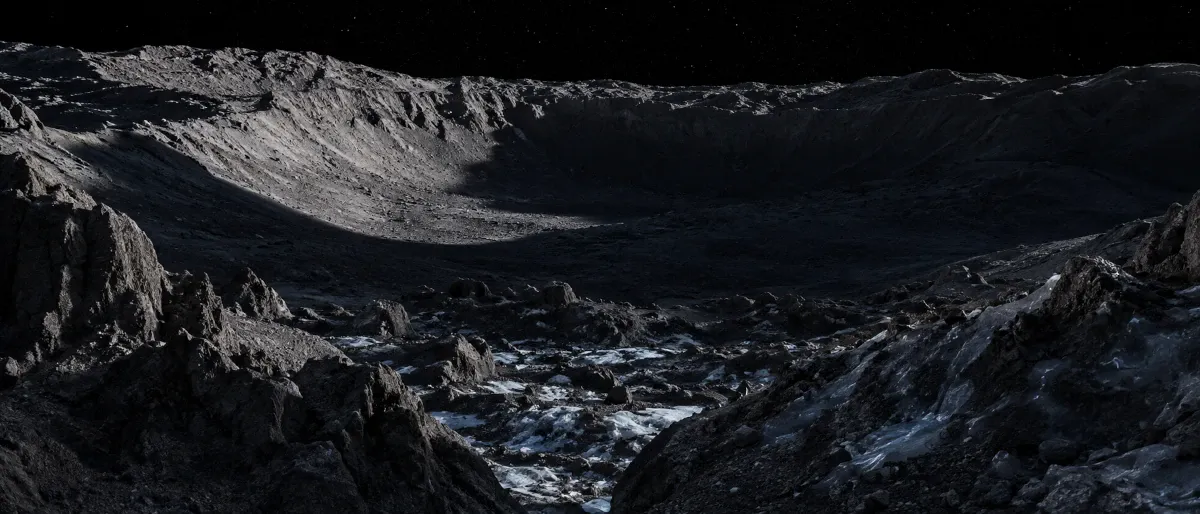
For decades the Moon was assumed to be bone dry. That changed with missions like India's Chandrayaan-1 and NASA's LCROSS impactor, which confirmed water ice mixed into the regolith inside permanently shadowed craters near the poles — places so deep and shadowed that sunlight has never reached their floors, holding temperatures cold enough to trap ice for billions of years. Trace amounts of water molecules have also been detected more broadly across the sunlit surface, likely delivered by solar wind interacting with surface minerals and by ancient comet and asteroid impacts.
This ice matters enormously for future exploration: it's a potential source of drinking water, breathable oxygen, and even rocket propellant (via electrolysis into hydrogen and oxygen) for astronauts who won't have to haul every drop from Earth. It's a major reason NASA's Artemis program is targeting landing sites near the lunar south pole.
08 · Cycles
Moon phases, explained
Moon phases aren't caused by Earth's shadow — that only happens during a lunar eclipse. They're simply a matter of geometry: as the Moon orbits Earth, we see varying portions of its sunlit half, cycling through eight recognized phases roughly every 29.5 days.
- New Moon — the Moon sits between Earth and the Sun, so the Earth-facing side is mostly unlit and the Moon is essentially invisible.
- Waxing Crescent — a thin, growing sliver appears after sunset.
- First Quarter — exactly half illuminated, rising around midday.
- Waxing Gibbous — more than half lit, growing toward full.
- Full Moon — the side of the Moon facing Earth is fully illuminated, rising as the Sun sets.
- Waning Gibbous — illumination begins shrinking after full.
- Last (Third) Quarter — half lit again, rising around midnight.
- Waning Crescent — a thinning sliver visible before dawn, heading back to new.
You can check tonight's exact phase and illumination for your location any time, or look ahead with a full moon phase calendar.
09 · Alignments
Eclipses of the Moon and Sun
Eclipses only happen at new or full moon, and only when the Moon's slightly tilted orbit (about 5° off Earth's orbital plane) brings it close enough to line up exactly with the Sun and Earth. Most months the alignment misses, which is why we don't get an eclipse every single new and full moon — only a handful of times a year, at most.
Lunar eclipses
A lunar eclipse happens at full moon, when Earth passes directly between the Sun and Moon, casting its shadow across the lunar surface. During totality, sunlight bent through Earth's atmosphere — the same effect that colors sunsets — turns the Moon a deep red or orange, giving rise to the popular "blood moon" name. Unlike solar eclipses, a total lunar eclipse can be seen from anywhere on the nighttime side of Earth where the Moon is above the horizon, and it's completely safe to watch with the naked eye.
Solar eclipses
A solar eclipse happens at new moon, when the Moon passes directly between Earth and the Sun, blocking some or all of the Sun's light for viewers along a narrow path. Because the Moon's apparent size varies slightly with its distance, some alignments produce a total eclipse (full blockage) and others an annular "ring of fire" eclipse when the Moon is too far away to fully cover the Sun. Solar eclipses require proper eye protection at every stage except brief totality.
Eclipses aren't random — they follow predictable patterns like the roughly 18-year Saros cycle, which is why astronomers can forecast eclipse dates centuries in advance.
10 · Exploration
Exploration & missions
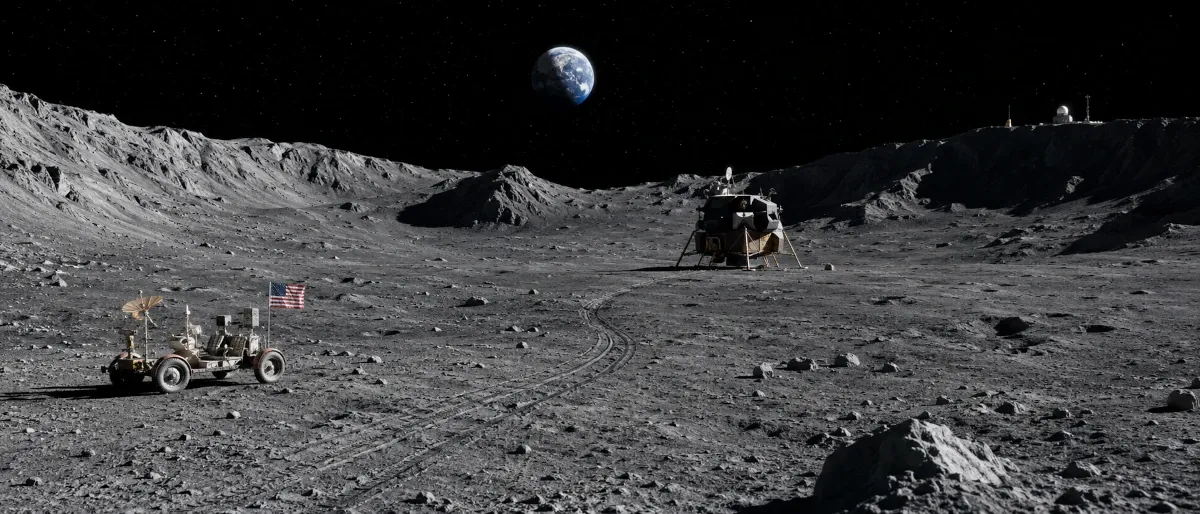
The Moon is the only celestial body beyond Earth that humans have physically visited. The Soviet Union got there first with uncrewed probes — Luna 2 impacted the surface in 1959, and Luna 9 achieved the first soft landing in 1966. The United States followed with the Apollo program, and on July 20, 1969, Apollo 11's Neil Armstrong and Buzz Aldrin became the first humans to walk on another world. Five more crewed landings followed through 1972, bringing back a combined 382 kg of lunar samples still studied today.
After a decades-long gap in crewed lunar missions, activity has picked back up sharply. NASA restructured its Artemis program in early 2026: Artemis III, planned for 2027, will now fly a crewed demonstration in low Earth orbit rather than land on the Moon, testing rendezvous and docking between the Orion spacecraft and test versions of one or both commercial landing systems from SpaceX and Blue Origin. Its crew — commander Randy Bresnik, pilot Luca Parmitano, and mission specialists Andre Douglas and Frank Rubio — was announced in June 2026. The first planned Artemis lunar landing is now targeted for Artemis IV in early 2028. Meanwhile China, India, Japan, and private companies have all sent landers or orbiters in recent years, with a fresh focus on the resource-rich south pole.
11 · Quick answers
Frequently asked questions
How old is the Moon?
About 4.5 billion years, forming not long after Earth itself in the early solar system.
How far away is the Moon?
On average about 384,400 km (238,900 miles), though it ranges from roughly 363,300 km at perigee to 405,500 km at apogee. Here's how to track apogee and perigee yourself.
Why do we only see one side of the Moon?
The Moon is tidally locked, so its rotation period matches its orbital period around Earth, keeping the same hemisphere facing us. Read more about the far side of the Moon.
Is there really water on the Moon?
Yes — mainly as ice trapped in permanently shadowed polar craters, plus trace amounts elsewhere. Full details are in our water on the Moon guide.
Does the Moon have its own light?
No — it only reflects sunlight. More on why the Moon doesn't glow on its own.
What causes ocean tides?
The Moon's gravity pulls Earth's oceans into bulges that sweep past coastlines as Earth rotates, producing regular high and low tides. See our full tides explainer.
What's the difference between a solar and lunar eclipse?
A lunar eclipse happens at full moon when Earth's shadow falls on the Moon; a solar eclipse happens at new moon when the Moon's shadow falls on Earth. See upcoming eclipse dates for both.
What is a supermoon?
A popular term — not an official astronomical classification — for a full moon that occurs near the Moon's closest approach to Earth, making it appear somewhat larger and brighter than a typical full moon. See our supermoon and micromoon calendar for upcoming dates.
Could humans live on the Moon?
Not without significant infrastructure — there's no breathable air, extreme temperature swings, and high radiation exposure. But polar ice and in-situ resource plans make a permanent base technically plausible; see how NASA plans to build one.
When is the next full moon?
Check our next full moon tracker for an always-current countdown.