

Best Moon Phase for Clamming: New Moon vs. Full Moon
Last updated: October 2026
The beach at first light is quiet, and the tide has gone farther out than you’ve seen it in weeks. Flats that are normally underwater are glistening, and the little squirts and dimples that give clams away are everywhere. That kind of morning isn’t entirely luck. The moon may have helped, but the tide chart is what tells you whether your beach will actually deliver.
The Short Answer
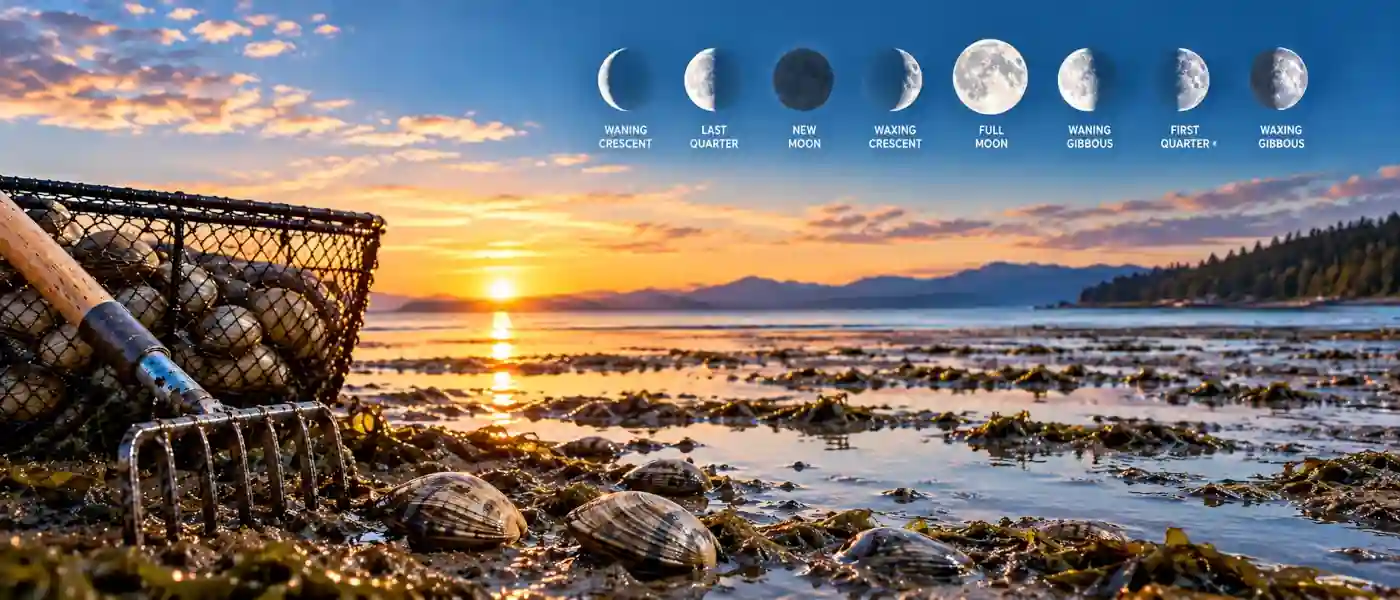
New and full moons generally produce the largest tidal ranges, called spring tides, so they are the best times to start looking. But moon phase alone doesn’t tell you whether a particular beach will have a useful low tide. For the best clamming, check the predicted low-tide height and time for your beach, confirm the area is open and safe, and use moon phase to spot promising windows.
- Most promising: new and full moons (spring tides), and especially perigean spring tides
- Middle ground: crescent and gibbous phases
- Usually weakest: first and third quarter moons (neap tides)
How the Moon Controls the Tides
Tides are the ocean’s response to gravity. The moon pulls on the water, creating a bulge on the side of Earth facing it and another on the opposite side. As Earth rotates, coastlines pass through those bulges. Many coasts get two high and two low tides a day, though some places have a different pattern, such as one high and one low a day, or two tides of unequal size. Your local tide table shows which applies to you.
The sun pulls on the ocean too, just less strongly. What matters is whether the sun and moon are working together or against each other.
Spring tides (nothing to do with the season) happen at the new and full moon, when the sun, Earth, and moon line up. Their pulls combine, so high tides run higher and low tides run lower than average. A lower low tide can expose more of the flat and more of the clams.
Neap tides happen at the first and third quarter moons, when the sun and moon pull at right angles. The pulls partly cancel, the tidal range shrinks, and the water often doesn’t drop as far. (For more, see spring tides vs. neap tides.)
The cycle repeats roughly every two weeks, so a promising window comes around about twice a month.
King Tides and Perigean Spring Tides
The moon’s orbit is slightly oval, so its distance from Earth changes over the month. The closest point is called perigee. When a new or full moon happens near perigee, the result is a perigean spring tide. NOAA notes that how much bigger these tides get is location dependent and shaped by the local tidal range.
People often call these king tides, but “king tide” is a popular term rather than a scientific one, and usage varies. It most often refers to exceptionally high tides, which is why you’ll see it in coastal flooding news. Perigean spring tides can also bring unusually low lows, which is why diggers watch for them, but whether that gives you the lowest usable low tide depends on your beach and on other water-level effects such as season and weather.
Heads up: Don’t treat “king tide” as a guarantee of great clamming. Check the predicted low tide height and time for your beach. Low tides on these days may fall at night or in rough weather, and the water can return faster, so plan your exit carefully.
Moon Phase Breakdown
| Moon Phase | Tide Type | General Tendency | Notes |
|---|---|---|---|
| New or full moon near perigee | Perigean spring | Largest tidal ranges | Can produce exceptionally low lows depending on location. Expect stronger currents. |
| New moon | Spring | Large range | Dark nights, so bring a good headlamp. |
| Full moon | Spring | Large range | More natural light for evening digs. |
| Crescent / gibbous | Transitioning | Moderate range | Range grows toward new or full moon. |
| First / third quarter | Neap | Small range | Water often doesn’t drop as far. |
The largest local tidal range doesn’t necessarily occur exactly on the day of the new or full moon. Check the local tide predictions for the surrounding days rather than relying on the moon-phase date alone.
Why Your Local Tide Matters More Than the Moon
Moon phase explains why some stretches of the month tend to have bigger tides. The tide prediction for your beach tells you what will actually happen there. Tide predictions are location-specific, so a prediction for a port 50 miles away can differ noticeably from your beach. In order of importance, check:
- Low-tide height at the station nearest your beach.
- Low-tide time, and whether it falls in daylight.
- Whether the area is open and safe for harvesting.
- Moon phase, to identify promising windows in advance.
- Weather and water-level conditions on the day.
Tide heights are measured relative to a local reference level called a tidal datum. A “-1.0 ft” tide at one station isn’t directly comparable with a “-1.0 ft” tide at another, so always use the prediction for the station you plan to visit. Predictions are available from NOAA Tides & Currents in the United States and from the Canadian Hydrographic Service in Canada.
Timing the Tide
- Tide times shift later each day. The tidal cycle follows the lunar day of about 24 hours and 50 minutes, so low tide generally arrives later from one day to the next. The exact shift varies by location and by tide, so use the table.
- Arrive 1 to 2 hours before low tide. This gives you time to find your spot and dig through the lowest water, then leave as the tide turns.
- Look for the lowest predicted tides in your area, including negative values on the chart, which sit below the local reference level.
- Check daylight. In many places the lowest tides fall at different times of day in different seasons.
Weather and Water Levels
Tide predictions are astronomical predictions, not guaranteed water levels. NOAA notes that predictions don’t account for short-term effects such as wind, rain, freshwater runoff, and other weather. The water can end up higher or lower than the chart says, so build in a margin.
- Wind and pressure: Both can shift water levels. Strong onshore wind and low pressure tend to raise the water, which can keep a low tide from dropping as far as predicted.
- Surf and swell: Rough conditions make a beach unsafe even when the tide is low.
- Season: Shellfish seasons and water temperature vary, and some areas are closed at certain times of year.
- Time of day: Cooler hours are easier on you and keep your catch fresher.
Species and Tide Height
The ideal tide depends on where the species lives on the shore. Species found higher in the intertidal zone may be reachable on ordinary low tides, while species concentrated near the low-water edge benefit more from exceptionally low tides. Substrate, gear, and best practice also vary by region, species, and local regulations, so ask local harvesters or your fisheries agency.
- Soft-shell and hard clams: Typically found in mud, sand, or gravel in the intertidal and shallow subtidal zones. Tools vary, commonly a rake or shovel.
- Razor clams: Occur near the lower edge of the intertidal zone in some regions, so very low tides can improve access. Local beach conditions and regulations determine when harvesting is practical.
- Mussels and oysters: Usually found on rocks, reefs, and hard bottom, and often hand-picked with gloves. Sharp shells and slippery surfaces make footing important.
How to Read a Tide Chart
A typical chart lists each high and low tide with a time and a height. Heights are measured against the station’s datum, so a negative number means the water drops below that reference. For a step-by-step walkthrough, see how to read a tide chart. Here’s an illustrative comparison:
- A promising day: new moon, low tide at 7:15 a.m. at -1.5 ft on your local chart. You arrive at 6 a.m. and have a long window of good access.
- A weaker day: first quarter moon, low tide at 7:15 a.m. at +2.0 ft. Same time, same beach, but the beds may never come out of the water.
The height is what separates them. Always check the number, not just the time.
Safety on the Flats
Never assume a low tide means safe access. Conditions can change quickly, and a plan that works at low water can fail on the return.
- Incoming water: Tidal channels and shallow depressions can flood before the open flat does, cutting you off from shore. Set a turnaround time and know your exit route.
- Tide height is not tidal current. NOAA publishes tide predictions and tidal-current predictions as separate products. Strong currents can occur even when the water level looks calm.
- Mud and suction: Soft mud can trap boots and legs. Stay near firm ground.
- Cold water and weather: Dress for immersion risk, and watch the surf and wind.
- Slippery rocks and darkness: Use a headlamp, wear sturdy footwear, and take extra care on night digs.
- Don’t rely only on your phone: Carry a printed tide table, tell someone your planned return time, and bring a buddy.
Where to Check Shellfish Closures
Closures can be caused by marine biotoxins, harmful algal blooms, bacterial contamination, sewage events, or other hazards. Don’t rely on water color or appearance to judge whether shellfish are safe, because harmful blooms aren’t always visible. Natural toxins in contaminated shellfish are not eliminated by ordinary cooking or freezing.
- Canada: Check Fisheries and Oceans Canada (DFO) shellfish closure information before every harvest, since status can change regularly.
- United States: Check your state shellfish management or health agency, along with NOAA tide predictions.
- Elsewhere: Check the relevant fisheries, environment, or health authority.
Also confirm licensing, size and bag limits, and open seasons, which vary by jurisdiction.
Gear Checklist
- Clam rake, shovel, or clam gun (depending on the species)
- Bucket or mesh bag
- Gauge for measuring legal size
- Gloves
- Waterproof boots or waders
- Headlamp for early or late digs
- Printed or downloaded tide table
- License and a copy of local regulations
Frequently Asked Questions
Is it better to go clamming at a full moon or new moon?
Generally neither is better. Both produce spring tides with a large tidal range. A full moon gives more light for evening digs, while a new moon is darker, so you’ll want a strong headlamp. What matters more is the predicted low tide height and time at your beach.
Can you go clamming during a quarter moon?
Yes, but expect less. Quarter moons bring neap tides, which have a smaller range, so the water often doesn’t drop as far. Species that live higher on the shore may still be reachable at an ordinary low tide, so check your local tide prediction.
Are king tides good for clamming?
Sometimes. “King tide” is a popular term, not a scientific one, and usually refers to very high tides. The related perigean spring tides can also bring unusually low lows, but this depends on your location. Check the predicted low tide height and time, and be extra cautious of faster-returning water.
What is a minus tide?
A minus tide is a predicted low tide below zero on the tide chart. Zero is a reference level called a tidal datum, which varies by location and agency. A minus tide at one station isn’t directly comparable to a minus tide at another, so use the prediction for the beach you plan to visit.
How low does the tide need to be for clamming?
There is no universal number. It depends on the species, how high or low the beds sit on the shore, the local tidal datum, and local regulations. Ask local harvesters or your fisheries agency what tide height works at your spot.
What time of day is best for clamming?
The best time is the one that overlaps with a suitably low tide in good light. Arrive one to two hours before low tide, dig through the turn, and leave with plenty of margin. Early mornings are also cooler.
Can I go clamming at night?
Possibly, but check local rules first, since some areas restrict harvesting hours. Night digs also need a reliable headlamp, a buddy, a clear exit route, and extra caution with the incoming tide.
Does the moon affect shellfish behavior or just the tides?
For harvesters, the moon’s main effect is through the tides, which determine how much of the shore is exposed. Some shellfish have tide-linked activity patterns, but tide height and timing are what you can plan around.
How do I find out if shellfishing is open in my area?
Check your government fisheries or health agency for current openings and closures on the day you go. In Canada, that is Fisheries and Oceans Canada. In the United States, it is your state shellfish or health agency. Closures can change quickly, and you can’t judge safety by looking at the shellfish or the water.
Conclusion
New and full moons are good periods to watch because they produce spring tides. But the best clamming opportunity is the combination of a suitably low local tide, a practical time of day, safe conditions, and an open harvesting area. Perigean spring tides can produce unusually large tidal ranges, but they don’t automatically guarantee the lowest usable tide at every beach.
Pull up the tide table for your beach, check today’s moon phase and the next new or full moon, confirm the area is open, and set your turnaround time before you go.