

Perseid Meteor Shower: Peak Dates, Radiant & How to Watch
A reference guide to the Perseids: when they peak, what determines a great year versus a moon-washed one, and how to get the most out of the Northern Hemisphere’s most beloved meteor shower.
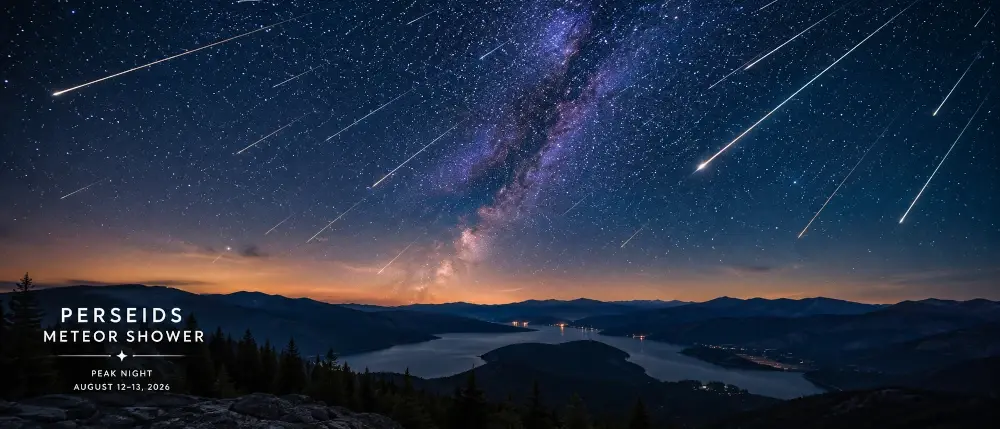
What Is the Perseid Meteor Shower?
The Perseids are an annual meteor shower that lights up warm August nights, named for Perseus, the constellation their radiant sits inside. As with every meteor shower, the “shooting stars” have nothing to do with the stars they streak past; they’re tiny fragments of comet debris burning up in Earth’s upper atmosphere. The Perseids are widely regarded as the most popular shower of the year for Northern Hemisphere observers, prized for a rich, steady supply of bright, often colorful meteors that leave more persistent glowing trains than most other showers.
The perseid meteor shower has been observed for roughly two thousand years, with the earliest known record coming from Chinese astronomers in 36 CE. In medieval Europe it picked up a second name, the “Tears of St. Lawrence,” because the peak falls close to the August 10 feast day of the martyred deacon Lawrence. Adolphe Quetelet, the Belgian astronomer, is generally credited with identifying the Perseid maximum in 1835.
Under excellent dark-sky conditions the Perseids can produce a theoretical ceiling of around 100 meteors an hour, though the American Meteor Society puts typical rural rates at closer to 30–50 per hour at maximum, with other sources citing up to 50–100 under the darkest skies. Either way, they’re among the strongest and most consistently impressive annual meteor showers, which combined with their reliable timing, warm-weather peak, and knack for fireballs makes them the shower most people plan a night around.
When to Watch Each Year
The Perseids are active for over five weeks every year, but most of the shower’s strongest activity is concentrated around a few nights near the maximum. Here’s the timeline that actually matters:
- Active period: roughly July 17 through late August (NASA and the IMO give August 24 as the closing date; AMS’s own materials vary between August 24 and August 29 depending on the source), though only the final week or so before the peak sees rates worth planning a night around.
- Peak nights: typically the nights of August 11–12 and August 12–13, with the physical maximum commonly falling in the pre-dawn hours of the 13th — though the exact timing shifts from year to year, so it’s worth confirming for the current year rather than assuming. Unlike a sharp, few-hours-wide peak, the Perseids build gradually and fall off quickly afterward, so the night before the traditional peak date can still produce strong activity — a good backup if the main night is clouded out.
- Broad maximum: the shower rises to its best rates gradually over the final nights before the 12th–13th, then drops off rapidly in the days after, unlike showers with a single sharp spike.
Exact peak timing can shift by up to a day depending on the year, so it’s worth confirming the current year’s predicted peak with a meteor-shower calendar shortly before you plan to watch, and checking whether the predicted maximum falls at a convenient time of night for your location.
The Comet Swift-Tuttle Connection
Every meteor shower is Earth passing through the debris trail of a comet or asteroid. For the Perseids, that parent body is Comet 109P/Swift-Tuttle, independently discovered in July 1862 by American astronomers Lewis Swift and Horace Tuttle. Swift-Tuttle’s orbit is enormous — roughly 133 years — and it last passed through the inner solar system in December 1992; NASA gives its next return as around 2125. Its nucleus, at about 26 kilometers (16 miles) across, is one of the largest objects known to make repeated close approaches to Earth.
Swift-Tuttle has supplied the Perseid stream over many returns to the inner solar system, and the stream contains numerous filaments and concentrations of debris rather than a single uniform band. That structure is part of why activity can vary somewhat from year to year even after accounting for the Moon. Gravitational perturbations, including effects from Jupiter, can also alter the distribution of material within the stream and may contribute to enhanced activity in some years — researchers have flagged 2028 in particular as one to watch, though the size of any boost remains uncertain.
It was the Italian astronomer Giovanni Schiaparelli who, in 1865, first connected the August meteors to Swift-Tuttle’s orbit — one of the earliest confirmations that meteor showers were made of cometary debris rather than some purely atmospheric phenomenon.
Finding the Radiant Near Perseus
The Perseid radiant sits at roughly right ascension 03h12m, declination +58°, placing it inside the constellation Perseus itself, near its border with Cassiopeia and not far from the Double Cluster. Cassiopeia’s distinctive W shape is an easy naked-eye landmark for locating the general area even from a light-polluted yard. The shower strongly favors the Northern Hemisphere, where the radiant is circumpolar at many latitudes and climbs high overhead before dawn; south of about 40°S it disappears below the horizon entirely, which is why the Perseids are largely a Northern Hemisphere event.
As with any shower, you don’t need to stare at the radiant to see meteors — they can streak across any part of the sky. In fact, looking directly at the radiant is the least effective strategy: meteors near their point of origin appear short and stubby, almost head-on. For longer, more dramatic streaks, look well away from the radiant — roughly 40–60 degrees is a useful rule of thumb, not a strict target. The simplest approach is to face a dark patch of sky partway between the radiant and the horizon and take in as much of the sky as possible.
Why the Moon Matters Every Year
Moonlight is the single biggest variable in any meteor shower forecast, and it changes completely from one year to the next. Because the Perseids fall on roughly the same calendar dates annually while the lunar cycle doesn’t, some years line up with a new or thin-crescent moon and dark skies all night, while others land close to a bright gibbous or full moon that washes out all but the brightest meteors.
2026 and 2027 make the contrast obvious. The 2026 peak landed right on a new moon — zero illumination and dark skies all night, giving 2026 exceptionally favorable Moon conditions, with the same new moon also producing a total solar eclipse that day across parts of the Arctic and Europe. In 2027, the peak instead falls under a bright waxing gibbous moon roughly 83–84% illuminated, which interferes with the fainter meteors through the evening and into the early morning hours before finally setting ahead of dawn.
- New moon or thin crescent near the peak: you’re in for a great year — dark skies all night, so any time after full darkness works.
- Gibbous or full moon near the peak: plan around it. Find local moonset time (or moonrise, if the moon is waning) and concentrate your viewing in the darkest window you can get, typically the hour or two before dawn.
Perseid Peak Schedule: 2026–2035
The Perseids peak on almost the same calendar dates every year — typically the nights of August 11–12 and 12–13, with the maximum usually landing in the pre-dawn hours of the 13th. What actually changes from year to year is the Moon. Because the shower’s date is fixed but the 29.5-day lunar cycle isn’t, some years land in dark, moonless skies while others land under a washed-out gibbous or full moon.
The 2026 and 2027 rows below are cross-checked against the American Meteor Society’s published shower calendar, the International Meteor Organization’s calendar, and independent lunar-phase reporting — these sources don’t currently publish shower-specific forecasts further out than that. The 2028–2035 rows are projected from lunar-cycle math alone, which is reliable for moon phase itself but hasn’t been checked against a shower-specific source this far in advance. Treat those years as a useful planning guide, and reconfirm the moon phase and local moonset time as the date approaches.
| Year | Typical Peak Night | Moon Phase | Moon Illumination | Viewing Outlook |
|---|---|---|---|---|
| 2026 | Aug 12–13 | New Moon | ~0% | Excellent – peak landed right on the new moon, dark skies all night |
| 2027 | Aug 12–13 | Waxing Gibbous | ~83–84% | Poor to mixed – bright moon interferes for most of the night, best after moonset before dawn |
| 2028 | Aug 11–13 | Waning Gibbous | ~60% (approx.) | Mixed – moon up for part of the night, improves after moonset |
| 2029 | Aug 11–13 | Waxing Crescent | ~8% (approx.) | Good to excellent – dark skies most of the night |
| 2030 | Aug 11–13 | Waxing Gibbous, near Full | ~99% (approx.) | Poor – near-full moon washes out the shower |
| 2031 | Aug 11–13 | Waning Crescent | ~27% (approx.) | Good – mostly dark skies |
| 2032 | Aug 11–13 | Waxing Crescent | ~32–42% (approx.) | Mixed to good – manageable early moonlight |
| 2033 | Aug 11–13 | Waning Gibbous | ~96% (approx.) | Poor – near-full moon up for most of the night |
| 2034 | Aug 11–13 | Waning Crescent, near New | ~3–4% (approx.) | Excellent – dark skies essentially all night |
| 2035 | Aug 11–13 | Waxing Gibbous | ~65–74% (approx.) | Mixed to poor – moonlight for much of the night |
Best Time and Viewing Strategy
Put the pieces together — radiant height, moon timing, and morning twilight — and the optimal plan looks like this:
- Don’t wait for the exact peak date alone. The night before the traditional peak often still delivers strong rates, so two consecutive nights are worth planning around if weather allows.
- Check moonset (or moonrise) for the current year and, if the moon is a factor, plan your darkest window around it.
- Watch from the late evening until the sky starts to brighten, with rates climbing steadily and the stretch from 1 a.m. to dawn consistently the best part of the night.
- Get away from significant light pollution. A darker sky can dramatically increase the number of meteors you’re able to see, though exactly how much depends on your starting point, the direction you’re facing, and the Moon.
- Give your eyes time. Full dark adaptation takes 20–30 minutes, and a bright phone screen can significantly set it back — use a dim red light if you need one.
- Lie back and look up. A reclining chair or blanket on the ground, facing away from the Moon and any residual light domes, beats standing and craning your neck.
How to Photograph the Perseids
Meteor photography is really wide-field night sky photography with patience layered on top — you’re not tracking a single fast-moving subject so much as leaving your shutter open on a big patch of sky and hoping something streaks through the frame.
Gear
- A camera capable of manual exposure control (mirrorless or DSLR).
- A wide-angle lens, ideally 14–24mm, with the widest available aperture (f/1.8–f/2.8).
- A sturdy tripod — nothing else matters if the camera moves.
- An intervalometer or built-in interval timer, so the camera fires continuously without you touching it.
- A spare battery; warm summer nights are gentler on batteries than winter showers, but hours of continuous shooting still adds up.
Camera Settings
- Focus: manual, set to infinity, checked visually on a bright star or planet at full zoom in live view.
- Aperture: as wide as your lens allows — f/2.8 or faster if possible.
- Shutter speed: start around 10–20 seconds and adjust from there based on your focal length and how much star trailing you see in test shots.
- ISO: start around 1600–3200 as a baseline and adjust based on your test shots.
- Shooting mode: continuous interval shooting with a 1–2 second gap between frames, for as long as your battery and card allow.
Composition
Frame roughly 40–60 degrees away from the radiant rather than centered on Perseus itself, and include an interesting foreground — a horizon, treeline, or silhouette — to give any captured meteor a sense of scale. Because you can’t predict exactly where a meteor will appear, plan to shoot for at least an hour and sort through the frames afterward rather than trying to time an individual shot.
What to Expect: Speed, Trains & Fireballs
Perseid meteors travel at about 59 kilometers (37 miles) per second — genuinely fast, among the quicker showers of the year. That speed, combined with the size of the debris particles, gives Perseid meteors their reputation for being bright and quick, often leaving a brief glowing streak behind them.
Persistent trains — glowing afterglows that linger for a second or more after the meteor itself has passed — are more common with the Perseids than with many other showers, and NASA and other observers consistently note the shower produces a healthy share of fireballs: meteors brighter than any planet in the sky. That combination of speed, brightness, and trains is a large part of why the Perseids draw more casual skywatchers than any other shower.
Unlike showers tied to long-period comets that swept through centuries ago, Swift-Tuttle passed through the inner solar system relatively recently, in 1992, leaving a denser, fresher debris trail. That keeps Perseid rates consistently strong from year to year rather than dependent on rare outbursts, though occasional nights of elevated activity — sometimes linked to Jupiter’s gravity nudging debris filaments into Earth’s path — still happen.
Perseids vs. Other Meteor Showers
Here’s how the Perseids stack up against the year’s other headline showers. Rates below are the Zenithal Hourly Rate (ZHR) — a theoretical ceiling under a perfectly dark sky with the radiant directly overhead — not what a typical observer actually sees, which is usually lower:
| Shower | Typical Peak | ZHR (ceiling) | Speed | Parent Body |
|---|---|---|---|---|
| Lyrids | Apr 21–22 | ~18/hr | Medium-fast | Comet C/1861 G1 (Thatcher) |
| Eta Aquariids | Early May | ~50/hr | Very fast | Comet 1P/Halley |
| Perseids | Aug 12–13 | ~100/hr | Fast | Comet 109P/Swift-Tuttle |
| Orionids | Oct 21–22 | ~20/hr | Very fast | Comet 1P/Halley |
| Geminids | Dec 13–14 | ~120/hr | Medium | Asteroid 3200 Phaethon |
The Geminids have a somewhat higher typical ZHR than the Perseids, though actual observed rates depend strongly on conditions for both, and the Geminids arrive in December cold rather than a comfortable August night. Combined with a knack for fireballs, persistent trains, and consistently strong rates rather than rare unpredictable outbursts, it’s easy to see why the Perseids are the shower most people plan a whole night around.
Viewing Night Checklist
Check the current year’s predicted peak, moon phase, and moon timing before you pick a night, not just the general mid-August date.
Pick the darkest accessible location you can, away from direct artificial lights and major urban light domes, with a wide, unobstructed view of the sky.
Dress for it anyway. Warm August days can still turn into chilly pre-dawn hours, especially away from cities; a light layer and a blanket go a long way.
Bring a reclining chair or mat so you can look straight up without neck strain for an extended stretch.
Leave the binoculars at home. Meteors move fast and unpredictably across a wide area, so unaided eyes give you a much better field of view than magnified optics.
Plan for at least 45–60 minutes of continuous watching. Meteor rates are uneven; long gaps are normal.