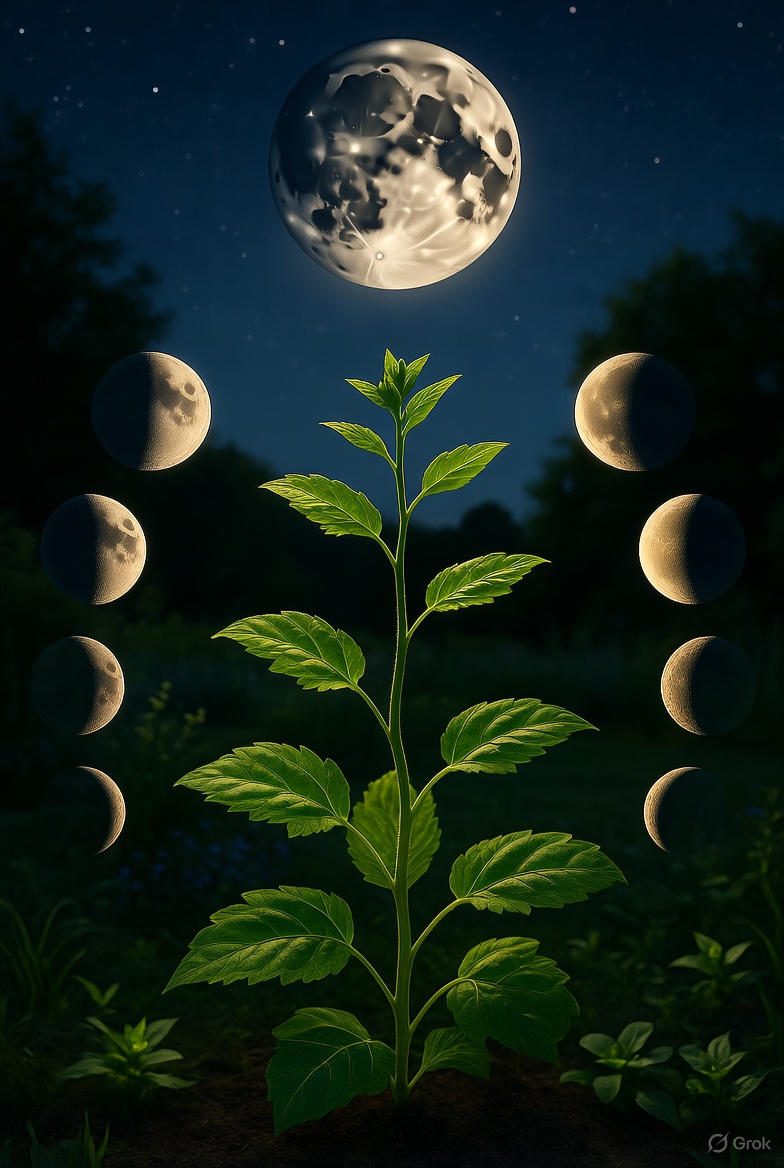
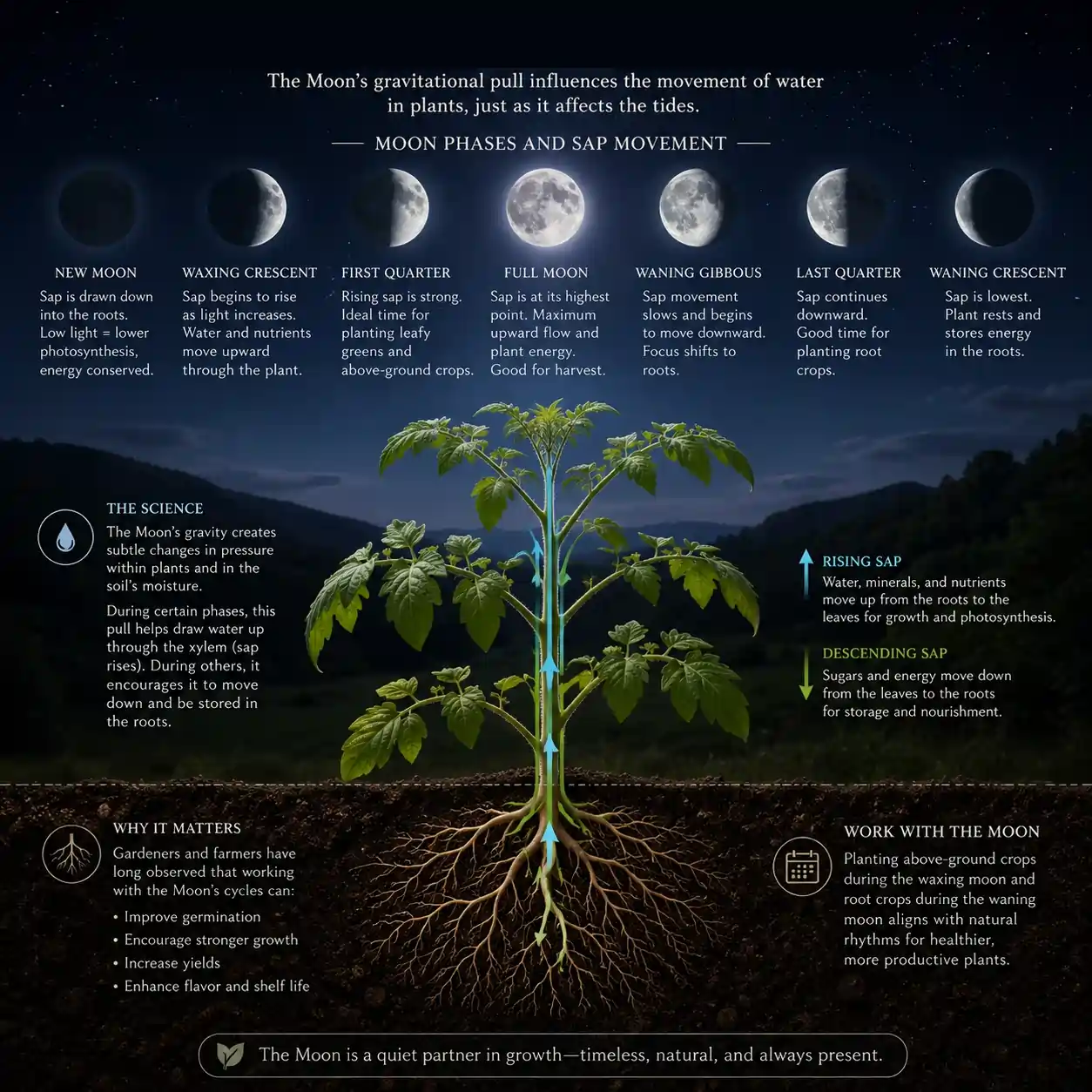
Interactive diagram showing how sap moves through a plant depending on the lunar phase — roots, stem, and leaf tissue pressure all respond to the moon's gravitational pull.
How the Moon
affects Plant Growth
Every living plant operates on a biological clock. While the sun provides the energy for life, the moon provides the rhythmic pulse that governs the movement of fluids within living tissue.
In the modern agricultural era, we are accustomed to viewing plants through the lens of chemistry — nitrogen, phosphorus, potassium levels — and meteorology. There is a third, more ancient dimension to plant life: chronobiology. Every organism on Earth, from deep-sea coral to the redwood, operates on a biological clock.
The phenomenon of lunar gardening is often dismissed as folklore, yet modern research into the electrophysiology of plants reveals a more complex reality. The moon does not merely "influence" plants; it acts as a mechanical and optical driver of water transport, cellular expansion, and nutrient distribution.
"A plant is not a static object but a dynamic system — a living pillar of water that rises and falls with the moon."
Lunar hydrodynamics — the physics of sap
The macro-tidal effect in micro-vessels
We accept that the moon's gravitational pull moves the Earth's oceans, creating tides. Physics dictates that this force acts on all bodies of water, regardless of size. Within a plant, water is held in the xylem — the tissue that transports water from roots to leaves — and the phloem, which transports sugars from leaves back to roots.
During the waxing moon, the moon's gravitational pull combined with the sun's position creates a slight but measurable "lifting" force. In the vascular system of a plant, this reduces the energy required for capillary action. Water moves more easily against gravity, surging toward the foliage — producing rising stem pressure and high leaf turgor in the waxing gibbous phase.
Cellular turgor and expansion
Turgor pressure is the force within the cell that pushes the plasma membrane against the cell wall. When sap is rising during the waxing phase, turgor pressure in leaves and stems reaches its peak. Plants often appear more vibrant and upright during the days leading up to a full moon. This is not merely aesthetic — it is a period of rapid cellular expansion. High turgor pressure is the primary driver of growth in leafy annuals.
The four biological quarters
The lunar cycle is a month-long inhalation and exhalation of the Earth's biosphere. Each quarter represents a distinct internal state for the plant — a shift in where fluids are held, where energy is directed, and what biological processes dominate.
The awakening
New moon to first quarter. Moisture is drawn from the root zone into the lower stem. Root uptake is moderate; xylem flow turns upward. Seeds sown now benefit from increasing hydraulic pressure that swells and ruptures the seed coat.
The surge
First quarter to full moon. Maximum hydraulic energy. Leaf turgor is high and tissue moisture peaks. The best window for transplanting — high sap flow allows the plant to rapidly move nutrients to its extremities to repair root shock.
The recessional
Full moon to last quarter. The plant shifts focus to the phloem. Sugars produced during the high-light waxing phase are transported downward toward the roots. Ideal for planting root crops whose tubers swell with the descending fluid.
The consolidation
Last quarter to new moon. Sap returns to the roots. Leaf turgor is at its lowest and metabolic activity slows. Because sap pressure is low, the plant bleeds less when cut — making this the optimal window for pruning and taking cuttings.
The optical signal — phytochromes and moonlight
The moon's influence is not solely gravitational; it is also optical. Plants contain phytochromes and cryptochromes — specialised proteins that act as light sensors, telling the plant whether it is day or night and what season it is. Moonlight is reflected sunlight, and while it is thousands of times weaker, research has shown that its intensity during the waxing and full phases is sufficient to trigger certain phytochrome responses that typically require darkness to pause.
Lunar photoperiodism
During the waxing gibbous and full moon, the extra light at night — even though it is thousands of times weaker than sunlight — can extend the "biological day." In many species, this triggers a growth spurt in the canopy. The plant is essentially working overtime, using low-intensity moonlight to continue cellular signalling processes that normally pause during the dark of the new moon.
Barlow's research found that even in controlled dark rooms, tree trunks continued to expand and contract in rhythm with the moon's position — suggesting an internal gravitational sense independent of light or temperature.
The Barlow research — gravitational sensing in trees
The science of lunar hydrodynamics is supported by the work of researchers including Dr. Peter Barlow. Using sensitive micrometers, Barlow and his team documented that tree trunks actually expand and contract in direct correlation with lunar tides. Even trees kept in controlled dark rooms at constant temperature and humidity continued to swell and shrink according to the moon's position.
This suggests that plants possess an internal gravitational sensor — an organic barometer — that allows them to anticipate tidal shifts and adjust their sap flow accordingly, independent of light or temperature cues. It is perhaps the most compelling evidence that lunar chronobiology is a real, measurable physical phenomenon rather than a cultural artefact.
Sap flow and nutrient density
The movement of sap is not just about water — it is about the transport of minerals, sugars, and secondary metabolites. The timing of harvest within the lunar cycle has a measurable effect on the quality and longevity of the crop.
The full moon harvest
Tissue moisture is highest at the full moon. Crops harvested during this peak are at their most hydrated and nutrient-dense. Leafy greens — lettuce, kale, herbs — harvested in this window are crisper and carry a higher concentration of essential oils and volatile compounds responsible for flavour and aroma.
The new moon storage harvest
Crops intended for long-term storage — onions, garlic, root vegetables, and timber — are best harvested during the sap-at-rest phase of the new moon. With lower moisture content in the tissue, these products are significantly less prone to rot and fungal growth, extending shelf life without chemical intervention.
Disruptions to the bio-clock
Ecological light pollution
The widespread use of artificial lighting in rural and suburban areas is a significant disruptor of lunar chronobiology. When skyglow or streetlights provide constant illumination, a plant's phytochromes can no longer detect the subtle shift between waxing and waning moons. The result is desynchronised growth — sap pressure that remains stagnant or moves in erratic pulses, weakening the plant's overall health and reducing the predictability of yield.
Soil health and hydraulic conductivity
For the lunar pulse to work, the soil must be healthy. Compaction or a lack of organic matter reduces the hydraulic conductivity of the soil — the ease with which water moves through its pores. If water cannot move freely through the soil, the moon's gravitational influence cannot draw that moisture into the roots. Biodynamic farmers emphasise regular aeration for precisely this reason: they are greasing the gears of the lunar pump.
Four operational rules for the bio-clock
We are entering a new era of precision agriculture — one where data minimises waste and maximises yield. While we often look to satellites and soil sensors, the most reliable sensor has been orbiting the Earth for billions of years. Returning to these rhythmic cycles may be among the most practical steps toward a sustainable, high-yield relationship with the land.
The future of agriculture is rhythmic
The Lunar Bio-Clock is a bridge between the ancient wisdom of the soil and the modern science of fluid dynamics. It reminds us that a plant is not a static object but a dynamic system — a living pillar of water that rises and falls with the moon. By aligning our hands with the sap flow, we stop fighting against the nature of the plant and start working with the rhythm of the planet.
As we face a future of climate instability and resource scarcity, returning to these rhythmic cycles may be our best path toward a truly sustainable, high-yield relationship with the Earth. Precision agriculture and ancient chronobiology are not in opposition — they are, at last, speaking the same language.
General chronobiology literature on phytochrome photoperiodism
Plant Chronobiology