Moon Phase Today Spain

Moon Phase Today Spain: Last Quarter

On Sunday 4 October 2026, the moon phase today in Spain is a Last Quarter, with 46% illumination. Next full moon: 26 Oct.

N
S
00:00 23:59
12:00

Times shown for Madrid (Central European Time). The Canary Islands run an hour behind the mainland — search your own city to see local times.

💡
Illumination
46%
🌙
Moon Age
22.6d
Full Moon phase diagram
Next Full Moon
26 Oct
New Moon phase diagram
Next New Moon
10 Oct

Explore Spanish Cities

Moon phase, moonrise/moonset, and local viewing details for cities across Spain.

No matching city yet — more Spanish cities are being added.

More Spanish cities added regularly.

Spain Moon Phase FAQ

What is the moon phase today in Spain?

On Sunday, October 4, 2026, the moon in Madrid is a Last Quarter with 46% illumination. Moon age: 22.6 days. The phase itself is the same right across Spain at any given moment, but moonrise and moonset times differ from city to city, so use the calculator at the top of this page or open your city's page above to check times for your own location.

Does the moon phase look different in different parts of Spain?

The phase itself doesn't change from place to place — everyone on the night side of Earth sees the same phase at the same moment. What does change is moonrise and moonset clock time. Mainland Spain and the Balearic Islands share one clock but stretch across more than 11 degrees of longitude, so the moon rises around 45 minutes later by the clock in Vigo than in Palma on the same day. Latitude matters too: the moon arcs a little higher in Málaga and Sevilla in the south than in Bilbao on the northern coast.

What time zone are moonrise and moonset times shown in?

Mainland Spain and the Balearic Islands use Central European Time, UTC+1 in winter and UTC+2 in summer. The Canary Islands use Western European Time, UTC+0 in winter and UTC+1 in summer, so they are always one hour behind the mainland. Spain changes its clocks on the last Sunday in March and the last Sunday in October, and moonrise and moonset times on this page follow the local clock in effect on each date. Spain has asked the EU to end the twice-yearly change, but no agreement has been reached, and clock-change dates are already scheduled through 2031.

Why do moonrise and sunset happen so late on the clock in Spain?

Most of Spain lies at roughly the same longitude as the United Kingdom and Portugal, but it has used Central European Time since 1940. Because its clocks run ahead of its geography, the sun and moon cross the sky about one to two and a half hours later by the clock than they would on a time zone matched to Spain's longitude, with the largest gap in western cities like Vigo during summer time. That is why evening moonrises and sunsets in Spain often fall later than visitors expect.

How often is there a full moon?

A full moon happens roughly every 29.5 days — the length of the synodic month, the time it takes the Moon to cycle through all its phases as seen from Earth. That works out to about 12 or 13 full moons a year. Check the "Next Full Moon" figure on the calculator above for the exact upcoming date.

Where are the darkest skies in Spain for watching the Moon and stars?

The Canary Islands have some of the darkest and clearest skies in Europe, which is why major research telescopes sit at the Roque de los Muchachos Observatory on La Palma and the Teide Observatory on Tenerife. On the mainland, skies darken quickly away from the big cities, especially in the less populated interior. For the full moon itself, dark skies matter less, since the Moon is bright enough to see clearly from any city on the list above.

Can I check the moon phase for a specific Spanish city?
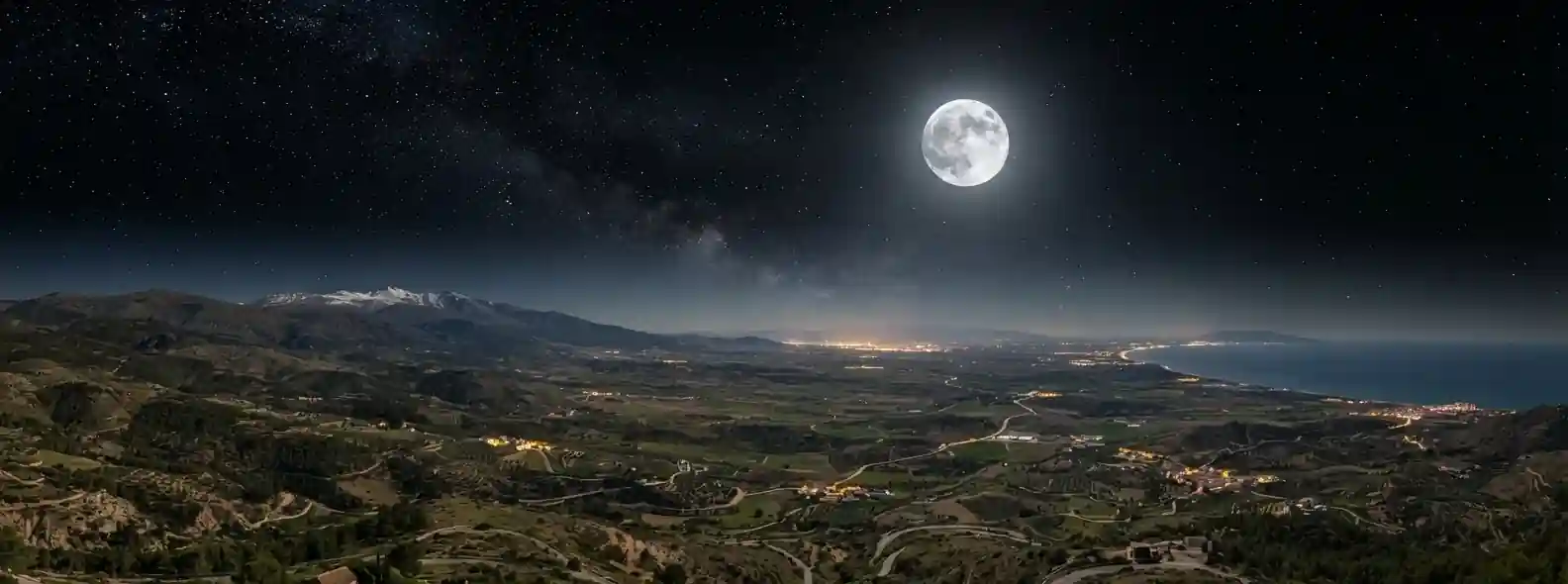
Yes — type any Spanish town or city into the location search on the calculator at the top of this page. We're also building out dedicated pages for individual Spanish cities with local viewing spots and tips; browse what's live so far in the "Explore Spanish Cities" section above.
moon-phase-today-spain-skyline-photo

Astronomy Watch Spain

Also coming up

Moon Phases Explained

The Moon doesn't change shape — only the angle of sunlight across its surface does. As it orbits Earth over 29.5 days, that shifting angle produces eight distinct phases, each with its own character and its own best targets for observation.

🇪🇸

How this looks from Spain

Mainland Spain sits at a fairly steep latitude — from Andalusia around 36°N up to Galicia and Catalonia near 43°N, with Madrid at roughly 40.4°N, comparable to Turkey or the northern US. The Canary Islands, off the coast of North Africa, sit at a notably lower latitude of around 28°N — closer to Mexico City or the US Gulf Coast — so the terminator runs visibly less steep there than on the mainland.

Spain also has a genuine clock oddity worth knowing: mainland Spain uses Central European Time, the same zone as Germany, even though its longitude actually sits closer to the UK and Portugal — a legacy of a 1940 political decision that was never reversed. The Canary Islands, despite being part of Spain, use Western European Time instead — a full hour behind the mainland, and the geographically correct zone for their location. Use the calculator above for exact moonrise, moonset, and phase times wherever you are in Spain.

Select a phase