
Moon Phase Madrid
On Sunday, October 4, 2026, the moon in Madrid is a Last Quarter with 45% illumination. Moon age: 22.6 days.
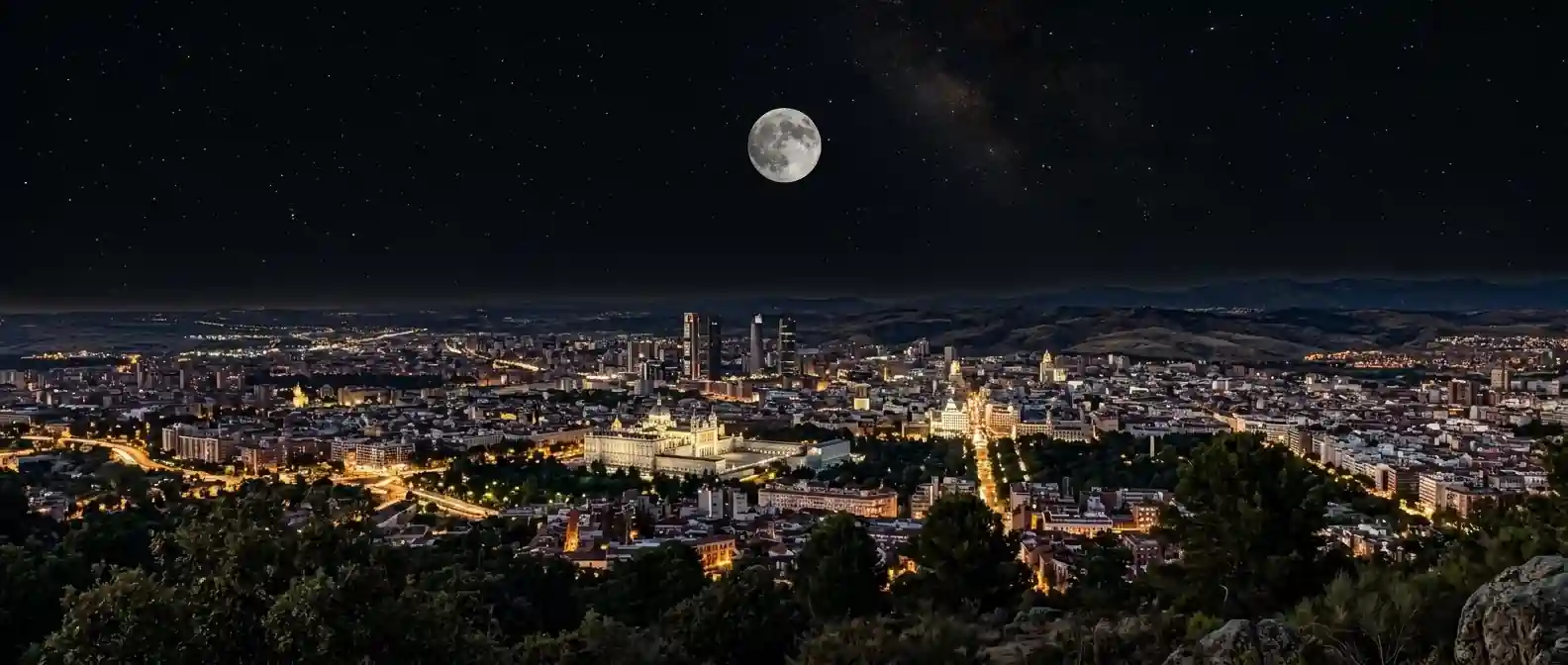
☽ Best Places to View the Moon in Madrid, Spain
Madrid sits high on the Meseta Central in central Spain, with the Manzanares River running through the city and the Sierra de Guadarrama visible to the north on clear days. It's a light-polluted metropolis, but its huge parks and hilltop viewpoints give you broad, open sky without leaving town.
Parque del Retiro – Historic Park
118 hectares at the eastern edge of the inner city. Boating lake, formal gardens and wide lawns that create big sky pockets for Moon-over-city shots. Central and well-lit — great for cityscape compositions, not dark-sky. Check current hours; it closes at night.
Casa de Campo – Cerro de Garabitas
Madrid's largest park — more than 1,722 hectares — and described as Spain's largest urban park. To the west of the city, with Cerro de Garabitas as its main viewpoint for panoramic city views. Elevated and relatively open, best for Moon-over-cityline photography.
Parque del Oeste & Templo de Debod – Western Views
The classic sunset spot. The viewpoint beside the Egyptian Templo de Debod looks straight west toward Casa de Campo. Terraces with temple and garden foregrounds, ideal for blue-hour and Moon rise when azimuth is westerly.
Madrid Río – Five Official Viewpoints
Linear park along the Manzanares with five official miradores, including Huerta de la Partida toward the western historic skyline and Glorieta de San Vicente toward Casa de Campo and the Sierra. Open river-corridor horizons for low Moon photography.
Cerro del Tío Pío – Parque de las Siete Tetas
Hilltop park in the southeast known locally as Parque de las Siete Tetas for its seven small hills. Wide panoramic views over Madrid from the summit — not 360°, but broad and high above the urban basin, perfect for moonrise over the skyline.
Teleférico & Rosaleda – Aerial Perspective
Cable car linking Parque del Oeste with Casa de Campo, offering sweeping views of the park and skyline. Not a nighttime observing location itself — check operating hours — but useful for daytime scouting and orientation before an evening session.
◉ Best Times for Moon Photography in Madrid
📷 Quick Tips for Madrid
🕐 Timezone
Central European Time — CET UTC+1 / CEST UTC+2 in summer. Europe/Madrid.
📍 Geography Note
Horizons: Madrid is on the high Meseta Central with the Manzanares River running through it and the Sierra de Guadarrama to the north visible on clear days. Your best open horizons are not in narrow streets but in big parks — Retiro to the east, Casa de Campo and Parque del Oeste to the west, and Madrid Río along the river. Templo de Debod is the natural western-facing terrace, while Tío Pío looks back over the city from the southeast.
Elevation: City sits around 650–670 m, municipality covers 605.77 km². No mountains in town — just urban hills. Retiro is 118 hectares, Parque del Oeste about 100 ha, and Casa de Campo is more than 1,722 hectares, Spain's largest urban park, with Cerro de Garabitas as its high viewpoint. Madrid Río includes five official viewpoints like Huerta de la Partida toward the historic skyline and Glorieta de San Vicente toward Casa de Campo and the Sierra. Cerro del Tío Pío is known for its seven small hills with wide panoramic city views.
Access: Retiro is a historic central park that closes at night. Casa de Campo, Parque del Oeste, Madrid Río and Cerro del Tío Pío are public outdoor parks with good trail access. Templo de Debod viewpoint is free and open. Teleférico is an aerial sightseeing ride linking Parque del Oeste and Casa de Campo — useful for orientation, but check current hours as it's not a late-night spot.
The moon phase today in Madrid is shown above. For moon phase today anywhere else, visit the calculator.
◐ What It Feels Like
In Retiro, you get 118 hectares of open lawns and a boating lake right in the dense city — sky pockets between old trees where the Moon hangs over the water.
At Casa de Campo to the west, it's wilder and higher, with Garabitas summit looking back over the whole metropolitan glow.
Along Madrid Río and at Templo de Debod, you're facing west with temple columns and river terraces in front, waiting for the Moon to rise over the historic skyline while the Sierra de Guadarrama fades blue to the north.
"Historic park on the eastern edge, Spain's largest urban park to the west with a summit view, and river terraces looking toward the old skyline."
✓ Checklist for Lunar Observers
Before You Go
- Check moonrise azimuth from your exact spot — river vs parks vs seven hills changes alignment
- Check AEMET for cloud and haze over the plateau
- Confirm park hours — Retiro closes at night, Casa de Campo and Tío Pío are open access, Templo de Debod viewpoint is open
What to Bring
- Telephoto and wide for park and Sierra foregrounds
- Tripod for blue-hour bracketing
- Lens cloth for dust
- Water and layer — it cools quickly after sunset at ~650 m on the Meseta
On the Night
- Manual focus on lunar limb
- Bracket disc vs foreground — city lights blow out fast
- Stay on paths — large parks with sensitive planting
- Light-polluted city — best for Moon-over-city, not dark-sky; Sierra visible north on clear nights
? Madrid Moon Phase — Frequently Asked Questions
Q. What is the moon phase today in Madrid?
The moon phase today in Madrid is a Last Quarter with 45% illumination. The next full moon is in 23 days, on Oct 26. Moonrise is at 12:54 AM and moonset at 4:44 PM.
Q. Where is the best place to view the moon in Madrid?
Parque del Retiro, a 118-hectare historic park on the eastern edge of the inner city, has a boating lake, formal gardens and wide lawns that give big pockets of sky for moon-over-city shots. To the west, Casa de Campo, Madrid's largest park at more than 1,722 hectares, has Cerro de Garabitas as its main viewpoint for panoramic city views. Beside Parque del Oeste, the viewpoint at the Templo de Debod looks west toward Casa de Campo, and Madrid Río has five official miradores along the Manzanares. In the southeast, Cerro del Tío Pío, known as the Parque de las Siete Tetas, gives broad views from a hilltop over the city.
Q. Is there an observatory I can visit in Madrid?
Yes, with a booking. The Real Observatorio de Madrid stands on the Cerrillo de San Blas hill beside Parque del Retiro, at Calle de Alfonso XII, 3. Founded on the initiative of King Carlos III, with its main building by Juan de Villanueva begun in 1790, it holds a Foucault pendulum, a replica of William Herschel's 60 cm reflecting telescope and a collection of historic instruments. It opens to the public through guided visits of about an hour and a half, mainly at weekends and mainly in Spanish, and booking in advance is required. It is a daytime heritage visit rather than a night observing session, so check the official booking page for current dates.
Q. Where does the moon rise and set in Madrid, and how high does it climb?
At about 40.4°N, Madrid's moonrise and moonset points swing across the horizon each month, from roughly east-northeast to east-southeast for rising and west-northwest to west-southwest for setting, with a wider swing in years near a major lunar standstill. A full moon near the winter solstice climbs high in the south, to roughly 73° above the horizon, while a full moon near the summer solstice follows a lower southern path, peaking near 26°. The Templo de Debod viewpoint and the Madrid Río miradores face west toward Casa de Campo, so they suit a setting moon, and Cerro del Tío Pío looks back toward the city to the northwest, so it suits a moon setting over the skyline. Cerro de Garabitas lies west of the city, so on some dates a rising moon can appear over the skyline from its summit. Check the azimuth for your date and exact spot.
Q. Is light pollution a problem for moon observing in Madrid?
The moon is bright enough to observe and photograph from almost anywhere in Madrid, so light pollution rarely limits the lunar disc itself. It does wash out earthshine on a thin crescent and any faint sky detail. Madrid is a large metropolis with substantial artificial lighting across the city and its surrounding suburbs, so it is a light-polluted site rather than a dark-sky one. Casa de Campo's large wooded area screens some direct lights, and the Sierra de Guadarrama is visible to the north on clear days, but the overall city glow remains.
Q. What camera settings and phases work best for moon photography in Madrid?
For a full moon, start with Looney 11 (f/11, ISO 100, 1/100 s) and refine using your histogram, since it is a baseline rather than a guarantee. The moon is much brighter than Madrid's parks, river and city lights at dusk, so shoot RAW and bracket or blend exposures to keep both crater detail and the foreground. A waxing gibbous is useful for blue hour at Retiro and the Templo de Debod while the foreground is still lit. A 200–400 mm lens helps compress the moon against Casa de Campo's ridge, the Madrid Río skyline or the seven hills of Tío Pío, with a tripod for bracketing and manual focus on the moon's edge using magnified live view. Haze over the plateau can lower contrast when the moon is low, and Retiro's lake can give a reflection when the water is calm and lies between you and the moon.
Q. How do heat, dry air and haze affect moon viewing in Madrid?
Madrid sits on a high plateau at roughly 650–670 m, with dry air and many clear nights. Summers are hot and dry, though temperatures drop quickly after sunset, and winter nights can turn cold enough for frost, so bring a layer even after a warm day. Saharan dust episodes can haze the sky and tint the moon orange near the horizon, and low cloud or fog occasionally settles over the city in winter. Check AEMET forecasts for cloud, haze and wind before heading out.
Q. What time zone are Madrid's moonrise and moonset times shown in?
Madrid runs on Central European Time: UTC+1 in winter and Central European Summer Time, UTC+2, in summer. Clocks move forward on the last Sunday in March and back on the last Sunday in October, and moonrise and moonset times on this page follow the local clock in effect on each date. Madrid lies at about 3.7°W, near the longitude of London, yet runs one hour ahead of London's clock all year, so evening moonrises and sunsets fall later on the clock than visitors from central Europe expect.
Q. Can I shoot the moon at Madrid's viewpoints after dark?
Access varies by site. Retiro is a historic central park that closes at night, so it suits a dusk moonrise rather than a late session. Casa de Campo, Parque del Oeste, Madrid Río and Cerro del Tío Pío are public outdoor parks, and the Templo de Debod viewpoint is free and open, but check posted hours and stay on marked paths after dark. The Teleférico between Parque del Oeste and Casa de Campo is a daytime ride, so check its operating hours and use it for scouting before an evening session.
Q. Does this page work for cities besides Madrid?
This page is set up specifically for Madrid, Spain. For the moon phase in any other city or location worldwide, use the Dynamic Moon Phase Calculator on the moonphase.today home page.
✦ Explore Further
Moon Phase Today: Zaragoza
Check tonight's moon phase in Zaragoza, roughly 275 km northeast of Madrid on the Ebro River.
🕌Moon Phase Today: Córdoba
See the moon over Córdoba, roughly 300 km south of Madrid on the Guadalquivir River.
🇪🇸Moon Phase in Spain
Browse moon phase pages for cities across Spain, from Vigo to Palma.
🌍World Moon Phase Directory
Find the moon phase, rise and set times for cities in every region of the world.
Blue Hour Calculator
Work out when blue hour falls, ideal for waxing gibbous shots at Retiro and the Templo de Debod.