
Moon Phase Sevilla
On Sunday, October 4, 2026, the moon in Sevilla is a Last Quarter with 45% illumination. Moon age: 22.6 days.
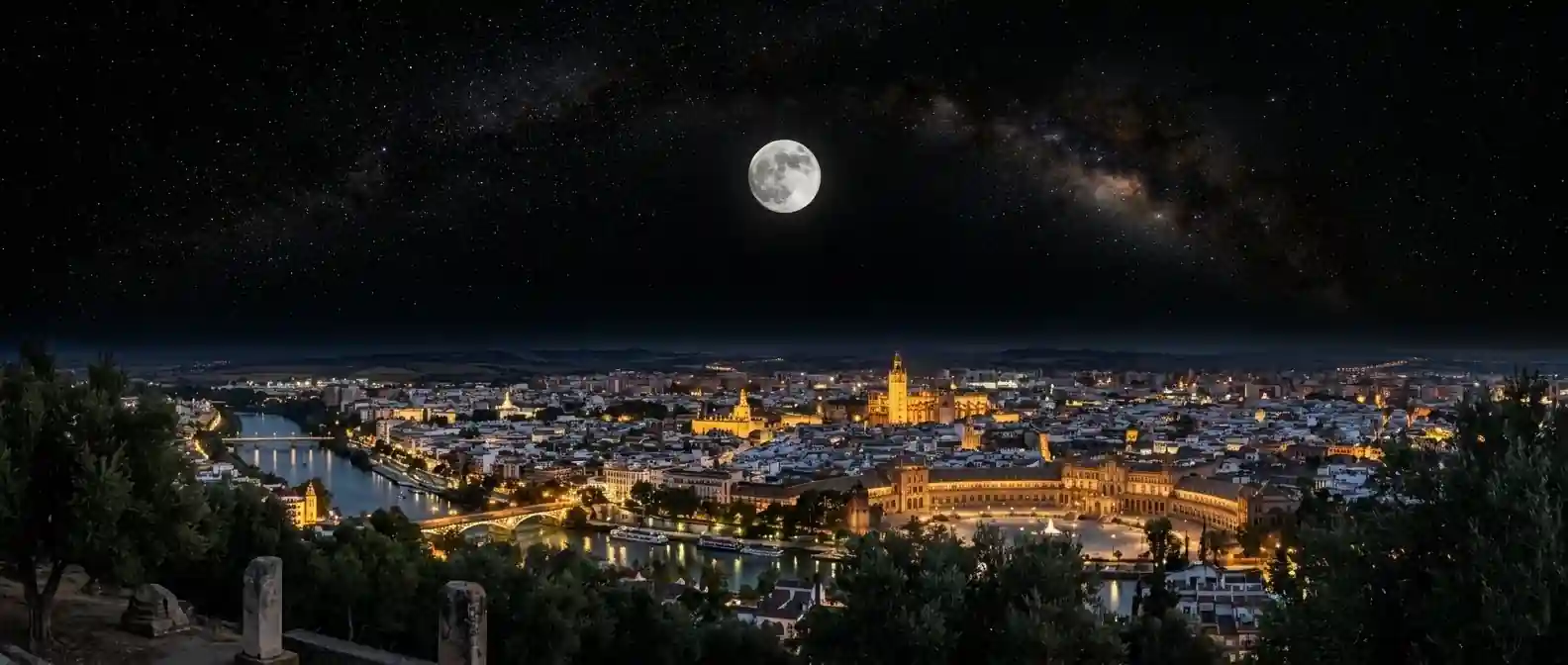
☽ Best Places to View the Moon in Sevilla, Spain
Sevilla sits on the Guadalquivir River in Andalusia, with the Triana district on the west bank. The city centre lies at low elevation, around 7 m above sea level, so there are no hills to climb. The best moon views come from open parks, plazas and the river corridor, plus one elevated viewpoint in the old town. The date and your location together set the moon's rise time and direction, and your viewpoint decides how much of that horizon is actually open.
Parque de María Luisa
Sevilla's first urban park, about 34 hectares of open parkland south of the centre beside the river. Plaza de España and Plaza de América both sit inside it. Check current park hours before an evening visit.
Plaza de España
A grand semi-circular complex with a canal and bridges, built for the 1929 Ibero-American Exposition and set inside María Luisa Park. Its open square gives broad views of the sky. It is listed as open 8:00–00:00 daily, though event or park closures can occur, so check before an evening visit.
Guadalquivir River Corridor
The riverfront along both banks, including Muelle de las Delicias, Torre del Oro and the Triana waterfront. It offers long, open horizons over the water, which suit moon-over-river compositions.
Parque del Alamillo
A 48-hectare park in the Cartuja area north of the centre, with lakes, paths and flat ground. It gives broader sky away from the densest part of the historic centre.
Metropol Parasol
An elevated structure in Plaza de la Encarnación with a viewpoint and walkway, giving a raised view over the old town. Access is controlled and ticketed, so check current opening times before planning a session.
Parque de San Jerónimo
A park on the northern edge of the city near the Guadalquivir, with wider horizons toward the floodplain and the northern districts. Check current park hours and conditions before an evening visit.
◉ Best Times for Moon Photography in Sevilla
📷 Quick Tips for Sevilla
🕐 Timezone
Central European Time (CET), UTC+1, in winter and Central European Summer Time (CEST), UTC+2, during daylight saving. Europe/Madrid zone.
📍 Geography Note
Horizons: Sevilla lies on the Guadalquivir, with Triana on the west bank. The city is low and flat, about 7 m above sea level in the centre, so buildings and trees are the main obstruction to the horizon. The river, Plaza de España and the parks give the most open views.
Access: Plaza de España is listed as open 8:00–00:00 daily, with possible event closures. Metropol Parasol is a controlled-access viewpoint, so check its hours and ticketing. Check hours and conditions at Parque de San Jerónimo before an evening visit.
Lighting: Urban locations generally have substantial artificial lighting, so they suit moon-over-city and moon-over-river compositions rather than dark-sky observing.
The moon phase today in Sevilla is shown above. For moon phase today anywhere else, visit the calculator.
◐ What It Feels Like
Parque de María Luisa gives you open parkland south of the city, running alongside the river, with Plaza de España and Plaza de América inside it.
Plaza de España, built for the 1929 Ibero-American Exposition, is a semi-circular complex of canal and bridges with broad sky above it, open until midnight apart from occasional event closures.
Along the Guadalquivir, and at Parque del Alamillo's lakes and paths, the waterfront and the northern park give open horizons for moon photography.
"A grand plaza built for a 1929 exposition, a river corridor with Triana on its west bank, and a 48-hectare park to the north."
✓ Checklist for Lunar Observers
Before You Go
- Check moonrise and moonset azimuth for your exact spot to see whether the moon will line up with the river, a plaza or a park
- Check AEMET for cloud, haze, humidity, wind and visibility
- Confirm access: Plaza de España is open 8:00–00:00 with possible event closures, and Metropol Parasol keeps its own hours
What to Bring
- A telephoto and a wide lens for river and park foregrounds
- A tripod for bracketing and steady horizons; a close moon can be shot handheld
- A lens cloth for dust, dew or condensation
- A light jacket for changing evening temperatures
On the Night
- Focus manually on the moon itself where possible
- Bracket exposures, since it is hard to hold both the lunar disc and the foreground in one shot
- Stay on designated paths and follow posted access rules
- Remember that Sevilla's parks and river corridors are lit urban spaces, good for moon-over-city shots rather than dark-sky observing
? Sevilla Moon Phase — Frequently Asked Questions
Q. What is the moon phase today in Sevilla?
The moon phase today in Sevilla is a Last Quarter with 45% illumination. The next full moon is in 23 days, on Oct 26. Moonrise is at 1:15 AM and moonset at 4:43 PM.
Q. Where is the best place to view the moon in Sevilla?
Parque de María Luisa and Plaza de España offer the most open sky, with the plaza's canal and bridges as a foreground. The Guadalquivir riverfront, including Muelle de las Delicias, Torre del Oro and the Triana bank, gives long horizons over the water, and Parque del Alamillo to the north has broader sky away from the dense historic centre. For height, Metropol Parasol in Plaza de la Encarnación is a ticketed, controlled-access viewpoint.
Q. Where does the moon rise and set in Sevilla, and how high does it climb?
At about 37°N, the moon rises between roughly northeast and southeast and sets between roughly northwest and southwest over each month, depending on its declination. A winter full moon culminates at roughly 75–80° above the southern horizon, while a summer full moon peaks at about 25°. The city centre is only about 7 m above sea level, so buildings and trees are the main horizon obstruction. Check the rise or set azimuth for your date and viewpoint before planning a shot.
Q. Which moon phase is best for photographing Sevilla?
A waxing gibbous at blue hour is useful at María Luisa and Alamillo, because the foreground is still lit while the moon is already up. A full moon generally rises around sunset and sets around sunrise, with exact timing and azimuth varying by date and location. A new moon suits night-sky photography away from the brightest urban lighting.
Q. What camera settings work best for moon photography in Sevilla?
For a full moon, start with the Looney 11 rule (f/11, ISO 100, 1/100 s) and refine with your histogram. The moon is much brighter than a dark foreground, so shoot RAW and bracket exposures to keep crater detail alongside the park, river and city lights. A 200–400 mm lens lets you frame the moon against a distant foreground such as Plaza de España or the lakes at Parque del Alamillo, and manual focus on the moon with magnified live view avoids autofocus hunting.
Q. How do haze and city lighting affect moon viewing in Sevilla?
Haze and humidity over the river plain can change contrast, so check AEMET for cloud, haze, humidity, wind and visibility before heading out. Sevilla's parks and river corridors are lit urban spaces, which suit moon-over-city and moon-over-river compositions rather than dark-sky observing. Carry a lens cloth for dust, dew or condensation.
Q. Can I photograph the moon in Sevilla after dark?
Plaza de España is listed as open 8:00–00:00 daily, though event or park closures can occur, so check before an evening visit. Metropol Parasol is a controlled-access viewpoint with its own opening times and ticketing. Check current hours at María Luisa, Alamillo and Parque de San Jerónimo, and stay on designated paths.
✦ Explore Further
Moon Phase Today: Córdoba
Check tonight's moon phase in Córdoba, northeast of Sevilla up the Guadalquivir valley.
🌊Moon Phase Today: Málaga
See the moon over Málaga, southeast of Sevilla on the Costa del Sol.
🇪🇸Moon Phase in Spain
Browse moon phase pages for cities across Spain, from Barcelona to Tenerife.
🌍World Moon Phase Directory
Find the moon phase, rise and set times for cities in every region of the world.
NASA Moon Phase & Libration Gallery
NASA's Scientific Visualization Studio's daily renders of the moon's exact phase, libration, and orientation, straight from official mission data.