
Moon Phase Vigo
On Sunday, October 4, 2026, the moon in Vigo is a Last Quarter with 45% illumination. Moon age: 22.6 days.
☽ Best Places to View the Moon in Vigo, Spain
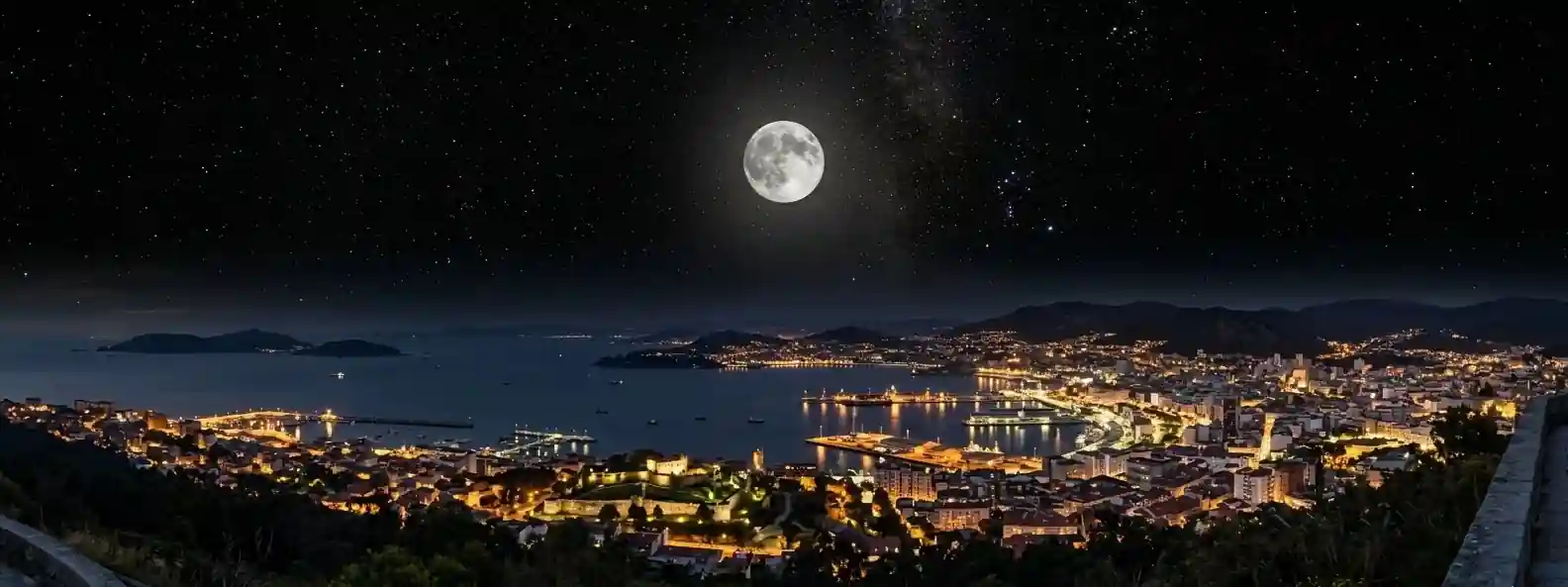
Vigo sits at roughly 42.23°N on the southern shore of the Ría de Vigo in Galicia, Spain, the most populous municipality in the region with around 296,000 residents. The city climbs the hills around the ría above one of Europe's leading fishing ports, with the historic fortress of Monte do Castro occupying a prominent position above the centre, and its municipal boundary even reaches out to a small archipelago protected as part of a national park. The ría opens to the Atlantic to the west, so the best views look west over the water, toward sunset and moonset. Between that hilltop fortress, the old town's granite lanes, and a set of islands often compared to the Caribbean, Vigo gives an unusually dramatic set of places to watch the moon.
Monte do Castro
A central hill crowned by the surviving fortress of O Castro, now a park with gardens, paths, and one of the city's best viewpoints over the Ría de Vigo. It looks out over the modern port and the silhouette of the Cíes Islands on the horizon — especially striking at sunset, when the light turns the water orange. The islands lie to the west, so the same view suits a setting moon.
Cíes Islands
A small archipelago that is technically a district of Vigo itself, protected as part of the Atlantic Islands of Galicia National Park and reached by ferry. Rodas Beach here is often compared with Caribbean shorelines. In high season, which in 2026 covers Easter week and 15 May to 15 September, entry needs an advance authorisation from the Xunta de Galicia, with a limit of 1,800 visitors a day. Day-trip ferries return in the early evening, so a day visit cannot include moonrise, and the only overnight option is the campsite.
Casco Vello (Old Town)
Vigo's historic quarter, with winding granite lanes, traditional taverns, and a distinctly Galician atmosphere. It's a good option for an evening walk with some architectural texture close to the port.
Vigo Harbour & Waterfront Promenade
One of Europe's leading fishing ports, with a well-maintained waterfront promenade running alongside the working docks (some areas of the working port itself have restricted public access). It's Vigo's easiest option for an ordinary evening, with an open view out over the ría.
Monte da Guía
A hilltop park in the Teis district, one of the city's other prominent hills alongside Monte do Castro, with a mirador beside the hermitage of Nuestra Señora de las Nieves. The views take in the city, the ría, the Rande roads and part of the O Morrazo peninsula, and it is a popular sunset spot, so it also suits a setting moon. It is a quieter option away from the busy centre, reached by car or city bus — check current access.
Rande Bridge & the Ría de Vigo
The bridge spanning the ría near the site of the 1702 Battle of Rande, where a combined Anglo-Dutch fleet defeated a Spanish and French convoy. The surrounding shoreline gives an open sightline over the water further up the estuary from the city centre.
◉ Best Times for Moon Photography
📷 Quick Photography Tips
🕐 Timezone: Vigo runs on Central European Time (UTC+1), shifting to Central European Summer Time (UTC+2) for daylight saving time, from the last Sunday in March to the last Sunday in October.
🌐 Other Locations: For the moon phase in any other city worldwide, visit our Dynamic Moon Phase Calculator for instant lunar data tailored to wherever you are.
The moon phase today in Vigo, Spain is shown in detail above — complete with exact illumination percentage, moonrise/set times, and the best viewpoints to see it. For the moon phase today in any other city or location worldwide, visit our Dynamic Moon Phase Calculator on the home page.
◐ While Actually There
Vigo doesn't separate itself from the sea the way some port cities do — it's built directly into the relationship. Monte do Castro's fortress once guarded the approach to the ría, and today it does the same job in a gentler form: it's where residents and visitors go specifically to look out at the water it was built to defend. From up there, the working harbour and the Cíes Islands on the horizon are laid out in a single view, with the sun, and on the right nights the moon, going down behind them.
The islands themselves are worth the extra effort if you have the time. Being technically part of Vigo's own municipality, despite sitting well out in the Atlantic, gives the city a genuinely unusual geography — a national park you can reach on a short ferry ride, with a beach that regularly gets compared to somewhere much further south.
None of the mainland spots require much beyond an ordinary evening's planning. Casco Vello, the harbour promenade, Monte do Castro and Monte da Guía are all straightforward, while the Cíes Islands need advance booking for both the ferry and, in high season, the Xunta authorisation.
"Vigo's old fortress hill still stands guard over the sea it was built to defend — and it's now the best place in the city to watch that same water at night."
✓ Your Vigo Moon Chase Checklist
Before You Go
- Check the moonrise and moonset times and phase on this page for each night of your stay — the Cíes Islands line up with a setting moon, not a rising one
- For the Cíes Islands, book your ferry and the Xunta authorisation well in advance if you visit in high season, and confirm the return ferry time
- Check current opening hours for Monte do Castro's park grounds before an evening visit
- Check the forecast for rain, which is common in Galicia even outside the wettest months
- Check current bus routes or plan to drive if you want Monte da Guía as a quieter alternative viewpoint
What to Bring
- A light rain layer regardless of season — Galicia's Atlantic climate brings rain even in summer
- A tripod, useful at open spots like Monte do Castro and the harbour promenade
- Comfortable shoes for Casco Vello's granite lanes and the climb up Monte do Castro
- A warm layer for winter evenings, even though freezing temperatures are uncommon
- A cloth to wipe down camera gear after time near the salty coastal air
On the Night
- Arrive 20–30 minutes before moonrise or moonset at open spots like the harbour promenade or Monte do Castro
- Shoot RAW and bracket exposures, especially where the Cíes Islands' silhouette mixes with moonlight
- Mind Atlantic wind at exposed hilltop and waterfront spots
- Day-trip ferries from the Cíes Islands return in the early evening, so don't plan to stay on the islands after dark unless you are camping
- Watch for sudden weather changes, since conditions on this coast can shift quickly
? Vigo Moon Phase — Frequently Asked Questions
Q. What is the moon phase today in Vigo?
The moon phase today in Vigo is a Last Quarter with 45% illumination. The next full moon is in 23 days, on Oct 26. Moonrise is at 1:07 AM and moonset at 5:11 PM.
Q. Where is the best place to view the moon in Vigo?
Monte do Castro, a central hill crowned by the surviving fortress of O Castro and now a park with gardens and paths, is one of the city's best viewpoints over the Ría de Vigo, the port and the Cíes Islands on the horizon. The waterfront promenade along the harbour gives an easy, open view out over the ría, though some areas of the working port have restricted access. Casco Vello, the historic old town with winding granite lanes, suits an evening walk close to the port, and the shoreline near the Rande Bridge gives an open sightline over the water further up the estuary from the city centre. For a remote vantage, the Cíes Islands sit at the mouth of the ría but need advance planning.
Q. Can I go to the Cíes Islands to watch the moon?
Only if you stay overnight. The Cíes Islands, part of the Atlantic Islands of Galicia National Park, are reached by ferry from Vigo and nearby ports. In high season, which in 2026 covers Easter week and 15 May to 15 September, visitors need an advance authorisation from the Xunta de Galicia, with a limit of 1,800 visitors a day. Day-trip ferries return in the early evening, around 17:30 to 19:00 depending on the season and port, so day visitors cannot stay for moonrise, and the only way to spend a night on the islands is the campsite. The islands lie west of Vigo, so from the mainland they make a backdrop for a setting moon. Confirm current season dates, permit rules and return times before planning a trip.
Q. Where does the moon rise and set in Vigo, and how high does it climb?
At about 42.2°N, Vigo's moonrise and moonset points swing across the horizon each month, from roughly east-northeast to east-southeast for rising and west-northwest to west-southwest for setting, with a wider swing in years near a major lunar standstill. A full moon near the winter solstice climbs high in the south, to roughly 71° above the horizon, while a full moon near the summer solstice follows a low southern path, peaking near 24°. The Ría de Vigo opens to the Atlantic to the west, and the Cíes Islands lie west of the city across the ría, the direction of moonset, so from Monte do Castro and the waterfront they suit a setting moon rather than a rising one. A rising moon comes up over land to the east, behind the city's hills and buildings. Check the azimuth for your date and exact spot.
Q. Is light pollution a problem for moon observing in Vigo?
The moon is bright enough to observe and photograph from almost anywhere in Vigo, so light pollution rarely limits the lunar disc itself. It does wash out earthshine on a thin crescent and any faint sky detail. Vigo is the most populous municipality in Galicia, with around 296,000 residents and a busy port, so it has substantial artificial lighting around the harbour and up the hillsides and is a light-polluted site rather than a dark-sky one. Looking out over the ría gives a dark-water foreground, but the port's lighting still washes out faint detail.
Q. What camera settings and phases work best for moon photography in Vigo?
For a full moon, start with Looney 11 (f/11, ISO 100, 1/100 s) and refine using your histogram, since it is a baseline rather than a guarantee. The moon is much brighter than the ría, port and city lights, so shoot RAW and bracket or blend exposures to keep both crater detail and the foreground, especially where the Cíes Islands' silhouette mixes with the light. A telephoto lens of 200–400 mm helps isolate a setting moon against the islands or the harbour from Monte do Castro, with a sturdy tripod for Atlantic wind and manual focus on the moon's edge using magnified live view. The ría can give a reflection when the water is calm and lies between you and the moon.
Q. How do Atlantic rain, wind and sea air affect moon viewing in Vigo?
Vigo has a mild Atlantic climate, with mild, rainy winters and relatively dry, warm summers, though rain is common in Galicia even outside the wettest months, so clear lunar windows can be short and conditions can shift quickly. Freezing temperatures are uncommon but possible on colder nights. Atlantic wind can pick up at exposed hilltop and waterfront spots such as Monte do Castro and the harbour promenade, shaking a tripod, and damp, salty coastal air can affect gear, so wipe down equipment after an evening near the water. Check AEMET and MeteoGalicia, the Galician weather agency, for rain, cloud, wind and visibility before heading out.
Q. What time zone are Vigo's moonrise and moonset times shown in?
Vigo runs on Central European Time: UTC+1 in winter and Central European Summer Time, UTC+2, in summer. Clocks move forward on the last Sunday in March and back on the last Sunday in October, and moonrise and moonset times on this page follow the local clock in effect on each date. Vigo lies at about 8.7°W, farther west than London and roughly level with Lisbon, yet runs one hour ahead of both cities' clocks all year, so evening moonrises and sunsets fall among the latest on the clock in mainland Spain.
Q. Can I shoot the moon at Vigo's viewpoints after dark?
Mostly, with limits. Casco Vello and the harbour promenade are public streets and waterfront, though some areas of the working port have restricted public access. Monte do Castro is a park, so check its current opening hours before an evening visit. The Cíes Islands are not an evening option for day visitors, since ferries return in the early evening and the only overnight stay is the campsite. Stay on marked paths on the hills after dark.
✦ Explore Further
Moon Phase Today: Lisbon
Check tonight's moon phase in Lisbon, roughly 390 km south of Vigo on the Portuguese Atlantic coast.
🏛Moon Phase Today: Madrid
See the moon over Madrid, roughly 470 km east-southeast of Vigo on the high central plateau.
🇪🇸Moon Phase in Spain
Browse moon phase pages for cities across Spain, from Vigo to Palma.
🌍World Moon Phase Directory
Find the moon phase, rise and set times for cities in every region of the world.
Blue Hour Calculator
Work out when blue hour falls, ideal for twilight shots over the ría from Monte do Castro.