
Moon Phase Bilbao
On Sunday, October 4, 2026, the moon in Bilbao is a Last Quarter with 45% illumination. Moon age: 22.6 days.
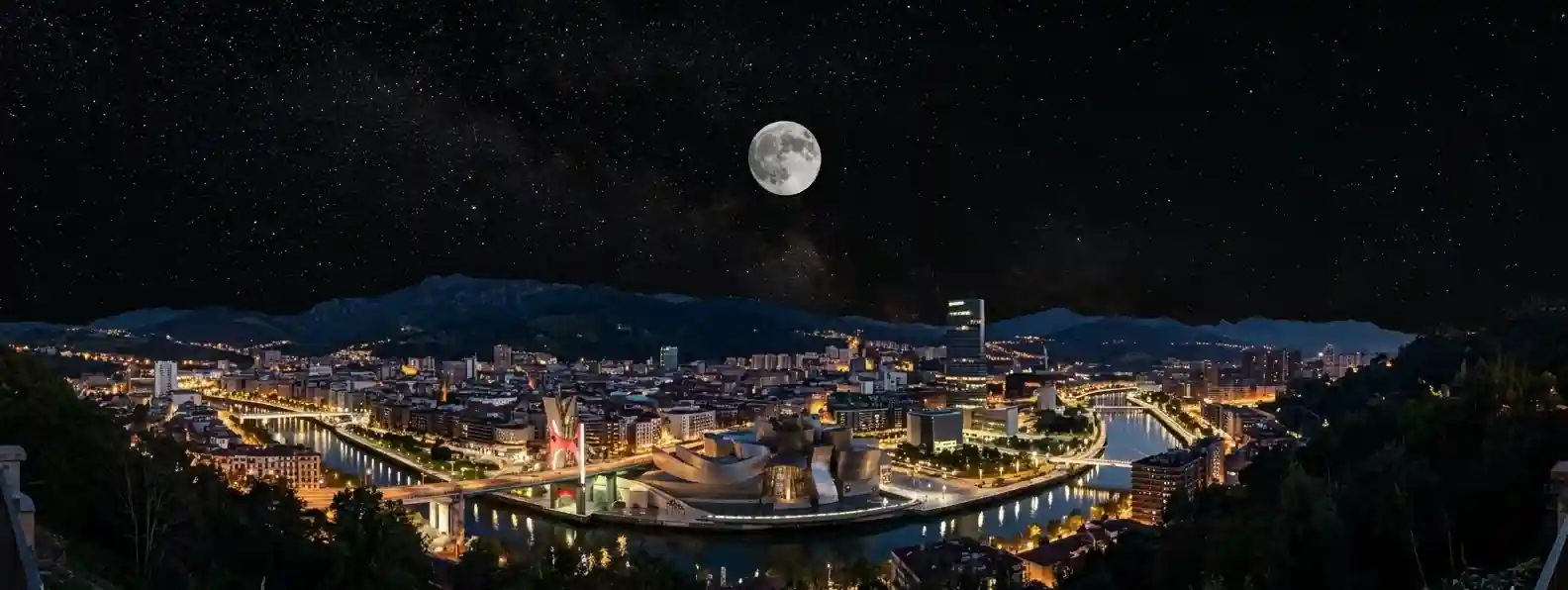
☽ Best Places to View the Moon in Bilbao, Spain
Bilbao lies in northern Spain on the Nervión estuary, close to the Bay of Biscay. The city is a low-lying urban area along the estuary, surrounded by hills and higher terrain, with an elevation of 19 m above sea level.
Monte Artxanda – Funicular Viewpoint
Bilbao Tourism describes Monte Artxanda as providing views over metropolitan Bilbao. The funicular reaches the mountain in about three minutes and can be useful for some evening sessions. Current tourism information gives service until 22:00 Monday–Saturday and 22:00 Sundays/holidays, with later service in specified summer periods. Higher terrain around Artxanda provides elevated perspectives over the Nervión estuary and metropolitan Bilbao. Check current funicular hours.
Parque Doña Casilda Iturrizar – Urban Heritage Park
Urban park with gardens, fountains and a small lake in the city centre, perfect for leisurely strolls and relaxation. Provides open sky pockets within an urban, light-polluted setting suitable for Moon-over-city compositions where access allows.
Parque Etxebarria – Elevated Urban Park
Elevated urban park on the site of a former steelworks above Casco Viejo. Open lawns and terraces offer elevated views over the historic quarter and river. Appropriate as a photographic location with significant artificial lighting rather than dark-sky conditions.
Ría de Bilbao / Abandoibarra – Estuary Corridor
Linear estuary views along the waterfront promenade from the Guggenheim toward Doña Casilda Park and the city centre. The Bilbao estuary offers scenic walks and boat trips, but buildings and bridges can interrupt the horizon in places, which matters for Moonrise and Moonset alignment. Useful for Moon-over-water compositions in a light-polluted urban corridor.
Parque del Arenal & Paseo del Arenal – Riverbank Open Areas
Historic park and riverside promenade near the Old Town with open lawns and tree-lined walks. Provides views along the river and toward the surrounding hills, suitable for blue-hour Moon sessions within the city.
Monte Pagasarri – Peri-Urban Natural Area
Peri-urban natural area in the Ganekogorta massif in the southern part of the municipality. Bilbao's planning documentation describes the Pagasarri area with ridges and cimas in roughly the 350–700 m range. Higher terrain around Pagasarri and the Ganekogorta massif provides broader views over the metropolitan basin. Check trail access and safety for evening use.
◉ Best Times for Moon Photography in Bilbao
📷 Quick Tips for Bilbao
🕐 Timezone
Central European Time (CET) — UTC+1, Central European Summer Time (CEST) — UTC+2 during daylight-saving. Europe/Madrid zone.
📍 Geography Note
Horizons: Bilbao lies in northern Spain on the Nervión estuary close to the Bay of Biscay. Low-lying urban area along the estuary surrounded by hills and higher terrain. Monte Artxanda providing views over metropolitan Bilbao with funicular reaching mountain in about three minutes. Doña Casilda Iturrizar Park with gardens and small lake, Ría de Bilbao offering scenic walks with linear estuary views where buildings and bridges can interrupt horizon.
Elevation: 19 m above sea level per Bilbao municipal website. Municipality area 41.6 km² per current city pages. Higher terrain around Artxanda and Pagasarri provides elevated perspectives over the Nervión estuary and metropolitan Bilbao. Pagasarri peri-urban natural area in Ganekogorta massif in southern part of municipality with ridges in roughly 350–700 m range providing broader views over metropolitan basin.
Access: Artxanda funicular service until 22:00 Monday–Saturday and 22:00 Sundays/holidays with later service in specified summer periods. Check current funicular hours. Urban parks such as Doña Casilda and Etxebarria within light-polluted city area, Arenal provides views along river and toward surrounding hills.
The moon phase today in Bilbao is shown above. For moon phase today anywhere else, visit the calculator on our home page.
◐ What It Feels Like
At Monte Artxanda, Bilbao Tourism describes views over metropolitan Bilbao with funicular reaching the mountain in about three minutes, above the Nervión estuary.
In Parque Doña Casilda Iturrizar, gardens and a small lake provide open sky pockets within a low-lying urban area along the estuary surrounded by hills.
Along the Ría de Bilbao from Abandoibarra toward the historic center, linear estuary views are framed by buildings and bridges that can interrupt the horizon, important for Moonrise and Moonset alignment.
"Funicular viewpoint over the metropolitan basin, gardens in the centre, and river walks where bridges frame the horizon."
✓ Checklist for Lunar Observers
Before You Go
- Check moonrise/moonset azimuth — use exact observing location to determine whether Moon will align with estuary, hills or other foregrounds, as buildings and bridges can interrupt horizon
- Check AEMET — haze, wind and visibility can vary between low-lying estuary area at 19 m and higher terrain around Artxanda and Pagasarri
- Confirm access — Artxanda funicular until 22:00 with later summer service, Doña Casilda and Etxebarria urban parks, Pagasarri peri-urban natural area in Ganekogorta massif in southern municipality
What to Bring
- Telephoto and wide for hill and estuary foregrounds
- Tripod for landscape and bracketing — useful for multi-exposure, close Moon can be handheld
- Lens cloth for dust, dew or condensation
- Water and extra layer — maritime conditions can change after sunset in low-lying estuary area
On the Night
- Manual focus on lunar limb — focus on Moon itself preferable when possible
- Bracket for disc vs. foreground — difficult to retain both in single exposure
- Stay on designated paths and observe posted access rules
- Urban parks and estuary promenades provide linear estuary views as light-polluted locations, useful for Moon-over-city and Moon-over-water rather than dark-sky observing
? Bilbao Moon Phase — Frequently Asked Questions
Q. What is the moon phase today in Bilbao?
The moon phase today in Bilbao is a Last Quarter with 45% illumination. The next full moon is in 23 days, on Oct 26. Moonrise is at 12:39 AM and moonset at 4:52 PM.
Q. Where is the best place to view the moon in Bilbao?
Monte Artxanda, reached by funicular in about three minutes, gives the widest views over metropolitan Bilbao and the Nervión estuary. In the city centre, Parque Doña Casilda Iturrizar has gardens, fountains and a small lake, and Parque Etxebarria, an elevated park above the Casco Viejo on the site of a former steelworks, looks over the historic quarter and river. Along the Ría de Bilbao, the waterfront promenade from the Guggenheim at Abandoibarra toward Doña Casilda Park gives linear estuary views, and the Parque del Arenal beside the Old Town has riverside lawns with views toward the surrounding hills. For broader views over the whole metropolitan basin, the Pagasarri area in the Ganekogorta massif to the south has ridges at roughly 350 to 700 m.
Q. Can I take the funicular up Monte Artxanda for moon views?
Yes. The Artxanda funicular climbs about 770 metres in roughly three minutes from the Plaza del Funicular, near the Zubizuri footbridge, with departures every 15 minutes. It runs until 22:00, and from June to September it runs until 23:00 on Fridays, Saturdays and the eve of holidays, but hours vary by season and during local festivals, so check Bilbao Turismo for current times. At the top, the mirador on Monte Artxanda, at about 251 m, looks out over metropolitan Bilbao and the Nervión estuary. Plan to be back at the upper station before the last departure, since the funicular is the quickest way down after dark.
Q. Where does the moon rise and set in Bilbao, and how high does it climb?
At about 43.3°N, Bilbao's moonrise and moonset points swing across the horizon each month, from roughly east-northeast to east-southeast for rising and west-northwest to west-southwest for setting, with a wider swing in years near a major lunar standstill. A full moon near the winter solstice climbs high in the south, to roughly 70° above the horizon, while a full moon near the summer solstice follows a low southern path, peaking near 23°. Bilbao lies at only 19 m above sea level in a basin ringed by hills, so buildings, bridges and the surrounding hills can hide a low moonrise or moonset from the estuary promenades. Monte Artxanda lies north of the centre and looks south over the city, the direction where the moon crosses the sky, and higher ground such as Artxanda and Pagasarri gives the clearest horizons. Check the azimuth for your date and exact spot.
Q. Is light pollution a problem for moon observing in Bilbao?
The moon is bright enough to observe and photograph from almost anywhere in Bilbao, so light pollution rarely limits the lunar disc itself. It does wash out earthshine on a thin crescent and any faint sky detail. Bilbao is the centre of a large metropolitan area with substantial artificial lighting along the estuary and across the basin, so it is a strongly light-polluted site rather than a dark-sky one. Higher ground at Artxanda and Pagasarri opens up sightlines, but darkness still depends on nearby artificial light.
Q. What camera settings and phases work best for moon photography in Bilbao?
For a full moon, start with Looney 11 (f/11, ISO 100, 1/100 s) and refine using your histogram, since it is a baseline rather than a guarantee. The moon is much brighter than the estuary, parks and city lights, so shoot RAW and bracket or blend exposures to keep both crater detail and the foreground. A waxing gibbous is useful for blue hour at Artxanda and Doña Casilda while the foreground is still lit. A 200–400 mm lens helps isolate the moon against the panoramic view from Artxanda or the higher terrain around Pagasarri, with a tripod for bracketing and manual focus on the moon's edge using magnified live view. Humidity and haze over the estuary can lower contrast, and the estuary and Doña Casilda's small lake can give a reflection when the water is calm and lies between you and the moon.
Q. How do rain, cloud and sea mist affect moon viewing in Bilbao?
Bilbao has a mild, humid Atlantic climate near the Bay of Biscay, with frequent rain and cloud through the year, including the fine drizzle locals call txirimiri, so clear lunar windows can be short and change quickly. Sea mist can fill the estuary basin while the surrounding heights stay clear, or low cloud can cap the hills, so conditions at Artxanda and Pagasarri can differ from the estuary at 19 m. Humidity can leave condensation on lenses, especially when gear moves between indoors and the damp air outside. An occasional dry southerly wind can bring clearer, milder spells. Check AEMET and Euskalmet, the Basque weather agency, for cloud, haze, wind and visibility before heading out.
Q. What time zone are Bilbao's moonrise and moonset times shown in?
Bilbao runs on Central European Time: UTC+1 in winter and Central European Summer Time, UTC+2, in summer. Clocks move forward on the last Sunday in March and back on the last Sunday in October, and moonrise and moonset times on this page follow the local clock in effect on each date. Bilbao lies at about 2.9°W, west of Greenwich, yet runs one hour ahead of London's clock all year, so evening moonrises and sunsets fall later on the clock than visitors from central Europe expect.
Q. Can I shoot the moon at Bilbao's viewpoints after dark?
Mostly, with limits. The Artxanda funicular runs until 22:00, and later on summer Fridays and Saturdays, so plan your descent around its last departure. The estuary promenade from Abandoibarra and the Parque del Arenal beside the Old Town are open public waterfront, while Parque Doña Casilda Iturrizar and Parque Etxebarria have posted hours, so check them before an evening visit. Pagasarri is a hill walk in the Ganekogorta massif, so check trail access and safety for evening use and stay on designated paths.
✦ Explore Further
Moon Phase Today: Zaragoza
Check tonight's moon phase in Zaragoza, roughly 245 km southeast of Bilbao on the Ebro River.
🏛Moon Phase Today: Madrid
See the moon over Madrid, roughly 320 km south-southwest of Bilbao on the high central plateau.
🇪🇸Moon Phase in Spain
Browse moon phase pages for cities across Spain, from Vigo to Palma.
🌍World Moon Phase Directory
Find the moon phase, rise and set times for cities in every region of the world.
Blue Hour Calculator
Work out when blue hour falls, ideal for waxing gibbous shots at Artxanda and Parque Doña Casilda.