
Moon Phase Córdoba
On Sunday, October 4, 2026, the moon in Cordoba is a Last Quarter with 45% illumination. Moon age: 22.6 days.
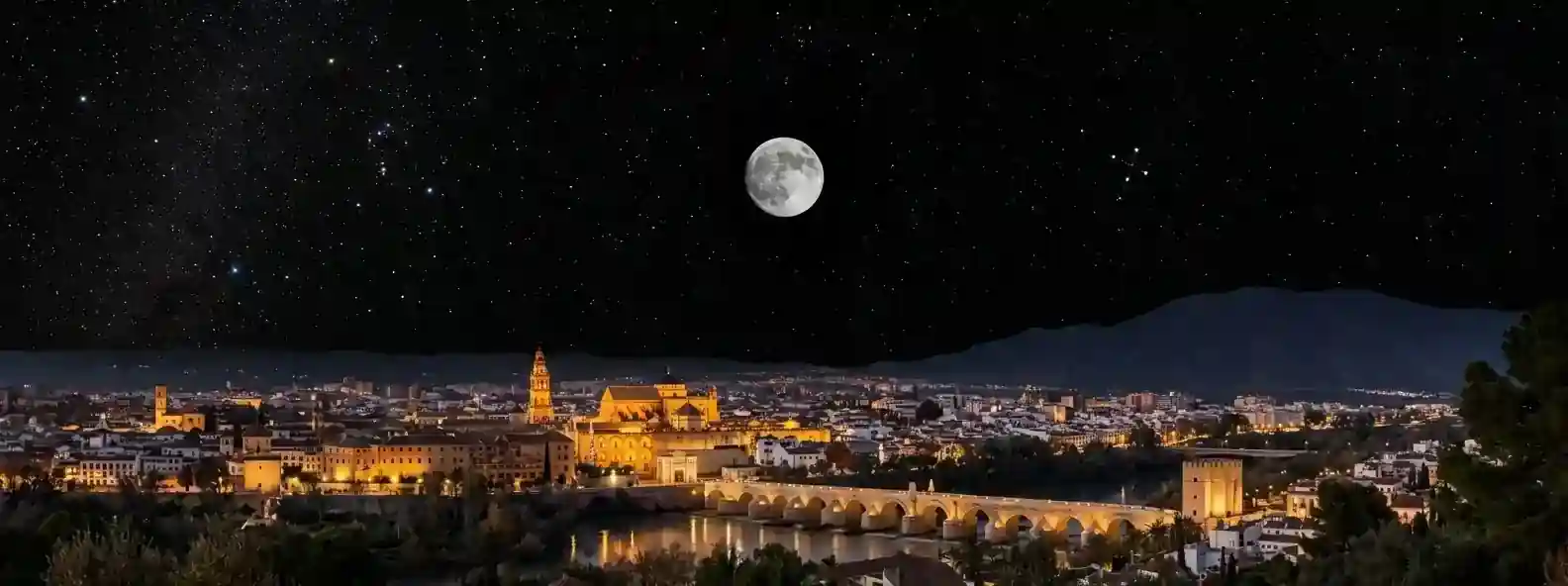
☽ Best Places to View the Moon in Córdoba, Spain
Córdoba is a low-lying city in the Guadalquivir valley, lying on the right bank of the river between the higher Sierra Morena to the north and the lower Campiña and Vega del Guadalquivir to the south. The river corridor and surrounding parks provide open horizons within a light-polluted urban environment.
Ribera del Guadalquivir & Puente Romano – Views Toward Sotos de la Albolafia
Best accessible viewpoints for photographing the protected area. Sotos de la Albolafia is 21.36 hectares and was declared a Monumento Natural in 2001 for its richness of birds. Because of difficult terrain, the Junta de Andalucía states it is not open to the public and can be viewed from the Guadalquivir riverbanks. Use the riverbanks, Roman Bridge and Miraflores riverside as foregrounds for Moon-over-river compositions toward the reserve, not as a site to enter.
Parque Cruz Conde – Urban Park
Large urban park covering 140,000 m² per Córdoba tourism material. Open lawns and tree-lined walks south of the centre provide broad sky views for Moon-over-park compositions in a light-polluted city setting.
Parque de la Asomadilla – Hilltop Park with Viewpoint
One of Córdoba's largest urban parks at about 27 hectares, with a viewpoint overlooking Córdoba. Extensive park north of the city with Mediterranean vegetation and open areas. Provides elevated perspectives over the city and toward Sierra Morena. Check trail access for evening use.
Parque Periurbano Los Villares – Sierra Viewpoint
Peri-urban park in the Sierra de Córdoba and Sierra Morena, about 8 km from Córdoba. Includes a mirador, trails and documented astronomy and night-hiking activities. Considerably more useful for Moon-viewing than the urban core, with broader horizons and darker conditions away from brightest urban lighting, while still requiring safety and access checks for nighttime use.
Paseo de la Victoria & Jardines de la Agricultura – Central Promenade
Central green promenade near the historic centre, described by the official Córdoba Film Office as a major urban green space. Not a riverside park, but a central urban park with gardens, fountains and open areas suitable for Moon-over-city compositions within the city centre.
Parque de Miraflores & Balcón del Guadalquivir – River Corridor
River corridor on the southern bank of the Guadalquivir with linear park, promenades and open areas. Provides Moon-over-river views along the Guadalquivir valley, with buildings and bridge structures that can interrupt the horizon in places. Suitable for blue-hour and evening compositions in a light-polluted environment.
◉ Best Times for Moon Photography in Córdoba
📷 Quick Tips for Córdoba
🕐 Timezone
Central European Time (CET) — UTC+1, Central European Summer Time (CEST) — UTC+2 during daylight-saving. Europe/Madrid zone.
📍 Geography Note
Horizons: Córdoba lies in central Andalusia on the right bank of the Guadalquivir, between higher Sierra Morena to the north and lower Campiña and Vega del Guadalquivir to the south. City in Guadalquivir valley with river corridor and broad parks providing open horizons.
Elevation & Area: Low-lying city in the Guadalquivir valley; municipality ranges roughly 90 m to 693 m with historic urban core around 120 m. Municipality about 1,255 km² per current municipal documentation, largest municipal territory in Andalusia.
Access: Sotos de la Albolafia is 21.36 ha Monumento Natural since 2001, not open to public due to difficult terrain, viewable from Guadalquivir riverbanks. Parque Cruz Conde 140,000 m². Parque de la Asomadilla about 27 ha with city viewpoint, one of largest urban parks. Parque Periurbano Los Villares about 8 km from Córdoba in Sierra de Córdoba with mirador and documented astronomy and night-hiking activities. Paseo de la Victoria central green promenade near historic centre.
The moon phase today in Córdoba is shown above. For moon phase today anywhere else, visit the calculator on our home page.
◐ What It Feels Like
At the Guadalquivir riverbanks near the Roman Bridge, open horizons toward Sotos de la Albolafia provide a natural foreground of islets and water birds within a protected area viewed from outside the reserve.
In Parque Cruz Conde and Paseo de la Victoria, central green spaces near the historic centre offer urban park foregrounds with broad sky within a light-polluted city.
At Parque de la Asomadilla and Parque Periurbano Los Villares in the Sierra de Córdoba, elevated viewpoints overlook Córdoba and provide broader sightlines toward the Guadalquivir valley, with Los Villares about 8 km from the city offering documented night activities.
"Riverbanks looking toward a protected islet reserve, central promenades near the historic centre, and Sierra viewpoints above the valley."
✓ Checklist for Lunar Observers
Before You Go
- Check moonrise/moonset azimuth — use exact observing location to determine whether Moon will align with river, hills or other foregrounds, as buildings and bridges can interrupt horizon
- Check AEMET for cloud, haze, wind and visibility before heading out
- Confirm access — Sotos de la Albolafia 21.36 ha Monumento Natural 2001 not open to public viewable from riverbanks, Cruz Conde 140,000 m², Asomadilla about 27 ha with viewpoint, Los Villares about 8 km in Sierra with mirador
What to Bring
- Telephoto and wide for river and hill foregrounds
- Tripod for landscape and bracketing — useful for multi-exposure, close Moon can be handheld
- Lens cloth for dust, dew or condensation
- Water and extra layer — temperatures can vary after sunset in Guadalquivir valley
On the Night
- Manual focus on lunar limb — focus on Moon itself preferable when possible
- Bracket for disc vs. foreground — difficult to retain both in single exposure
- Stay on designated paths and observe posted access rules — Sotos reserve not open to entry, view from banks
- Urban parks and river corridors provide Moon-over-city and Moon-over-water views as light-polluted locations, while Sierra viewpoints such as Los Villares provide darker-sky options where access permits
? Córdoba Moon Phase — Frequently Asked Questions
Q. What is the moon phase today in Córdoba?
The moon phase today in Córdoba is a Last Quarter with 45% illumination. The next full moon is in 23 days, on Oct 26. Moonrise is at 1:08 AM and moonset at 4:40 PM.
Q. Where is the best place to view the moon in Córdoba?
The Guadalquivir riverbanks and the Roman Bridge give Córdoba its most open horizons, with the river and the protected islets of Sotos de la Albolafia as a foreground. Sotos de la Albolafia is a 21.36-hectare Monumento Natural, declared in 2001 for its birdlife, and it is not open to the public, so view it from the riverbanks rather than trying to enter. Parque Cruz Conde and the Paseo de la Victoria give open lawns and gardens near the centre, and Parque de la Asomadilla, about 27 hectares north of the city, has a viewpoint overlooking Córdoba. Further out, Parque Periurbano Los Villares in the Sierra de Córdoba has a mirador and darker skies than the urban core.
Q. Is there a darker-sky spot near Córdoba?
Yes. Parque Periurbano Los Villares sits in the Sierra de Córdoba, about 8 km from the city, with a visitor centre, trails and several miradores. The park describes the area as part of the Sierra Morena Starlight Reserve and has offered guided night hikes and sky-observation evenings in summer, including for the Perseid meteor shower in August, so skies there are considerably darker than in the urban core. These are scheduled events, so check the park's current dates and access rules before planning a night visit. For truly dark skies, the Los Pedroches valley in the north of the province was declared a Starlight Reserve in 2016, though it is a longer drive.
Q. Where does the moon rise and set in Córdoba, and how high does it climb?
At about 37.9°N, Córdoba's moonrise and moonset points swing across the horizon each month, from roughly east-northeast to east-southeast for rising and west-northwest to west-southwest for setting, with a wider swing in years near a major lunar standstill. A full moon near the winter solstice climbs high in the south, to roughly 75° above the horizon, while a full moon near the summer solstice follows a lower southern path, peaking near 29°. The Guadalquivir runs roughly east to west through the city, so from the Roman Bridge, looking upstream suits a rising moon and looking downstream toward Sotos de la Albolafia suits a setting moon. Córdoba sits low in the valley, and buildings and bridges can interrupt the horizon in places, so check the azimuth for your date and exact spot.
Q. Is light pollution a problem for moon observing in Córdoba?
The moon is bright enough to observe and photograph from almost anywhere in Córdoba, so light pollution rarely limits the lunar disc itself. It does wash out earthshine on a thin crescent and any faint sky detail. The riverbanks, Paseo de la Victoria and the parks near the centre are all light-polluted urban sites rather than dark-sky ones. Moving up into the Sierra de Córdoba, away from the brightest urban lighting, gives broader horizons and noticeably darker conditions.
Q. What camera settings and phases work best for moon photography in Córdoba?
For a full moon, start with Looney 11 (f/11, ISO 100, 1/100 s) and refine using your histogram, since it is a baseline rather than a guarantee. The moon is much brighter than the river, parks and city lights, so shoot RAW and bracket or blend exposures to keep both crater detail and the foreground. A waxing gibbous is useful for blue hour over the Guadalquivir while the foreground is still lit. A 200–400 mm lens helps isolate the moon against the Roman Bridge, with Sotos de la Albolafia as a natural foreground viewed from the banks, or against the viewpoints at La Asomadilla and Los Villares, with a tripod for bracketing and manual focus on the moon's edge using magnified live view. The river can give a reflection when the water is calm and lies between you and the moon.
Q. How do summer heat, haze and dust affect moon viewing in Córdoba?
Córdoba has very hot summers, when daytime temperatures can reach 40°C or more, so evenings are the practical time to shoot. Winters are mild, though clear nights can turn cold enough for frost, and temperatures can vary noticeably after sunset in the Guadalquivir valley. Heat haze and dust, including Saharan dust episodes, can soften the moon near the horizon or tint it orange, and mist can form over the river on calm, cool nights. Check AEMET forecasts for cloud, haze, wind and visibility before heading out.
Q. What time zone are Córdoba's moonrise and moonset times shown in?
Córdoba runs on Central European Time: UTC+1 in winter and Central European Summer Time, UTC+2, in summer. Clocks move forward on the last Sunday in March and back on the last Sunday in October, and moonrise and moonset times on this page follow the local clock in effect on each date. Córdoba lies at about 4.8°W, well to the west of Greenwich, yet runs one hour ahead of London's clock all year, so evening moonrises and sunsets fall later on the clock than visitors from central Europe expect.
Q. Can I shoot the moon at Córdoba's viewpoints after dark?
Access varies by site. The Guadalquivir riverbanks and the Roman Bridge are open public spaces, but Sotos de la Albolafia is a protected reserve that is not open to the public, so shoot toward it from the banks and stay on designated paths. City parks such as Parque Cruz Conde, Parque de la Asomadilla and the Paseo de la Victoria have posted hours, so check them before planning an evening session. At Los Villares, the park's facilities keep their own hours and its night-sky activities are scheduled events, so confirm dates and access rules before going.
Q. Does this page work for cities besides Córdoba?
This page is set up specifically for Córdoba, Spain. For the moon phase in any other city or location worldwide, use the Dynamic Moon Phase Calculator on the moonphase.today home page.
✦ Explore Further
Moon Phase Today: Sevilla
Check tonight's moon phase in Sevilla, roughly 120 km southwest of Córdoba further down the Guadalquivir.
🌊Moon Phase Today: Málaga
See the moon over Málaga, roughly 135 km south of Córdoba on the Mediterranean coast.
🇪🇸Moon Phase in Spain
Browse moon phase pages for cities across Spain, from Vigo to Palma.
🌍World Moon Phase Directory
Find the moon phase, rise and set times for cities in every region of the world.
Blue Hour Calculator
Work out when blue hour falls, ideal for waxing gibbous shots over the Roman Bridge and the Guadalquivir.