
Moon Phase Today Barcelona
On Saturday, October 10, 2026, the moon in Barcelona is a New Moon with 0% illumination. Moon age: 28.9 days.
☽ Best Places to View the Moon in Barcelona
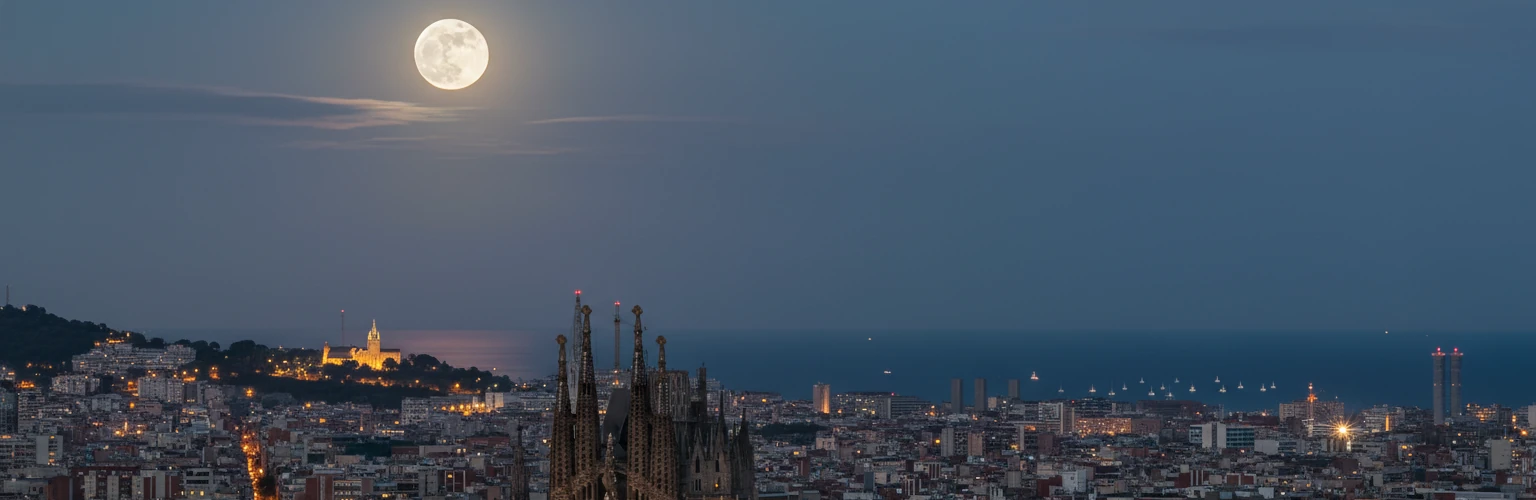
Barcelona’s unique blend of stunning Mediterranean coastline, dramatic hills, and iconic architecture creates truly magical moonrises. Whether the moon is rising over the sparkling sea behind Sagrada Família, or from an elevated viewpoint on Montjuïc, the city offers breathtaking photographic opportunities. The interplay of Gaudí’s masterpieces, vibrant city lights, and natural beauty provides unique compositions. Use specialized planning apps like PhotoPills to pinpoint the exact alignment for your desired date and location. Here are the top spots for experiencing and photographing the moon in Barcelona (all free and accessible unless otherwise noted, and always check specific venue hours for night access):
Bunkers del Carmel (Turó de la Rovira) – Daytime Views Only
The absolute #1 Barcelona daytime viewpoint. These elevated former anti-aircraft bunkers (~262 m) offer panoramic 360° views across the city skyline, Sagrada Família, and the distant Mediterranean Sea. **However, please note: the Bunkers del Carmel site is officially closed and strictly enforced before sunset (typically 7:30 pm in summer, 5:30 pm in winter) and is NOT accessible for evening or nighttime moon photography.** For after-dark moon viewing, consider nearby Parc del Guinardó (Spot 4).
Montjuïc Castle – Terraces & Walls
This historic hilltop fortress (173 m above sea level) offers superb views for moonrise photography. From its terraces and walls, the moon rises gracefully over the bustling port and city skyline, often allowing for a dramatic silhouette of the distant Sagrada Família. Accessible by cable car or bus. Entry to the castle is €12 for adults (free on Sundays after 3 pm and the first Sunday of the month). **Note: The castle closes early (8 pm in summer, 6 pm in winter), which may limit opportunities for late moonrise viewing.**
Park Güell – Upper Terraces (Paid Area)
Gaudí’s iconic park provides uniquely artistic elevated views. From its upper terraces (within the paid monumental zone), the moon rises over the city and the distinctive spires of the Sagrada Família. The vibrant mosaic-covered benches and architectural elements offer a beautiful and unparalleled foreground. Entry to the monumental zone requires a fee (around €10) and timed tickets. **Note: The monumental zone typically closes in the early evening (e.g., 9:30 pm in summer, earlier in winter), which may limit moonrise viewing depending on the date.**
Carmel Hill / Parc del Guinardó
Situated directly adjacent to the Bunkers del Carmel, this hill offers very similar and equally impressive panoramic views over the city. The moon rises majestically over the Barcelona skyline from this vantage point. **Crucially, unlike the Bunkers, Parc del Guinardó does not have enforced night closures**, making it an excellent and more reliable alternative for after-dark moonrise viewing, with well-maintained trails and ample space to find your perfect composition.
Barceloneta Beach / Port Olímpic
For a coastal perspective, the long sandy stretch of Barceloneta Beach and the vibrant Port Olímpic offer direct views of the moon rising straight out of the Mediterranean Sea. At low tide, the wet sand creates beautiful mirror reflections of the moon and the distant city lights. The iconic twin towers (Hotel Arts and Mapfre Tower) and the cityscape provide an excellent urban foreground for sea-level moonrise shots.
Tibidabo – Amusement Park Viewpoints (Seasonal Access)
At 512 meters, Tibidabo is the highest point in the Serra de Collserola, offering truly epic panoramas. Many viewpoints around the Temple Expiatori del Sagrat Cor provide breathtaking views of the entire city below, where the moon rises dramatically. **Important: Access via funicular and public transport is seasonal and aligns with the amusement park's opening hours (often closing before dark). This makes Tibidabo impractical for consistent nighttime moon photography outside of specific summer evenings.** Plan carefully for seasonal opening times if this is your chosen spot.
◉ Best Times for Moon Photography
📷 Quick Photography Tips
Barcelona operates on CET (Central European Time, UTC+1) in winter and CEST (Central European Summer Time, UTC+2) during daylight saving time. Clocks go forward on the last Sunday in March and back on the last Sunday in October. Apps like PhotoPills or Stellarium set to Barcelona automatically handle the offset, ensuring accurate moonrise and moonset times for your planning.
For the moon phase in any other city worldwide, visit our Dynamic Moon Phase Calculator for instant lunar data tailored to wherever you are.
The moon phase today in Barcelona, Spain is shown in detail above — complete with exact illumination percentage, moonrise/set times, and the best local spots to see it. For the moon phase today in any other city or location worldwide, visit our Dynamic Moon Phase Calculator on the home page.
◐ What the Experience Actually Feels Like
There’s an undeniable romance to a Barcelona moonrise. Imagine standing on Parc del Guinardó, the evening air carrying a hint of sea salt, as the sprawling city lights begin to twinkle below like scattered jewels. To the east, the iconic silhouette of Sagrada Família rises proudly, its intricate spires reaching towards the twilight sky. Then, a vast, warm orb emerges from the horizon, often appearing to perch perfectly behind Gaudí’s masterpiece or ascend gracefully over the distant Mediterranean. For a few breathtaking minutes, the city's architectural marvels and its natural coastal beauty are bathed in an ethereal, golden light, creating a moment that feels distinctly Catalan and utterly unforgettable.
Barcelona offers an incredible diversity of perspectives for this celestial spectacle. From the commanding heights of Montjuïc Castle, you gaze down at the bustling port, the shimmering coastline, and the expansive city, all crowned by the moon. The atmosphere is often vibrant, with locals and visitors alike sharing in the view. From the whimsical, mosaic-covered terraces of Park Güell, the experience is more artistic, with Gaudí's fantastical creations providing a unique, colorful foreground to the rising moon and distant Sagrada Família spires. Even from the sea level at Barceloneta Beach, the moon's ascent directly from the Mediterranean creates a powerful sense of vastness, with the wet sand reflecting its glow and the modern twin towers adding a contemporary urban touch.
The cooler months, particularly October to March, often deliver the most spectacular views. While evenings can be crisp, the air is typically clearer and less prone to the summer haze, allowing for incredibly sharp lunar details and crystalline cityscapes. The moon's more southerly path during these months can also create more dramatic and precise alignments with specific landmarks from various elevated viewpoints. Autumn brings often stable weather and beautiful, soft light before the moon takes center stage. Regardless of the season, a clear evening in Barcelona promises a moonrise that elegantly blends ancient beauty with vibrant modern life.
"A vast, warm orb emerges from the horizon, often appearing to perch perfectly behind Gaudí’s masterpiece or ascend gracefully over the distant Mediterranean. For a few breathtaking minutes, the city's architectural marvels and its natural coastal beauty are bathed in an ethereal, golden light."
✓ Your Barcelona Moon Chase Checklist
Before You Go
- Check the moonrise time and phase on this page — Barcelona's hilly terrain and coastal setting demand precise planning for landmark alignments
- Use PhotoPills or Stellarium to verify the moon's exact path and alignment with Sagrada Família or other features from your chosen viewpoint on your specific date
- Target the 48–72 hour window before full moon if possible — the moon rises during civil twilight, bathing the city in soft, balanced light
- Check weather forecasts for clear skies and low wind, essential for sharp images and comfortable viewing on exposed hillsides or beaches
- Note that some attractions (Montjuïc Castle, Park Güell, Tibidabo amusement park) have entry fees and very specific, often early, operating hours, limiting evening access. The Bunkers del Carmel are not accessible for evening viewing.
What to Bring
- Sturdy tripod — hills like Parc del Guinardó, Montjuïc, and Tibidabo can be windy, requiring maximum stability for sharp long exposures
- A telephoto lens (200-400mm) for tight compression shots — crucial for making the moon appear large and aligned with Sagrada Família or other specific spires
- A wide-angle lens (16-35mm) for expansive city and coastal panoramas, especially from Parc del Guinardó or Tibidabo
- Layers of warm clothing — evenings on the hills or by the sea can be cool, even in warmer months
- Headlamp or flashlight — many paths on the hillsides and parts of the beaches have limited lighting after dark
- Comfortable walking shoes — many top spots, especially the hills, require a decent walk or hike
On the Night
- Arrive at your viewpoint 30–45 minutes before moonrise — the pre-moonrise light over the city and sea is often spectacular, setting a beautiful mood
- From Parc del Guinardó, carefully compose your shot to align the moon with the Sagrada Família for that quintessential Barcelona image
- Shoot RAW — the extreme dynamic range between the bright moon and the illuminated city requires the flexibility of RAW files for optimal post-processing
- Stay 20–30 minutes after moonrise — as the moon climbs, the compositions shift, and the interplay of light on the landmarks continues to evolve
- For beach views at Barceloneta, consider a composition that includes the twin towers and utilizes wet-sand reflections at low tide
? Barcelona Moon Phase — Frequently Asked Questions
Q. What is the moon phase today in Barcelona?
The moon phase today in Barcelona is a New Moon with 0% illumination. The next full moon is in 17 days, on Oct 26. Moonrise is at 7:49 AM and moonset at 7:04 PM.
Q. Where is the best place to view the moon in Barcelona?
Parc del Guinardó, next to the Bunkers del Carmel, gives sweeping views over the city and Sagrada Família and stays open after dark, unlike the Bunkers themselves. Montjuïc Castle and Park Güell offer elevated views but close in the early evening, while Barceloneta Beach gives a sea-level moonrise with wet-sand reflections at low tide.
Q. Why does moon visibility change so much in Barcelona through the year?
Barcelona's hills and coastline keep most viewpoints clear year-round, so it's mostly the weather that shifts visibility: October through March tends to bring lower humidity, less haze, and a more southerly moon path that lines up well with landmarks like Sagrada Família.
Q. Does Barcelona observe daylight saving time?
Yes. Barcelona runs on CET (UTC+1) in winter and switches to CEST (UTC+2) for Central European Summer Time, from the last Sunday in March to the last Sunday in October. The times shown on this page are already adjusted for whichever period applies today.
Q. What's the best time of year for moon photography in Barcelona?
October through March offers the clearest skies and a moon path that aligns most tightly with landmarks like Sagrada Família from the city's hilltops. For beach shots at Barceloneta, checking tide tables for low tide adds the best wet-sand reflections regardless of season.
Q. Does this page work for cities besides Barcelona?
This page is set up specifically for Barcelona, Spain. For the moon phase in any other city or location worldwide, use the Dynamic Moon Phase Calculator on the moonphase.today home page.
✦ Explore Further
Moon Photography Guide
Camera settings, lenses, and techniques for shooting sharp, well-exposed moon shots.
📐Looney 11 Exposure Calculator
Dial in the exact f-stop, ISO, and shutter speed for a full moon — the same rule used in our Sagrada Família tips.
🌆Blue Hour Calculator
Find tonight's exact blue hour window to time your Parc del Guinardó moonrise shots.
🌍World Moon Phase Directory
Browse the moon phase today in hundreds of other cities and locations around the world.
NASA Moon Phase & Libration Gallery
NASA's Scientific Visualization Studio's daily renders of the moon's exact phase, libration, and orientation, straight from official mission data.