
Moon Phase Zaragoza
On Sunday, October 4, 2026, the moon in Zaragoza is a Last Quarter with 45% illumination. Moon age: 22.6 days.
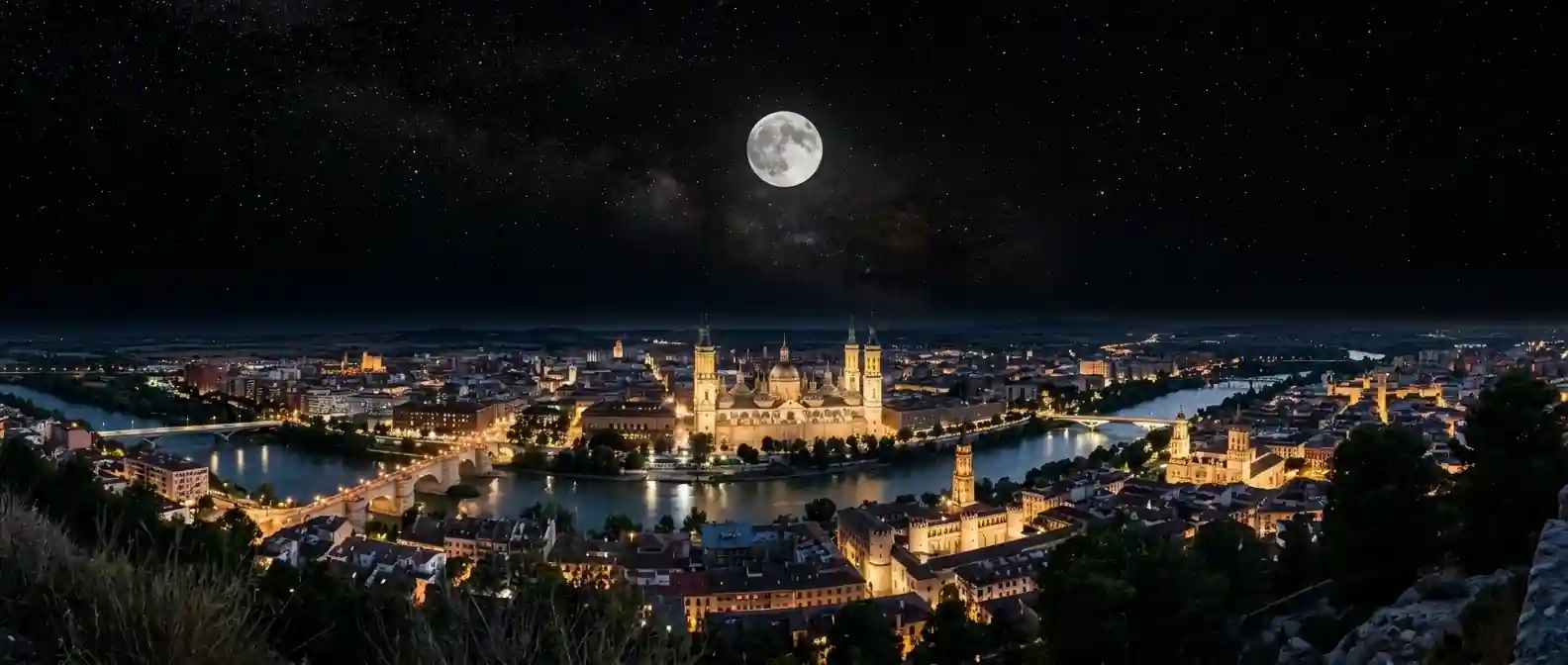
☽ Best Places to View the Moon in Zaragoza, Spain
Zaragoza sits at roughly 41.65°N on the Ebro River in northeastern Spain, the capital of Aragon and Spain's fourth-largest city with around 699,000 residents. Founded by the Romans as Caesaraugusta more than two thousand years ago, the city carries layers of Roman, Moorish, and Christian history side by side, with important Mudéjar elements of the Aljafería Palace and La Seo Cathedral included in the UNESCO World Heritage property Mudéjar Architecture of Aragon. Between a baroque basilica, an 11th-century Moorish palace, and a landmark glass tower left over from a world's fair about water, Zaragoza gives an unusually rich set of places to watch the moon.
Basílica del Pilar & Plaza del Pilar
The city's defining landmark, built largely between 1681 and 1872 on the site of a much older chapel, with interior frescoes by the Zaragoza-born painter Francisco Goya. The vast Plaza del Pilar in front of it, described by the city's own tourism board as Europe's largest pedestrian plaza, gives an open, illuminated backdrop for an evening under the moon.
Puente de Piedra
The oldest bridge over the Ebro in Zaragoza, built between 1401 and 1440, crossing the river with a view directly back toward the Basílica del Pilar's domes and towers. It's one of the most photographed vantage points in the city, especially at night when the basilica is lit.
Aljafería Palace
An 11th-century Moorish palace built by the Banu Hud dynasty, once the residence of the Muslim rulers of the Taifa of Zaragoza, with its surviving Mudéjar elements forming part of the UNESCO World Heritage listing. Its horseshoe arches and courtyards give a quieter, more historic option than the busier riverside landmarks.
Parque del Agua "Luis Buñuel" & Torre del Agua
A 120-hectare park in the Ranillas meander of the Ebro, Zaragoza's largest urban park, built as the legacy green space of the 2008 international Expo on water and sustainable development. At its edge stands the Torre del Agua, a 76-metre glass tower shaped like a water drop — one of the Expo's most iconic buildings — though it's currently closed for a major renovation expected to finish in early 2027, after which it will reopen with a new 360-degree viewing platform.
La Seo Cathedral
Zaragoza's cathedral, standing near the site of the old Roman forum, with its apse, parroquieta, and cimborio specifically included in the Mudéjar Architecture of Aragon UNESCO listing. Its plaza gives a central, easy option for an evening walk in the historic quarter.
Ebro Riverside (Paseo del Ebro)
The walking paths along the Ebro's banks, running past the old city and its bridges. It's Zaragoza's simplest option for an ordinary evening, with an open view along the water in either direction.
◉ Best Times for Moon Photography
📷 Quick Photography Tips
Zaragoza runs on Central European Time (UTC+1), switching to Central European Summer Time (UTC+2) for daylight saving time.
For the moon phase in any other city worldwide, visit our Dynamic Moon Phase Calculator for instant lunar data tailored to wherever you are.
The moon phase today in Zaragoza, Spain is shown in detail above — complete with exact illumination percentage, moonrise/set times, and the best viewpoints to see it. For the moon phase today in any other city or location worldwide, visit our Dynamic Moon Phase Calculator on the home page.
◐ While Actually There
Zaragoza wears its layers of history openly. The Romans founded it as Caesaraugusta more than two thousand years ago, the Moors later built the Aljafería as a palace fit for the rulers of an independent taifa, and Christian builders spent nearly two centuries raising the Basílica del Pilar over the site of a much older shrine. Walking from one to the other in an evening is a genuine walk through the centuries, not just a list of tourist stops.
The 2008 Expo added a very different, very modern layer to that story. Held under the theme of water and sustainable development, it left behind Parque del Agua, now the city's largest urban park, and the Torre del Agua, a water-drop-shaped tower that remains one of the Expo's most recognizable buildings. The tower itself has stood mostly closed since the fair ended, but a major renovation now underway is set to finish in early 2027 and add a proper 360-degree viewing platform — worth checking back on for a future visit, even if it isn't an option right now.
None of it requires much beyond checking the Aljafería's opening hours. The basilica, the bridges, and the riverside are all straightforward for an ordinary evening without much advance planning.
"Zaragoza has been layering history onto the same stretch of the Ebro for two thousand years — Roman, Moorish, baroque, and soon a reopened glass tower shaped like a drop of water."
✓ Your Zaragoza Moon Chase Checklist
Before You Go
- Check the moonrise time and phase on this page for each night of your stay
- Note that the Torre del Agua is closed for renovation until early 2027 — don't plan a visit around it for now
- Check current opening hours for the Aljafería Palace if you want to go inside, not just view the exterior
- Check the Fiestas del Pilar dates in October if you want to combine your visit with the city's biggest festival
- Check the forecast for the Cierzo wind, which can be strong and persistent at any time of year
What to Bring
- A warm, windproof layer for winter evenings — Zaragoza's Cierzo wind can make it feel colder than the temperature alone suggests
- A tripod, useful at open spots like the Ebro riverside and Parque del Agua
- Comfortable shoes for walking between the basilica, the bridges, and the Aljafería
- A light layer for summer evenings, which stay warm well after sunset
- Spare camera batteries kept warm in an inner pocket during cold, windy sessions
On the Night
- Arrive 20–30 minutes before moonrise at open spots like the Puente de Piedra or the Ebro riverside
- Shoot RAW and bracket exposures, especially where the illuminated basilica mixes with moonlight
- Brace for wind at exposed riverside and park locations, particularly during Cierzo events
- Confirm current hours before heading to the Aljafería in the evening
- Expect larger crowds around the Plaza del Pilar during the Fiestas del Pilar in October
? Zaragoza Moon Phase — Frequently Asked Questions
Q. What is the moon phase today in Zaragoza?
The moon phase today in Zaragoza is a Last Quarter with 45% illumination. The next full moon is in 23 days, on Oct 26. Moonrise is at 12:38 AM and moonset at 4:37 PM.
Q. Where is the best place to view the moon in Zaragoza?
The Puente de Piedra, the oldest bridge over the Ebro in Zaragoza, built between 1401 and 1440, gives an open sightline over the water with a view back toward the domes and towers of the Basílica del Pilar, which is lit at night. The vast Plaza del Pilar in front of the basilica is an open, illuminated plaza, and the plaza of La Seo Cathedral in the historic quarter makes an easy evening stop. The Ebro riverside paths, the Paseo del Ebro, run past the old city and its bridges with open views along the water in either direction. For a quieter, more historic option, the Aljafería Palace, an 11th-century Moorish palace with horseshoe arches and courtyards, is worth a visit, and the 120-hectare Parque del Agua Luis Buñuel in the Ranillas meander of the Ebro is the city's largest urban park.
Q. Can I go up the Torre del Agua for moon views?
Not at the moment. The Torre del Agua, the 76-metre water-drop tower left over from the 2008 Expo, is closed for a major renovation that began in early 2026. Project announcements give a completion date of January 2027, though a report in August 2026 said the full reopening could slip to 2028. The plans include a glazed 360-degree mirador at roughly 75 m, open to the public at set times, with views over the Ebro meander and the city. Until it reopens, use the grounds of Parque del Agua for views of the tower itself, and check Expo Zaragoza Empresarial for the current status and visiting hours.
Q. Where does the moon rise and set in Zaragoza, and how high does it climb?
At about 41.6°N, Zaragoza's moonrise and moonset points swing across the horizon each month, from roughly east-northeast to east-southeast for rising and west-northwest to west-southwest for setting, with a wider swing in years near a major lunar standstill. A full moon near the winter solstice climbs high in the south, to roughly 72° above the horizon, while a full moon near the summer solstice follows a lower southern path, peaking near 25°. Zaragoza sits in the broad Ebro valley, so the main horizon obstacles are buildings and riverside trees rather than mountains, and the Ebro bridges and riverside paths give open sightlines along the water. Check the azimuth for your date and exact spot.
Q. Is light pollution a problem for moon observing in Zaragoza?
The moon is bright enough to observe and photograph from almost anywhere in Zaragoza, so light pollution rarely limits the lunar disc itself. It does wash out earthshine on a thin crescent and any faint sky detail. Zaragoza is a large city of roughly 700,000 people with substantial artificial lighting, and the illuminated basilica and old town add to the glow along the riverside, so it is a light-polluted site rather than a dark-sky one. Open space such as Parque del Agua gives wider sky than the streets of the old town, but the overall city glow remains.
Q. What camera settings and phases work best for moon photography in Zaragoza?
For a full moon, start with Looney 11 (f/11, ISO 100, 1/100 s) and refine using your histogram, since it is a baseline rather than a guarantee. The moon is much brighter than the river, bridges and city lights, so shoot RAW and bracket or blend exposures to keep both crater detail and the foreground, especially where the illuminated basilica mixes with moonlight. A waxing gibbous is useful for blue hour over the Ebro while the foreground is still lit. A 200–400 mm lens helps isolate the moon against the basilica's domes from the Puente de Piedra, with a sturdy tripod for the Cierzo wind and manual focus on the moon's edge using magnified live view. The Ebro can give a reflection when the water is calm and lies between you and the moon.
Q. How do the Cierzo wind, fog and winter cold affect moon viewing in Zaragoza?
Zaragoza has hot, dry summers and cold winters by Spanish standards, with recurring frost and occasional sub-freezing nights typical of the Ebro valley. The Cierzo, a strong northwesterly wind, can blow at any time of year and is felt most on open ground such as the Ebro riverside and Parque del Agua, where it can shake a tripod and make evenings feel much colder than the temperature suggests. Winter can also bring fog in the Ebro valley, so clear lunar windows can close quickly. Cold, windy nights drain camera batteries faster, so carry a spare and keep it in an inner pocket. Check AEMET forecasts for cloud, wind and fog before heading out.
Q. What time zone are Zaragoza's moonrise and moonset times shown in?
Zaragoza runs on Central European Time: UTC+1 in winter and Central European Summer Time, UTC+2, in summer. Clocks move forward on the last Sunday in March and back on the last Sunday in October, and moonrise and moonset times on this page follow the local clock in effect on each date. Zaragoza lies at about 0.9°W, almost on the same longitude as London, yet runs one hour ahead of London's clock all year, so evening moonrises and sunsets fall later on the clock than visitors from central Europe expect.
Q. Can I shoot the moon at Zaragoza's viewpoints after dark?
Mostly, yes. The Puente de Piedra, the Ebro riverside paths and the Plaza del Pilar are open public spaces, and the basilica is lit at night. The Aljafería Palace keeps set opening hours, so check them if you want to go inside rather than view the exterior, and check Parque del Agua's posted hours before an evening visit. The Torre del Agua is closed for renovation. During the Fiestas del Pilar in October, expect large crowds around the Plaza del Pilar and plan to arrive early.
✦ Explore Further
Moon Phase Today: Bilbao
Check tonight's moon phase in Bilbao, roughly 245 km northwest of Zaragoza near the Bay of Biscay.
🏛Moon Phase Today: Madrid
See the moon over Madrid, roughly 275 km west-southwest of Zaragoza on the high central plateau.
🇪🇸Moon Phase in Spain
Browse moon phase pages for cities across Spain, from Vigo to Palma.
🌍World Moon Phase Directory
Find the moon phase, rise and set times for cities in every region of the world.
Blue Hour Calculator
Work out when blue hour falls, ideal for waxing gibbous shots from the Puente de Piedra.