
Moon Phase Palma
On Sunday, October 4, 2026, the moon in Palma is a Last Quarter with 45% illumination. Moon age: 22.6 days.
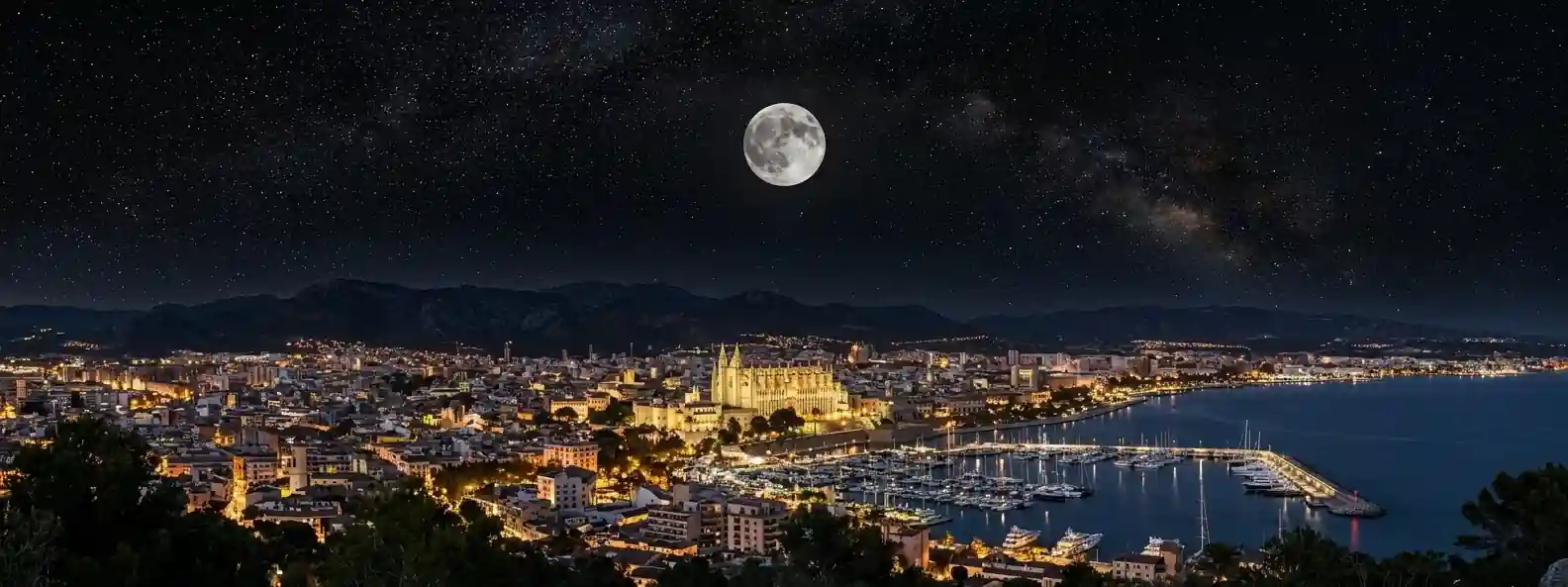
☽ Best Places to View the Moon in Palma, Spain
Palma is a coastal city on the Bay of Palma. The municipality covers about 208.6 km², while the city centre is only a few metres above sea level. Higher terrain rises west and northwest toward the Bellver and Na Burguesa areas, with the Serra de Tramuntana visible to the north on clear days.
Castell de Bellver – 14th-Century Circular Castle
14th-century circular castle west of Palma, on a hill with broad views over the Bay of Palma and Serra de Tramuntana. Not a dependable nighttime observing location. Current published hours: April–September Tuesday–Saturday 10:00–19:00, Sundays and holidays 10:00–15:00; October–March Tuesday–Saturday 10:00–18:00, Sundays and holidays 10:00–15:00; Monday closed. Castle access is daytime and evening-limited; check current hours before planning a session.
Bosc de Bellver – Pine Forest City Park
The castle is surrounded by a large pine forest used as a city park per regional tourism authority. This forested area around Bellver is a separate option and should not be treated as having the same access hours as the castle. Provides trails and elevated perspectives over the city and bay, suitable for Moon-over-city compositions where public park access allows.
Mirador de Na Burguesa / Gènova – Foot of the Range
Palma Tourism specifically identifies the viewpoint in Gènova at the foot of the Na Burguesa mountain range and describes broad views of Palma and the bay. The viewpoint in Gènova provides elevated views across Palma and the bay. Check the route and access conditions before an evening visit; walking times depend on starting point and route, and vehicle access depends on specific roads and parking.
Paseo Marítimo – Waterfront Promenade with Bay Views
Waterfront promenade with Bay of Palma views. Official Balearic tourism information describes the promenade as approximately 5.5 km long with views across the bay, but a general description is sufficient for Moon photography. Linear coastal promenade suitable for Moon-over-water compositions with city and bay foregrounds.
Can Pere Antoni – Urban Beach with Cathedral Views
Palma Tourism describes it as the urban beach closest to Palma, more than 700 m long, with views of the Cathedral and access via the Paseo Marítimo. Open Mediterranean views, making it useful for Moon-over-water compositions. Exact Moon alignment depends on position along the beach and promenade.
Es Baluard & Cathedral Terraces – Scheduled Elevated Viewpoints
Controlled-access cultural sites rather than freely accessible nighttime observing platforms. Es Baluard is a museum with exterior terraces that provide excellent views of the sea and Cathedral per official Palma Tourism. Current listed hours: Tuesday–Saturday 10:00–20:00 and Sunday 10:00–15:00, closed Monday. Cathedral terraces have scheduled access: terrace season March–November with scheduled visits Monday–Friday and Saturday; special sunset terrace visits occur during summer. Useful for daytime and early-evening photography, but check current terrace tours and times.
◉ Best Times for Moon Photography in Palma
📷 Quick Tips for Palma
🕐 Timezone
Central European Time (CET) — UTC+1, Central European Summer Time (CEST) — UTC+2 during daylight-saving. Europe/Madrid zone.
📍 Geography Note
Horizons: Palma is a coastal city on the Bay of Palma. Higher terrain rises west and northwest toward Bellver and Na Burguesa areas. Es Pla is a recognized plain of Mallorca to the east. Mediterranean Sea and Bay of Palma provide major open-water photographic foreground with waterfront promenade about 5.5 km long per official tourism information.
Elevation & Area: Municipality about 208.6 km², city centre only a few metres above sea level per commonly reported municipal figures of about 208.63 km² and 13 m elevation. Castell de Bellver 14th-century circular castle west of Palma on hill with broad views Bay of Palma and Serra de Tramuntana. Bosc de Bellver large pine forest used as city park surrounding castle. Mirador de Na Burguesa viewpoint in Gènova at foot of Na Burguesa mountain range with broad views Palma and bay. Can Pere Antoni urban beach closest to Palma more than 700 m long with views of Cathedral and access via Paseo Marítimo. Paseo Marítimo waterfront promenade with Bay of Palma views.
Access: Bellver Castle daytime and evening-limited April–September Tue–Sat 10:00–19:00 Sun/holidays 10:00–15:00 Oct–March Tue–Sat 10:00–18:00 Sun/holidays 10:00–15:00 Mon closed. Bosc de Bellver forest separate option not same hours as castle. Es Baluard museum Tue–Sat 10:00–20:00 Sun 10:00–15:00 closed Mon, exterior terraces excellent views sea and Cathedral. Cathedral terraces scheduled access season March–November scheduled visits Mon–Fri and Sat special sunset terrace visits summer check current tours and times. Waterfront and beach locations generally unrestricted public space with substantial artificial lighting.
The moon phase today in Palma is shown above. For moon phase today anywhere else, visit the calculator on our home page.
◐ What It Feels Like
At Castell de Bellver, a 14th-century circular castle west of Palma provides broad views over the Bay of Palma and Serra de Tramuntana within daytime and evening-limited hours.
In Bosc de Bellver, a large pine forest used as a city park surrounding the castle provides trails and elevated perspectives over the city and bay as a separate option from the castle interior.
At the viewpoint in Gènova at the foot of the Na Burguesa range, and along Paseo Marítimo waterfront promenade and Can Pere Antoni urban beach more than 700 m long with Cathedral views, broad bay views provide open horizons for Moon-over-water compositions.
"Circular castle with daytime hours, pine forest city park around it, viewpoint at the foot of the Na Burguesa range, and waterfront with urban beach closest to the city."
✓ Checklist for Lunar Observers
Before You Go
- Check moonrise/moonset azimuth — use exact observing location to determine whether Moon will align with bay, port or hill foregrounds around Bay of Palma
- Check AEMET for cloud, haze, humidity, wind and visibility
- Confirm access — Bellver Castle Apr–Sep Tue–Sat 10:00–19:00 Sun 10:00–15:00 Oct–Mar Tue–Sat 10:00–18:00 Sun 10:00–15:00 Mon closed, Bosc de Bellver forest separate, Na Burguesa viewpoint in Gènova at foot of range broad views Palma and bay check route, Es Baluard Tue–Sat 10:00–20:00 Sun 10:00–15:00 Cathedral terraces Mar–Nov scheduled
What to Bring
- Telephoto and wide for hill and bay foregrounds
- Tripod for landscape and bracketing — useful for multi-exposure, close Moon can be handheld
- Lens cloth for dust, dew or condensation
- Light jacket for changing evening temperatures and coastal breezes
On the Night
- Manual focus on lunar limb — focus on Moon itself preferable when possible
- Bracket for disc vs. foreground — difficult to retain both in single exposure
- Stay on designated paths and observe posted access rules — Bellver Castle daytime-limited, Bosc de Bellver forest separate city park, Es Baluard and Cathedral terraces scheduled access
- Waterfront and beach locations provide open horizons as light-polluted locations useful for Moon-over-city and Moon-over-water rather than dark-sky observing, while higher viewpoints such as Gènova at foot of Na Burguesa range provide broader bay views
? Palma Moon Phase — Frequently Asked Questions
Q. What is the moon phase today in Palma?
The moon phase today in Palma is a Last Quarter with 45% illumination. The next full moon is in 23 days, on Oct 26. Moonrise is at 12:31 AM and moonset at 4:14 PM.
Q. Where is the best place to view the moon in Palma?
The Paseo Marítimo, a waterfront promenade of about 5.5 km with views across the Bay of Palma, and Can Pere Antoni, the urban beach closest to the centre, more than 700 m long with Cathedral views, give the most open Mediterranean horizons. The viewpoint in Gènova at the foot of the Na Burguesa range gives elevated views across Palma and the bay, though you should check the route and access before an evening visit. Castell de Bellver, west of the city, has broad views over the bay and the Serra de Tramuntana but is not a dependable nighttime location, and the Bosc de Bellver pine forest around it is a separate option with its own access. Es Baluard and the Cathedral terraces are scheduled elevated viewpoints.
Q. Where does the moon rise and set in Palma, and how high does it climb?
At about 39.6°N, Palma's moonrise and moonset points swing across the horizon each month, from roughly northeast to southeast for rising and northwest to southwest for setting. A winter full moon culminates high in the south, at roughly 74° above the horizon, while a summer full moon stays low, peaking near 27°. The Bay of Palma opens to the south, so the moon's high southern path crosses the water, while the higher terrain of Bellver and Na Burguesa lies to the west and northwest and the Serra de Tramuntana to the north, so a winter moon setting in the northwest sets toward that higher ground. From Can Pere Antoni the Cathedral lies to the west-southwest, so a setting moon can appear near it on some dates. Check the azimuth for your date and exact spot.
Q. Is light pollution a problem for moon observing in Palma?
The moon is bright enough to observe and photograph from almost anywhere in Palma, so light pollution rarely limits the lunar disc itself. It does wash out earthshine on a thin crescent and any faint sky detail. The waterfront and beach locations are generally unrestricted public space with substantial artificial lighting, so Palma is a light-polluted site rather than a dark-sky one, best suited to moon-over-city and moon-over-water compositions. Higher viewpoints such as the one in Gènova give broader bay views, but not darker sky.
Q. What camera settings and phases work best for moon photography in Palma?
For a full moon, start with Looney 11 (f/11, ISO 100, 1/100 s) and refine using your histogram, since it is a baseline rather than a guarantee. The moon is much brighter than the lit waterfront and city, so shoot RAW and bracket or blend exposures to keep both crater detail and the foreground. A waxing gibbous is useful for blue hour at Can Pere Antoni and the Bellver forest while the foreground is still lit, and a full moon rises around sunset. A 200–400 mm lens helps isolate the moon against the Cathedral or distant hills, with a tripod for bracketing and manual focus on the moon using magnified live view.
Q. How do haze, humidity and sea breezes affect moon viewing in Palma?
Palma is a coastal city on the Bay of Palma, and humidity and haze over the sea can reduce sky transparency and soften lunar contrast, particularly with a low moon over the water. Cloud, wind and sea breezes can change conditions quickly and can shake a tripod at exposed waterfront spots, and dew or condensation can form on lenses. Check Spain's AEMET forecasts for cloud, haze, humidity, wind and visibility before heading out, and carry a lens cloth.
Q. Can I shoot the moon at Palma's viewpoints after dark?
Access varies by site. Castell de Bellver keeps daytime hours, currently Tuesday to Saturday 10:00–19:00 from April to September and 10:00–18:00 from October to March, Sundays and holidays 10:00–15:00, closed Monday, so it is not a dependable nighttime location. The Bosc de Bellver forest has its own access and should not be assumed to share the castle's hours. Es Baluard is open Tuesday to Saturday 10:00–20:00 and Sunday 10:00–15:00, closed Monday, and the Cathedral terraces run scheduled visits from March to November, with special sunset visits in summer, so check current tours and times. The Gènova viewpoint depends on specific roads, parking and walking routes, while the waterfront and beach are generally open public space.
Q. Does this page work for cities besides Palma?
This page is set up specifically for Palma, Spain. For the moon phase in any other city or location worldwide, use the Dynamic Moon Phase Calculator on the moonphase.today home page.
✦ Explore Further
Moon Phase Today: Barcelona
Check tonight's moon phase in Barcelona, northeast of Palma across the Balearic Sea.
⚓Moon Phase Today: Valencia
See the moon over Valencia, west of Palma on the Spanish mainland coast.
🇪🇸Moon Phase in Spain
Browse moon phase pages for cities across Spain, from Madrid to Seville.
🌍World Moon Phase Directory
Find the moon phase, rise and set times for cities in every region of the world.
Eclipses
Check upcoming lunar and solar eclipses and whether they are visible from the Balearic Islands.