
Moon Phase Málaga
On Sunday, October 4, 2026, the moon in Malaga is a Last Quarter with 45% illumination. Moon age: 22.6 days.
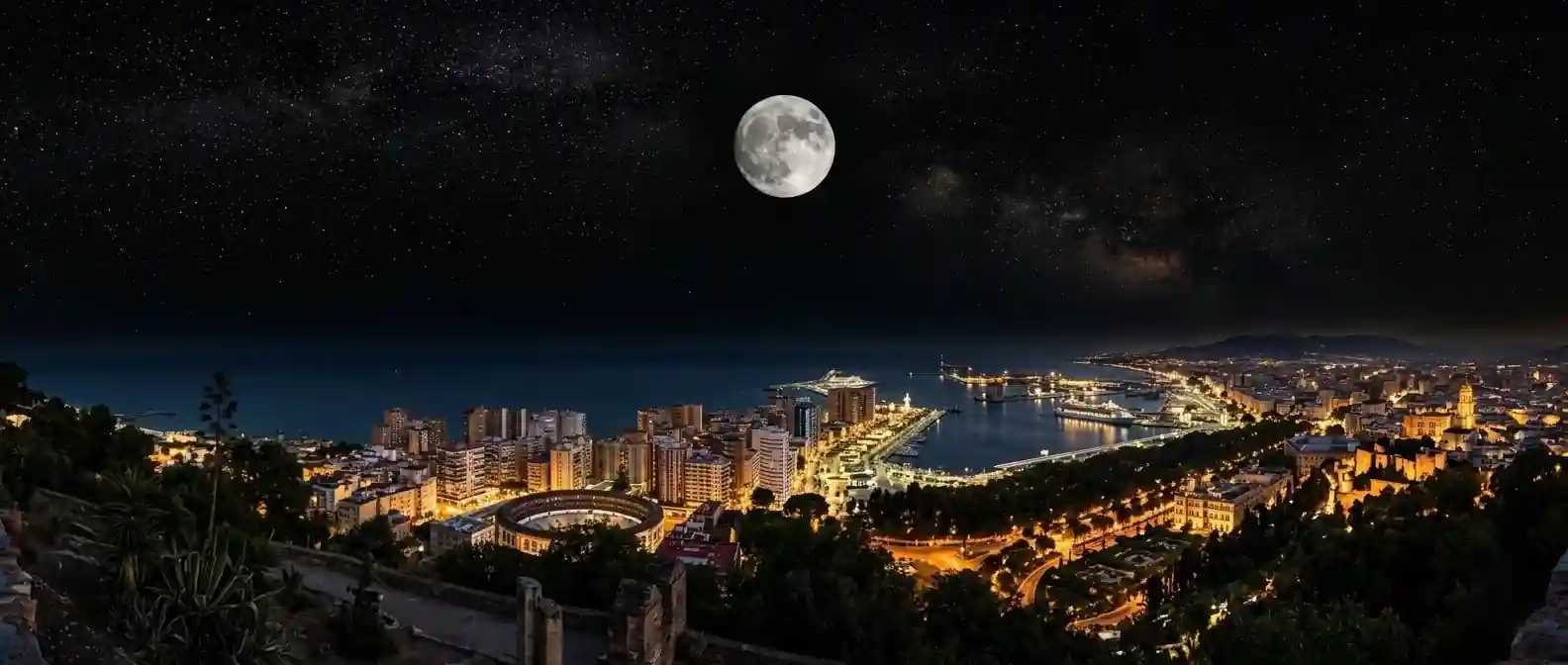
☽ Best Places to View the Moon in Málaga, Spain
Málaga is a coastal city on Málaga Bay on the Costa del Sol, where the Guadalmedina River cuts through the historic centre and the Guadalhorce Valley opens to the west. The centre is low — around 11 m above sea level — while the municipality rises quickly into the southern foothills of the Montes de Málaga, giving you both sea-level horizons and hilltop panoramas within minutes.
Mirador de Gibralfaro – 130 m Hilltop
The classic elevated viewpoint over Málaga, the port and the bay. The hill is about 130 m high. The mirador itself is outside the castle and can be useful after hours, while the castle interior has restricted hours. Great for panoramic Moon-over-city shots.
Castillo de Gibralfaro – Daytime / Early-Evening Only
Historic fortress on the same hill. Currently open 09:00–18:00 from Nov–Mar and 09:00–20:00 from Apr–Oct, last entry an hour before close. Perfect for blue-hour and early Moon rise when it aligns with opening times, not for late-night observing inside.
Parque Forestal de Gibralfaro – Hillside Trails
Forested park linking the Alcazaba and Gibralfaro Castle, with more than 2 km of trails through pine and hillside. Shaded paths with intermittent viewpoints over the centre and bay — good for framed Moon-over-city compositions.
Monte Victoria – 193.5 m Forest Park
A forested park northeast of the centre, about 193.5 m high and much larger and wilder than Gibralfaro. Open horizons above the urban basin, with Montes de Málaga to the north, Gibralfaro to the south, and Monte San Antón (500 m) to the east. One of the best natural high points for moonrise.
Playa de la Malagueta – Urban Beach 1.2 km
City beach right next to the historic centre with a long seafront promenade. About 1.2 km of sand facing the Mediterranean — ideal for Moon-over-water when azimuth lines up with the bay. Light-polluted, so better for reflective cityscapes than dark-sky work.
Peñón del Cuervo – Coastal Natural Park
Municipal coastal park at the far eastern edge of Málaga, with a 2 km continuous trail along rocky coves in a natural Mediterranean setting. More open and darker than Malagueta, with true sea horizons. Pairs well with Muelle Uno, the seafront promenade overlooking the bay.
◉ Best Times for Moon Photography in Málaga
📷 Quick Tips for Málaga
🕐 Timezone
Central European Time — CET UTC+1 / CEST UTC+2 in summer. Europe/Madrid.
📍 Geography Note
Horizons: Coastal city on Málaga Bay, open to the Mediterranean. The bay itself is your main open horizon, complemented by the Guadalmedina River through the centre and the Guadalhorce Valley to the west. Malagueta and Peñón del Cuervo give you sea-level views; Gibralfaro and Monte Victoria lift you above the basin.
Elevation: The historic centre sits around 11 m, but the municipality covers about 398 km² and climbs into the Montes de Málaga. Gibralfaro is about 130 m and Monte Victoria is about 193.5 m, with Monte San Antón at 500 m visible to the east. No need for exact square-metre park sizes — think: Gibralfaro's forest park has kilometres of trails between Alcazaba and the castle, Monte Victoria is a larger forest park above it, and Peñón del Cuervo is a 2 km coastal trail at the far east end.
Access: Castillo de Gibralfaro is daytime and early-evening only (09:00–18:00 Nov–Mar, 09:00–20:00 Apr–Oct). The mirador and surrounding hillside trails, Monte Victoria, Malagueta promenade, Muelle Uno and Peñón del Cuervo are public outdoor areas. All are urban or semi-urban with significant artificial light — great for Moon-over-city and Moon-over-water, not dark-sky.
The moon phase today in Málaga is shown above. For moon phase today anywhere else, visit the calculator.
◐ What It Feels Like
On Gibralfaro at dusk, about 130 m up, the port lights start to flicker and the bay opens wide — the Moon lifts out of the sea haze right over the water.
On Monte Victoria a little higher and wilder, pine forest and open ridge give you the whole basin, from Montes de Málaga to the 500 m hump of San Antón in the east.
Down on Malagueta and Peñón del Cuervo, you're at sea level with a 2 km promenade and rocky coves, where the Moon makes a silver path across the Mediterranean.
"Hilltop fortress above the port, forested ridges between castles, and beaches and rocky coves looking out over Málaga Bay."
✓ Checklist for Lunar Observers
Before You Go
- Check moonrise azimuth from your exact spot — bay vs port vs hills changes alignment
- Check AEMET for cloud, haze and sea breeze
- Confirm hours — Gibralfaro castle is daytime only, mirador and parks are open, Peñón del Cuervo has a coastal trail
What to Bring
- Telephoto and wide — hill and sea need both
- Tripod for blue-hour bracketing
- Lens cloth for sea spray and humidity
- Light layer — sea breeze gets cool after sunset
On the Night
- Manual focus on lunar limb, lock it
- Bracket disc vs foreground
- Stay on paths — protected hillside and coastal rocks
- Expect light pollution — use it for Moon-over-city and water, not dark-sky
? Málaga Moon Phase — Frequently Asked Questions
Q. What is the moon phase today in Málaga?
The moon phase today in Málaga is a Last Quarter with 45% illumination. The next full moon is in 23 days, on Oct 26. Moonrise is at 1:11 AM and moonset at 4:35 PM.
Q. Where is the best place to view the moon in Málaga?
The Mirador de Gibralfaro, on a hill about 130 m high, is the classic elevated viewpoint over the city, the port and the bay, and the mirador itself is outside the castle and can be useful after hours. Monte Victoria, a forested park about 193.5 m high northeast of the centre, gives open horizons above the urban basin and is one of the best natural high points for moonrise. At sea level, Playa de la Malagueta, about 1.2 km of city beach, and the seafront promenade at Muelle Uno suit moon-over-water compositions, while Peñón del Cuervo, a coastal park at the far eastern edge with a 2 km trail along rocky coves, is more open and darker. The Castillo de Gibralfaro is a daytime and early-evening site.
Q. Where does the moon rise and set in Málaga, and how high does it climb?
At about 36.7°N, Málaga's moonrise and moonset points swing across the horizon each month, from roughly east-northeast to east-southeast for rising and west-northwest to west-southwest for setting. A winter full moon culminates high in the south, at roughly 77° above the horizon, while a summer full moon stays low, peaking near 30°. Málaga Bay opens to the Mediterranean to the south, so the moon's whole southern path crosses the sea. A summer full moon rising in the southeast can come up over the water from the Gibralfaro mirador or Malagueta, while a winter full moon rises further north over land, and the Montes de Málaga lie to the north. Check the azimuth for your date and exact spot.
Q. Is light pollution a problem for moon observing in Málaga?
The moon is bright enough to observe and photograph from almost anywhere in Málaga, so light pollution rarely limits the lunar disc itself. It does wash out earthshine on a thin crescent and any faint sky detail. All of these spots are urban or semi-urban with significant artificial lighting, so Málaga is a light-polluted site rather than a dark-sky one, best suited to moon-over-city and moon-over-water compositions. Peñón del Cuervo and Monte Victoria are the better choices around a new moon, being more open and darker than the beachfront.
Q. What camera settings and phases work best for moon photography in Málaga?
For a full moon, start with Looney 11 (f/11, ISO 100, 1/100 s) and refine using your histogram, since it is a baseline rather than a guarantee. The moon is much brighter than the port and promenade at dusk, so shoot RAW and bracket or blend exposures to keep both crater detail and the lit foreground. A waxing gibbous is useful for blue hour from Gibralfaro and Malagueta while the foreground is still lit, and a full moon rises around sunset. A 200–400 mm lens helps isolate the moon against the fortress, the forest ridge or the beachfront, with a tripod for bracketing and manual focus on the moon using magnified live view.
Q. How do Mediterranean haze, humidity and sea breezes affect moon viewing in Málaga?
Málaga is a coastal city open to the Mediterranean, and haze and humidity over the sea can reduce sky transparency and soften lunar contrast, particularly when the moon is low over the bay. Sea breezes get cool after sunset, and sea spray and humidity can leave a film on lenses, so carry a lens cloth. Check AEMET for cloud, haze, wind and sea breeze before heading out, since conditions on the water can differ from the hilltops.
Q. Can I shoot the moon at Málaga's viewpoints after dark?
Access varies by site. The Castillo de Gibralfaro is open 09:00–18:00 from November to March and 09:00–20:00 from April to October, with last entry an hour before closing, so it is a daytime and early-evening site. The mirador outside the castle and the hillside trails are public outdoor areas, as are Monte Victoria, the Malagueta promenade, Muelle Uno and Peñón del Cuervo. Stay on the paths, since the hillside and coastal rocks are protected.
Q. Does this page work for cities besides Málaga?
This page is set up specifically for Málaga, Spain. For the moon phase in any other city or location worldwide, use the Dynamic Moon Phase Calculator on the moonphase.today home page.
✦ Explore Further
Moon Phase Today: Córdoba
Check tonight's moon phase in Córdoba, north of Málaga inland on the Guadalquivir.
🏰Moon Phase Today: Seville
See the moon over Seville, northwest of Málaga on the Guadalquivir plain.
🇪🇸Moon Phase in Spain
Browse moon phase pages for cities across Spain, from Madrid to Seville.
🌍World Moon Phase Directory
Find the moon phase, rise and set times for cities in every region of the world.
Moonrise Tonight
Check tonight's moonrise time and plan your position at the Gibralfaro mirador before the moon clears the horizon.