

NASA commits to a $30 billion permanent base on the moon by 2036
A three-phase, $30 billion, 11-year plan to build a permanent nuclear-powered outpost at the lunar south pole — and use it as the launchpad for Mars.
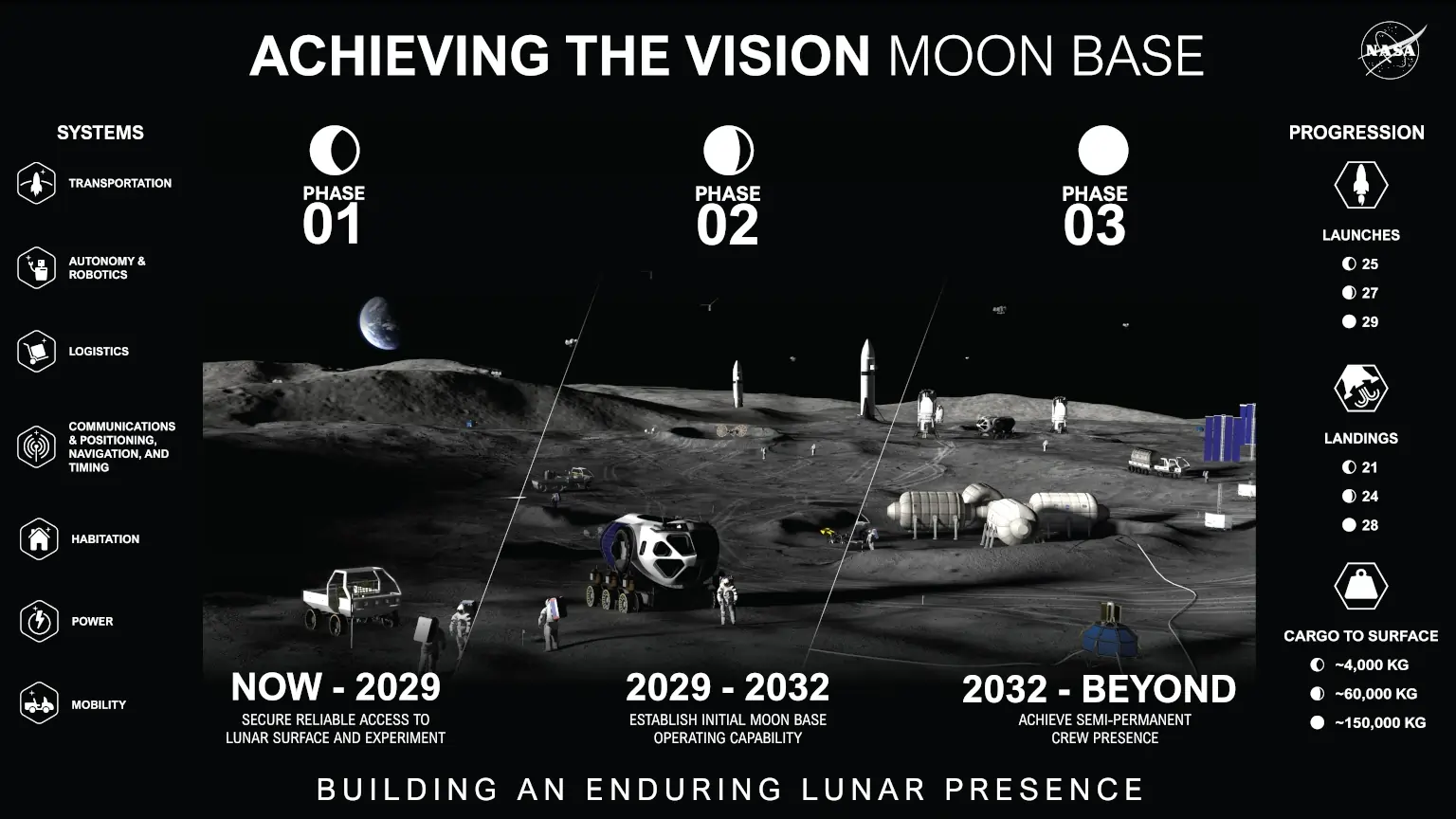
Artist's concept of Phase 3 of NASA's Moon Base at the lunar south pole. Credit: NASA
NASA's Moon Base programme is the most ambitious lunar plan since Apollo — a permanent, nuclear-powered outpost on the rim of Shackleton Crater at the lunar south pole, built in three phases over eleven years at a cost of around $30 billion. The goal is not just to visit. It is to stay, and to use the Moon as the proving ground for eventually sending humans to Mars.
The south pole was chosen for two reasons. First, certain ridgelines there receive near-continuous sunlight, making solar power generation viable year-round. Second, the permanently shadowed craters nearby are among the most scientifically compelling locations in the solar system — untouched by sunlight for billions of years, they may contain significant deposits of water ice that could be converted into drinking water, oxygen, and rocket propellant. Getting to those craters, mapping them, and eventually mining them is central to the programme's long-term logic.
The environment is extraordinarily hostile. In sunlight the surface temperature exceeds 250°F. In shadow it drops below -200°F. In the permanently shadowed craters, temperatures can fall below -400°F. There is no atmosphere to moderate any of these extremes, no protection from radiation or solar particle events, and the surface is continuously exposed to meteorite impacts. Every system designed for the Moon Base has to survive all of it — often through a lunar night that lasts two Earth weeks.
The first three missions
The first privately funded lunar lander mission in history. The Mark 1 Endurance lander will deliver multiple payloads to the Shackleton Connecting Ridge, including two NASA science payloads and a Lunar Retroreflector Array. Critically, it also de-risks future crewed missions — the Mark 1 is the uncrewed variant of the same vehicle family Blue Origin will use for Artemis crewed landings.
The Griffin lander will carry more than 500kg of cargo to the lunar surface — the largest commercial payload ever delivered to the Moon. Its primary cargo is Astrolab's FLIP rover, which will mature capabilities for future Lunar Terrain Vehicles including autonomous operations, logistics, and astronaut mobility support.
The first payload selected through NASA's PRISM initiative — an open-competition programme bringing together universities, researchers and industry. The anchor science mission is Lunar Vertex, which will study lunar swirls: bright formations where portions of the surface are mysteriously shielded from the solar wind. The mission also carries payloads from ESA and the Korean Space Agency, marking the Moon Base programme as an international effort from its earliest missions.
Three phases to permanent habitation
The programme is structured in three phases. Phase One, running from 2026 through 2029, is about reliability and reconnaissance. Twenty-five launches and 21 landings will deliver roughly four metric tonnes of cargo to the surface, testing landers, deploying rovers, and characterising the south pole environment at a level of detail never previously attempted. Nothing is assumed to work until it is proven on the surface.
Phase Two begins building permanent infrastructure — a power grid, a pressurised rover that doubles as mobile crew quarters, and the first pathfinder habitation modules. Power generation in Phase Two will initially come from solar, potentially supplemented by smaller nuclear units capable of producing 2–15kW. Astronaut stays will grow progressively longer, with up to two crew rotations per year as the infrastructure matures.
Phase Three completes the base. A 20kW nuclear fission reactor comes online, providing the continuous power needed for year-round habitation regardless of lighting conditions. Cargo delivery scales to 150 metric tonnes. And the base itself, rather than being a single compact installation, will sprawl across hundreds of square miles — habitats on sunlit ridgelines, nuclear power systems a kilometre away for radiation protection, rovers connecting the nodes, drones scouting ahead. It is less a station and more a distributed infrastructure network, closer in concept to a remote research settlement than a space station.
Mission timeline
Commercial partners announced
Both lunar terrain vehicles — Astrolab's CLV-1 and Lunar Outpost's Pegasus — are designed to travel up to 200km from their delivery point over their operational lifetimes, four times further than any rover has ever driven on the Moon or Mars. They park approximately two kilometres from crewed landing sites to avoid the violent ejecta thrown up when heavy landers like Starship and Blue Moon Mark 2 touch down, then drive in to meet the crew. Each can carry two astronauts at up to ten kilometres per hour across slopes of up to 20 degrees, and can operate autonomously between crewed missions — mapping terrain, scouting potential infrastructure sites, and prospecting for resources.
The decision to award two competing rover contracts rather than one reflects a broader philosophy running through the entire programme. Rather than committing to a single highly capable system before any crew has tested one on the surface, NASA is fielding multiple simpler vehicles simultaneously, learning from both, and using that data to inform Phase Two rovers with greater capability. The same logic applies to landers, habitats, and power systems. Nothing gets scaled up until its simpler predecessor has been proven in the actual environment.
The MoonFall drone network
One of the most technically ambitious elements of Phase One is the MoonFall drone programme — a constellation of three or four hopper drones developed by JPL and carried to lunar orbit by a Firefly Elytra Dark carrier spacecraft. Unlike rovers, the drones can reach areas that wheeled vehicles cannot — including the floors of permanently shadowed craters and the steep terrain between ridge features. They will land approximately a mile apart and operate independently from that point.
The drones' capabilities go well beyond photography. They will map the surface at centimetre-scale resolution — not the metre-scale resolution currently available from orbital data — dramatically improving the precision of future landing sites. They will prospect for water ice up to a metre below the surface across tens of kilometres of terrain. They will characterise the radiation environment in specific areas before any rover or crew is sent there. And crucially, they are designed to survive the lunar night, meaning that wherever they end their final hop, they can be repurposed — as communications beacons, navigation retroreflectors, or permanent observation posts. The temperature variance at the south pole can be 400–500 degrees within a single metre of horizontal distance, and the drones need to survive the full range.
Living and working on the surface
Keeping humans healthy on the Moon presents challenges that go beyond hardware. The Apollo programme accumulated roughly 80 hours of total lunar EVA time across all missions — spread over six landings, more than half a century ago. Moon Base crews will be expected to conduct multiple EVAs over stays of a week or more, which creates a decompression sickness risk that mission planners are actively working to mitigate. Each time an astronaut pressurises and depressurises for a spacewalk, the risk accumulates. NASA has been running exploration atmosphere research exercises at Johnson Space Center specifically to understand what atmosphere composition inside suits and habitats minimises that risk while maximising time on the surface.
Radiation is the other primary health concern. The Moon has no magnetic field and no atmosphere — nothing to deflect or absorb the solar wind, cosmic rays, or the occasional high-energy solar particle event that can deliver a dangerous radiation dose in hours. The permanent habitats in Phase Two and Three will need substantial shielding, which is one reason the programme is interested in lava tubes as potential supplementary shelter. Underground caves provide natural radiation protection, and NASA has been examining their potential as secondary outpost locations — not as the primary base, but as possible extensions of it in later phases.
Why the Moon — and what it's really for
The Moon Base is explicitly framed as preparation for Mars, not as an end in itself. The south pole outpost is where NASA intends to master the logistics, construction techniques, life support systems, and in-situ resource utilisation capabilities needed for a planet that is months away rather than days. Water ice at the south pole, if confirmed in accessible quantities, enables the production of hydrogen and oxygen — both rocket propellant and life support consumables — which is the key to making deep space missions economically viable at all.
The programme is also intended to seed a commercial lunar economy. By generating sustained demand for dozens of landers, rovers, drones, communications satellites, and eventually habitation modules, NASA is attempting to create the industrial base and cost curves that might eventually attract non-NASA customers to the lunar surface. What those customers might actually want to buy there remains an open question — but the theory is that you cannot discover the answer without first building the infrastructure that makes it possible to find out.
Keep exploring