

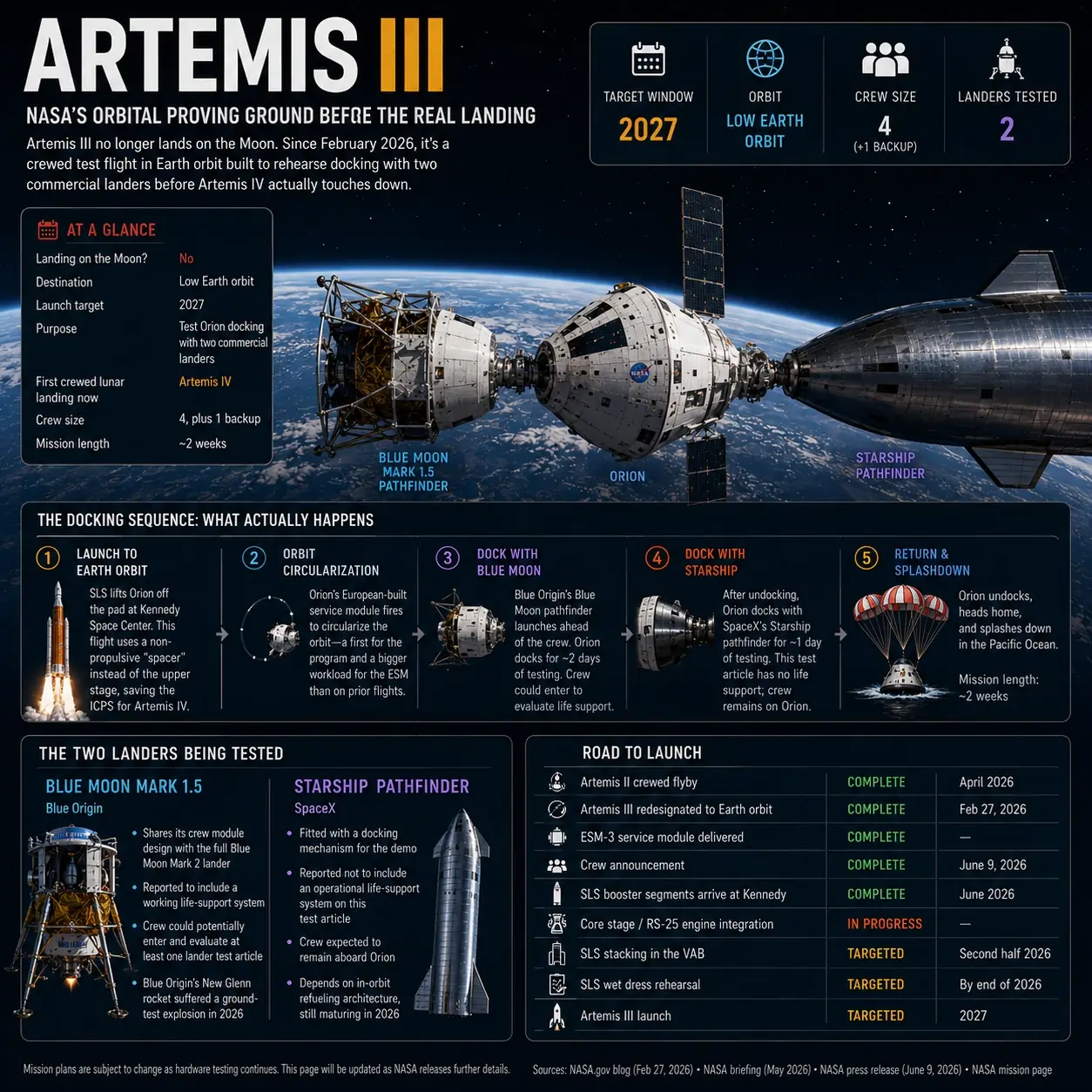
Artemis III: NASA's Orbital Proving Ground Before the Real Landing
Artemis III no longer lands on the Moon. Since February 2026, it's a crewed test flight in Earth orbit built to rehearse docking with two commercial landers before Artemis IV actually touches down. Here's the mission NASA is really flying.
Artemis III at a Glance
| Landing on the Moon? | No |
| Destination | Low Earth orbit |
| Launch target | 2027 |
| Purpose | Test Orion docking with two commercial landers |
| First crewed lunar landing now | Artemis IV |
| Crew size | 4, plus 1 backup |
| Mission length | ~2 weeks |
Artemis III vs. Artemis IV
Once people learn Artemis III isn't landing on the Moon, this is usually the next question — what's actually different about the mission that will?
| Feature | Artemis III | Artemis IV |
|---|---|---|
| Destination | Low Earth orbit | Lunar vicinity |
| Moon landing | No | Planned |
| Primary objective | Docking demonstrations | Lunar surface landing |
| Landers involved | Blue Moon & Starship pathfinders | Certified landing vehicle |
| Mission duration | ~2 weeks | Not yet finalized |
| Primary risk focus | Rendezvous & docking | Surface operations |
What Happened to the Original Artemis III Moon Landing?
For years, Artemis III was the headline mission — the first crewed Moon landing since Apollo 17, aimed at the lunar South Pole. That plan is gone. On February 27, 2026, NASA Administrator Jared Isaacman announced a revised Artemis flight sequence that turns Artemis III into a crewed demonstration mission in low Earth orbit, pushing the actual surface landing to Artemis IV.
Why was Artemis III moved from the Moon to Earth orbit? NASA moved Artemis III from a lunar landing mission to an Earth-orbit mission to validate Orion's rendezvous and docking procedures with two commercial landers before attempting a crewed lunar descent. The change also gives Blue Origin and SpaceX more time to mature their landing systems, while letting NASA keep flying Artemis hardware and crews instead of standing down to wait.
The short version
Artemis III will not go to the Moon. It stays in Earth orbit to prove that Orion can rendezvous and dock with both commercial landers — Blue Origin's Blue Moon and SpaceX's Starship — before either one is trusted with an actual lunar descent on Artemis IV.
Apollo didn't skip this step — Gemini and the early Apollo missions spent years developing and rehearsing rendezvous and docking before Apollo 11 ever attempted a landing. Artemis, by contrast, was originally built to go straight from a crewed lunar flyby (Artemis II) to a crewed lunar landing (Artemis III), with no dedicated orbital docking rehearsal in between. Artemis III now fills that gap.
In plain terms: Artemis II (April 2026) demonstrated Orion's first crewed lunar flyby and validated many of the systems needed for future missions. Artemis III now tests something Artemis II never touched — whether Orion can actually find, approach, and physically dock with the landers themselves, in the safer, closer confines of Earth orbit, before anyone rides one down to the surface.
Why not just delay Artemis IV instead?
The obvious alternative was to leave Artemis III as the landing mission and push it back until the landers were ready. NASA went a different way, for a few compounding reasons:
- An independent safety review was already critical of the plan. Right before the February 27 announcement, NASA's Aerospace Safety Advisory Panel — an independent body established by Congress to review NASA's safety practices and program risks — had released a report raising concerns about attempting a full lunar landing on Artemis III.
- Neither lander was ready to be trusted with a landing. Both Blue Moon and Starship were still under development and hadn't completed the certification required for crewed lunar operations.
- Docking is genuinely untested at this scale. Rather than validate rendezvous, docking, and lander systems for the first time on the same flight as an actual landing, NASA split that risk into its own dedicated mission.
- It keeps hardware and schedules moving. Inserting a proving-ground mission lets SLS, Orion, and both lander programs keep flying and gathering data instead of sitting idle waiting on landing readiness.
Meet the Crew
NASA announced the Artemis III crew on June 9, 2026 at Johnson Space Center. It's an all-male, four-person crew — a decision Isaacman addressed directly, noting reactions "ranging from disappointment to outrage," while stating the assignments reflected the astronauts best suited to this specific mission's objectives.
 Commander
A former Marine Corps test pilot and two-time spaceflight veteran, leading the crew through the mission's docking demonstrations.
 Pilot
PilotThe first ESA astronaut ever assigned to an Artemis mission, flying alongside a NASA commander for the first time in the program's history.
 Mission Specialist
Holds the U.S. record for longest single spaceflight (371 days), bringing long-duration systems experience to the crew.
 Mission Specialist
An engineer with a background supporting NASA's DART planetary defense mission, now working the lander interface and hardware evaluations.
 Backup
Named as backup crew member during the June 9 announcement, training alongside the prime crew.
Why Docking Matters More Than It Sounds
Docking two spacecraft in orbit is one of the hardest routine operations in spaceflight, and it's easy to undersell in a headline. Orion and each pathfinder are both moving at roughly 17,500 mph relative to Earth — docking means matching their relative velocity to extremely small tolerances, aligning two independently-built docking interfaces, and doing it with enough margin that either vehicle can safely abort and separate if something doesn't line up. NASA's own navigation systems have to track relative position, closing speed, and orientation in real time, largely autonomously, before the crew ever gets hands-on. Two commercial landers, built by two different companies to two different designs, means running that same high-stakes choreography twice, against two systems Orion has never met before.
What's a "pathfinder," exactly?
A pathfinder is an early test version of a spacecraft, built to validate operations, interfaces, and procedures before a fully capable version ever flies. Blue Origin's and SpaceX's Artemis III vehicles are pathfinders — close enough to the real landers to test docking and (in one case) crew entry, but missing systems a real lunar descent would require.
Why Is Orion Docking With Two Different Landers?
NASA is deliberately funding two competing lander programs — Blue Origin's Blue Moon and SpaceX's Starship — rather than betting on one. That's a hedge against exactly the kind of delay either company could face individually. Artemis III provides NASA its first opportunity to evaluate both commercial lander architectures in operational conditions, instead of validating just one lander's docking system in isolation. If one program slips, NASA still has a second path toward a certified landing vehicle for Artemis IV. It also means the mission doubles as a real comparative test of two very different spacecraft architectures under the same conditions.
The Docking Sequence: What Actually Happens
Artemis III's whole job is choreography — launching, circularizing, and docking with two separate spacecraft in a tight window, without ever leaving Earth orbit. Here's the order of operations NASA has laid out.
Launch to Earth orbit
SLS lifts Orion off the pad at Kennedy Space Center. Instead of a propulsive upper stage, this flight uses a non-propulsive "spacer" — a structural stand-in that matches the mass and dimensions of a real upper stage, since NASA is saving its one remaining Interim Cryogenic Propulsion Stage for Artemis IV.
Orbit circularization
With no propulsive upper stage doing the work, Orion's own European-built service module fires to circularize the orbit — a first for the program, and a bigger workload for the ESM than on any prior flight.
Dock with Blue Moon
Blue Origin's Blue Moon Mark 1.5 pathfinder launches ahead of the crew and waits in orbit. Orion rendezvous and docks with it for roughly two days of testing. NASA's preliminary mission plans indicate crew members could enter the vehicle to evaluate its life-support systems, though the exact concept of operations was still being finalized as of mid-2026.
Dock with Starship
After undocking from Blue Moon, Orion rendezvous with SpaceX's Starship pathfinder for about a day of docked checkouts. This test article is reported not to include an operational life-support system, so the crew is expected to stay aboard Orion rather than entering it.
Return and splashdown
Orion undocks, heads home, and splashes down in the Pacific Ocean. Total mission length is expected to run about two weeks, with the exact duration depending on how rendezvous operations play out in real time.
The Two Landers Being Tested
Both vehicles docking with Orion are described by NASA as "pathfinders" — early test articles missing several systems a real lunar lander needs. As of spring 2026, neither had completed the certification process required for crewed lunar operations.
Blue Moon Mark 1.5
Blue Origin- Shares its crew module design with the full Blue Moon Mark 2 lander
- Reported to include a working life-support system
- NASA has said the crew could potentially enter and evaluate at least one lander test article
- Blue Origin's New Glenn rocket — needed to launch it — suffered a ground-test explosion in 2026
Starship Pathfinder
SpaceX- Fitted with a docking mechanism for the demo
- Reported not to include an operational life-support system on this test article
- Crew is expected to remain aboard Orion during this docked period
- Depends on SpaceX's in-orbit refueling architecture, still maturing through 2026
Road to Launch
Hardware is moving. Rocket processing is underway at Kennedy Space Center, with solid rocket booster segments already arriving by rail and stacking targeted to begin in the second half of 2026.
| Milestone | Status |
|---|---|
| Artemis II crewed flyby | Complete — April 2026 |
| Artemis III redesignated to Earth orbit | Complete — Feb 27, 2026 |
| ESM-3 service module delivered | Complete |
| Crew announcement | Complete — June 9, 2026 |
| SLS booster segments arrive at Kennedy | Complete — June 2026 |
| Core stage / RS-25 engine integration | In progress |
| SLS stacking in the VAB | Targeted — second half 2026 |
| SLS wet dress rehearsal | Targeted — by end of 2026 |
| Artemis III launch | Targeted — 2027 |
Frequently Asked Questions
No. Since February 2026, Artemis III is a crewed demonstration mission that stays in Earth orbit, testing docking between Orion and two commercial landers. The first crewed lunar landing since Apollo 17 is now planned for Artemis IV.
Randy Bresnik (commander), Luca Parmitano of ESA (pilot), Frank Rubio (mission specialist), and Andre Douglas (mission specialist), with Bob Hines as backup. Announced June 9, 2026.
NASA Administrator Jared Isaacman acknowledged the all-male crew drew reactions "ranging from disappointment to outrage," and said the selections reflected the astronauts NASA judged best suited to this mission's specific objectives, with others already committed to ISS expeditions or better suited to later Artemis flights.
NASA is targeting 2027. Rocket stacking is expected to begin in the second half of 2026, with a wet dress rehearsal targeted before year's end.
Artemis II demonstrated Orion's first crewed lunar flyby. Artemis III focuses on a different challenge: proving Orion can rendezvous and dock with two independently developed lunar landers before those systems are used on an actual Moon landing mission.
That's NASA's current plan. Artemis IV is positioned as the first crewed lunar landing of the program, targeting the Moon's South Pole region, once the docking and lander systems validated on Artemis III have been proven out.
Tracking the Moon While NASA Gets There
Follow the current moon phase, plan your own night-sky viewing, and see how Artemis fits into the bigger lunar picture.
Check tonight's moon phaseSources
Last updated July 2026, following NASA's June 9, 2026 crew announcement. Reviewed against NASA briefing and press-release dates listed below.
- NASA — Feb 27, 2026NASA Adds Mission to Artemis Lunar Program, Updates Architecture
- NASA — May 2026NASA Outlines Preliminary Artemis III Mission Plans
- NASA — June 9, 2026NASA Marches Toward Artemis III Mission in 2027, Names Crew Members
- NASA mission pageArtemis III — NASA.gov