

Moon rocks:
where are
they now?
Six missions. 382 kilograms. 2,196 samples. Over fifty years after Apollo astronauts lifted off from the lunar surface, humanity’s most extraordinary geological collection is still rewriting science — and the story isn’t close to finished.
From the lunar surface to a Houston vault
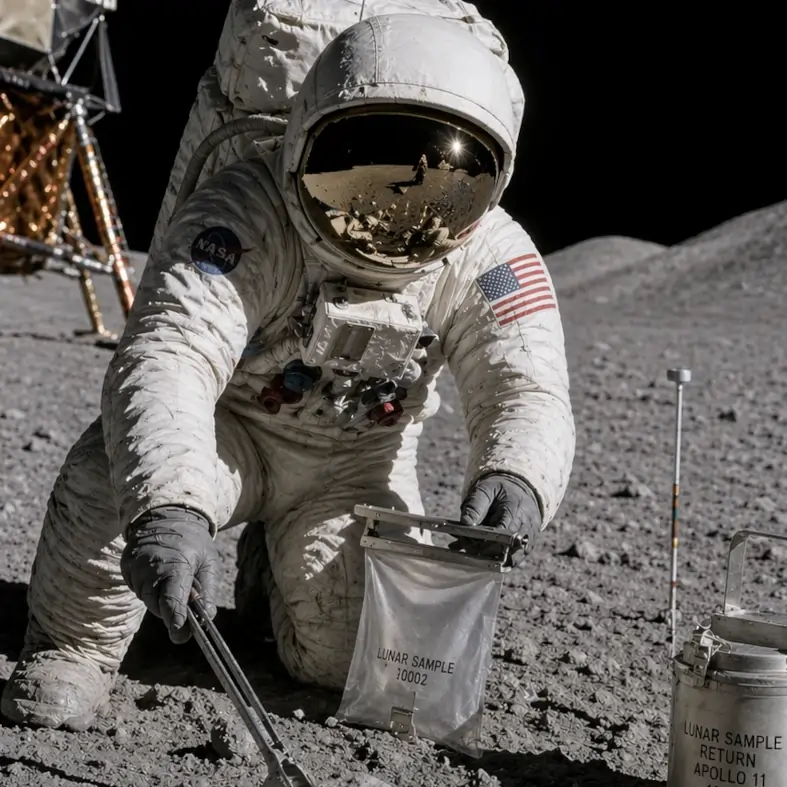
The story of the moon rocks begins not in a laboratory, but on the lunar surface itself — a landscape that had never changed in billions of years until the moment a human boot pressed into its dust. Between July 1969 and December 1972, six Apollo missions landed on the Moon. Astronauts didn’t just plant flags; they worked methodically, sometimes for hours at a stretch, gathering material with specialised tongs, scoops, rakes, and core tubes driven into the regolith. Every sample was documented, sealed in sterile containers, and stowed for the journey home.
Their first destination on Earth wasn’t a press conference — it was the Lunar Receiving Laboratory (LRL) at NASA’s Johnson Space Center in Houston, Texas. In 1969, there was a genuine, if ultimately unfounded, concern about extraterrestrial biological contamination. Astronauts and samples alike entered strict quarantine inside biohazard cabinets flooded with ultra-pure nitrogen, while scientists conducted the first careful examinations: cataloguing, photographing, and taking initial measurements.
That quarantine protocol is now regarded as one of the most consequential decisions in the history of science — not because of moon germs, but because the nitrogen environment it created turned out to be the perfect preservation medium. The samples have barely aged since the day they were collected.
Today, the vast majority of Apollo material resides at the Lunar Sample Laboratory Facility (LSLF), also at Johnson Space Center. Purpose-built vaults store the samples in sealed cabinets continuously purged with ultra-pure nitrogen — an environment with virtually no oxygen, no moisture, and no earthly contamination. Temperature and humidity are held constant. Every gram of material that moves, every cabinet that opens, every interaction is logged in a database that traces the complete chain of custody for each of the 2,196 individual samples. A backup collection of roughly 15% of the total sits approximately 1,300 kilometres away at White Sands Test Facility in New Mexico — insurance against catastrophic events in Houston, including hurricanes.
Apollo scientists made a deliberate, far-sighted choice: hold material back. More than 80% of the original collection has never been allocated for study. The bet was that analytical technology would improve dramatically — and it has. Techniques unavailable in 1972, from high-precision U-Pb zircon dating to atom-probe tomography, are now extracting information the original curators couldn’t have imagined. Researchers a century from now will have capabilities we can only guess at. The goal is to pass these rocks down through time as pristinely as the day they were collected.
What the rocks have already told us — and what they’re still revealing
If moon rocks were souvenirs, their story would have ended in 1972. They are not souvenirs. Each fragment is a miniature time capsule, sealed from weathering, plate tectonics, erosion, or any of the geological processes that continuously destroy and recycle Earth’s rock record. They preserve the conditions of the early solar system with a fidelity nothing on Earth can match.
The most foundational discovery came almost immediately: precise radiometric dating confirmed the Moon formed approximately 4.5 billion years ago — a near-twin in age to Earth itself. This data became the cornerstone of the Giant Impact Hypothesis, now the leading model for lunar formation: a Mars-sized body called Theia collided with early Earth, and the ejected debris coalesced into the Moon. Without the Apollo samples, this elegant theory would have remained speculation. The rocks made it science.
They also revealed the Moon’s volcanic past — a world that was once covered in a global ocean of molten rock, cooling and crystallising over hundreds of millions of years into the layered geological structure we probe today. They showed us the violent history of the inner solar system written in impact craters. They explained why the Moon has no magnetic field today. And they provided the first definitive proof that the Moon’s surface has been bombarded by solar wind for billions of years — a record that Earth’s atmosphere would have erased.
Recent breakthroughs from half-century-old samples
The pace of discovery has, if anything, accelerated. Here is what samples already fifty-plus years old revealed in the past eighteen months alone:
“The Moon is a time capsule. Every rock is a chapter from the first billion years of our solar system — and we are still only on the opening pages.”
The consistency of discovery across so many years has reshaped how scientists think about sample return missions in general. The Apollo collection is now the template: collect more than you can immediately study, preserve rigorously, and let the samples outlive the technology used to collect them.
On display: touching another world
Not every moon rock lives in a vault. A carefully curated subset of the collection is on permanent public display at institutions across the world — physical proof of one of humanity’s greatest achievements, available to anyone who walks through the door.
The most visited specimens are at the Smithsonian National Air and Space Museum in Washington D.C., where a sample from Apollo 17 is mounted in a display that allows visitors to touch the actual lunar surface — an idea conceived by geoscientist Farouk El-Baz, inspired by his childhood pilgrimage to Mecca where he touched the Black Stone. The concept is simple and powerful: contact. The rock, a basalt from the Valley of Taurus-Littrow, is 3.8 billion years old and has been touched by millions of human hands since the museum opened in 1976. Space Center Houston and counterpart institutions in Europe and Asia offer similar encounters.
The Goodwill Rocks: diplomacy written in stone
Following Apollo 11 and Apollo 17, President Nixon directed NASA to prepare Goodwill Rocks — small lunar samples encased in acrylic, mounted on plaques alongside a flag flown to the Moon, and presented to 135 nations and all 50 U.S. states as gifts of peace. The gesture was unprecedented: sharing an extraterrestrial artifact as a symbol of shared humanity.
The subsequent history of the Goodwill Rocks is part treasure hunt, part cautionary tale. Many are proudly displayed in government buildings, presidential museums, and national institutions. But a significant number have gone missing — stolen in the chaos of political transitions, misplaced during moves, forgotten in storage rooms, or lost in fires. Investigative journalists and dedicated researchers have spent careers tracking them. As recently as 2024, non-destructive X-ray fluorescence and hyperspectral imaging was used to authenticate a suspect Apollo 11 sample at the Rijksmuseum Boerhaave in Leiden, Netherlands — the Dutch Goodwill Rock had been questioned for years.
The ongoing effort to locate, verify, and recover missing Goodwill Rocks has given rise to a small but serious field of lunar sample forensics. Each recovery is treated as a cultural and scientific event.
| Location type | Examples | Status |
|---|---|---|
| NASA curation facilities | Johnson Space Center (Houston), White Sands (New Mexico) | Majority of total collection, actively studied |
| Public museums | Smithsonian, Space Center Houston, Natural History museums globally | On permanent display; some touchable |
| Research institutions | Universities, ESA labs, JAXA, international partners | ~400 samples loaned per year for study |
| Goodwill Rocks (accounted) | Government buildings, presidential museums, national institutions | Majority of 135 nations’ samples on display |
| Goodwill Rocks (missing) | Estimated dozens unaccounted across multiple countries | Subject to ongoing forensic recovery efforts |
China’s far-side breakthrough: the first new lunar samples in 52 years
Every Apollo sample came from the Moon’s near side — the hemisphere permanently facing Earth, geologically distinct and relatively well-mapped. For over fifty years, that was the entirety of humanity’s lunar collection. Then, in June 2024, everything changed.
China’s Chang’e-6 mission executed a technically extraordinary feat: landing in the South Pole–Aitken Basin on the Moon’s far side — the largest, deepest, and oldest impact basin on the Moon — retrieving 1,935 grams of material, and returning it to Earth. It required a relay satellite in a halo orbit above the far side to maintain communications. No nation had ever done it before.
The samples are now being analysed by Chinese researchers and international collaborators. Preliminary findings suggest the far-side crust is compositionally distinct from anything in the Apollo collection — older, more anorthosite-rich, and potentially containing material excavated from deep within the lunar mantle by the ancient impact that formed the basin itself. The implications for understanding the asymmetry between the Moon’s two hemispheres — one volcanic and smooth, one heavily cratered and ancient — are profound.
Chang’e-6 transformed the field from a fifty-year-old dataset into an active, expanding one. And China has already announced Chang’e-7 and Chang’e-8, targeting the lunar south pole in the late 2020s.
Artemis and the south pole: the next chapter begins
NASA’s Artemis programme is delivering the first sustained human return to the Moon since Apollo 17 in 1972. Unlike Apollo — which landed in equatorial regions chosen for safety and sunlight — Artemis is targeting the lunar south pole, a geologically exotic region of permanently shadowed craters where water ice is confirmed to exist.
“New rocks. New terrain. New chapters. The story of the moon rocks is nowhere near finished — it’s barely begun.”
Questions people ask
Where are the Apollo moon rocks kept?
The majority of Apollo lunar samples are stored at the Lunar Sample Laboratory Facility (LSLF) at NASA’s Johnson Space Center in Houston, Texas. The samples are held in nitrogen-filled, sealed cabinets that prevent contact with Earth’s atmosphere. A backup collection of approximately 15% of the total (52 kilograms) is stored at White Sands Test Facility in New Mexico as a contingency against disaster.
How many moon rocks did Apollo astronauts bring back?
Apollo astronauts returned 382 kilograms (842 pounds) of lunar material across six missions between 1969 and 1972. This comprised 2,196 individually catalogued samples ranging from fine dust to rocks weighing several kilograms.
Can you see or touch a moon rock?
Yes. Several institutions display lunar samples publicly, including the Smithsonian National Air and Space Museum in Washington D.C. and Space Center Houston. The Smithsonian hosts a basalt sample from Apollo 17 that visitors can physically touch — it has been handled by millions of people since the museum opened in 1976.
What are scientists still learning from moon rocks?
Ongoing research continues to yield major findings. In 2025, Apollo samples helped scientists establish that the Moon’s global magma ocean solidified 4.338 billion years ago, reveal evidence of an ancient lunar landslide, and detect previously unknown sulfur isotope signatures in the lunar mantle. New analytical techniques unavailable in 1972 are driving this continued productivity.
Are there moon rocks from the lunar far side?
Yes, as of 2024. China’s Chang’e-6 mission returned 1,935 grams of material from the South Pole–Aitken Basin on the Moon’s far side in June 2024 — the first far-side samples ever collected. All previous samples, including the entire Apollo collection, came from the near side.
What happened to the moon rocks given to other countries?
Following Apollo 11 and 17, President Nixon presented Goodwill Rocks to 135 nations and all 50 U.S. states. Many are on public display. However, a significant number have gone missing over the decades — lost through political transitions, theft, or administrative neglect. Forensic authentication techniques are increasingly used to verify suspected samples when they resurface.
When will humans next land on the Moon?
NASA’s Artemis IV mission is currently targeting 2028 for the first crewed lunar landing since Apollo 17 in 1972. The mission plan was revised in early 2026: Artemis III (2027) will conduct an Earth-orbit test of the crewed landers rather than attempting a lunar landing. The Lunar Gateway space station, originally part of the Artemis architecture, was cancelled in March 2026 in favour of a direct surface-first approach.
Why moon rocks still matter — more than ever
Fifty years on, the Apollo samples remain the most scientifically productive geological collection in human history. They anchor the Giant Impact Hypothesis. They established the absolute age of the inner solar system. They revealed how planetary bodies form, cool, and evolve. They remain the only extraterrestrial geological material collected by human hands and brought to Earth’s labs under controlled conditions — everything else that has fallen to Earth arrived as a meteorite, altered by its violent passage through the atmosphere.
They are also a model for how to conduct science across generations. The deliberate decision to hold back the majority of the collection — to bank it for researchers and technologies not yet born — is now considered one of the most prescient choices in the history of NASA. That philosophy is written into every subsequent sample-return mission: Hayabusa2’s asteroid samples, OSIRIS-REx’s Bennu material. Collect more than you can study. Preserve beyond your own lifetime. Let the science compound.
As Artemis prepares to deliver the first south pole samples, and as Chang’e-6 material enters the global research pipeline, the Apollo collection is no longer the final word — it is the reference standard against which everything new will be measured. The rocks are not a relic. They are a living scientific instrument, still running, still accumulating results, still surprising the people who work with them.
Some treasures grow more valuable with time. The moon rocks are proof.
NASA Johnson Space Center Astromaterials Curation · NASA Artemis II mission reports (April 2026) · NASA Artemis programme updates (2026) · Science Advances (2025) · Journal of Geophysical Research: Planets (2025) · University of Oxford (2026) · Natural History Museum, London (2025) · Communications Earth & Environment (2024) · Chinese National Space Administration Chang’e-6 mission reports (2024) · Smithsonian National Air and Space Museum · Rijksmuseum Boerhaave authentication report (2024) · Lunar Sample Laboratory Facility, Wikipedia · Artemis program, Wikipedia (April 2026)
Technical Expansion
Analyze Further High-Fidelity Lunar Intel
🗺️ Lunar 100 Map
Identify the specific impact sites discussed in this article, including the circular Tycho and the elliptical Messier.
📸 Moon Photography
Master the camera settings needed to resolve sharp crater shadows and fine ejecta ray systems through your lens.
📊 Astronomy Tools
Access our suite of technical calculators and observation planners to time your next high-contrast lunar mission.
NASA LRO Archive
Technical acknowledgement to NASA’s Lunar Reconnaissance Orbiter for the high-resolution imagery and topographical data.