

Every mission to land on the Moon — click a marker to see who went, when, and what claim they made
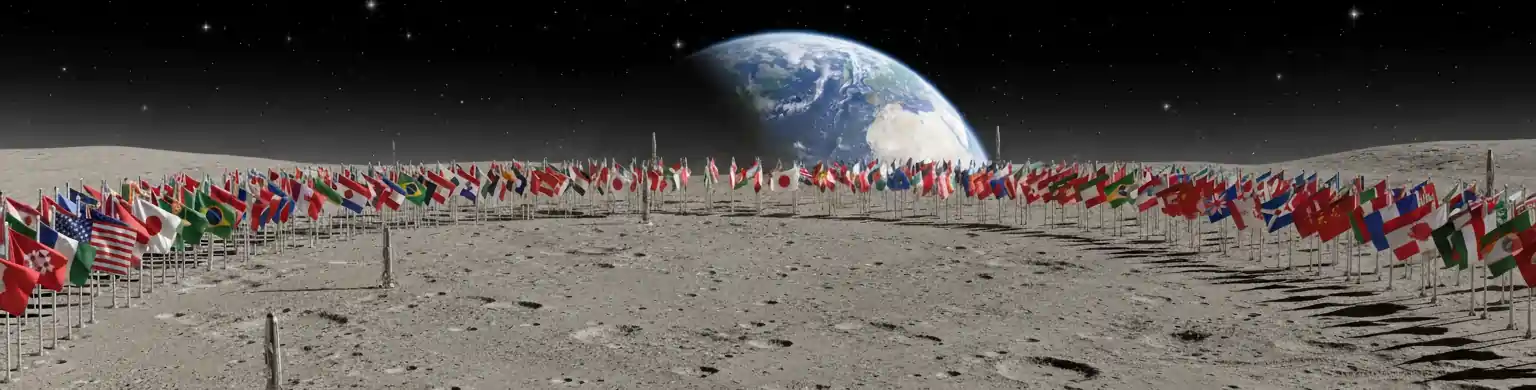
No country, company, or individual owns the Moon. But that simple answer conceals one of the most consequential unresolved legal questions of our era: who controls what happens there — and who benefits? With humans back in lunar space for the first time in 54 years, those questions are no longer theoretical.
Four key questions that define the debate
How we got here: the legal timeline
The five key treaties — who signed what
| Country | Outer Space Treaty (1967) | Liability Conv. (1972) | Moon Agreement (1979) | Artemis Accords (2020) |
|---|---|---|---|---|
| 🇺🇸 United States | Ratified | Ratified | Not signed | Founding member |
| 🇷🇺 Russia | Ratified | Ratified | Not signed | Not signed |
| 🇨🇳 China | Ratified | Ratified | Not signed | Not signed |
| 🇮🇳 India | Ratified | Ratified | Not signed | Signed 2023 |
| 🇯🇵 Japan | Ratified | Ratified | Not signed | Founding member |
| 🇦🇺 Australia | Ratified | Ratified | Not signed | Founding member |
| 🇳🇱 Netherlands | Ratified | Ratified | Ratified | Signed |
| 🇦🇹 Austria | Ratified | Ratified | Ratified | Signed |
The Netherlands and Austria are notable — among very few nations that ratified the Moon Agreement and also joined the Artemis Accords, positions some legal scholars consider in tension. Belgium and Kazakhstan have also ratified the Moon Agreement.
The Artemis mission architecture — current status
| Mission | What it did / will do | Date | Status |
|---|---|---|---|
| Artemis 1 | Uncrewed test flight — Orion to lunar orbit and back | Nov 2022 | Complete |
| Artemis 2 | First crewed flight — 4 astronauts on a 10-day lunar flyby; splashdown April 11, 2026 | Apr 2026 | Complete |
| Artemis 3 | Earth orbit lander test — docking with Starship HLS and/or Blue Moon; no landing | Mid-2027 | Next |
| Artemis 4 | First crewed lunar landing since Apollo 17 — south pole surface EVAs | Early 2028 | Planned |
| Artemis 5+ | Annual lunar surface missions; begin building surface base infrastructure | Late 2028+ | Planned |
Lunar Gateway — originally planned as an orbital outpost supporting these missions — was cancelled in March 2026. NASA is now focused on direct surface infrastructure.
The resource extraction debate in full
The central legal dispute is not about owning the Moon — everyone agrees that is forbidden. It is about whether you can own what you take from it. Two coherent but incompatible positions exist:
Proponents: US, Luxembourg, UAE
- The OST prohibits national appropriation of celestial bodies, not of movable resources once severed from them.
- Analogous to fishing in international waters — you don't own the ocean, but you own the fish you catch.
- Without property rights, there is no investment incentive; the Moon goes undeveloped for everyone.
- The 2015 US SPACE Act and equivalent national laws give commercial actors the legal certainty they need.
Proponents: Moon Agreement signatories, many developing nations
- The Moon Agreement explicitly declares lunar resources the "common heritage of mankind" — not subject to private appropriation.
- The fishing analogy is flawed: global fisheries have been catastrophically depleted under exactly that regime.
- Allowing wealthy nations and corporations to extract freely replicates colonial patterns on a cosmic scale.
- Any exploitation should require an international governance body and equitable benefit-sharing.
The practical resolution right now: the Moon Agreement's "common heritage" principle is politically dead among spacefaring nations, but no universally accepted alternative exists. The US-led extraction-rights position is advancing by default — through national law, bilateral accords, and the sheer momentum of actual missions.
Safety zones: safety or sovereignty?
Major space powers: where they stand today
Architects of the Accords. National law permits resource extraction ownership. Artemis 2 successful; planning Artemis 4 south pole landing for early 2028. Pushing Accords norms as customary international law through coalition-building.
Most active lunar power by mission cadence. Co-leading ILRS with Russia. New national legislation asserts "space resource rights." Has not joined Artemis Accords. Barred from NASA cooperation by the Wolf Amendment.
Co-founded ILRS with China. Luna-25 crashed in 2023 — Russia's first lunar mission in 47 years. Diminished technical capacity but significant political opposition to Artemis Accords norms.
Signed Artemis Accords in 2023, same year as Chandrayaan-3's south pole landing — giving India unique leverage as the only nation that has actually landed at the most contested part of the Moon.
Founding Accords member. Contributing the pressurized rover for Artemis surface operations. SLIM achieved record-precision landing in 2024. Among the most technically capable partners in the coalition.
ESA built Orion's service module used on Artemis 2. France has been most cautious, raising concerns about the Accords bypassing UN multilateralism. Germany, Italy, and the UK are signatories.
Frequently asked questions
Does any country own the Moon?
No. The Outer Space Treaty of 1967, ratified by all major spacefaring nations including the US, Russia, and China, explicitly prohibits national appropriation of the Moon and other celestial bodies "by claim of sovereignty, by means of use or occupation, or by any other means."
This is considered settled, binding international law. The US planting flags during Apollo, and China landing rovers, does not constitute a territorial claim under the Treaty.
Can private companies mine the Moon?
This is the central unresolved question. The OST prohibits national appropriation of celestial bodies but does not explicitly address resource extraction.
Yes, under US law: The 2015 US SPACE Act grants American citizens the right to own space resources they extract. Luxembourg and the UAE have equivalent national laws.
No, under the Moon Agreement: The 1979 Moon Agreement declares lunar resources the "common heritage of mankind." But no major spacefaring nation has ratified it, making it effectively unenforceable.
Unclear under the OST: Many legal scholars argue the OST is simply silent on resource extraction — and that this gap requires new international agreement to resolve.
What changed with Artemis 2, 3, and 4?
Artemis 2 completed successfully on April 11, 2026 — the first humans to travel to the Moon since Apollo 17 in 1972. No landing; crewed test of Orion and SLS in deep space.
Artemis 3 was revised in February 2026. No lunar landing — instead rendezvous and docking tests with commercial landers in Earth orbit, targeting mid-2027.
Artemis 4 is now the first planned crewed lunar landing, targeting early 2028 at the south pole. Lunar Gateway was cancelled in March 2026.
What are Artemis Accords safety zones and why are they controversial?
Safety zones are buffer areas around lunar operations where others should not interfere — framed as safety, not territory. NASA has discussed zones up to 225 km radius.
The problem: at the south pole, where permanently shadowed craters containing water ice are limited in number, a zone that large could block competitors from the Moon's most valuable real estate without technically claiming sovereignty. The OST guarantees free access to all areas of celestial bodies.
Can I buy land on the Moon?
No. "Moon deed" certificates have zero legal standing under any national or international law. No nation has the authority to sell or grant lunar land, so no company can either. The documents are novelty items — no legal system anywhere recognises these claims.
What happens if two missions target the same deposit?
No binding mechanism currently exists to allocate access rights between competing missions at the same site. The Artemis Accords address this only through non-binding "deconfliction." In practice, first-mover advantage would likely determine access. Artemis 4 will be the first real-world test.