
Moon Phase Today Canada
Moon Phase Today Canada: Waxing Gibbous
On Sunday, November 22, 2026, the moon phase today in Canada is a Waxing Gibbous, with 94% illumination. Next full moon: Nov 24.


The Moon wobbles slightly as it orbits Earth — a phenomenon called libration. Hit Animate Day to watch the surface shift live. Over time, this lets us see 59% of the lunar surface rather than just 50%.
DismissTimes shown for Ottawa (Eastern Time). Search your own city — Canada spans six time zones.
Explore Canadian Cities
Moon phase, moonrise/moonset, and local viewing details for towns and cities across Canada.
More Canadian cities added regularly.
Moon Phase in Canada: Your Questions Answered
Straight answers to the moon questions Canadians ask most, with today's live numbers built in.
What is the moon phase today in Canada?
On Sunday, November 22, 2026, the moon phase today in Canada is a Waxing Gibbous, with 94% illumination. Next full moon: Nov 24. The Moon is about 12.4 days into its 29.5-day cycle.
🕐 Times here use Eastern Time (Ottawa). For moonrise and moonset where you live, use the live calculator at the top of this page.What was the moon phase last night in Canada?
On Saturday, November 21, 2026, the moon phase last night was a Waxing Gibbous, with 92% illumination. The Moon was about 12.0 days into its 29.5-day cycle. Last night is measured at 9:00 PM Eastern Time.
📅 Look up any past date in the Monthly Moon Phase Calendar.What is the moon phase tonight in Canada?
Tonight's moon is a Waxing Gibbous at 94% illumination. The phase is the same from coast to coast. Only the moonrise and moonset times differ from city to city.
Can you see the moon tonight in Canada?
Usually yes, unless the Moon is within a day or two of New Moon, when it sits too close to the Sun to see. Tonight it is a Waxing Gibbous at 94% illumination. A waxing moon is up in the evening, a Full Moon is up all night, and a waning moon rises late at night or before dawn. Cloud and coastal fog are the other half of the answer.
📡 Check tonight's cloud cover with the Sky Clarity tool.What time does the moon rise tonight in Canada?
Moonrise depends on your location, so use the live calculator at the top of this page for your exact time. On average the Moon rises about 50 minutes later each day, but around the autumn equinox the delay shrinks to 20 or 30 minutes in southern Canada, which is the Harvest Moon effect.
🌅 Full rise and set details: Moonrise Tonight.What time zone are moonrise and moonset times shown in?
Canada spans six main time zones. The live numbers in this FAQ use Eastern Time (Ottawa), and the calculator at the top of this page shows the local time of whichever city you search.
Clock rules also changed in 2026. Most of British Columbia has been on permanent UTC−7 since March 8, and Alberta, Manitoba, and the Northwest Territories stop changing their clocks from November 1. Saskatchewan and Yukon never change, while most of Ontario, Quebec, and Atlantic Canada still set clocks back.
Is the moon waxing or waning tonight in Canada?
The current phase is a Waxing Gibbous. Waxing phases (plus First Quarter) are growing toward Full Moon, and waning phases (plus Last Quarter) are shrinking toward New Moon. Everywhere in Canada, a lit right side means waxing and a lit left side means waning.
When is the next full moon in Canada?
The next full moon is on Nov 24 (Eastern Time), 3 days from today. The calendar date can fall a day apart in other time zones.
When is the next new moon in Canada?
The next new moon is on Dec 8 (Eastern Time), 17 days from today. The Moon is effectively invisible then, which makes the nights around it the darkest of the month.
How often is there a full moon?
A full moon happens roughly every 29.5 days, so most years have 12 and some have 13. Every two to three years an extra one lands in a month or season, which is called a blue moon.
🌕 Dates for the next one: Blue Moon Guide.Does the moon phase look different in different parts of Canada?
No. Everyone on the night side of Earth sees the same phase at the same moment. What changes is the clock time of moonrise and moonset, which can differ by several hours between Newfoundland and British Columbia, and how high the Moon climbs. Canada runs from about 42°N to roughly 83°N, so the Moon sits noticeably higher over southern Ontario than over the territories.
🧭 See the Moon's live height and bearing with the Moon Radar Compass.Why does the Moon look different in Canada than in other countries?
It's the viewing angle, not a different Moon. Canada is entirely in the Northern Hemisphere, so the Moon looks the same way up as in the United States or Europe, but upside down compared with Australia or South America. The farther north you are, the more a crescent leans over, because the Sun sets at a shallower angle.
Which direction does the moon rise and set in Canada?
The Moon rises in the east and sets in the west, because Earth spins from west to east. From anywhere in Canada it always reaches its highest point in the southern half of the sky. A winter Full Moon rides high, and a summer Full Moon stays low, the reverse of the Sun.
Does the Moon behave differently in the Canadian Arctic?
Yes. North of the Arctic Circle the Moon can stay above the horizon for a day or longer without setting, then stay below it just as long. At the top of the country, such as Alert, Nunavut, those spells can last for days. If a calculator shows no moonrise or moonset for a northern community, that is not an error.
What is the best moon phase for stargazing and the northern lights in Canada?
The New Moon is best for stars, galaxies, and faint aurora, because there is no moonlight to wash out the sky. Strong aurora still shows under a Full Moon. Canada's top dark-sky sites include Jasper, Wood Buffalo (the world's largest dark-sky preserve), Cypress Hills, Torrance Barrens, and Mont-Mégantic.
For viewing the Moon itself through a telescope, the First and Last Quarter phases are best, because long shadows along the terminator line give craters real depth.
🔭 See which features are in peak shadow now with the live Terminator Calculator.Does the moon phase affect tides in Canada?
Yes. Spring tides (the highest and lowest) occur at New Moon and Full Moon, and neap tides (the mildest) occur at the quarter phases. The Bay of Fundy shows it best, with a tidal range of up to about 16 metres (53 feet), and a supermoon pushes tides a little higher still.
🌊 Tide heights for any coastal location: Tide Charts. Upcoming supermoons: Supermoon and Micromoon Calendar.What are the full moon names, and does Canada have its own?
Names like the Wolf Moon and Harvest Moon come from a mix of Indigenous, colonial, and farming traditions, and there is no official Canadian list. Indigenous Nations across Canada, including Anishinaabe, Cree, Mi'kmaq, and Inuit communities, each have their own moon names that vary by region and season.
Can I check the moon phase for a specific Canadian city?
Yes. Type any Canadian town or city into the location search on the calculator at the top of this page. We are also building dedicated pages for individual cities with local viewing spots and tips.
🍁 See the cities that are live so far in Explore Canadian Cities.How accurate is the data on MoonPhase.Today?
Our calculations use SunCalc open-source astronomical algorithms based on the methods of Jean Meeus, and results have been verified against NASA's Jet Propulsion Laboratory (JPL) Horizons system. Moonrise and moonset are typically accurate to within about a minute for any location in Canada and worldwide.
Still have a question? Our moon phase calculator covers illumination, rise and set times, lunar distance, and the full phase calendar for any Canadian city and any date from 1900 to 2100.
Back to the live calculator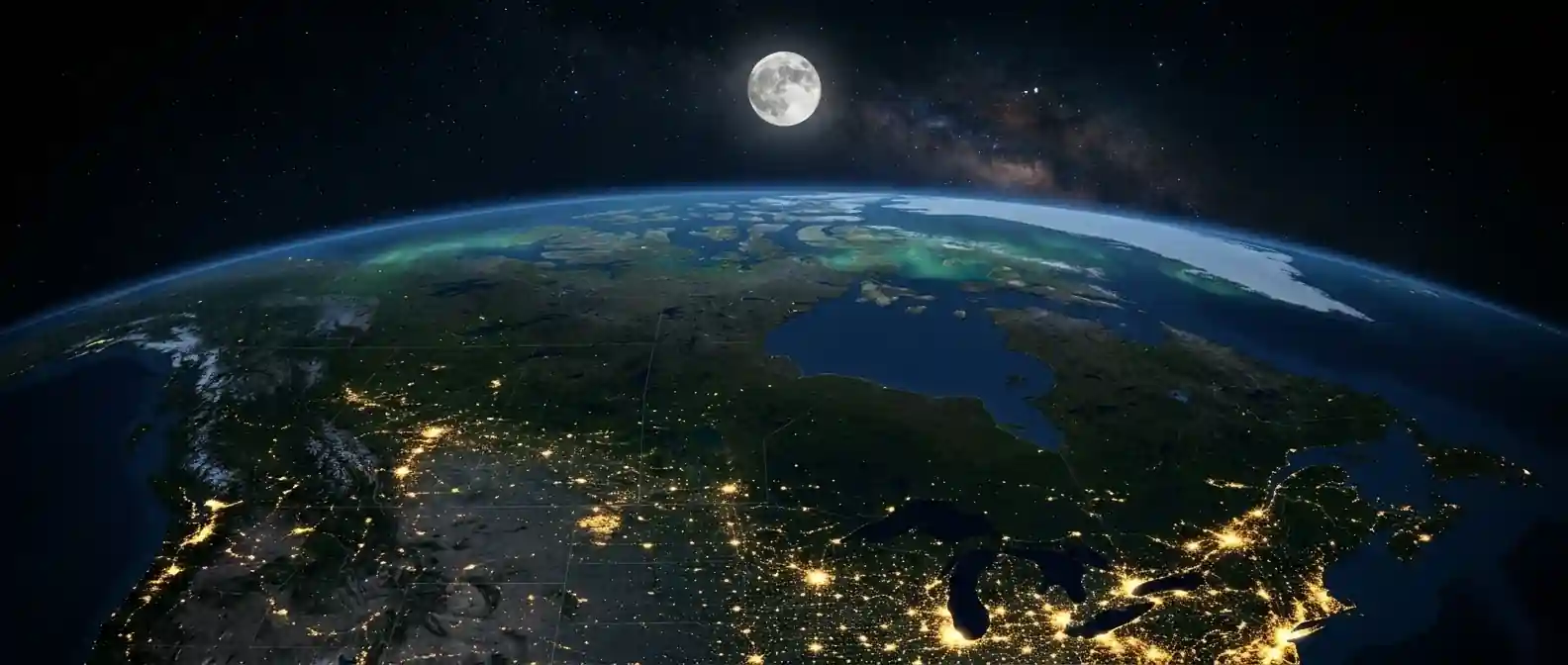
Astronomy Watch Canada
Moon Phase Today Canada: Monthly Moon Phases
Checked the moon phase today Canada and want to plan ahead? Pick a month to see the dates of the New Moon, First Quarter, Full Moon and Last Quarter. Each month links to its own calendar page, and each Full Moon name opens the same page.
2026
- AugustSturgeon Moon
- SeptemberHarvest Moon
- OctoberHunter’s Moon
- NovemberBeaver Moon
- DecemberCold Moon
2027
Understanding the Moon's Phases
The Moon has eight phases across a cycle of about 29.5 days. Its shape never changes; what changes is the angle at which sunlight falls across its surface. Moonrise slips roughly 50 minutes later each night, so every phase has its own best viewing window.
Watching the Moon from Canada
Canada stretches from about 42°N at the southern tip of Ontario to well past 80°N in the high Arctic, a wider range than almost anywhere else on Earth, and it changes how the Moon's path looks depending on where you're standing. Most Canadians, clustered along the southern border, see a Moon that swings from a high winter arc to a low-skimming summer one, similar to most of the mid-latitude world. Head north toward Yukon, the Northwest Territories, or Nunavut, though, and the seasonal swing turns extreme: above the Arctic Circle, a deep-winter full moon can circle the sky without ever setting, while the summer Moon barely clears the horizon, if it rises at all. Use the calculator above for exact moonrise, moonset, and phase times wherever you are in Canada.
Jump to a phase
The eight moon phases at a glance
| Phase | Cycle day | Illuminated | Rises and sets | Best for |
|---|---|---|---|---|
| The New Moon | ~1 | 0% | Rises at sunrise, sets at sunset | Faint galaxies and nebulae |
| Waxing Crescent | ~4 | 1-49% | Visible after sunset in the west | Earthshine |
| First Quarter | ~8 | 50% | Visible from noon to midnight | Telescope views along the terminator |
| Waxing Gibbous | ~11 | 51-99% | Rises afternoon, sets after midnight | Copernicus crater |
| The Full Moon | ~15 | 100% | Rises at sunset, up all night | Ray craters like Tycho |
| Waning Gibbous | ~19 | 99-51% | Rises after sunset, up into morning | Mare Crisium, Langrenus |
| Last Quarter | ~22 | 50% | Rises around midnight, up in the morning | Clavius crater field |
| Waning Crescent | ~26 | 49-1% | Visible just before sunrise in the east | Earthshine at dawn |
The New Moon
Day ~1 of cycle · Rises at sunrise, sets at sunset
Sun and Moon rise and set together, so no moonlight reaches the night sky at all. It's the least rewarding night for watching the Moon itself, and the best night each month for spotting faint galaxies and nebulae.
The science
New moon is the only time a solar eclipse can happen, since that's when the Moon's shadow can strike Earth. The Moon's orbit is tilted just enough that this alignment is rare rather than monthly.
What to look for
With no moonlight to wash out the sky, this is peak season for deep-sky hunting. Dark-site observers can pick out the Milky Way, along with nebulae and galaxies that vanish under brighter skies.
Fun fact
At new moon the Moon's far side is the one fully lit by the Sun. The so-called dark side of the Moon isn't permanently dark.
Waxing Crescent
Day ~4 of cycle · Visible after sunset in the west
A thin curve of light shows up low in the western sky right after sunset. Watch for Earthshine, a soft glow across the shadowed part of the disc, caused by sunlight bouncing off Earth and back onto the Moon.
The science
The crescent stays narrow because you're only catching a sliver of the lit half from a steep angle. Most of the illuminated hemisphere is still facing away from Earth this early in the cycle.
What to look for
Earthshine: a faint blue-grey wash across the unlit portion. It's sunlight reflecting off Earth's clouds and oceans, striking the Moon's dark side, then bouncing back to you.
Fun fact
The word "crescent" traces back to the Latin crescere, meaning to grow, the same root behind the everyday word "increase."
First Quarter
Day ~8 of cycle · Visible from noon to midnight
A straight terminator line splits the disc in half, with the Sun just rising on the Moon all along that line. This is when craters cast their longest, sharpest shadows, making it ideal telescope territory.
The science
At this point the Sun, Earth, and Moon form a right angle. That geometry is why the line between light and shadow, the terminator, appears as a nearly straight edge.
What to look for
Grab a telescope: the shallow sun angle along the terminator throws mountains and crater walls into dramatic relief, giving you maximum shadow length and surface texture.
Fun fact
The Sea of Tranquility, where Apollo 11 landed, is already in daylight at first quarter and easy to find with a small telescope, though the lander itself is far too small to see.
Waxing Gibbous
Day ~11 of cycle · Rises afternoon, sets after midnight
More than half lit and still growing, rising well before sunset. Sunlight now covers most of the maria, and Copernicus crater becomes the feature everyone points their scope at.
The science
The terminator has moved past centre and now curves along the disc's left edge, proof you're looking at more of the sunlit hemisphere than the shadowed one.
What to look for
Copernicus: a crater about 93 km wide whose terraced walls drop nearly 4 km to its floor, with a cluster of central peaks.
Fun fact
Because it rises mid-afternoon, the waxing gibbous is often visible while daylight still lingers. Check the eastern sky not long after lunch.
The Full Moon
Day ~15 of cycle · Rises at sunset, visible all night
The brightest phase of the month, but the toughest for surface detail, since direct light flattens every shadow. What it does show off beautifully are the bright ray systems streaking out from younger craters like Tycho.
The science
Sunlight hits the Moon head-on at full moon, erasing shadow and washing out topography. That same flat lighting makes the bright ejecta rays from young impacts stand out so clearly.
What to look for
Tycho's ray system, radiating from an 85-km crater in the southern highlands, stretches across much of the visible face, and Copernicus's rays put on a similar show.
Fun fact
The Moon reflects only about 12% of the sunlight hitting it, yet on a clear night it's still bright enough to cast visible shadows.
Waning Gibbous
Day ~19 of cycle · Rises after sunset, visible into morning
Moonrise now comes well after sunset, and the shadow creeping in from the right side of the disc brings the eastern maria into sharp relief. Mare Crisium and the craters near the terminator gain real depth.
The science
The terminator now sits on the right side of the disc and creeps toward the centre each night, a mirror image, geometrically, of the waxing gibbous a couple of weeks earlier.
What to look for
Mare Crisium, a dark oval basin about 560 km across near the eastern edge, stands out clearly, along with the crater Langrenus, whose walls catch the low light.
Fun fact
This phase quietly rewards patient observers: the eastern side, flatly lit around full moon, finally gets long, dramatic shadows of its own.
Last Quarter
Day ~22 of cycle · Rises around midnight, visible in the morning
The reverse of first quarter: now it's the left half lit, with moonrise around midnight. The terminator crosses the central highlands, and the huge walled plain of Clavius anchors the view.
The science
Just like first quarter, the Sun and Moon sit at a 90-degree angle from Earth's vantage point, but this time the opposite half catches the light.
What to look for
Clavius, in the southern highlands, is a 225-km walled plain that hosts its own internal chain of smaller craters, one of the Moon's most striking features.
Fun fact
Because it rises at midnight and sets around noon, the last quarter moon often hangs visibly in a fully daylit morning sky, a surprise for anyone who spots it.
Waning Crescent
Day ~26 of cycle · Visible just before sunrise in the east
A slim pre-dawn sliver rising just a few hours ahead of the Sun. The month is winding down, and Earthshine tends to reappear along the darkened edge before the cycle resets.
The science
Earthshine makes a comeback at crescent phases: the dark part of the Moon picks up a faint glow from sunlight bouncing off Earth's oceans and cloud cover.
What to look for
An early-riser's target. Low morning light picks out the ancient crater Schickard and the rugged Schiller-Zucchius basin near the southwestern limb, and Oceanus Procellarum, roughly 4 million square km, sits along the lit western edge.
Fun fact
Several traditional lunar calendars treated the waning crescent as the close of a month, with the first glimpse of the next waxing crescent, often just after sunset, marking day one of the new cycle.
For daily high-resolution renderings of the Moon's phase and orientation, see NASA's Scientific Visualization Studio.
View NASA's Moon Phase Gallery