
Moon Phase Today Calgary
On Friday, October 9, 2026, the moon in Calgary is a New Moon with 0% illumination. Moon age: 28.9 days.
☽ Best Places to View the Moon in Calgary
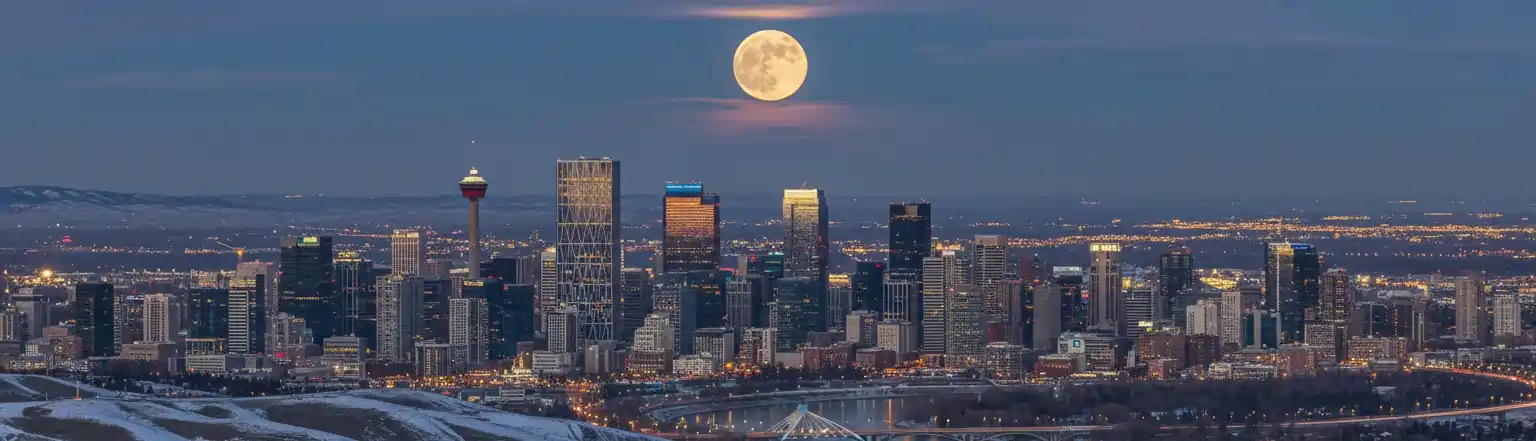
Calgary sits at just over 1,000 metres elevation on the Canadian prairies at the foot of the Rocky Mountains — a geographic position that gives it one of the most dramatic skyline contexts of any city in North America. To the west, the Front Ranges of the Rockies rise abruptly from the flat plain; to the east, the prairies extend to the horizon with nothing between Calgary's towers and the sky. The Bow River bends through the city, and a series of natural bluffs — Scotsman's Hill, Crescent Heights, McHugh Bluff — rise above the river valleys on all sides, giving elevated vantage points over the compact, photogenic downtown core. The Calgary Tower (190 m) and the saddle-shaped Scotiabank Saddledome are the two most recognisable skyline anchors, and on the right dates the moon rises dead-centre between them from the classic Scotsman's Hill viewpoint. Calgary also sits far enough north — at just over 51° latitude — that winter full moons ride high and bright across the sky, and the dry prairie air in autumn and winter gives some of the crispest moonrises in Canada.
Scotsman's Hill – Ramsay
The quintessential Calgary moonrise viewpoint. Scotsman's Hill sits above the Elbow River in the Ramsay neighbourhood southeast of downtown and looks northwest directly at the full skyline — the Calgary Tower, the Saddledome, and the downtown towers visible in one frame. On the right dates the moon rises dead-centre behind the Tower and Saddledome; PhotoPills is essential for planning that alignment. The hill has a wooden observation deck with benches and metal barriers. Historically used as a free grandstand for the Calgary Stampede since 1912, earning it the nickname "Scotsman's Grandstand." Free, open 24/7; access off Spiller Road SE.
Crescent Heights Lookout – Crescent Road NW
The Crescent Heights Lookout on Crescent Road NW sits on the north bank bluff above the Bow River and looks south across the river at the full downtown skyline — a panoramic view that takes in the Centre Street Bridge, the downtown towers, and the Bow River below. The moon rises to the east and tracks above the city core; on calm evenings the Bow reflects the skyline and the Centre Street Bridge lions in a long mirror below. One of Calgary's most visited evening viewpoints, particularly popular at sunset. Free, open 24/7; parking along Crescent Road.
Nose Hill Park – Northern High Points
Nose Hill Park is one of the largest urban parks in Canada — over 11 square kilometres of natural prairie on the northern edge of the city. Its highest points give noticeably darker skies than the river bluffs closer to downtown and an unobstructed eastern horizon that produces genuine prairie moonrise illusions: the moon rising enormous and amber over the flat grassland with the full Calgary skyline glowing to the south. The wide-open prairie setting rewards wide-angle compositions that no other Calgary viewpoint can match. Free, open 24/7; multiple trail access points from 14th Street NW and Shaganappi Trail.
Prince's Island Park – Bow River Pathways
Prince's Island Park sits in the Bow River between downtown and Kensington and its riverside pathways give ground-level compositions that the bluff viewpoints cannot: the moon rising above the Peace Bridge and the downtown skyline with calm river sections below offering mirror reflections of the towers. The red pedestrian Peace Bridge makes a distinctive architectural foreground element for moonrise compositions from the west bank. A more intimate and accessible alternative to the hilltop spots. Free, open 24/7; connected to the Bow River Pathway system throughout.
Tom Campbell's Hill Natural Park
Tom Campbell's Hill rises east of downtown near the Bridgeland neighbourhood and gives an elevated view back west across the Bow River valley and downtown skyline. The slightly elevated position above the valley floor provides better foreground separation than street level — the Bow River visible below and the full tower cluster behind. A quieter alternative to Scotsman's Hill with a similar east-of-downtown perspective. Free, open 24/7; accessible from Murdoch Road NE.
McHugh Bluff – Above Crescent Heights
McHugh Bluff sits just east of the Crescent Heights Lookout on the same north-bank ridge and gives a slightly elevated, more dramatic edge position above the Bow River valley. The steep drop-off below and the layered composition — river, downtown towers, and the moon rising to the east — make it a strong choice for photographers who want a more dynamic foreground than the open Crescent Heights terrace. The Centre Street Bridge is visible from this angle and adds foreground architecture. Free, open 24/7; accessible via the bluff trail from Crescent Road NW.
◉ Best Times for Moon Photography
📷 Quick Photography Tips
Calgary operates on MST (UTC−7) in winter and MDT (UTC−6) during daylight saving time. Alberta observes DST — clocks go forward on the second Sunday in March and back on the first Sunday in November. Apps like PhotoPills or Stellarium set to Calgary apply the correct offset automatically. At 51°N latitude, moonrise times shift more dramatically between summer and winter than in lower-latitude cities, making planning tools essential for timing specific skyline alignments.
For the moon phase in any other city worldwide, visit our Dynamic Moon Phase Calculator on our home page for instant lunar data tailored to wherever you are.
The moon phase today in Calgary, AB is shown in detail above — complete with exact illumination percentage, moonrise/set times, and the best local spots to see it. For the moon phase today in any other city or location worldwide, visit our Moon Phase Calendar on the home page.
◐ What the Experience Actually Feels Like
There is a particular quality to a moonrise in Calgary that you do not fully understand until you are standing on Scotsman's Hill on a clear November evening with the Saddledome directly in front of you and the Calgary Tower rising above it to the left. The hill drops steeply to the Elbow River below and the city spreads northwest in a tight, photogenic cluster — no sprawl, no visual noise, just the compact Calgary skyline framed by the cold Alberta sky. And then the moon clears the horizon to the east behind you and begins to rise above the tower cluster, and the Bow River, visible in the distance, catches the glow as a thin silver line between the buildings and the dark prairie beyond.
Calgary is a city that rewards photographers who understand its two contrasting personalities. From the bluffs and hilltops — Scotsman's Hill, Crescent Heights, McHugh Bluff — it is a tight, vertical skyline city with strong foreground architecture and river-valley depth. From Nose Hill to the north, it becomes something else entirely: a prairie city where the towers are small and distant and the sky is enormous, and the moon rises over grassland that extends unbroken to the east while the Rocky Mountains rise behind you to the west on clear days. Both compositions are genuine and both are worth planning. They require different lenses, different positions, and a different understanding of what Calgary actually is.
Winter is when Calgary earns its reputation as a moonrise city. The dry prairie air clears to a sharpness that summer humidity never achieves, and a winter full moon at 51°N latitude rides high across the southern sky — visible for hours, bright enough to cast shadows on the snow, and sharp enough to read without a telescope from Scotsman's Hill. The Bow River, if it hasn't frozen, reflects the tower lights in long streaks below the Crescent Heights bluff. The Rockies are visible to the west, white and close. And the moon tracks above the Calgary Tower in a sky that, on the best nights, is as clear as anything you will find in Canada this far south.
"The city spreads northwest in a tight, photogenic cluster — no sprawl, just the compact Calgary skyline framed by the cold Alberta sky. Then the moon clears the horizon and the Bow River catches the glow as a thin silver line between the buildings and the dark prairie beyond."
✓ Your Calgary Moon Chase Checklist
Before You Go
- Check the moonrise time and phase on this page — at 51°N the moon's arc across the sky changes significantly between summer and winter, and the Calgary Tower alignment from Scotsman's Hill is highly seasonal
- Use PhotoPills to find the specific date when the moon rises centred behind the Calgary Tower and Saddledome — the alignment window is narrow and planning months ahead pays off
- Target the 48–72 hour window before full moon if possible — the moon rises during blue and golden hour, and the prairie twilight above the Rockies to the west gives the Calgary skyline its most atmospheric backdrop
- Check the Bow River conditions before heading to Crescent Heights or Prince's Island — calm evenings only produce mirror reflections; strong Chinook winds common in winter and spring will break the surface entirely
- For Nose Hill, check the weather specifically — it is an exposed plateau and Chinook winds can make the high points genuinely dangerous in winter; the park has no windbreaks at the summit positions
What to Bring
- Serious cold-weather layers from October through April — Calgary's winter temperatures regularly fall below −20°C, and standing still on an exposed bluff for moonrise accelerates heat loss dramatically faster than walking
- Sturdy tripod — prairie wind is persistent and often strongest at the exposed bluff edges; the Crescent Heights lookout and Nose Hill high points are particularly exposed to westerly Chinook gusts
- A lens between 200–400mm for Scotsman's Hill — compressing the moon against the Calgary Tower requires significant focal length from the hill's distance, and the Saddledome alignment rewards longer glass
- A wide-angle lens (16–24mm) for Nose Hill — the open prairie foreground and the full southern city glow reward environmental compositions that include both the grassland and the distant skyline
- Hand warmers and spare batteries — lithium batteries drain fast in sub-zero temperatures; carry a spare inside a chest pocket and swap before shooting to avoid a dead battery at the critical moment
- Microspikes or traction cleats from November through March — the bluff paths at Crescent Heights and McHugh Bluff ice to glass and the drop-offs below are significant
On the Night
- Arrive at Scotsman's Hill 30–45 minutes before moonrise — the eastern sky brightens before the moon clears the horizon, and the warm pre-moonrise glow against the lit skyline to the northwest is often the best light of the evening
- At Crescent Heights, position yourself on the lookout terrace for the widest view — move east along the bluff path to change the moon's position relative to the Centre Street Bridge and downtown towers as it rises
- Shoot RAW throughout — the dynamic range between the bright moon, the Calgary Tower's lit crown, the dark river surface, and the Saddledome's curve requires separate exposures blended in post
- Stay 20–30 minutes after moonrise — as the moon climbs above the horizon haze it sharpens and brightens rapidly in the dry prairie air, and the skyline alignments from Scotsman's Hill become cleaner and more precise
- At Nose Hill, allow your eyes 10 minutes to dark-adapt before shooting — the park has no artificial lighting at the high points and the transition from the lit car park to true prairie dark requires adjustment time
? Calgary Moon Phase — Frequently Asked Questions
Q. What is the moon phase today in Calgary?
The moon phase today in Calgary is a New Moon with 0% illumination. The next full moon is in 17 days, on Oct 25. Moonrise is at 6:53 AM and moonset at 6:23 PM.
Q. Where is the best place to view the moon in Calgary?
Scotsman's Hill in Ramsay is the classic spot, looking straight at the Calgary Tower and Saddledome with the moon rising dead-centre between them on the right dates. Crescent Heights Lookout and McHugh Bluff give a similar downtown skyline view from across the Bow River, while Nose Hill Park to the north offers a wide-open prairie horizon and noticeably darker skies for a completely different kind of moonrise.
Q. Why does moon visibility change so much in Calgary through the year?
Calgary sits at just over 51° N, so the moon's arc across the sky shifts noticeably more between summer and winter than it does in lower-latitude cities. Winter full moons ride high and stay visible for hours, and the dry prairie air that arrives from October through April gives some of the sharpest, clearest moonrises anywhere in Canada.
Q. When is the next full moon in Calgary?
The date of the next full moon is calculated live and shown in the "Next Full Moon" card above. For a full breakdown of upcoming full moons and their traditional names, see our next full moon guide.
Q. Does Calgary observe daylight saving time?
Yes. Calgary runs on Mountain Standard Time (MST, UTC−7) in winter and switches to Mountain Daylight Time (MDT, UTC−6) from the second Sunday in March to the first Sunday in November. All times shown on this page already account for the correct offset.
Q. What's the best time of year for moon photography in Calgary?
October through April brings the clearest, driest prairie air and the most southerly moon path, which makes lining the moon up behind the Calgary Tower from Scotsman's Hill much easier to plan. Just watch for Chinook winds, which can gust hard at exposed spots like Nose Hill and the Crescent Heights bluff with little warning.
Q. Does this page work for cities besides Calgary?
This page is set up specifically for Calgary, AB. For the moon phase in any other city or location worldwide, use the Dynamic Moon Phase Calculator on the moonphase.today home page.
✦ Explore Further
Moon Phase Today: Edmonton
Check tonight's moon phase and best viewpoints in Edmonton, about 300km north up the QE2.
📷Moon Photography Guide
Camera settings, lenses, and techniques for shooting sharp, well-exposed moon shots.
🔭Photography Field of View Calculator
Work out the focal length you'll need to line the moon up with the Calgary Tower from Scotsman's Hill.
🌆Blue Hour Calculator
Time your visit to Crescent Heights or Nose Hill for the richest prairie twilight before moonrise.
NASA Moon Phase & Libration Gallery
NASA's Scientific Visualization Studio's daily renders of the moon's exact phase, libration, and orientation, straight from official mission data.