
Moon Phase Today Laval
On Friday, October 9, 2026, the moon in Laval is a New Moon with 0% illumination. Moon age: 28.9 days.
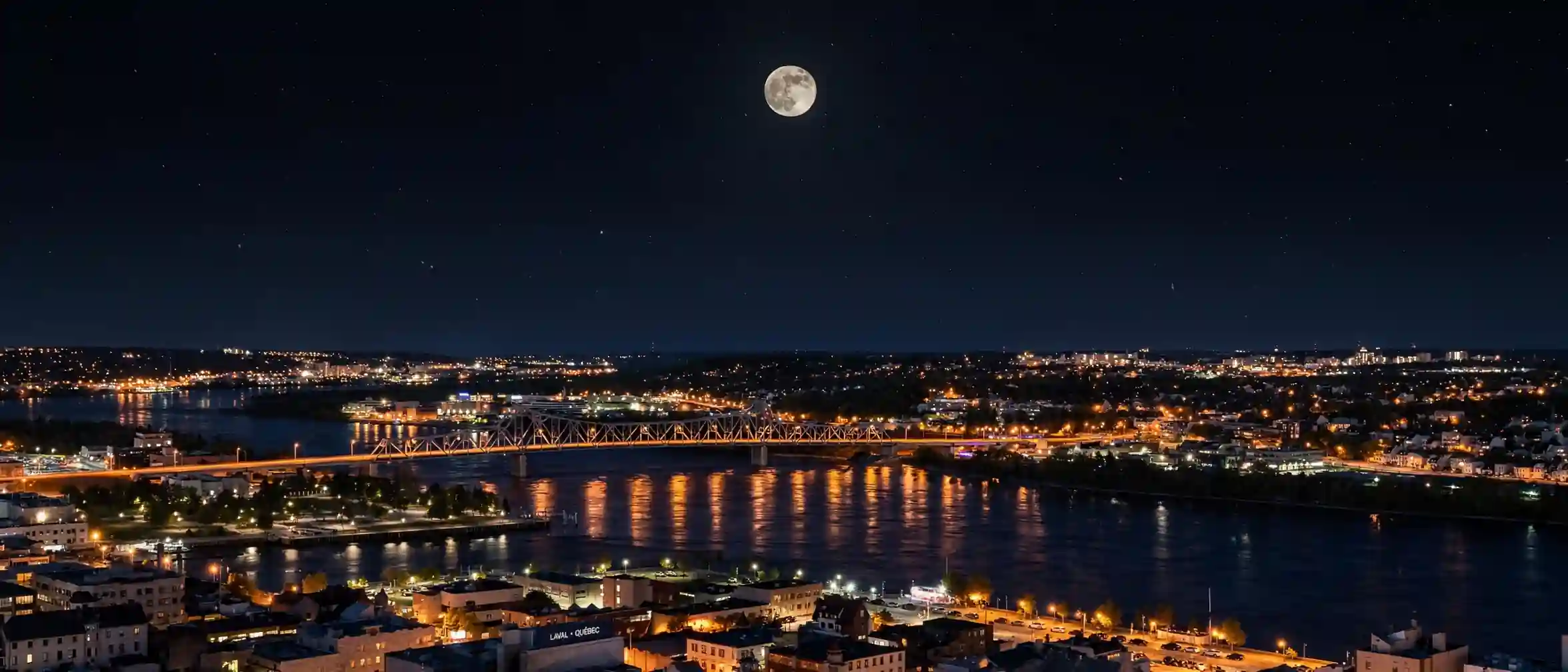
☽ Best Places to View the Moon in Laval, Quebec, Canada
Laval is an island city just north of Montreal, bounded by the Rivière des Prairies to the south and the Rivière des Mille Îles to the north. Its shorelines hold most of the open sky: river islands and bayous on the north side, riverside parks looking toward Montreal on the south side, and a large lake park in a former quarry at the city's centre.
Centre de la nature – Former Quarry, About 50 Hectares
Laval's best-known urban park at 901 avenue du Parc in Duvernay, built on a former stone quarry and turned into a park in the 1970s. Its artificial lake, gardens and walking trails make the lake the main open-sky viewpoint, with calm water for moon reflections on still evenings. The park is open from 8 a.m. to 10 p.m.
Parc de la Rivière-des-Mille-Îles – River Islands and Bayous
Along Laval's northern shore, the Rivière des Mille Îles spreads into a maze of wooded islands, marshes and bayous. The river gives long views across open water toward the north shore, and its quieter channels suit a moon low over the trees in calm conditions. Its visitor facilities and access points keep their own hours, separate from Laval's municipal park schedule.
Parc Bernard-Landry – 30-Hectare Natural Park
A 30-hectare natural park on Laval's south side, near the Rivière des Prairies, with parking at 15e Rue and boulevard Cartier and on boulevard des Prairies. Its walking paths and picnic areas make it an easy evening stop in the southern part of the city, and the City lists it as open year-round from 7 a.m. to 10 p.m.
Rivière des Prairies Shoreline – Looking Toward Montreal
Laval's whole southern edge runs along the Rivière des Prairies, with Montreal on the opposite bank. A full moon near the summer solstice follows a relatively low path across the southern sky, so parks along this shore give open water in the foreground and a view south toward Montreal while the moon crosses that part of the sky.
Cosmodôme – Space Science Museum
At 2150 Autoroute des Laurentides, the Cosmodôme opened in 1994 and is the only museum in Canada devoted entirely to space science and exploration. Its exhibits include a piece of lunar rock on public display, and it is home to Space Camp Canada. It is an indoor museum rather than an observing site.
Rio Tinto Alcan Planetarium – Montreal
Across the Rivière des Prairies in Montreal, the Rio Tinto Alcan Planetarium beside the Olympic Park is part of Espace pour la vie. Its dome shows give context for the lunar cycle and the night sky, a short trip from Laval when clouds block the real moon.
◉ Best Times for Moon Photography in Laval
📷 Quick Tips for Laval
Timezone: Eastern Time – EST UTC-5 / EDT UTC-4 in summer.
Horizons: Laval sits on an island in the flat St. Lawrence Lowlands, with the Rivière des Prairies along its southern edge and the Rivière des Mille Îles along its northern edge. The two shorelines give the city's longest open views. The south shore looks across the water toward Montreal while the moon crosses the southern sky, and the north shore looks across the river islands toward the north bank.
Terrain: Flat lowland with no real high ground, so trees along the shorelines and the city's buildings are the main horizon obstacles. Centre de la nature's lake sits in a former stone quarry, turned into a park in the 1970s.
Access: Centre de la nature at 901 avenue du Parc is open from 8 a.m. to 10 p.m. Parc Bernard-Landry has parking at 15e Rue and boulevard Cartier and on boulevard des Prairies, and the City lists it as open from 7 a.m. to 10 p.m. Parc de la Rivière-des-Mille-Îles keeps its own hours for its visitor facilities and access points. The Cosmodôme is at 2150 Autoroute des Laurentides.
The moon phase today in Laval is shown above. For moon phase today anywhere else, visit the calculator.
◐ What It Feels Like
At Centre de la nature, the lake fills the floor of an old quarry, and on a still evening the rising moon lies doubled on the water between the gardens and the trees.
On the Rivière des Mille Îles, wooded islands and quiet channels break the river into pieces, and the light fades slowly over marsh and open water.
On the Rivière des Prairies shore, the water runs wide toward Montreal, and a full moon near the summer solstice tracks low across the southern sky above the far bank.
"An island between two rivers, with bayous on one shore, Montreal on the other, and a lake in an old quarry at its heart."
✓ Checklist for Lunar Observers
Before You Go
- Check moonrise / moonset azimuth — determines alignment along each shoreline and over the lake
- Check Environment Canada — cloud, snow, freezing rain and river mist can change quickly
- Confirm access — Centre de la nature is open 8 a.m. to 10 p.m., municipal parks close at 10 p.m., and Parc de la Rivière-des-Mille-Îles keeps its own hours
What to Bring
- Telephoto and wide for river, island and skyline foregrounds
- Tripod for landscape and bracketing — useful for multi-exposure, close Moon can be handheld
- Lens cloth for humidity near the water
- Spare batteries and warm layers for winter nights — check current park hours and access rules before nighttime session
On the Night
- Manual focus on lunar limb
- Bracket for disc vs. foreground — difficult to retain both in single exposure
- Stay on marked paths — marshes, riverbanks and sensitive shoreline habitat
- Shorelines give open sightlines, but darkness still depends on nearby artificial light
? Laval Moon Phase — Frequently Asked Questions
Q. What is the moon phase today in Laval?
The moon phase today in Laval is a New Moon with 0% illumination. The next full moon is in 17 days, on Oct 26. Moonrise is at 6:00 AM and moonset at 5:46 PM.
Q. Where is the best place to view the moon in Laval?
Laval is an island between two rivers, so its shorelines give the most open sky. The Rivière des Prairies along the south side looks across the water toward Montreal while the moon crosses the southern sky. Along the north side, Parc de la Rivière-des-Mille-Îles has wooded islands, marshes and bayous for quieter river views. In the middle of the city, Centre de la nature has a lake in a former stone quarry, with calm water for reflections on still evenings.
Q. Is there a space museum or planetarium near Laval?
Yes. The Cosmodôme at 2150 Autoroute des Laurentides opened in 1994 and is the only museum in Canada devoted entirely to space science and exploration. Its exhibits include a piece of lunar rock on public display, and it is home to Space Camp Canada. Across the Rivière des Prairies in Montreal, the Rio Tinto Alcan Planetarium beside the Olympic Park runs dome shows on the night sky. Both are indoor venues, so they work on cloudy nights too.
Q. Where does the moon rise and set in Laval, and how high does it climb?
At about 45.6°N, Laval's moonrise and moonset points swing widely across the horizon each month, from roughly northeast to southeast for rising and northwest to southwest for setting, with an even wider swing in years near a major lunar standstill. A full moon near the winter solstice climbs high in the south, to roughly 68° above the horizon, while a full moon near the summer solstice follows a relatively low southern path, peaking near 21°. The Rivière des Prairies shore gives a view south across the water toward Montreal while the moon crosses the southern sky. Laval is flat, with trees along the shorelines and city buildings as the main horizon obstacles, so check the azimuth for your date and exact spot.
Q. Is light pollution a problem for moon observing in Laval?
The moon is bright enough to observe and photograph from almost anywhere in Laval, so light pollution rarely limits the lunar disc itself. It does wash out earthshine on a thin crescent and any faint sky detail. Laval is part of the Greater Montreal area, with Montreal directly to the south and substantial artificial lighting across the city, so it is a light-polluted site rather than a dark-sky one. The wooded islands along the Rivière des Mille Îles can screen some direct lights, but the overall glow remains.
Q. What camera settings and phases work best for moon photography in Laval?
For a full moon, start with Looney 11 (f/11, ISO 100, 1/100 s) and refine using your histogram, since it is a baseline rather than a guarantee. The moon is much brighter than the rivers, islands and city lights, so shoot RAW and bracket or blend exposures to keep both crater detail and the foreground. A waxing gibbous is useful for blue hour while the foreground is still lit. A 200–400 mm lens helps isolate the moon over the Montreal skyline from the Rivière des Prairies shore or above the wooded islands of the Mille Îles, with a tripod for bracketing and manual focus on the moon using magnified live view. The rivers and the lake at Centre de la nature can give a reflection when the water is calm and lies between you and the moon.
Q. How do winter cold, snow and humidity affect moon viewing in Laval?
Laval has cold, snowy winters with occasional freezing rain, and winter nights are often well below freezing, which drains camera batteries faster and calls for warm layers and spare batteries. Summers are warm and humid, with thunderstorms and haze that can soften the moon near the horizon, and humidity can leave condensation on lenses when gear comes from an air-conditioned space. Mist can also gather over the rivers on calm, cool nights. Check Environment and Climate Change Canada forecasts for cloud, snow and wind before heading out.
Q. What time zone are Laval's moonrise and moonset times shown in?
Laval runs on Eastern Time: Eastern Standard Time, UTC−5, in winter and Eastern Daylight Time, UTC−4, in summer. Clocks move forward on the second Sunday in March and back on the first Sunday in November, and moonrise and moonset times on this page follow the local clock in effect on each date.
Q. Can I shoot the moon at Laval's viewpoints after dark?
Partly. Centre de la nature is open from 8 a.m. to 10 p.m., and the City lists municipal parks such as Parc Bernard-Landry as open year-round from 7 a.m. to 10 p.m., so evening moonrise sessions work there, but late-night ones do not. Parc de la Rivière-des-Mille-Îles keeps its own hours for its visitor facilities and access points, separate from the municipal park schedule, so check them before a visit. Keep to marked paths along the riverbanks and marshes, especially after dark. The Cosmodôme and the Montreal planetarium keep their own hours as well.
Q. Does this page work for cities besides Laval?
This page is set up specifically for Laval, Quebec, Canada. For the moon phase in any other city or location worldwide, use the Dynamic Moon Phase Calculator on the moonphase.today home page.
✦ Explore Further
Moon Phase Today: Montreal
Check tonight's moon phase in Montreal, directly south of Laval across the Rivière des Prairies.
🏛Moon Phase Today: Ottawa
See the moon over Ottawa, roughly 165 km west of Laval on the Ottawa River.
🇨🇦Moon Phase in Canada
Browse moon phase pages for cities across Canada, from St. John's to Vancouver.
🌍World Moon Phase Directory
Find the moon phase, rise and set times for cities in every region of the world.
Blue Hour Calculator
Work out when blue hour falls, ideal for waxing gibbous shots over the lake at Centre de la nature.