
Moon Phase Today London Ontario
On Friday, October 9, 2026, the moon in London is a New Moon with 0% illumination. Moon age: 28.9 days.
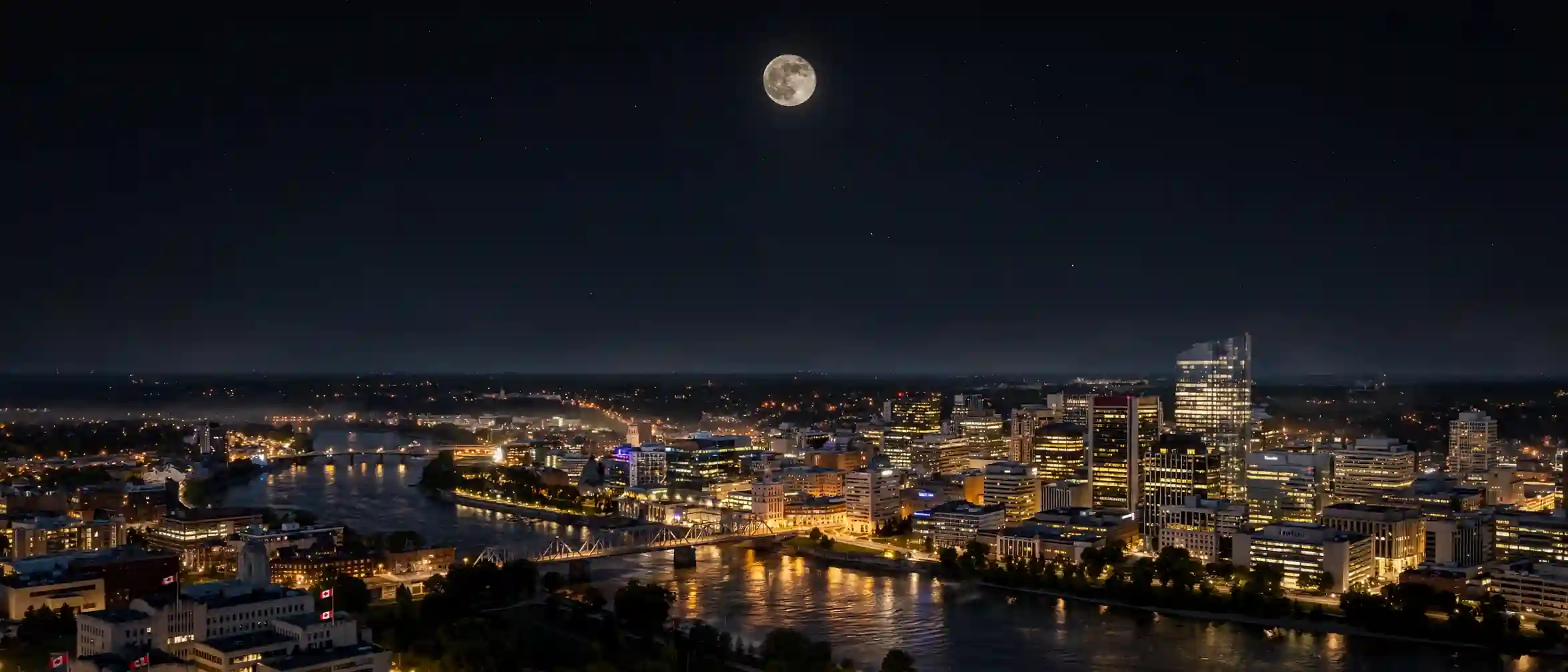
☽ Best Places to View the Moon in London, Ontario, Canada
London sits in Southwestern Ontario on flat to gently rolling land, where the North and South branches of the Thames River meet downtown at the Forks. The river valley holds most of the city's open sky, with a large riverside park in the west end, a flood-control reservoir in the northeast, kettle ponds in the south end, and a historic university observatory in the north.
Springbank Park – London's Largest Park
The city's largest park follows the Thames River through London's west end, with its main entrance at 1085 Commissioners Road West. Long riverside lawns and trails give open stretches of sky over the water, with the treeline on the far bank as a foreground for a rising or setting moon.
Forks of the Thames & Harris Park – Downtown
The North and South branches of the Thames meet downtown beside Harris Park, the city's riverside event park. It is London's most central viewpoint, with the river in the foreground and the downtown skyline rising behind it, a strong urban composition for a moon low over the city.
Fanshawe Conservation Area – Fanshawe Lake
In the city's northeast, Fanshawe Lake is a flood-control reservoir on the North Thames, surrounded by a conservation area run by the Upper Thames River Conservation Authority. The lake gives the widest sheet of open water in London for moon reflections. The conservation area has its own gate hours and fees.
Westminster Ponds – Kettle Ponds in the South End
At about 200 hectares, Westminster Ponds / Pond Mills is the largest publicly owned Environmentally Significant Area in London and a Provincially Significant Wetland. Five large kettle ponds and a beaver pond sit among forest and wetland south of Commissioners Road and east of Wellington Road, a quieter, natural setting for still-water reflections.
Thames Valley Parkway – Riverside Path Network
London's main multi-use path follows the Thames and its branches through the city, linking Springbank Park, the Forks and riverside parks to the north and east. Moving along the path lets you line the moon up with bridges, water and open river flats as the rise and set points shift through the month.
Hume Cronyn Memorial Observatory – Western University
On the Western University campus, the Cronyn Observatory was inaugurated on October 25, 1940 and has been the hub of public astronomy outreach in London ever since. Free public nights include a talk by an astronomer and, when skies are clear, views through its 10-inch refractor and other telescopes.
◉ Best Times for Moon Photography in London
📷 Quick Tips for London
Timezone: Eastern Time – EST UTC-5 / EDT UTC-4 in summer.
Horizons: London sits on flat to gently rolling land in Southwestern Ontario, with the Thames valley cutting through the city. The North and South branches meet downtown at the Forks, and the river then runs west through Springbank Park. The valley floor and the riverside flats are where the open sky is, and the Thames Valley Parkway links them along the water.
Terrain: No mountains or real high ground, so trees along the Thames valley and city buildings are the main horizon obstacles. Fanshawe Lake in the northeast is a reservoir on the North Thames, and Westminster Ponds in the south end holds five kettle ponds and a beaver pond in about 200 hectares of forest and wetland.
Access: Springbank Park's main entrance is at 1085 Commissioners Road West. Harris Park and the Forks are downtown. Westminster Ponds is south of Commissioners Road and east of Wellington Road, extending to Pond Mills Road. Fanshawe Conservation Area has its own gate hours and fees. The Cronyn Observatory is on the Western University campus and opens for scheduled public nights.
The moon phase today in London, Ontario is shown above. For moon phase today anywhere else, visit the calculator.
◐ What It Feels Like
At the Forks of the Thames, the two branches of the river meet below the downtown skyline, and a rising moon climbs above the city with its light broken across the water.
At Springbank Park, the river runs slow past long lawns and a wooded far bank, and the west end quietens as dusk settles over the valley.
At Westminster Ponds, the kettle ponds sit still among forest and wetland, a pocket of natural quiet just off two of the city's busiest roads.
"Two branches of the Thames meeting below the skyline, a reservoir to the northeast, and kettle ponds hidden in the south end."
✓ Checklist for Lunar Observers
Before You Go
- Check moonrise / moonset azimuth — determines alignment along the Thames and over the ponds
- Check Environment Canada — cloud, lake-effect snow squalls and river mist can change quickly
- Confirm access — city park hours, Fanshawe Conservation Area gate hours and fees, Cronyn public night dates
What to Bring
- Telephoto and wide for river, skyline and pond foregrounds
- Tripod for landscape and bracketing — useful for multi-exposure, close Moon can be handheld
- Lens cloth for humidity near the water
- Spare batteries and warm layers for winter nights — check current park hours and access rules before nighttime session
On the Night
- Manual focus on lunar limb
- Bracket for disc vs. foreground — difficult to retain both in single exposure
- Stay on marked trails — Westminster Ponds is an Environmentally Significant Area and Provincially Significant Wetland
- River flats give open sightlines, but darkness still depends on nearby artificial light
? London, Ontario Moon Phase — Frequently Asked Questions
Q. What is the moon phase today in London, Ontario?
The moon phase today in London, Ontario is a New Moon with 0% illumination. The next full moon is in 17 days, on Oct 26. Moonrise is at 6:31 AM and moonset at 6:18 PM.
Q. Where is the best place to view the moon in London, Ontario?
Springbank Park, the city's largest park, follows the Thames River through London's west end and gives long open stretches of sky above the river and its lawns. Downtown, the Forks of the Thames, where the North and South branches meet beside Harris Park, gives a central riverside view with the skyline as foreground. In the northeast, Fanshawe Conservation Area surrounds Fanshawe Lake, a reservoir on the North Thames, with open water that suits a rising or setting moon. Westminster Ponds in the south end has five kettle ponds and a beaver pond among forest and wetland, a quieter, more natural setting.
Q. Can I look at the moon through a telescope in London, Ontario?
Yes. The Hume Cronyn Memorial Observatory on the Western University campus has run public astronomy events since it opened in 1940, and its free public nights include telescope viewing through its 10-inch refractor and other telescopes when skies are clear, along with a talk by an astronomer. The observatory has also hosted International Observe the Moon Night events. Check the observatory's event listings for upcoming dates, since viewing depends on the weather.
Q. Where does the moon rise and set in London, Ontario, and how high does it climb?
At about 43°N, London's moonrise and moonset points swing across the horizon each month, from roughly east-northeast to east-southeast for rising and west-northwest to west-southwest for setting, with a wider swing in years near a major lunar standstill. A winter full moon culminates high in the south, at roughly 70° above the horizon, while a summer full moon stays low, peaking near 24°. London sits on flat to gently rolling land, so the main horizon obstacles are trees along the Thames valley and city buildings rather than hills. A low summer full moon is best caught from open ground such as the river flats, so check the azimuth for your date and exact spot.
Q. Is light pollution a problem for moon observing in London, Ontario?
The moon is bright enough to observe and photograph from almost anywhere in London, so light pollution rarely limits the lunar disc itself. It does wash out earthshine on a thin crescent and any faint sky detail. London is a mid-sized city with substantial artificial lighting downtown and along its main roads, so it is a light-polluted site rather than a dark-sky one. The river valley in Springbank Park and the wooded edges of Fanshawe Conservation Area can screen some direct lights, but the overall city glow remains.
Q. What camera settings and phases work best for moon photography in London, Ontario?
For a full moon, start with Looney 11 (f/11, ISO 100, 1/100 s) and refine using your histogram, since it is a baseline rather than a guarantee. The moon is much brighter than the river, parks and downtown lights, so shoot RAW and bracket or blend exposures to keep both crater detail and the foreground. A waxing gibbous is useful for blue hour while the foreground is still lit. A 200–400 mm lens helps isolate the moon against the downtown skyline from the Forks or against the treeline at Springbank Park, with a tripod for bracketing and manual focus on the moon using magnified live view. The Thames and Fanshawe Lake can give a reflection when the water is calm and lies between you and the moon.
Q. How do lake-effect snow, humidity and winter cold affect moon viewing in London, Ontario?
London sits east of Lake Huron, so winter brings frequent cloud and lake-effect snow squalls that can close off clear lunar windows quickly. Winter nights are often well below freezing, which drains camera batteries faster and calls for warm layers and spare batteries. Summers are warm and humid, with thunderstorms and haze that can soften the moon near the horizon, and humidity can leave condensation on lenses when gear comes from an air-conditioned space. Mist can also gather over the Thames on calm, cool nights. Check Environment and Climate Change Canada forecasts for cloud, snow squalls and wind before heading out.
Q. What time zone are London, Ontario's moonrise and moonset times shown in?
London, Ontario runs on Eastern Time: Eastern Standard Time, UTC−5, in winter and Eastern Daylight Time, UTC−4, in summer. Clocks move forward on the second Sunday in March and back on the first Sunday in November, and moonrise and moonset times on this page follow the local clock in effect on each date.
Q. Can I shoot the moon at London, Ontario's viewpoints after dark?
Access varies by site. City parks such as Springbank Park and Harris Park have posted hours, so check signage before planning a late session. Westminster Ponds is an Environmentally Significant Area and a Provincially Significant Wetland, so keep to marked trails, especially after dark. Fanshawe Conservation Area is run by the Upper Thames River Conservation Authority and has its own gate hours and fees, so confirm them before an evening visit. Cronyn Observatory public nights are scheduled events, so check the listed start time.
Q. Does this page work for cities besides London, Ontario?
This page is set up specifically for London, Ontario, Canada. For the moon phase in any other city or location worldwide, use the Dynamic Moon Phase Calculator on the moonphase.today home page.
✦ Explore Further
Moon Phase Today: Detroit
Check tonight's moon phase in Detroit, roughly 165 km southwest of London across the border.
🏙Moon Phase Today: Toronto
See the moon over Toronto, roughly 170 km east of London on Lake Ontario.
🇨🇦Moon Phase in Canada
Browse moon phase pages for cities across Canada, from St. John's to Vancouver.
🌍World Moon Phase Directory
Find the moon phase, rise and set times for cities in every region of the world.
Blue Hour Calculator
Work out when blue hour falls, ideal for waxing gibbous shots over the Thames at Springbank Park.