
Moon Phase Today Moncton
On Friday, October 9, 2026, the moon in Moncton is a New Moon with 0% illumination. Moon age: 28.9 days.
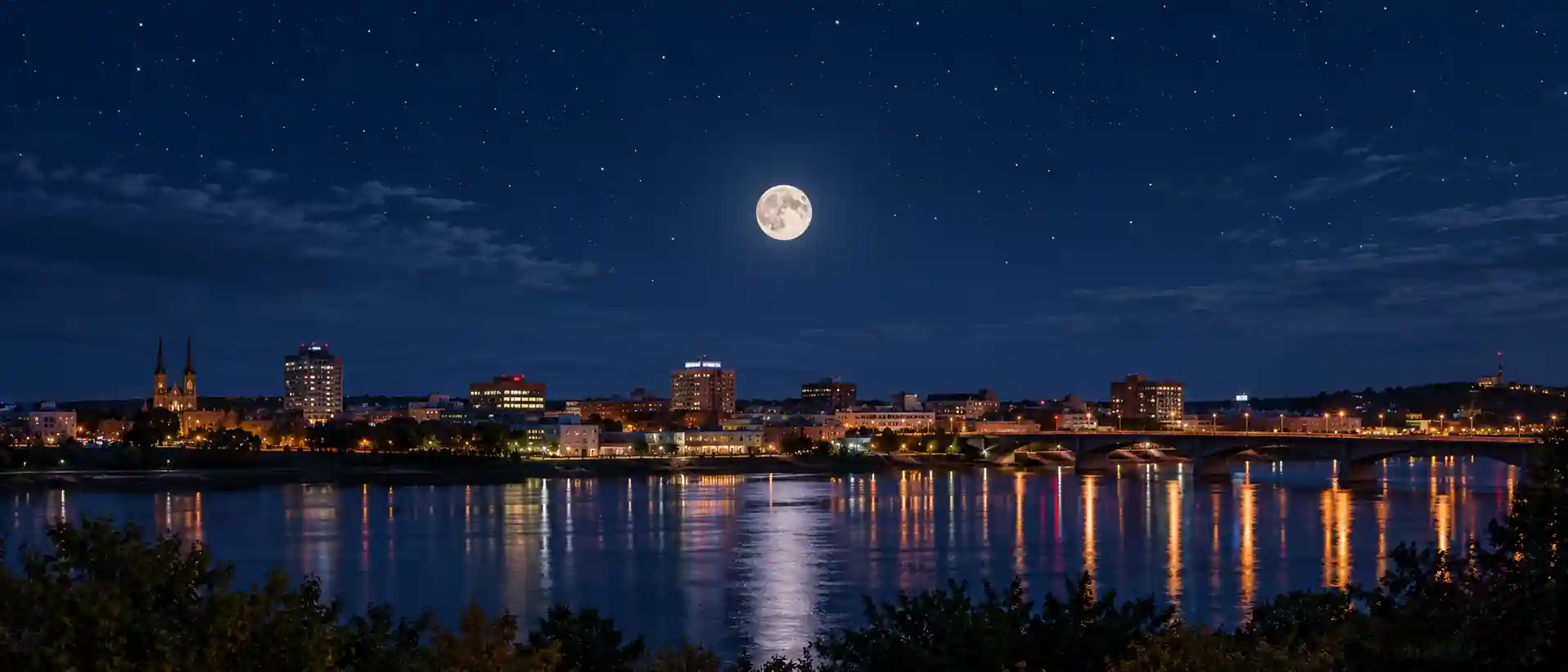
☽ Best Places to View the Moon in Moncton, New Brunswick
Moncton sits on the Petitcodiac River, close enough to the Bay of Fundy that the moon's pull on the tides is a visible, twice-daily event here rather than an abstract fact — the City of Moncton notes that tidal bores get noticeably stronger around full and new moons, when the Bay of Fundy's tides are at their most extreme. That makes this one of the few cities where moon-watching and tide-watching genuinely overlap. Downtown clusters around the river, while a couple of large parks and a day trip to the Bay of Fundy itself round out the options. As always, the moon's exact rise time and direction shift with the date and your observing location, so it's worth checking both against whichever spot you're planning around. Here are six useful moon-viewing options in the area, each suited to a different kind of visit.
Bore Park
Downtown Moncton's dedicated viewing spot for the Petitcodiac River's tidal bore, with amphitheater-style seating facing the water. The bore arrives twice daily and runs noticeably larger around full and new moons, when Bay of Fundy tides are at their most extreme. Free, wheelchair accessible. Address: 10 Bendview Ct.
Riverfront Park & Trail
A paved and gravel trail system following the Petitcodiac River through downtown, connecting to Bore Park and extending toward Dieppe and Riverview. Free to visit. The City lists Riverfront Park as open dawn to dusk. Address: 110 Assomption Blvd.
Palette Urban Rooftop Bar
A 9th-floor rooftop bar at the Canvas Moncton hotel, 16+, with cocktails and an elevated view over downtown. Hours vary by day (commonly listed as Tue–Wed 4–9 p.m., Thu–Sat 4 p.m.–midnight); check current hours before heading over. Address: 55 Queen St.
Centennial Park
A 94-hectare city park in the city centre, with forested and open recreational space, walking and cycling trails, a beach, and a dog park. Free to visit. The City lists the park as open dawn to dusk year-round. Address: 801 St George Blvd.
Irishtown Nature Park
An 890-hectare park on the city's north edge — one of the largest urban parks in Canada — with Acadian forest, marshland, and a reservoir lake, genuinely quieter than downtown. Free to visit. The City lists it as open dawn to dusk. Address: 1155 Elmwood Dr.
Hopewell Rocks Provincial Park
The Bay of Fundy's famous "flowerpot" sea stacks, about 35 minutes by car southeast of Moncton, where the world's highest tides — shaped by the combined gravitational pull of the moon and sun — expose the ocean floor at low tide and submerge it again a few hours later. Open seasonally; current opening dates, admission rates, and gate hours vary by season, so check the official schedule before visiting. Address: Hopewell Cape.
◉ Best Times for Moon Photography
📷 Quick Photography Tips
Moncton runs on Atlantic Time — AST (UTC−4) in winter and ADT (UTC−3) in summer, one hour ahead of Eastern Time. New Brunswick observes daylight saving time. PhotoPills or Stellarium will handle the moon's exact rise azimuth for any of these spots automatically.
The moon phase today in Moncton is shown in detail above — complete with exact illumination percentage, moonrise/set times, and the best local spots to see it. For the moon phase today in any other city worldwide, visit our Dynamic Moon Phase Calculator on the home page.
◐ What the Experience Actually Feels Like
Bore Park is a genuinely public, multi-use space: the City posts the next bore's estimated arrival, visitors often gather in the amphitheatre beforehand — especially when a strong bore is expected — and the crowd thins out again almost as soon as the wave passes. Checking the current tidal bore schedule before you go tells you roughly when the water — and, around full and new moons, a noticeably bigger surge of it — will roll through.
Palette is a hotel rooftop bar first, with its own dress expectations and hours that shift through the week. From the 9th floor of Canvas Moncton, the view takes in the low-rise downtown skyline and the bend of the Petitcodiac River below.
Hopewell Rocks is a genuinely different kind of destination from anywhere else on this list — an admission ticket that lets you experience the site around changing tides, seeing the same stretch of ocean floor transformed within hours, and a seasonal closure that means winter planning has to look elsewhere. The connection to this page's subject is direct: the same lunar gravitational forces that contribute to Earth's tides also help drive the dramatic rise and fall of the Bay of Fundy, while the bay's shape amplifies the effect.
"The same lunar gravitational forces that contribute to Earth's tides also help drive the dramatic rise and fall of the Bay of Fundy, while the bay's shape amplifies the effect."
✓ Your Moncton Moon Chase Checklist
Before You Go
- Check the moon's rise time and azimuth for your date and observing location — alignment with the river, downtown, or a specific landmark depends on both
- Check the current tidal bore schedule before heading to Bore Park; arrival times change daily, and the City's estimates can be off by up to about 20 minutes
- Verify Site Access: Hopewell Rocks Provincial Park is only open seasonally — confirm current season dates and gate hours before planning a trip out
- Use PhotoPills or Stellarium to check whether the moon will align with a specific landmark on your date
- Check the marine forecast for fog, particularly in summer, in addition to the general weather outlook
- Bring a payment method for Hopewell Rocks admission and for drinks at Palette, since the city parks and Bore Park on this list are free
What to Bring
- A telephoto lens — 200mm or longer can be useful when you want a relatively large moon beside a distant landmark, depending on your shooting distance
- A warm layer, even in summer — river and coastal air can make an evening feel cooler than the daytime temperature suggests
- A remote shutter release or a 2-second timer to avoid shake on tripod shots, where tripods are permitted
- Sturdy, waterproof footwear if you're combining a Hopewell Rocks visit with walking the exposed ocean floor at low tide
- A backup viewing location in case your first choice is fogged in, crowded, or hosting an event
On the Night
- Arrive at least 30–45 minutes early when photographing from a rooftop or for a scheduled tidal bore arrival
- If autofocus struggles in the low light, switch to manual focus and focus carefully on the moon's edge
- Bracket your exposures — one for the bright lunar disc, one for the darker river or park below
- If the moon looks soft or hazy right at moonrise, consider waiting until it climbs higher above the horizon; the longer path through the atmosphere at low altitude increases scattering and distortion
- At Centennial Park or Irishtown Nature Park, plan around each site's current posted hours rather than assuming late-night access
? Moncton Moon Phase — Frequently Asked Questions
Q. What is the moon phase today in Moncton?
The moon phase today in Moncton is a New Moon with 0% illumination. The next full moon is in 17 days, on Oct 26. Moonrise is at 6:23 AM and moonset at 6:09 PM.
Q. Where is the best place to view the moon in Moncton?
Bore Park, downtown Moncton's dedicated viewing spot for the Petitcodiac River's tidal bore, has amphitheatre-style seating facing the water and is free and wheelchair accessible. Riverfront Park and Trail follows the river through downtown, while Palette, a 9th-floor rooftop bar at the Canvas Moncton hotel, offers an elevated view over downtown. Centennial Park, a 94-hectare park in the city centre, and Irishtown Nature Park, an 890-hectare park on the city's north edge with Acadian forest, marshland and a reservoir lake, are quieter options, and Hopewell Rocks Provincial Park on the Bay of Fundy is about 35 minutes by car southeast of the city.
Q. Where does the moon rise and set in Moncton, and how high does it climb?
At about 46°N, Moncton's moon rises and sets roughly 40° either side of due east and west over each month, depending on its declination. A winter full moon climbs high, to roughly 65–70° above the southern horizon, while a summer full moon stays low, peaking at about 15–20°. Where the moon lines up with the river, downtown or a specific landmark depends on the date and your viewpoint, so check the moon's rise azimuth for your date and observing location.
Q. How does the moon affect the Petitcodiac tidal bore in Moncton?
The City of Moncton notes that the tidal bore, which arrives twice daily, gets noticeably stronger around full and new moons, when the Bay of Fundy's tides are at their most extreme. Because the moon rises and crosses the sky later each day, tide times shift too, and on average they arrive roughly 50 minutes later each day, so check the current tidal bore schedule before heading to Bore Park. The City's estimates can be off by up to about 20 minutes, so arrive early, especially when a strong bore is expected.
Q. What do the moon and tides have to do with Hopewell Rocks?
Hopewell Rocks Provincial Park, about 35 minutes by car southeast of Moncton, is home to the Bay of Fundy's flowerpot sea stacks, where the world's highest tides, shaped by the combined gravitational pull of the moon and sun, expose the ocean floor at low tide and submerge it again a few hours later. The bay's shape amplifies the effect. The park is open seasonally, and opening dates, admission rates and gate hours vary by season, so check the official schedule before visiting.
Q. What camera settings work best for moon photography in Moncton?
For a bright full moon, start with the Looney 11 rule (f/11, ISO 100, 1/100 s) and adjust from your histogram, and shoot RAW so you can keep lunar surface detail against the downtown lights. Low on the horizon the moon can look strikingly large, but that is the moon illusion, a perceptual effect rather than a change in size, and a telephoto of 200 mm or longer helps frame a relatively large moon beside a distant landmark depending on your shooting distance. A sturdy tripod is useful along the river and at the parks, but check current rules before setting one up at Palette. Bracket exposures for the bright lunar disc and the darker river or park below.
Q. How does Bay of Fundy fog affect moon viewing in Moncton?
Coastal areas near the Bay of Fundy can experience frequent summer fog when moist air moves over colder coastal waters, and it can roll in with little warning, so check the marine forecast for fog as well as the general weather outlook. River and coastal air can make an evening feel cooler than the daytime temperature suggests, so carry a warm layer even in summer, and have a backup viewing location in case your first choice is fogged in.
Q. Can I photograph the moon in Moncton's parks after dark?
Access varies by site. The City lists Riverfront Park, Centennial Park and Irishtown Nature Park as open dawn to dusk, so plan around each site's current posted hours rather than assuming late-night access. Bore Park is free, and Palette's hours vary by day, commonly listed as Tuesday–Wednesday 4–9 p.m. and Thursday–Saturday 4 p.m. to midnight, so check current hours before heading over. Hopewell Rocks is open only seasonally, so confirm current season dates and gate hours before planning a trip out.
✦ Explore Further
Moon Phase Today: Halifax
Check tonight's moon phase in Halifax, east of Moncton on Nova Scotia's Atlantic coast.
🏰Moon Phase Today: Quebec City
See the moon over Quebec City, northwest of Moncton along the St. Lawrence.
🇨🇦Moon Phase in Canada
Browse moon phase pages for cities across Canada, from St. John's to Vancouver.
🌍World Moon Phase Directory
Find the moon phase, rise and set times for cities in every region of the world.
NASA Moon Phase & Libration Gallery
NASA's Scientific Visualization Studio's daily renders of the moon's exact phase, libration, and orientation, straight from official mission data.