
Moon Phase Today Edmonton
On Friday, October 9, 2026, the moon in Edmonton is a New Moon with 0% illumination. Moon age: 28.9 days.
☽ Best Places to View the Moon in Edmonton
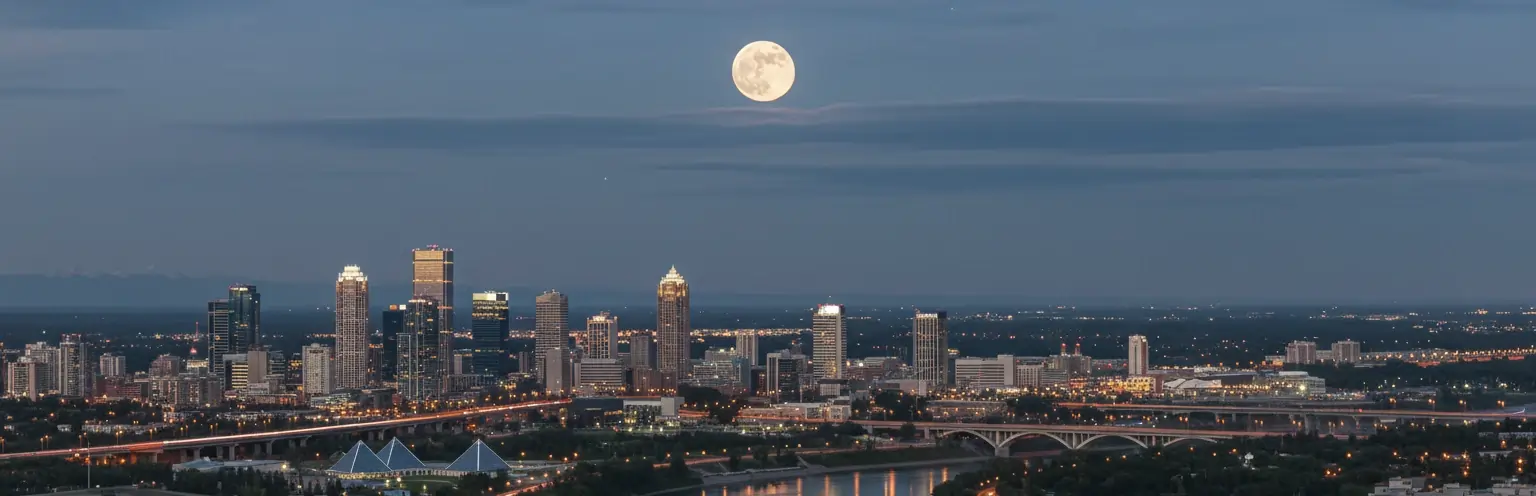
Edmonton sits at 53.5° North latitude — farther north than any other large Canadian city — on the south bank of the North Saskatchewan River, which carves a deep, wide valley through the heart of the city. That river valley is the defining geographic feature for moonrise photography here. The valley walls rise steeply on both sides, and the south-bank bluffs — running along Connors Road, Strathearn Drive, and Saskatchewan Drive — give elevated vantage points looking north across the river at the full downtown skyline, the Muttart Conservatory's glass pyramids, and the High Level Bridge and Walterdale Bridge spanning the water below. At 53°N, winter full moons ride extremely high across the southern sky — higher than at almost any other major North American city — and the dry Alberta air in October through March gives some of the sharpest, most defined moonrises in Canada. The North Saskatchewan, when calm, reflects the entire skyline and bridges in long vertical streaks that reward photographers who time their visits carefully.
Gallagher Hill – Connors Road & Strathearn Drive
The premier Edmonton moonrise viewpoint. Gallagher Hill above Connors Road gives one of the most complete views of the Edmonton skyline available from any public spot — the downtown towers, the Legislature Grounds, and the Muttart Conservatory's four glass pyramids all visible in a single wide-angle frame, with the North Saskatchewan River below. The moon rises to the east and tracks south above the skyline from this elevated south-bank position. The Strathearn Drive pullouts just north of the hill extend the same view with a slightly different angle on the Muttart pyramids. Free, open 24/7; access from Connors Road and the Edmonton Ski Club area.
Forest Heights Park – Lookout Bluff
Forest Heights Park on the east side of the river valley is consistently rated one of Edmonton's finest skyline viewpoints. The lookout bluff sits elevated above the North Saskatchewan and looks west across the river at the downtown skyline, the High Level Bridge, and the Walterdale Bridge — layered compositions with river, bridges, and towers in the same frame. Less crowded than the Connors Road area and particularly good at night when the bridges are lit. A bench at the lookout makes extended evening sessions comfortable. Free, open 24/7; accessible from 84 Street NE.
Emily Murphy Park & Kinsmen Park – River Valley Trails
The riverside parks along Emily Murphy Park and Kinsmen Park on the south bank give ground-level compositions along the North Saskatchewan with the High Level Bridge as the dominant foreground element. On calm evenings the river reflects the bridge span and the city lights in long horizontal lines below. The proximity to the High Level Bridge allows for close-range bridge-and-moon compositions that the bluff viewpoints cannot achieve. Free, open 24/7; well-used trail network throughout both parks.
Kinnaird Park – North Bank Lookout
Kinnaird Park is one of the few north-bank viewpoints that gives a clear southward view of the Edmonton skyline — a perspective most visitors never find. The lookout at the park's southern edge looks across the river at the downtown towers with a large grassy area behind providing room for wide compositions. Rarely crowded and often feels like a private view. The trails connect east toward the Highlands neighbourhood and Ada Boulevard, which has its own elevated river views. Free, open 24/7; access from Jasper Avenue near 76th Street.
Rowland Park Lookout – Saskatchewan Drive
The Rowland Park Lookout along Saskatchewan Drive NW — near 105th Street — is a quiet benched overlook above a steep drop to the river valley below. The view takes in downtown, the Muttart Conservatory pyramids, and the James Macdonald Bridge in a more intimate, less-visited composition than the Gallagher Hill area. The location along Saskatchewan Drive places it in the Glenora neighbourhood surrounded by heritage homes, adding character to the approach. Free, open 24/7; street parking along Saskatchewan Drive.
Dawson Park & Rundle Park – East Valley
Dawson Park and Rundle Park further east along the North Saskatchewan offer darker skies than the central river valley positions and more open eastern horizons for moonrise compositions over the water. The Dawson Bridge provides bridge-and-river foreground; Rundle Park's open fields allow wide prairie-sky shots with the distant downtown glow on the western horizon. A good choice for photographers who want the moon rising over open water and trees rather than framed by the city skyline. Free, open 24/7.
◉ Best Times for Moon Photography
📷 Quick Photography Tips
Edmonton operates on MST (UTC−7) in winter and MDT (UTC−6) during daylight saving time. Alberta observes DST — clocks go forward on the second Sunday in March and back on the first Sunday in November. Apps like PhotoPills or Stellarium set to Edmonton apply the correct offset automatically. At 53.5°N, Edmonton's moonrise times shift more dramatically between summer and winter than almost any other major North American city, making planning tools essential.
For the moon phase in any other city worldwide, visit our Dynamic Moon Phase Calculator on our home page for instant lunar data tailored to wherever you are.
The moon phase today in Edmonton, AB is shown in detail above — complete with exact illumination percentage, moonrise/set times, and the best local spots to see it. For the moon phase today in any other city or location worldwide, visit our Moon Phase calendar on the home page.
◐ What the Experience Actually Feels Like
There is a particular quality to a moonrise in Edmonton that you do not fully understand until you are standing on Gallagher Hill on a clear November evening with the North Saskatchewan valley spread below you and the city across the water. The valley is deeper and wider than most visitors expect — the river is far below the bluff, and the Muttart Conservatory's four glass pyramids catch the light from the city behind them and glow in the valley floor like something placed there by a science fiction prop department. The downtown skyline rises on the north bank beyond the pyramids, and the High Level Bridge spans the river to the west. And then the moon rises to the east and begins to track south above the skyline, and at 53° North it rides higher and more dramatically than almost any other city in North America can offer.
Edmonton at this latitude changes the geometry of everything. The winter full moon does not arc lazily across a southern sky — it climbs steeply and rides near the zenith, bright enough at its peak to cast sharp shadows on the snow in the valley below. The valley itself, once frozen, becomes a different environment: the North Saskatchewan locks up in winter and the ice surface reflects the city lights and the moon in broken, textured patterns that open-water reflections cannot produce. From the bluff at Forest Heights on the east side of the valley, looking west across the frozen river at the lit bridges and the downtown towers, the scene has a quality that is entirely Edmonton and no other Canadian city.
What Edmonton has that makes it exceptional for moon photography is the layering. At almost every viewpoint, there are at least three distinct elements between the camera and the sky: the bluff edge, the river valley floor, the bridges, the conservatory, the skyline. A telephoto lens compresses all of those layers into a composition that rewards the photographer who plans their position precisely. The Muttart pyramids are the key foreground element that no other city can replicate — four glass structures lit from within, rising from the valley floor at the base of the downtown hill, with the moon tracking above them on winter evenings in a scene that is uniquely Edmonton.
"The Muttart Conservatory's four glass pyramids catch the light and glow in the valley floor like something placed there by a science fiction prop department — and then the moon rises to the east and rides higher at 53°N than almost any other city in North America."
✓ Your Edmonton Moon Chase Checklist
Before You Go
- Check the moonrise time and phase on this page — at 53.5°N, moonrise times and the moon's arc shift more dramatically between summer and winter than almost any other major city; PhotoPills is essential for planning exact Muttart or bridge alignments
- Target the dry October–April window for the clearest skies — Edmonton's summer evenings barely darken even at full moon, and the best contrast between the lit city and the dark sky comes in the colder months
- Target the 48–72 hour window before full moon — the moon rises during civil twilight and the warm Alberta sky gives the Muttart pyramids and skyline their most atmospheric colour before full dark
- Check river conditions before heading to Emily Murphy or Kinsmen Park — calm sections produce river reflections; in winter, the frozen North Saskatchewan gives a different but equally compelling textured-ice reflection
- For Forest Heights Park, note that the lookout has no lighting at night — bring a headlamp for the approach and descent, particularly on icy winter evenings when the bluff path can be slippery
What to Bring
- Serious cold-weather layers from October through April — Edmonton winters are genuinely cold, often dropping below −25°C, and standing still on an exposed bluff for moonrise is significantly colder than the ambient temperature suggests
- Sturdy tripod — valley winds funnel along the North Saskatchewan corridor and the bluff positions at Forest Heights, Gallagher Hill, and Kinnaird Park are exposed; a heavy tripod holds far steadier than a travel-weight option
- A lens between 200–400mm for Gallagher Hill compositions — compressing the moon against the Muttart pyramids or downtown towers from the south-bank bluffs requires significant focal length
- A wide-angle lens (16–24mm) for Emily Murphy Park and the riverside positions — the High Level Bridge and Walterdale Bridge both reward environmental wide-angle compositions that include the bridge span, the river, and the sky
- Hand warmers and spare batteries carried inside a chest pocket — lithium batteries drain extremely fast at Edmonton's winter temperatures; swap to a warm battery before your critical shooting window
- Microspikes or traction cleats from November through March — the bluff approaches at Forest Heights and Gallagher Hill ice to glass and the drop-offs below are significant
On the Night
- Arrive at Gallagher Hill or Forest Heights 45 minutes before moonrise — the eastern sky brightens significantly before the moon clears the horizon, and the pre-moonrise alpenglow above the valley is often the best light of the evening
- From Gallagher Hill, position yourself to include all four Muttart pyramids in the lower frame — a 200mm+ lens from the upper bluff area compresses the pyramids against the downtown skyline behind them and puts the moon above both
- Shoot RAW throughout — the dynamic range between the lit pyramids, the bridge lights, the moonrise, and the dark river below requires careful blending of multiple exposures in post
- Stay 20–30 minutes after moonrise — at 53°N the moon climbs quickly and steeply; after 20 minutes it has already moved significantly above the skyline and the compositions from the bluffs change character entirely
- At Forest Heights, use the lookout bench to stabilise your tripod during extended sessions — the exposed bluff edge can be windy and the bench provides a lower-wind position a few metres back from the railing
? Edmonton Moon Phase — Frequently Asked Questions
Q. What is the moon phase today in Edmonton?
The moon phase today in Edmonton is a New Moon with 0% illumination. The next full moon is in 17 days, on Oct 25. Moonrise is at 6:52 AM and moonset at 6:18 PM.
Q. Where is the best place to view the moon in Edmonton?
Gallagher Hill above Connors Road is Edmonton's signature moonrise spot, looking north across the North Saskatchewan River at the downtown skyline and the Muttart Conservatory's glass pyramids. Forest Heights Park gives a similar view from the east side of the valley, Emily Murphy and Kinsmen Parks offer close-range shots of the High Level Bridge, and Kinnaird Park and Rowland Park Lookout provide quieter alternatives with fewer crowds.
Q. Why does moon visibility change so much in Edmonton through the year?
Edmonton sits at roughly 53.5° N, farther north than any other large Canadian city, so the moon's rise and set times and its height in the sky shift more dramatically between seasons than in most North American cities. Winter full moons climb steeply and ride near the zenith, while summer evenings barely darken even around a full moon, since twilight lingers much later this far north.
Q. Does Edmonton observe daylight saving time?
Yes. Edmonton runs on Mountain Standard Time (MST, UTC−7) in winter and switches to Mountain Daylight Time (MDT, UTC−6) from the second Sunday in March to the first Sunday in November. All times shown on this page already account for the correct offset.
Q. What's the best time of year for moon photography in Edmonton?
October through April offers the clearest, driest skies and the deepest contrast between the lit city and a properly dark sky, since Edmonton's high-latitude summer evenings barely darken at all. Winter full moons riding high above the frozen North Saskatchewan, with the Muttart pyramids and downtown skyline as foreground, are the standout shot of the year.
Q. Does this page work for cities besides Edmonton?
This page is set up specifically for Edmonton, Alberta. For the moon phase in any other city or location worldwide, use the Dynamic Moon Phase Calculator on the moonphase.today home page.
✦ Explore Further
Moon Phase Today: Calgary
Check tonight's moon phase in Calgary, about 300km south down the QE2.
📷Moon Photography Guide
Camera settings, lenses, and techniques for shooting sharp, well-exposed moon shots.
📐Looney 11 Exposure Calculator
Dial in the exact f-stop, ISO, and shutter speed for a full moon — the same rule used in our Edmonton valley tips.
🌑How Can There Be No Moonrise One Day?
A quirk of the lunar cycle that's especially noticeable at high latitudes like Edmonton's.
NASA Moon Phase & Libration Gallery
NASA's Scientific Visualization Studio's daily renders of the moon's exact phase, libration, and orientation, straight from official mission data.