
Northern Lights
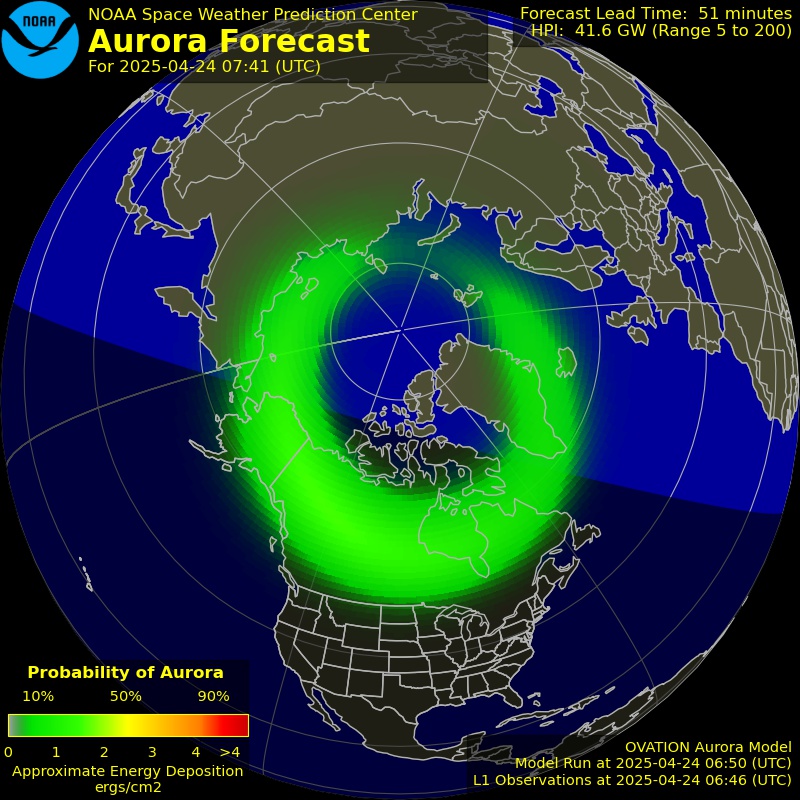
Can you see the northern lights tonight? The Aurora Borealis is an elusive phenomenon driven by solar wind and magnetic storms. Use the real-time data below to monitor the Kp-Index, check the forecast, and determine exactly when and where the sky will light up.
Northern lights right now: Quiet / Low. Planetary K-index (Kp): 2.7. Northern hemispheric power: 13 GW. Updated from NOAA SWPC data.
AURORA STATUS
Where can you see the Northern Lights
Solar Maximum Alert (2024–2026)
The Sun is currently entering its peak activity cycle. This means Aurora sightings will be more frequent and visible at lower latitudes (like Michigan, UK, and Northern Germany) than in previous years.
Fairbanks
64.8° NThe inland geography shields Fairbanks from coastal clouds, offering a high percentage of clear nights. It sits directly beneath the “Auroral Oval,” guaranteeing activity even during minor storms.
Tromsø
69.6° NKnown as the “Capital of the Aurora.” Thanks to the Gulf Stream, it is milder than other arctic locations. It offers high probability sightings combined with excellent tourist infrastructure.
Thingvellir
64.2° NWhile Reykjavik has light pollution, a short drive to Thingvellir National Park creates a dramatic backdrop. Iceland’s weather is volatile, but the entire country lies within the viewing zone.
Yellowknife
62.4° NFlat topography and a semi-arid climate mean extremely clear skies. Yellowknife famously boasts a 95% chance of seeing the lights if you stay for 3 nights during the season.
Tactical Viewing Tips
🌑 Watch the Moon
A Full Moon acts like a giant streetlamp in the sky, washing out faint auroras. Aim for the New Moon phase for the darkest skies.
⏱️ The Midnight Window
While auroras can happen anytime it’s dark, magnetic midnight (usually 10 PM to 2 AM) offers the highest statistical probability.
📷 Camera vs. Eye
Human eyes struggle to see color in the dark. A faint grey cloud might appear vibrant green on a camera sensor. Use Night Mode.
The Physics of the Aurora Borealis
The Northern Lights are not merely a weather phenomenon; they are a visual manifestation of a violent cosmic interaction between our sun and our planet. While poets describe them as dancing spirits, physicists describe them as electrodynamics in the upper atmosphere. To understand what causes the aurora borealis, we must look 93 million miles away to the surface of the Sun.
Step 1: The Solar Wind Injection
The process begins with the Solar Wind, a continuous stream of highly charged particles (plasma) ejected from the Sun’s upper atmosphere, the corona. Under normal conditions, this wind flows past Earth at roughly 400 km/s (900,000 mph). However, during violent solar events known as Coronal Mass Ejections (CMEs), the Sun hurls a billion tons of plasma into space at speeds exceeding 3,000 km/s.
When this shockwave reaches Earth (usually 18 to 72 hours later), it slams into our Magnetosphere—the magnetic bubble that protects us from cosmic radiation. This impact compresses the magnetic field on the day-side and stretches it into a long “tail” on the night-side.
Step 2: Magnetic Reconnection
As the magnetic tail stretches further and further, it eventually snaps back like a rubber band in a process called Magnetic Reconnection. This violent snap propels charged electrons and protons backward toward Earth’s poles at varying speeds.
This is why the aurora is centered around the magnetic poles in an area known as the Auroral Oval. It is also why we have the Aurora Borealis in the north and the mirror-image Aurora Australis in the south simultaneously.
What Does “Aurora” Mean?
The name was coined in 1619 by Galileo Galilei. It is a compound of Aurora, the Roman goddess of the dawn, and Boreas, the Greek god of the north wind. Literally translated, it means “Dawn of the North.”
Step 3: Atmospheric Ionization (The Colors)
The colors we see are determined by two specific factors: Altitude and Gas Composition. When the charged solar particles collide with atoms in our atmosphere, they transfer energy to the atoms, “exciting” them. When these atoms return to their resting state, they release that excess energy as a photon of light.
This is the exact same physical principle behind a neon sign. A neon tube uses electricity to excite gas; the aurora uses solar wind to excite the atmosphere.
| Color | Gas Element | Altitude | Rarity / Cause |
|---|---|---|---|
| Green | Oxygen | 60 – 150 miles | Most Common. The human eye is most sensitive to this wavelength, making it the easiest aurora to spot. |
| Red | Oxygen | 150 – 400 miles | Rare. Occurs only during intense storms. Low-density oxygen at high altitudes emits red light, but it is often too faint for the human eye. |
| Purple / Blue | Nitrogen | Below 60 miles | High Velocity. Requires highly energetic particles to penetrate this deep into the thick atmosphere to excite Nitrogen ions. |
| Pink | Mixture | ~50 miles | Often seen at the lower fringe of a green curtain where rapid-moving electrons strike Nitrogen molecules violently. |
The 11-Year Solar Cycle (Why 2024 is Critical)
The sun does not burn at a constant rate; it goes through distinct cycles of activity lasting approximately 11 years. We are currently ascending into Solar Cycle 25.
Solar Minimum: During the minimum, sunspots are rare, and auroras are confined strictly to the Arctic Circle.
Solar Maximum: We are approaching the predicted “Solar Max” in 2024-2025. During this phase, the sun’s magnetic field flips, creating massive sunspots and frequent X-class solar flares. This pushes the Auroral Oval further south, making the Northern Lights visible in places like Michigan, Oregon, the UK, and Germany.
Advanced Phenomena: STEVE and Pulsating Aurora
What is STEVE? (The Purple Arc)
STEVE (Strong Thermal Emission Velocity Enhancement) is a recently discovered atmospheric phenomenon often mistaken for an aurora. Unlike the broad curtains of the northern lights, STEVE appears as a narrow, distinct purple or mauve arc running east-to-west, often accompanied by green “picket fence” structures.
While auroras are caused by particle precipitation (electrons hitting the atmosphere), STEVE is caused by a supersonic river of hot plasma flowing through the ionosphere at speeds of over 13,000 mph. It is essentially atmospheric friction creating heat and light.
Why do the lights “dance” or pulse?
Auroras are dynamic. The “dancing” curtains are caused by shifting currents in the magnetosphere steering the particle beams. However, you may also see Pulsating Auroras—faint patches of light that blink on and off in seconds.
These pulsations are caused by “Chorus Waves”—plasma waves in space that act like a rhythmic gatekeeper, periodically dumping bunches of electrons into the atmosphere in a heartbeat-like pattern.
The Sound of the Aurora?
For centuries, Inuit and Sami folklore spoke of the aurora making crackling or clapping noises. Scientists dismissed this as illusion until 2012, when Finnish researchers proved that during intense geomagnetic storms, an inversion layer about 70 meters above the ground can trap static charge, creating audible crackles synchronized with the lights.
Northern Lights FAQ
Where can you see the northern lights?
What time will the northern lights be visible tonight?
Can I see the northern lights tonight?
What are the northern lights and what causes them?
What is the Kp index?
Do I need special equipment to see the northern lights?
NOAA Space Weather Prediction Center via NorthernLightsTonight.Org
Real-time Kp-Index, Solar Wind data, and OVATION Forecast models provided directly by the U.S. National Oceanic and Atmospheric Administration.
Navigate the Cosmos
Polaris is famous for staying still, but the rest of the galaxy is drifting. Learn how constellations shift over millennia.
Galactic TitansPolaris is a Supergiant, but it’s tiny compared to the true monsters. Compare the Sun to the largest star known.
Solar PhysicsUnderstand the fusion engine that powers stars like the Sun and Polaris, from the core to the corona.