Moon Phase Today Canada

Moon Phase Today Canada: New Moon

On Friday, October 9, 2026, the moon phase today in Canada is a New Moon, with 0% illumination. Next full moon: Oct 26.

N
S
00:00 23:59
12:00

Times shown for Ottawa (Eastern Time). Search your own city — Canada spans six time zones.

Moon phase diagram
Illumination
0%
Moon Age
28.9d
Full Moon phase diagram
Next Full Moon
Oct 26
New Moon phase diagram
Next New Moon
Oct 10
Distance
—

Explore Canadian Cities

Moon phase, moonrise/moonset, and local viewing details for towns and cities across Canada.

No matching city yet — more Canadian cities are being added.

More Canadian cities added regularly.

Canada Moon Phase FAQ

What is the moon phase today Canada?

On Friday, October 9, 2026, the moon phase today in Canada is a New Moon, with 0% illumination. Next full moon: Oct 26. The Moon is about 28.9 days into its 29.5-day cycle.

Does the moon phase look different in different parts of Canada?

The phase itself doesn't change from place to place — everyone on the night side of Earth sees the same phase at the same moment. What does shift dramatically across Canada is moonrise and moonset clock time — up to several hours apart between Newfoundland and British Columbia — plus how high the Moon arcs and how vertical the terminator sits, since Canada's latitude range runs from around 42°N at its southern tip to over 80°N in the high Arctic.

What time zone are moonrise and moonset times shown in?

Canada spans six time zones — Newfoundland, Atlantic, Eastern, Central, Mountain, and Pacific — so there's no single "Canadian time." Times on this page reflect whichever city is currently shown, whether that's the default or a location you've searched for; search your own city on the calculator above to see times in your own local clock. Clock-change rules also differ by province: most of Canada still changes clocks twice a year, but most of Saskatchewan stays on Central Standard Time year-round, Yukon stays on UTC−7 year-round, British Columbia moved to permanent UTC−7 in 2026, and Manitoba stopped changing its clocks after announcing permanent daylight time in September 2026.

How often is there a full moon?

A full moon happens roughly every 29.5 days — the length of the synodic month, the time it takes the Moon to cycle through all its phases as seen from Earth. That works out to about 12 or 13 full moons a year. Check the "Next Full Moon" figure on the calculator above for the exact upcoming date.

Why does the Moon look different across Canada than in other countries?

It's a latitude effect, not a different Moon. Canada's huge north-south span means the effect varies within the country too — southern cities like Toronto or Vancouver see a noticeably steeper, more vertical terminator than observers near the equator, while the northern territories see the Moon's arc and visible phase orientation shift even further with the seasons. See the "Moon Phases Explained" section further down this page for more on how each phase actually looks.

Can I check the moon phase for a specific Canadian city?
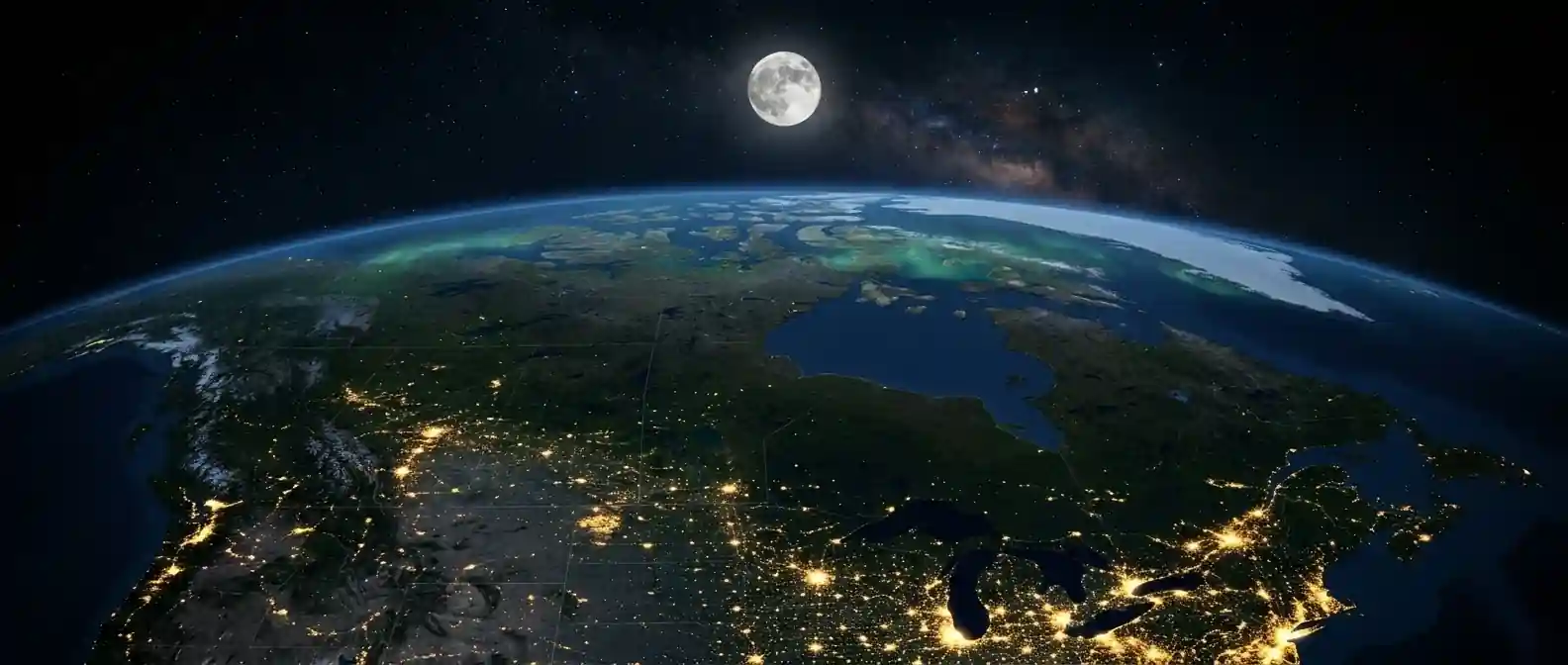
Yes — type any Canadian town or city into the location search on the calculator at the top of this page. We're also building out dedicated pages for individual Canadian cities with local viewing spots and tips; browse what's live so far in the "Explore Canadian Cities" section above.
moon-phase-today-canada-cities

Astronomy Watch Canada

Also coming up

Understanding the Moon's Phases

The Moon itself never changes shape — what changes is the angle at which sunlight falls across its surface. Over the course of a 29.5-day orbit around Earth, that shifting angle cycles through eight recognizable phases, each offering something different to watch for.

🇨🇦

Watching the Moon from Canada

Canada stretches from about 42°N at the southern tip of Ontario to well past 80°N in the high Arctic — a wider range than almost anywhere else on Earth, and it changes how the Moon's path looks depending on where you're standing. Most Canadians, clustered along the southern border, see a Moon that swings from a high winter arc to a low-skimming summer one, similar to most of the mid-latitude world. Head north toward Yukon, the Northwest Territories, or Nunavut, though, and the seasonal swing turns extreme: above the Arctic Circle, a deep-winter full moon can circle the sky without ever setting, while the summer Moon barely clears the horizon, if it rises at all. Use the calculator above for exact moonrise, moonset, and phase times wherever you are in Canada.

Select a phase