Moon Phase Today Netherlands

Moon Phase Today Netherlands: Last Quarter

On Sunday 4 October 2026, the moon phase today in Netherlands is a Last Quarter, with 46% illumination. Next full moon: 26 Oct.

N
S
00:00 23:59
12:00

Times shown for Amsterdam (Central European Time). The Netherlands uses one time zone across its European territory, so they apply nationwide.

💡
Illumination
46%
🌙
Moon Age
22.6d
Full Moon phase diagram
Next Full Moon
26 Oct
New Moon phase diagram
Next New Moon
10 Oct

Explore Dutch Cities

Moon phase, moonrise/moonset, and local viewing details for cities across the Netherlands.

No matching city yet — more cities are being added.

More cities added regularly.

Netherlands Moon Phase FAQ
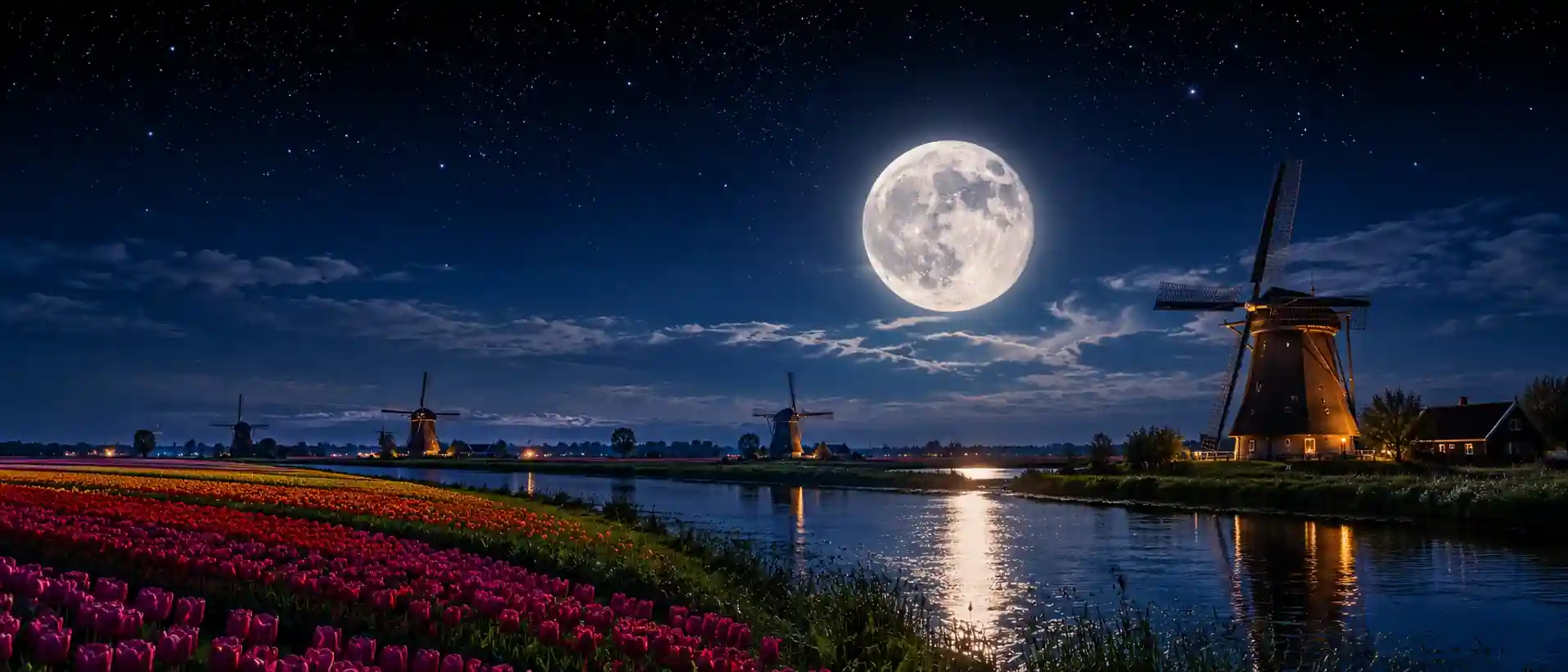
On Sunday 4 October 2026, the moon phase today in Netherlands is a Last Quarter, with 46% illumination. Next full moon: 26 Oct. The Moon is about 22.6 days into its 29.5-day cycle.
The phase itself doesn't change from place to place — everyone on the night side of Earth sees the same phase at the same moment. What shifts across the Netherlands is when the Moon rises and sets, and how high it climbs. The country is small, spanning only about 3.4° of longitude on the mainland, so moonrise and moonset differ by only a few minutes between east and west. It spans about 3° of latitude, from roughly 50.8°N to 53.5°N, so a full Moon near the winter solstice climbs to roughly 60° to 63°, while a full Moon near the summer solstice stays low, at roughly 13° to 16°.
All times on this page use the local time of the city you search for. The Netherlands uses Central European Time, CET, UTC+1, in winter and Central European Summer Time, CEST, UTC+2, in summer. Clocks go forward on the last Sunday in March and back on the last Sunday in October, and the times shown follow whichever applies on that date. The country lies between about 3.4°E and 7.2°E, well west of the 15°E meridian on which Central European Time is based, so the Sun and Moon cross the sky roughly 30 to 45 minutes later on the clock than they would on that meridian. This page covers the European Netherlands, which is one time zone.
A full moon happens roughly every 29.5 days — the length of the synodic month, the time it takes the Moon to cycle through all its phases as seen from Earth. That works out to about 12 or 13 full moons a year. Check the "Next Full Moon" figure on the calculator above for the exact upcoming date.
Like the Sun, the Moon rises in the east and sets in the west, but its exact rising and setting points swing widely through the month — roughly from north-east to south-east for rising and from north-west to south-west for setting at this latitude — and it reaches its highest point in the southern sky. Because the Netherlands is in the Northern Hemisphere, a waxing (growing) Moon is lit on its right side and a waning Moon on its left. The Moon's path is the mirror of the Sun's: a full Moon rides high in winter and very low in summer.
Yes — type any Dutch town or city into the location search on the calculator at the top of this page. We're also building out dedicated pages for individual cities with local viewing spots and tips; browse what's live so far in the "Explore Dutch Cities" section above.
moon-phase-netherlands-moonrise

Astronomy Watch Netherlands

Also coming up

Understanding the Moon's Phases

The Moon itself never changes shape — what changes is the angle at which sunlight falls across its surface. Over the course of a 29.5-day orbit around Earth, that shifting angle cycles through eight recognizable phases, each offering something different to watch for.

🇳🇱

Watching the Moon from the Netherlands

The Netherlands sits between roughly 50.8°N and 53.5°N, a narrow band for a whole country, so the Moon looks much the same from Maastricht to Groningen. At this latitude its path swings from a high winter arc to a very low summer one: a full Moon near the winter solstice climbs to around 60° to 63° above the southern horizon, while a full Moon near the summer solstice peaks at only about 13° to 16°, often hazy and orange. The land is almost entirely flat, so horizons are open, and moonrise over polder fields, dunes or the North Sea coast is easy to watch. Around midsummer the Sun never drops much more than 15° below the horizon, so from roughly mid-May to the end of July the sky never gets fully dark, which makes autumn to spring the best seasons for faint galaxies and nebulae on a new Moon night. The country is also heavily lit, so the Moon itself is an easier target than faint objects, and the public observatories of the KNVWS, along with the national Stargazing Days each spring, are a good way to see the phases through a telescope. Use the calculator above for exact moonrise, moonset, and phase times wherever you are in the Netherlands.

Select a phase