
Moon Phase Today Utrecht
On Sunday, October 4, 2026, the moon in Utrecht is a Last Quarter with 45% illumination. Moon age: 22.6 days.
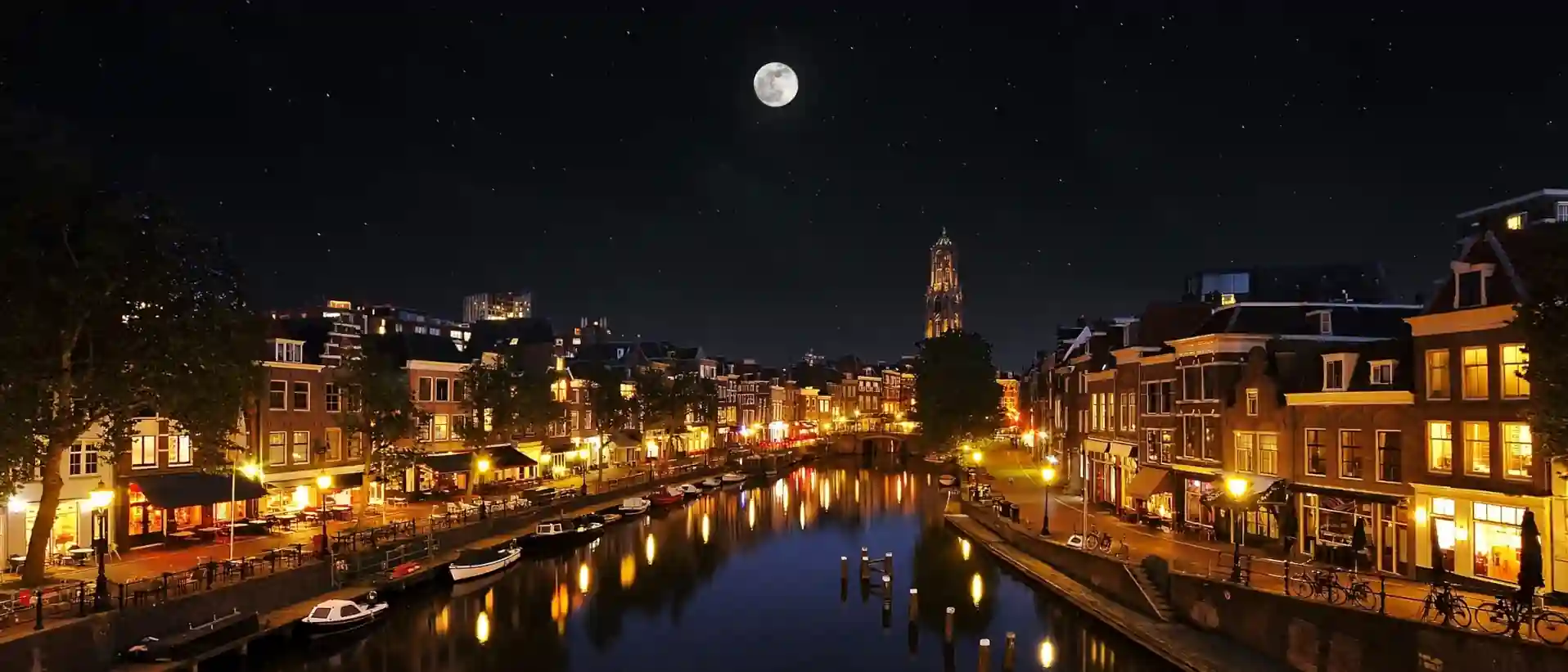
☽ Best Places to View the Moon in Utrecht, Netherlands
Utrecht, nicknamed Domstad (Cathedral City), lies in the low river plain of the Kromme Rijn and the Vecht, and east of the city the Utrechtse Heuvelrug rises as a low wooded ridge. The ground is flat, so the best places are its parks and its towers. The 112 m Dom Tower stands east of Máximapark and east-north-east of Park Transwijk, inside the range of directions where the Moon rises, so from those parks a rising Moon can line up with it on some dates. At about 52°N a summer full Moon stays very low, near 15°, while a winter one climbs to about 61°. Exact rise and set times and azimuth depend on the date and your observing position, so check both before planning a specific composition.
Griftpark – Central Park with Griftsteede
Griftpark, in the north of the centre, is a well-used city park with playgrounds, sports fields, a skatepark, gardens and Griftsteede with its animals and garden. It offers large open lawns and pond edges that can be useful when the calculated azimuth for your date and viewpoint places the Moon over open meadow. Check current opening and event information before a late visit.
Wilhelminapark – Historic Park Opened 1898, Rijksmonument Since 2001
Wilhelminapark, in the east, is a major historic park, opened in 1898 and a rijksmonument since 2001. It has a pond, walking paths and broad lawns for picnics. The open lawns and pond reflections can be useful when the calculated azimuth aligns over water, and its trees make a natural frame for a telephoto Moon.
Julianapark & Park Lepelenburg – Open Fields and a City-Wall Promenade
Julianapark, in the north-west, has a petting zoo, a miniature golf course and playgrounds among mature trees, with open fields that can be useful when the calculated azimuth aligns over open sky. Park Lepelenburg, on the former city wall in the centre, has an outdoor theatre, an event location with specific restrictions, so it can close for events. Its compact lawn and wall promenade give a small sky window above the centre.
Park Transwijk – Meadows and Canal Edges in the South-West
Park Transwijk, in the south-west, is known for its annual Bevrijdingsfestival, the Liberation Day festival on 5 May, which the municipality describes as one of the park's best-known and largest annual events. The broad meadows and canal edges can be useful when the calculated azimuth aligns over western horizons, and the Dom Tower lies to the east-north-east, in the direction where the Moon rises. Event activity can affect access, so check current information.
Máximapark – Very Large Park with Het Lint
Máximapark, in Leidsche Rijn and Vleuten-De Meern, is a very large park with the nearly 10-km Het Lint encircling it, plus Binnenhof, Buitenhof and other features. Its extensive open areas and long sightlines can be useful when the calculated azimuth places the Moon over open polder or parkland, and the Dom Tower lies to the east, across the city. As a large municipal park, check current access and event information.
Dom Tower & Sonnenborgh – Landmark and Observatory
The Dom Tower, 112 m high with 465 steps, is the tallest church tower in the Netherlands and the city's landmark, a natural subject for a Moon shot from a distance. Museum Sterrenwacht Sonnenborgh, at Zonnenburg 2, sits on a 16th-century bastion in the centre, and the top of the observatory is open to visitors who want to see the telescope domes. It is listed as open Tuesday to Friday 11:00 to 17:00 and Sunday 13:00 to 17:00, closed Monday, and holds Sunday-afternoon solar viewing and special stargazing days where the Moon's craters are on show, so check its agenda.
◉ Best Times for Moon Photography in Utrecht
📷 Quick Photography Tips for Utrecht
🕐 Timezone: Utrecht runs on Central European Time (CET, UTC+1) in winter and Central European Summer Time (CEST, UTC+2) in summer — the Netherlands observes daylight saving time. Use PhotoPills or Stellarium to calculate exact rise azimuth for your date and location.
🔭 Telescope Option: Museum Sterrenwacht Sonnenborgh, at Zonnenburg 2, has an observatory whose top is open to visitors, Sunday-afternoon solar viewing with the largest solar telescope in the Netherlands, and special stargazing days and evenings. Check its agenda for Moon-viewing dates.
The moon phase today in Utrecht is shown in detail above — complete with exact illumination, moonrise/set times and best spots. For the moon phase today anywhere else, visit the Dynamic Moon Phase Calculator.
◐ What the Experience Actually Feels Like
At Griftpark, the Moon shares the evening with neighbourhood life — a central park with Griftsteede, playgrounds and sports fields offering open lawns.
At Wilhelminapark, Utrecht feels like a historic garden city — opened in 1898 and a rijksmonument since 2001, with a pond and broad paths for evening walks.
At Máximapark and Transwijk, the city feels wide and open, with long sightlines across the park and the Dom Tower standing on the eastern horizon where the Moon can rise, and Transwijk busy on Liberation Day on 5 May.
At Sonnenborgh, a 16th-century bastion carries a 19th-century observatory right in the centre of the city, with telescope domes you can walk up to on a visit.
"At Griftpark, the Moon over open lawns; at Wilhelminapark, over the 1898 historic pond; at Máximapark, over the long Het Lint with the Dom Tower on the horizon — each when the calculated azimuth for your date and viewpoint aligns."
✓ Your Utrecht Moon Chase Checklist
Before You Go
- Check moonrise / moonset time and azimuth for your date — around full Moon, moonrise is generally near sunset and moonset near sunrise, but exact times and azimuth depend on date and location
- Verify Access: check current opening and events for Griftpark, Wilhelminapark, Julianapark, Park Lepelenburg's outdoor theatre, Park Transwijk and Máximapark before a late visit
- Use PhotoPills or Stellarium to check whether the Moon will line up with the Dom Tower or the Wilhelminapark trees on your date — exact azimuth must be calculated for the specific date and location
- Check KNMI for cloud, visibility, wind and precipitation — the low river plain can bring mist
- Check Sonnenborgh's agenda if you want a telescope
What to Bring
- A telephoto lens, often 200mm or longer, to frame the Moon tightly against the Dom Tower, plus a wider lens for pond reflections from Wilhelminapark when azimuth places the Moon over water
- A warm layer — Dutch evenings are cool, even in spring and autumn
- A remote shutter release or 2-second timer to avoid shake
- A lens cloth for humidity and mist — the low river landscape can be humid
- A light rain layer and water-resistant footwear for Griftpark and Máximapark paths
On the Night
- Arrive early — Griftpark, Wilhelminapark and Transwijk can be busy, especially around the Liberation Day festival on 5 May in Transwijk
- Focus manually on the Moon's edge — city lighting can confuse autofocus at dusk
- Bracket exposures: one for the bright lunar disc and another for the darker park lawns or pond edges — expose for the lunar disc, as the foreground will be darker
- Stay in designated public areas, park paths or city wall promenades — avoid private gardens and restricted theatre areas without permission
- Confirm the viewpoint is accessible and safe — check current park access and events
? Utrecht Moon Phase — Frequently Asked Questions
Q. What is the moon phase today in Utrecht?
The moon phase today in Utrecht is a Last Quarter with 45% illumination. The next full moon is in 23 days, on 26 Oct. Moonrise is at — and moonset at 5:01 PM.
Q. Where is the best place to view the moon in Utrecht?
Utrecht, nicknamed Domstad (Cathedral City), lies in a low river plain, so its parks and towers give the open horizons. The 112 m Dom Tower, the tallest church tower in the Netherlands, is the city's landmark, and the Sonnenborgh observatory sits on a 16th-century bastion in the centre. Griftpark and Wilhelminapark, a historic park with a pond that opened in 1898, have open lawns, Park Transwijk has broad meadows in the south-west, and Máximapark in Leidsche Rijn is a very large park with long sightlines.
Q. Can I look at the moon through a telescope in Utrecht?
Yes, at Museum Sterrenwacht Sonnenborgh, at Zonnenburg 2 in the city centre, whose observatory top is open to visitors who want to see the telescope domes. It is open Tuesday to Friday from 11:00 to 17:00 and on Sunday from 13:00 to 17:00, and closed on Monday. Its Sunday afternoon "Zon op zondag" sessions use the largest solar telescope in the Netherlands, in daylight. Night-time moon viewing from its roof is offered at special stargazing days and evenings, when the craters of the moon are on show, so check its agenda for dates.
Q. Where does the moon rise and set in Utrecht, and how high does it climb?
At about 52.1°N, Utrecht's moonrise and moonset points swing widely across the horizon each month, from roughly north-east to south-east for rising and north-west to south-west for setting, with an even wider swing in years near a major lunar standstill. A full moon near the winter solstice climbs to roughly 61° in the south, while a full moon near the summer solstice stays very low, peaking near 15°, and is often hazy. The Dom Tower stands east of Máximapark and east-north-east of Park Transwijk, inside the range of directions where the moon rises, so a rising moon can line up with it from those parks on some dates. Check the azimuth for your date and exact spot.
Q. Is light pollution a problem for moon observing in Utrecht?
The moon is bright enough to observe and photograph from almost anywhere in Utrecht, so light pollution rarely limits the lunar disc itself. It does wash out earthshine on a thin crescent and any faint sky detail. Utrecht is a large city in the heavily built Randstad, so its parks are lit by nearby streets and stars are faint at every viewpoint. The wooded Utrechtse Heuvelrug to the east is a little darker, but it is not a dark-sky site.
Q. What camera settings and phases work best for moon photography in Utrecht?
For a full moon, start with Looney 11 (f/11, ISO 100, 1/100 s) and refine using your histogram, since it is a baseline rather than a guarantee. The foreground is much darker than the lunar disc, so shoot RAW and expose for the moon, or bracket to keep both. To make the moon look large against the Dom Tower or the trees of Wilhelminapark, shoot from a distance with a long telephoto: distance creates the scale, and focal length frames it tightly. A waxing gibbous suits blue hour, and a tripod, a remote release and manual focus on the moon's edge help.
Q. How do mist, cloud and rain affect moon viewing in Utrecht?
Utrecht's maritime climate means frequent cloud, wind and rain, and the low river landscape can bring mist that reduces contrast. Check KNMI, the Dutch weather service, for cloud, visibility, wind and precipitation before you go, and bring a lens cloth for humidity and a light rain layer with water-resistant footwear for the park paths.
Q. What time zone are Utrecht's moonrise and moonset times shown in?
Utrecht runs on Central European Time, CET, UTC+1, in winter and Central European Summer Time, CEST, UTC+2, in summer. Clocks go forward on the last Sunday in March and back on the last Sunday in October, and moonrise and moonset times on this page follow the local clock in effect on each date. Utrecht lies at about 5.1°E, west of the 15°E meridian on which Central European Time is based, so the sun and moon cross the sky about 40 minutes later on the clock than they would on that meridian.
Q. Can I shoot the moon at Utrecht's viewpoints after dark?
Mostly, with care, but check each place. Griftpark, Wilhelminapark, Julianapark, Park Transwijk and Máximapark are public city parks, but check current opening and event information before a late visit, since events such as the Liberation Day festival on 5 May at Transwijk can affect access. Park Lepelenburg's outdoor theatre is an event location with restrictions, so it can close for events. Stay on park paths and the city wall promenades, and avoid private gardens.
✦ Explore Further
Moon Phase Today: Amsterdam
Check tonight's moon phase in Amsterdam, roughly 35 km north-north-west of Utrecht among its canals.
🚢Moon Phase Today: Rotterdam
See the moon over Rotterdam, roughly 50 km west-south-west of Utrecht on the Nieuwe Maas.
🌍World Moon Phase Directory
Find the moon phase, rise and set times for cities in every region of the world.
Blue Hour Calculator
Work out when blue hour falls, ideal for waxing gibbous shots over the Dom Tower.