
Moon Phase Today Eindhoven
On Sunday, October 4, 2026, the moon in Eindhoven is a Last Quarter with 45% illumination. Moon age: 22.6 days.
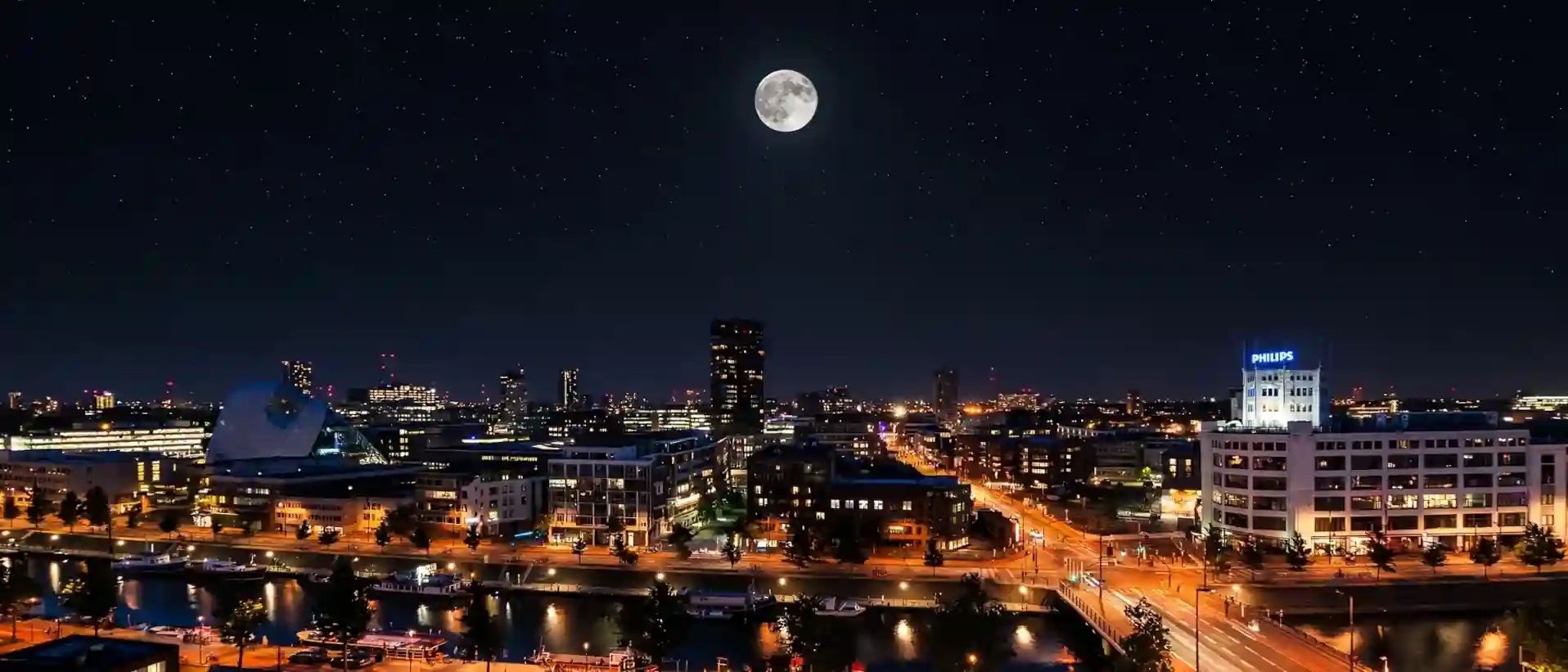
☽ Best Places to View the Moon in Eindhoven, Netherlands
Eindhoven, the largest city in North Brabant, began where the Dommel and Gender streams met, and the villages that make up the modern city grew on higher, sandy ground between the stream valleys of the Dommel, Gender and Tongelreep. The ground is flat, so the best places are its big parks and its water edges, and the view of a rising or setting Moon is limited mainly by trees and buildings, so moving along a park or valley matters more than height. At about 51°N the Moon rises between north-east and south-east, and a summer full Moon stays very low, near 15°, while a winter one climbs to about 62°. The city also has a real public observatory. Exact rise and set times and azimuth depend on the date and your observing position, so check both before planning a specific composition.
Stadswandelpark – Walking Paths and Ponds South of the Centre
The Stadswandelpark, south of the city centre, has pleasant walking paths and serene ponds, and the municipality identifies it as a park and historic landscape. It is one of the major parks in Eindhoven, along with Genneper Parken, the Philips van Lenneppark, the Philips de Jongh Wandelpark and Henri Dunantpark. Its broad open lawns and pond reflections can be useful when the calculated azimuth for your date and viewpoint places the Moon over water or open meadow. Individual parks can have their own access arrangements and events, so check current conditions.
Sterrenwacht Eindhoven – Dr. A.F. Philips Observatorium
Sterrenwacht Eindhoven, at Alberdingk Thijmlaan 3, has a large telescope in its tower and opens to the public for viewing evenings, and it also offers a free app for a space walk in the Stadswandelpark. At one public evening, from 20:00 to 22:00, the topic was the Moon and later Jupiter, with volunteers on each floor explaining what you see. It has no parking of its own, though there are spaces along the street. Check its agenda for dates.
Genneper Parken – One of the Largest Parks in the Netherlands
The expansive Genneper Parken form a large natural and recreational area, ideal for walking and cycling, which the municipality describes as one of the largest parks in the Netherlands, with historic landscape, nature, culture, sport and recreation. Within it are the Heempark Frater Simon Deltour, with example gardens showing original regional landscape types, and the Genneper Watermolen. This southern valley park combines Dommel floodplain, a historic watermill and open pastures, which can be useful when the calculated azimuth aligns over valley meadows. Stay on designated trails and check event access.
Philips de Jongh Wandelpark & Philips van Lenneppark – Lichtbos Eindhoven
The Philips de Jongh Wandelpark, a historic park in the north-west near Oirschotsedijk, and the Philips van Lenneppark in the north are both part of the large green Lichtbos Eindhoven area, according to the municipality. They offer mature trees, wide avenues, open fields and playgrounds, with broad sky windows that can be useful when the calculated azimuth aligns over open lawns. Access is public, but events can affect it, so check current hours.
Henri Dunantpark & Karpendonkse Plas – Dommel Valley, East
Henri Dunantpark is one of the city's major parks, and the Karpendonkse Plas, with its routes, lies on the east and north-east side of the city, in the Dommel valley, where the municipality describes nature connections around the lake. These eastern water parks provide lake and meadow horizons that can be useful when the calculated azimuth places the Moon over open water. Check individual access arrangements.
Dommel Banks & Genderpark – Waterways Through the City
Eindhoven began at the confluence of the Dommel and Gender, and the Dommel still runs through the city. The riverbanks near the Van Abbemuseum and the Genderpark in Gestel give linear water corridors with open sky that can be useful when the calculated azimuth aligns over river reflections. These are urban waterways, so stay on public paths and respect private moorings.
◉ Best Times for Moon Photography in Eindhoven
📷 Quick Photography Tips for Eindhoven
🕐 Timezone: Eindhoven runs on Central European Time (CET, UTC+1) in winter and Central European Summer Time (CEST, UTC+2) in summer — the Netherlands observes daylight saving time. PhotoPills or Stellarium will handle the Moon's exact rise azimuth for any of these spots.
🔭 Telescope Option: Sterrenwacht Eindhoven, the Dr. A.F. Philips Observatorium at Alberdingk Thijmlaan 3, has a large telescope in its tower and opens for public viewing evenings. The national Stargazing Days, organised by the KNVWS, also put telescopes in front of the public. Check the observatory's agenda for dates.
The moon phase today in Eindhoven is shown in detail above — complete with exact illumination percentage, moonrise/set times, and the best local spots to see it. For the moon phase today in any other city worldwide, visit our Dynamic Moon Phase Calculator on the home page.
◐ What the Experience Actually Feels Like
At Stadswandelpark, the Moon shares the evening with the ponds, with walking paths winding through a historic landscape just south of the centre, and the observatory tower close by.
At Genneper Parken, Eindhoven feels like a Brabant stream valley — a large natural and recreational area for walking and cycling, with the Heempark Frater Simon Deltour and the Genneper Watermolen.
At the Philips parks and along the Dommel banks, the city feels green and industrial at once — the Lichtbos parks of mature trees and wide avenues, and the Dommel, where Eindhoven began.
At a public evening at Sterrenwacht Eindhoven, visitors climb the tower for a look at the Moon and planets through the telescope, with volunteers on every floor to explain what they see.
"At Stadswandelpark, over serene ponds south of the centre; at Genneper Parken, over meadows and an old watermill; at the Philips parks, over wide avenues — when the calculated azimuth for your date and viewpoint aligns."
✓ Your Eindhoven Moon Chase Checklist
Before You Go
- Check moonrise / moonset time and azimuth for your date — the Moon's rise and set azimuth changes substantially through the lunar month, so check the calculated azimuth for your exact date and viewpoint
- On flat ground, changing position along Stadswandelpark, Genneper Parken or the Lichtbos parks is often more useful than seeking height
- Verify Access: individual parks can have their own access arrangements and events, so confirm current conditions before a late-night setup
- Use PhotoPills or Stellarium to check whether the Moon will line up with the Genneper Watermolen or a Philips building on your date — exact azimuth must be calculated for the specific date and location
- Check KNMI for cloud, visibility, wind and precipitation — the stream valleys can have mist
- Check the observatory's agenda if you want a telescope
What to Bring
- A telephoto lens, often 200mm or longer, to frame the Moon tightly against the Genneper Watermolen, plus a wider lens for pond reflections at Stadswandelpark or the Karpendonkse Plas when the calculated azimuth places the Moon over water
- A warm layer — Dutch evenings are cool, even in spring and autumn
- A remote shutter release or 2-second timer to avoid shake on tripod shots
- A lens cloth for humidity and mist — the stream valleys can be humid, especially in the evening
- A light rain layer and water-resistant footwear for Genneper Parken trails and the Dommel riverbanks
On the Night
- Arrive early — Stadswandelpark's paths can be busier after sunset, and Genneper Parken is popular for cycling
- Focus manually on the Moon's edge — city park and campus lighting can confuse autofocus at dusk
- Bracket exposures: one for the bright lunar disc and another for the darker park lawns, pond edges or the Dommel valley below — expose for the lunar disc, because the foreground will be much darker
- Stay in designated public areas, park paths, Dommel banks or public river viewpoints — avoid private industrial areas and restricted nature-reserve zones without permission
- Confirm that your chosen viewpoint remains accessible and safe before arriving, noting individual park access arrangements
? Eindhoven Moon Phase — Frequently Asked Questions
Q. What is the moon phase today in Eindhoven?
The moon phase today in Eindhoven is a Last Quarter with 45% illumination. The next full moon is in 23 days, on 26 Oct. Moonrise is at — and moonset at 4:55 PM.
Q. Where is the best place to view the moon in Eindhoven?
Eindhoven, the largest city in North Brabant, sits on flat sandy ground between the Dommel, Gender and Tongelreep streams, so its parks and water edges give the open horizons. The Stadswandelpark, a park and historic landscape south of the centre with walking paths and ponds, is the easiest choice. Genneper Parken, which the municipality describes as one of the largest parks in the Netherlands, has the Genneper Watermolen and the Heempark Frater Simon Deltour. The Philips de Jongh Wandelpark and the Philips van Lenneppark are part of the green Lichtbos Eindhoven, and Henri Dunantpark and the Karpendonkse Plas lie to the east and north-east, in the Dommel valley.
Q. Can I look at the moon through a telescope in Eindhoven?
Yes. Sterrenwacht Eindhoven, the Dr. A.F. Philips Observatorium at Alberdingk Thijmlaan 3, has a large telescope in its tower and opens to the public for viewing evenings. At one evening, from 20:00 to 22:00, the topic was the moon and later Jupiter, with volunteers on each floor explaining what you see. The observatory has no parking of its own, but there are spaces along the street. Check its agenda for dates, since observing depends on the weather. The national Stargazing Days, organised by the KNVWS, also put telescopes in front of the public.
Q. Where does the moon rise and set in Eindhoven, and how high does it climb?
At about 51.4°N, Eindhoven's moonrise and moonset points swing widely across the horizon each month, from roughly north-east to south-east for rising and north-west to south-west for setting, with an even wider swing in years near a major lunar standstill. A full moon near the winter solstice climbs to roughly 62° in the south, while a full moon near the summer solstice stays very low, peaking near 15°, and is often hazy. The ground is flat, so the view of a rising or setting moon is limited mainly by trees and buildings, and moving along a park or valley can matter more than height. Check the azimuth for your date and exact spot.
Q. Is light pollution a problem for moon observing in Eindhoven?
The moon is bright enough to observe and photograph from almost anywhere in Eindhoven, so light pollution rarely limits the lunar disc itself. It does wash out earthshine on a thin crescent and any faint sky detail. Eindhoven is a large city in the densely built south of the Netherlands, so its parks are lit by nearby streets and campuses, and stars are faint at every viewpoint. The Genneper Parken are one of the darker places in the city, but they are not a dark-sky site.
Q. What camera settings and phases work best for moon photography in Eindhoven?
For a full moon, start with Looney 11 (f/11, ISO 100, 1/100 s) and refine using your histogram, since it is a baseline rather than a guarantee. The foreground is much darker than the lunar disc, so shoot RAW and expose for the moon, or bracket to keep both. To make the moon look large against the Genneper Watermolen or the silhouette of a Philips building, shoot from a substantial distance with a long telephoto: the distance sets the perspective and the long focal length frames it tightly. A waxing gibbous, one or two days before full, suits blue hour, when some colour remains in the sky to balance the city lights.
Q. How do mist, cloud and rain affect moon viewing in Eindhoven?
Eindhoven's maritime climate means frequent cloud, wind and rain, and the stream valleys can be misty in autumn. Check KNMI, the Dutch weather service, for cloud, visibility, wind and precipitation before you go, and bring a lens cloth for humidity and water-resistant footwear for the Genneper Parken trails and the Dommel banks.
Q. What time zone are Eindhoven's moonrise and moonset times shown in?
Eindhoven runs on Central European Time, CET, UTC+1, in winter and Central European Summer Time, CEST, UTC+2, in summer. Clocks go forward on the last Sunday in March and back on the last Sunday in October, and moonrise and moonset times on this page follow the local clock in effect on each date. Eindhoven lies at about 5.5°E, west of the 15°E meridian on which Central European Time is based, so the sun and moon cross the sky about 38 minutes later on the clock than they would on that meridian.
Q. Can I shoot the moon at Eindhoven's viewpoints after dark?
Mostly, with care, but check each place. The city's parks are public, but individual parks can have their own access arrangements and events, so check current conditions before a late setup. In Genneper Parken, stay on the designated trails, and avoid private industrial areas and restricted nature-reserve zones without permission. Along the Dommel and the other waterways, stay on public paths and respect private moorings. The observatory is open only at its scheduled viewing evenings.
✦ Explore Further
Moon Phase Today: Utrecht
Check tonight's moon phase in Utrecht, roughly 75 km north-north-west of Eindhoven beneath the Dom Tower.
🚢Moon Phase Today: Rotterdam
See the moon over Rotterdam, roughly 85 km north-west of Eindhoven on the Nieuwe Maas.
🌍World Moon Phase Directory
Find the moon phase, rise and set times for cities in every region of the world.
Blue Hour Calculator
Work out when blue hour falls, ideal for waxing gibbous shots over the Dommel valley.