
Moon Phase Today Amsterdam
On Saturday, October 10, 2026, the moon in Amsterdam is a New Moon with 0% illumination. Moon age: 28.9 days.
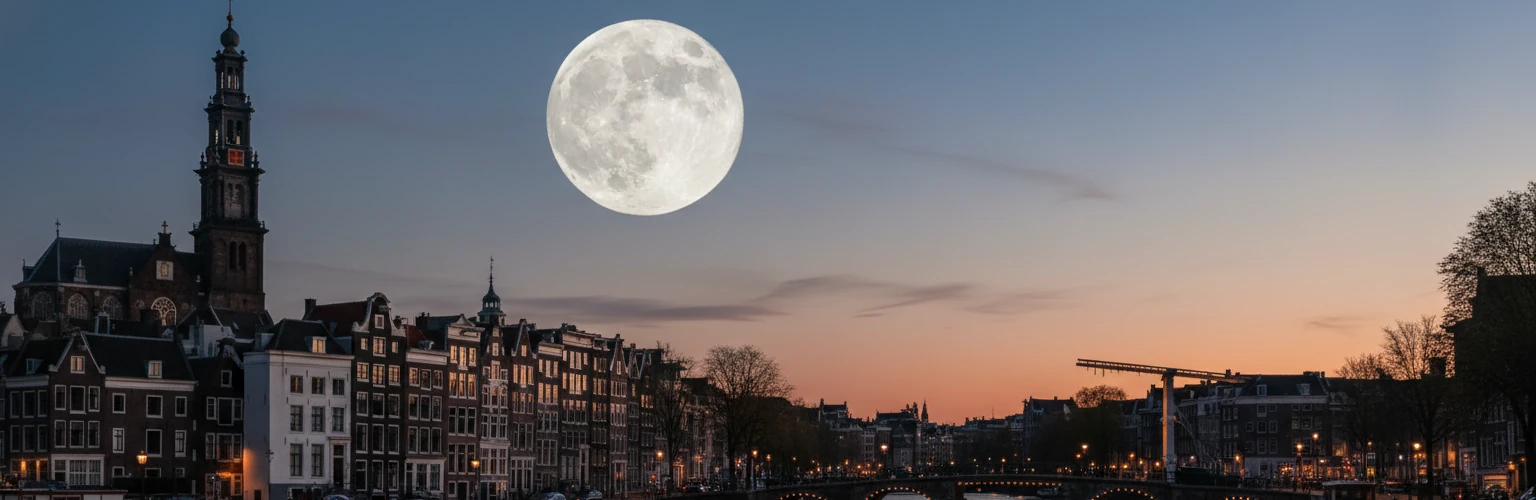
☽ Best Places to View the Moon in Amsterdam
Amsterdam’s enchanting network of canals, historic bridges, and distinctive gabled houses creates an unparalleled backdrop for moon viewing. The low-rise skyline allows for relatively unobstructed eastern horizons, while the calm waters offer exquisite reflections that double the lunar magic. Whether you’re seeking a romantic silhouette over an iconic drawbridge or a serene reflection down a quiet canal, Amsterdam presents unique opportunities for capturing the moon’s beauty. Use specialized planning apps like PhotoPills to pinpoint the exact alignment for your desired date and location. Here are the top spots for experiencing and photographing the moon in Amsterdam (all free and accessible 24/7 unless otherwise noted):
Magere Brug (Skinny Bridge – Amstel River)
The absolute #1 postcard moonrise spot. From the west bank of the Amstel, the moon rises dramatically behind the beautifully illuminated wooden drawbridge. Classic canal houses line the banks, and the still waters of the Amstel perfectly reflect the bridge's iconic white lights and the moon’s glow, creating a truly fairy-tale composition. This is a must-see for romantic and photogenic moonrises. The Magere Brug itself is an iconic pedestrian connection over the Amstel River.
NEMO Science Museum Rooftop Terrace (Oosterdok)
This elevated public terrace on top of the distinctive green NEMO building offers wide-open eastern views. The moon rises over the historic centre, often perfectly framing prominent landmarks like the Montelbaanstoren tower and the Oude Kerk spire. Access to the terrace is free and open daily from 10:00 to 17:30, extending to 21:00 on Thursdays and Fridays during summer months. **Due to these hours, this spot is largely unsuitable for moonrise viewing on most nights.**
Westerpark – East Side (near the pond)
This large urban park offers a more natural setting for moon viewing. From the east side, near the main pond, the Westertoren (Western Church tower) can appear on the eastern horizon, and with precise planning using tools like PhotoPills, the moon can be framed in relation to it. The calm waters of the pond often provide beautiful, undisturbed reflections. It's a great spot for a more serene moonrise experience, offering views towards the city centre without being immersed in its busiest areas.
Amstelveld / Prinsengracht (Seven Bridges view)
Discover the magic of Amsterdam's "Seven Bridges" view from the corner of Prinsengracht and Reguliersgracht. This classic canal intersection allows you to look down a long stretch of waterway, where the moon can rise along the canal, silhouetting multiple arched bridges and classic gabled houses. The calm canal waters multiply the illuminated structures and the moon's glow through exquisite reflections, creating an iconic Amsterdam scene. This spot is renowned for its romantic atmosphere.
Ouderkerkse Bridge (Amstel River south bank)
Just south of Amsterdam, the charming village of Ouderkerk aan de Amstel offers a wider perspective along the river. From the south bank near the historic Ouderkerkse Bridge, you'll find an unobstructed eastern horizon. The moon rises straight over the expansive Amstel River, allowing for stunning telephoto compression shots that align the moon with distant city lights or picturesque windmills. The wide, calm river provides exceptional mirror reflections, making it a favorite for landscape astrophotographers.
Rembrandtplein – East Side (near the Amstel)
This vibrant urban square provides a lively backdrop for a city moonrise. From the east side, closest to the Amstel River, the moon rises over the eastern skyline. With precise planning, it's possible to frame the moon in interesting compositions with the surrounding historic architecture. The square's bustling atmosphere, with illuminated cafés and public art, offers dynamic foreground interest for your compositions, making it an excellent spot to capture the moon blending with Amsterdam's energetic nightlife.
◉ Best Times for Moon Photography
📷 Quick Photography Tips
Amsterdam operates on CET (Central European Time, UTC+1) in winter and CEST (Central European Summer Time, UTC+2) during daylight saving time. Clocks go forward on the last Sunday in March and back on the last Sunday in October. Apps like PhotoPills or Stellarium set to Amsterdam automatically handle the offset, ensuring accurate moonrise and moonset times for your planning.
For the moon phase in any other city worldwide, visit our Dynamic Moon Phase Calculator for instant lunar data tailored to wherever you are.
The moon phase today in Amsterdam is shown in detail above — complete with exact illumination percentage, moonrise/set times, and the best local spots to see it. For the moon phase today in any other city or location worldwide, visit our Dynamic Moon Phase Calculator on the home page.
◐ What the Experience Actually Feels Like
There’s a unique, almost storybook charm to experiencing a moonrise in Amsterdam. As twilight deepens, the city’s myriad bridges begin to sparkle with thousands of tiny lights, casting intricate patterns on the canal waters. The air is cool and often still, carrying the faint scent of waffles and damp stone. Then, a soft glow emerges over the low, gabled rooftops to the east. The moon, often appearing large and warm, begins its ascent, and as it climbs, its light reflects across the calm canals, weaving through the shimmering city lights. It’s a gentle, romantic spectacle, a quiet counterpoint to the city’s daytime energy.
Whether you’re standing by the iconic Magere Brug, watching its white lights merge with the lunar glow, or peering down a quiet canal from the "Seven Bridges" spot, the experience is profoundly picturesque. The low horizon and the city’s flat topography mean you rarely miss the full arc of the moon’s rise. The reflections are the true stars here; the moon's light isn't just in the sky, it's also dancing on the water, multiplied by every ripple and every illuminated canal house. Even from an elevated spot like the NEMO Science Museum rooftop (if you catch a summer evening opening), the moon feels close, a silent observer over the historical heart of the city, perfectly framed by classic towers and modern architecture.
Winter (November to February) often brings the clearest and most dramatic moonrises to Amsterdam. The colder, crisper air means less haze, leading to sharper lunar details and more vibrant city lights. The moon's path is also more southerly during these months, which can create those prized alignments with the city's iconic bridges and towers. While summer evenings are lovely for enjoying a stroll, they can sometimes bring more atmospheric haze. Autumn, however, is a sweet spot, offering stable weather and often stunning pre-moonrise colours that blend beautifully with the city’s soft glow. Every season in Amsterdam offers a unique lunar embrace, but a clear winter night, especially around full moon, is truly magical.
"As twilight deepens, the city’s myriad bridges begin to sparkle with thousands of tiny lights. The moon, often appearing large and warm, begins its ascent, and its light reflects across the calm canals, weaving through the shimmering city lights."
✓ Your Amsterdam Moon Chase Checklist
Before You Go
- Check the moonrise time and phase on this page — crucial for timing your visit to coincide with the moon appearing over Amsterdam's landmarks
- Use PhotoPills or Stellarium to precisely map the moon's path relative to iconic bridges (like Magere Brug), towers (Westertoren, Montelbaanstoren), or canal stretches
- Target the 48–72 hour window before full moon — this is often ideal for blending the moon's light with the soft, golden/blue hour glow of the city
- Check weather forecasts for clear skies and minimal wind — calm conditions are paramount for crisp lunar details and undisturbed canal reflections
- Consider visiting in late autumn or winter (Nov-Feb) for potentially clearer skies and more southerly moon paths that align well with city structures
What to Bring
- Sturdy tripod — essential for long exposures needed to capture both the moon and the illuminated city, especially for reflections on the canals
- A telephoto lens (200-400mm) for tight, compressed shots of the moon with distant bridges (like Magere Brug) or specific towers (like Westertoren)
- A wide-angle lens (16-35mm) for expansive canal scenes and capturing the breadth of reflections
- Warm layers and waterproof outerwear — Amsterdam evenings can be chilly and damp, even outside of winter
- Headlamp or small flashlight — useful for navigating dimly lit canal paths and setting up your camera
- Lens cloth and a rain cover — to protect against humidity or unexpected light rain, common near the canals
- Power bank for your phone/camera — planning apps and long exposures drain batteries quickly
On the Night
- Arrive at your chosen spot 30–45 minutes before moonrise — this allows time for setup and to capture the beautiful pre-moonrise blue hour light over the city
- At the Magere Brug, position yourself on the west bank of the Amstel to capture the moon rising directly behind the bridge for that iconic postcard shot
- Shoot RAW — critical for managing the high dynamic range between the bright moon and the warm, nuanced city lights and their reflections
- Focus on compositions that incorporate canal reflections — these are a hallmark of Amsterdam moon photography and can double the visual impact
- Stay for 20–30 minutes after moonrise — the moon’s position relative to landmarks and its color can change significantly as it ascends
- For quieter, more romantic shots, explore the smaller side canals away from the main tourist arteries, where reflections are often more pristine
? Amsterdam Moon Phase — Frequently Asked Questions
Q. What is the moon phase today in Amsterdam?
The moon phase today in Amsterdam is a New Moon with 0% illumination. The next full moon is in 17 days, on Oct 26. Moonrise is at 7:52 AM and moonset at 6:33 PM.
Q. Where is the best place to view the moon in Amsterdam?
The Magere Brug is the city's signature moonrise spot, with the moon rising behind the illuminated wooden drawbridge and reflecting in the Amstel. The Amstelveld corner of Prinsengracht and Reguliersgracht gives the famous "Seven Bridges" canal view, Westerpark and the Ouderkerkse Bridge offer quieter, more open horizons, and Rembrandtplein adds a lively city-centre alternative.
Q. Why does moon visibility change so much in Amsterdam through the year?
Amsterdam's flat, low-rise skyline keeps the horizon fairly open all year, so weather does most of the work: November through February tends to bring clearer, crisper air and sharper moon detail, while summer evenings can carry more atmospheric haze. Calm, wind-still nights are also key for the canal reflections the city is known for.
Q. Does Amsterdam observe daylight saving time?
Yes. Amsterdam runs on CET (UTC+1) in winter and switches to CEST (UTC+2) for Central European Summer Time, from the last Sunday in March to the last Sunday in October. The times shown on this page are already adjusted for whichever period applies today.
Q. What's the best time of year for moon photography in Amsterdam?
November through February offers the clearest skies and the most southerly moon path, which lines up well with the city's bridges and towers. Autumn (September–November) is a reliable middle ground with stable weather and less haze, and calm nights after rainfall can give especially sharp, well-lit canal reflections.
Q. Does this page work for cities besides Amsterdam?
This page is set up specifically for Amsterdam, the Netherlands. For the moon phase in any other city or location worldwide, use the Dynamic Moon Phase Calculator on the moonphase.today home page.
✦ Explore Further
Moon Phase Today: Antwerp
Check tonight's moon phase in Antwerp, about 90 miles south.
📷Moon Photography Guide
Camera settings, lenses, and techniques for shooting sharp, well-exposed moon shots.
📐Looney 11 Exposure Calculator
Dial in the exact f-stop, ISO, and shutter speed for a full moon — the same rule used in our Magere Brug tips.
🌆Blue Hour Calculator
Find tonight's exact blue hour window to time your canal-side moonrise shots.
NASA Moon Phase & Libration Gallery
NASA's Scientific Visualization Studio's daily renders of the moon's exact phase, libration, and orientation, straight from official mission data.