
Moon Phase Today Rotterdam
On Sunday, October 4, 2026, the moon in Rotterdam is a Last Quarter with 45% illumination. Moon age: 22.6 days.
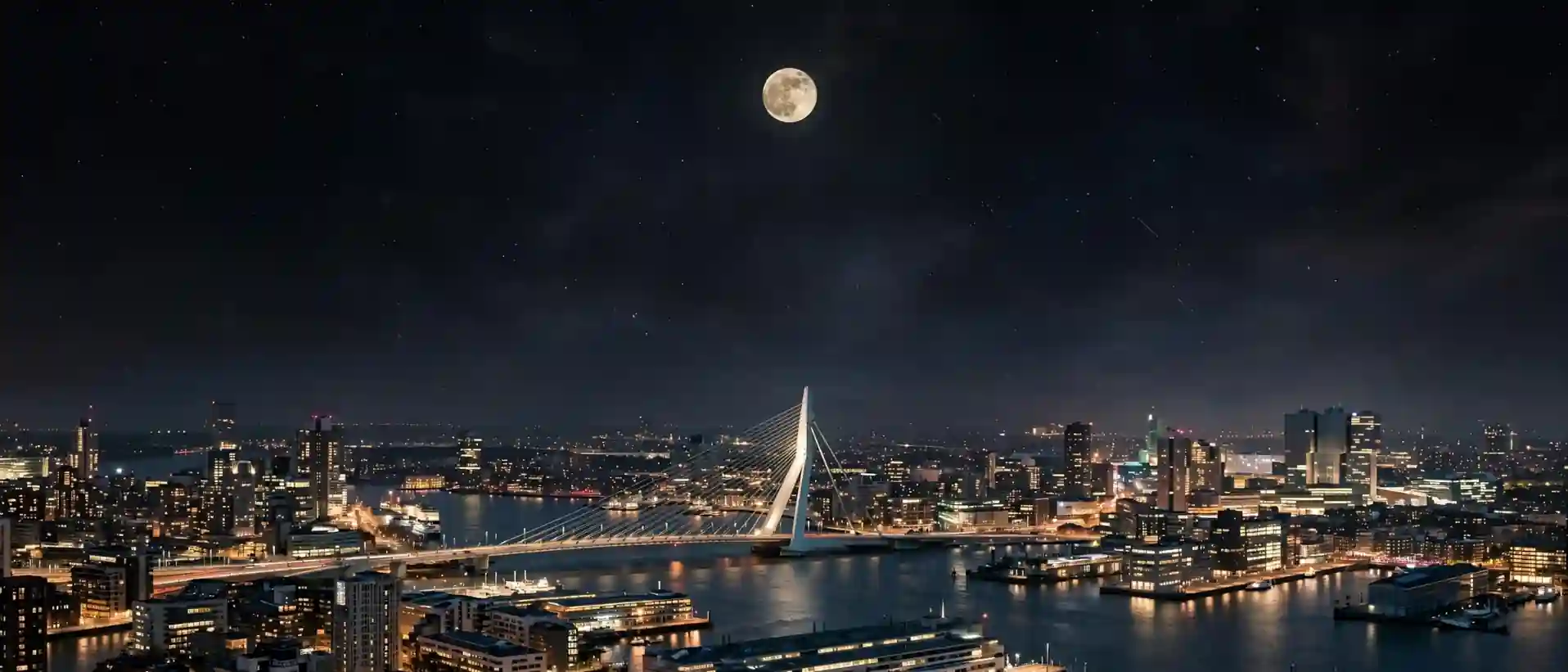
☽ Best Places to View the Moon in Rotterdam, Netherlands
Rotterdam lies on the Nieuwe Maas in the Rhine–Meuse delta, and the ground is flat, so the best places are its big parks, the Euromast and the river itself. At about 52°N the Moon rises between north-east and south-east and sets between north-west and south-west, and a summer full Moon stays very low, near 15°, while a winter one climbs to about 61°. The Nieuwe Maas runs roughly east to west through the city, in line with where the Moon rises and sets, so from the quays a Moon can rise or set over the water. Exact rise and set times and azimuth depend on the date and your observing position, so check both before planning a specific composition.
Kralingse Bos – Large City Park with Kralingse Plas
A large park of about 250 hectares in the north-east of the city, officially opened in 1953, with Kralingse Plas, a major recreational lake. The lake and forest clearings provide wide horizons that can be useful when the calculated azimuth places the Moon over water. Park paths can be wet, so bring water-resistant footwear.
Het Park & Euromast – Landscape Garden and 185 m Tower
Het Park is a landscape garden in the English style laid out in the early 1850s by Jan David Zocher and his son Louis Paul Zocher, and a Rijksmonument since 2010, with ponds and open lawns that offer broad sightlines. Beside it stands the Euromast, built from 1958 to 1960 and 185 m tall, with an observation deck at about 100 m and the rotating Euroscoop lift to the top. It is reportedly open daily from 9:30 a.m. to 10 p.m., but the platforms are exposed and the Euroscoop can close in wind, so check current hours.
Museumpark & Vroesenpark – City Lawns
Museumpark is a centrally located park surrounded by major museums, with lawns and open areas useful for urban-sky photography and an event field that gives open sky windows in the city centre. Vroesenpark, laid out in 1929 as an ornamental park and redesigned in 1948 as a recreational park, has large grass areas, walking paths and two ponds. Open lawns can be useful when the calculated azimuth aligns over open sky.
Zuiderpark – Vast Southern Park
A huge southern recreational park developed from 1952 as a gebruikspark, a recreational and utility park rather than an ornamental one. The municipality describes it as the largest park in the Netherlands, at 430 football fields in size. Its vast meadows provide broad southern horizons, where a winter Moon crosses the sky in front of you.
Maas Riverside – Public Nieuwe Maas Viewpoints
Public riverside areas along the Nieuwe Maas, such as the Kop van Zuid and Noordereiland quays, offer water reflections and long views along the Rhine–Meuse delta. Because the river runs roughly east to west, a Moonrise or Moonset can follow the water. Use designated public paths and check local access and event restrictions. Avoid private port and industrial areas, which are not public viewpoints.
Old Leiden Observatory – Telescopes 26 km North
Rotterdam has no widely advertised public telescope night, but the Old Leiden Observatory, at Sterrenwachtlaan 11 in Leiden, is about 26 km to the north. The Werkgroep Leidse Sterrewacht holds a monthly evening with a lecture and a tour of the domes and telescopes, except in summer, with registration required, and the observatory opens free to the public during the national Stargazing Days, when the Moon is a target in clear weather. Check its current agenda.
◉ Best Times for Moon Photography in Rotterdam
📷 Quick Photography Tips for Rotterdam
🕐 Timezone: Rotterdam runs on Central European Time (CET, UTC+1) in winter and Central European Summer Time (CEST, UTC+2) in summer — the Netherlands observes daylight saving time.
🔭 Telescope Option: No regular public telescope night is widely advertised in Rotterdam. The Old Leiden Observatory, about 26 km north, runs a monthly evening with a tour of its domes and telescopes, except in summer, and opens during the national Stargazing Days. The KNVWS lists local societies and public observatories across the Netherlands.
The moon phase today in Rotterdam is shown in detail above — complete with exact illumination, moonrise/set times and best spots. For the moon phase today anywhere else, visit the Dynamic Moon Phase Calculator.
◐ What the Experience Actually Feels Like
At Kralingse Bos, the Moon shares the evening with the lake — a large city park of about 250 hectares with Kralingse Plas, a major recreational lake, and wide horizons over the water.
At Het Park, Rotterdam feels like a 19th-century landscape garden, laid out in the early 1850s and a Rijksmonument since 2010, with the Euromast beside the park as a useful photographic landmark and, from its deck, a view across the whole flat delta.
At Zuiderpark and along the Maas, the city feels wide and riverine — a huge southern recreational park of meadows, and public Nieuwe Maas viewpoints at Kop van Zuid and Noordereiland with long delta views, where a Moon can rise or set along the water.
"Over a forest lake at Kralingse Bos, beside the Euromast at Het Park, across the meadows of Zuiderpark, or along the Nieuwe Maas — when the calculated azimuth aligns."
✓ Your Rotterdam Moon Chase Checklist
Before You Go
- Around full Moon, moonrise is generally near sunset and moonset near sunrise, but exact times and azimuth depend on date and location — calculate for your specific date and viewpoint
- Verify Access: use designated public paths and marked riverside viewpoints along the Nieuwe Maas, check local access and event restrictions, and avoid private port and industrial areas
- Check the Euromast's current opening hours, since the Euroscoop can close in wind
- Check KNMI for cloud, visibility, wind and precipitation
What to Bring
- A telephoto lens, often 200mm or longer, to frame the Moon tightly, plus a wider lens for lake reflections from Kralingse Plas when azimuth places the Moon over water
- A remote shutter release or 2-second timer to avoid shake
- A lens cloth for wet weather
- A light rain layer and water-resistant footwear for park paths
On the Night
- Focus manually on the Moon's edge — city and harbour lighting can confuse autofocus at dusk
- Bracket exposures: one for the bright lunar disc and another for the darker park lawns or Maas edges — expose for the lunar disc, as the foreground will be darker
- Stay in designated public areas, park paths or marked riverside viewpoints — distinguish public riverside areas from port and industrial areas rather than assuming all Maas banks are accessible viewpoints
- Confirm the viewpoint is accessible and safe — check current park and riverside access
? Rotterdam Moon Phase — Frequently Asked Questions
Q. What is the moon phase today in Rotterdam?
The moon phase today in Rotterdam is a Last Quarter with 45% illumination. The next full moon is in 23 days, on 26 Oct. Moonrise is at — and moonset at 5:03 PM.
Q. Where is the best place to view the moon in Rotterdam?
Rotterdam is flat, on the Nieuwe Maas in the Rhine–Meuse delta, so the best places are its big parks and the river. Kralingse Bos, a large park of about 250 hectares with the Kralingse Plas lake, has wide open horizons. Het Park, a 19th-century landscape garden, sits beside the Euromast, a 185 m tower with an observation deck at about 100 m. Zuiderpark in the south has vast meadows, Museumpark and Vroesenpark have open lawns, and the quays at Kop van Zuid and Noordereiland give long views along the Maas.
Q. Can I look at the moon through a telescope in Rotterdam?
A regular public telescope night is not widely advertised in Rotterdam itself. The nearest established option is the Old Leiden Observatory, at Sterrenwachtlaan 11 in Leiden, about 26 km to the north, where the Werkgroep Leidse Sterrewacht holds a monthly evening with a lecture and a tour of the domes and telescopes, except in summer, with registration required. The observatory also opens free to the public during the national Stargazing Days (Landelijke Sterrenkijkdagen), when the moon is a target in clear weather. The KNVWS, the Royal Netherlands Association for Meteorology and Astronomy, lists local societies and public observatories across the country.
Q. Where does the moon rise and set in Rotterdam, and how high does it climb?
At about 51.9°N, Rotterdam's moonrise and moonset points swing widely across the horizon each month, from roughly north-east to south-east for rising and north-west to south-west for setting, with an even wider swing in years near a major lunar standstill. A full moon near the winter solstice climbs to roughly 61° in the south, while a full moon near the summer solstice stays very low, peaking near 15°, and is often hazy. The Nieuwe Maas runs roughly east to west through the city, in line with where the moon rises and sets, so from the quays a moon can rise or set over the water. Check the azimuth for your date and exact spot.
Q. Is light pollution a problem for moon observing in Rotterdam?
The moon is bright enough to observe and photograph from almost anywhere in Rotterdam, so light pollution rarely limits the lunar disc itself. It does wash out earthshine on a thin crescent and any faint sky detail. Rotterdam is a large city and port in one of Europe's most densely lit regions, so stars are faint at every viewpoint, including the big parks, and the lights of the port and the surrounding towns add to the glow. For darker skies you need to leave the Randstad.
Q. What camera settings and phases work best for moon photography in Rotterdam?
For a full moon, start with Looney 11 (f/11, ISO 100, 1/100 s) and refine using your histogram, since it is a baseline rather than a guarantee. The foreground is much darker than the lunar disc, so shoot RAW and expose for the moon, or bracket to keep both. Distance and focal length together set the apparent size, so move far from the Euromast or Kralingse Plas and use a long telephoto to frame the moon tightly. A waxing gibbous suits blue hour, when the moon is above the horizon while some daylight remains. Use a sturdy tripod, a remote release or 2-second timer, and manual focus on the moon's edge.
Q. How do cloud, wind and rain affect moon viewing in Rotterdam?
Rotterdam's maritime climate means cloud, wind and rain are frequent, so check KNMI, the Dutch weather service, for cloud, visibility, wind and precipitation before you go. The Euromast's open platforms are exposed, and its rotating Euroscoop lift can shut in strong wind. Bring a light rain layer and water-resistant footwear for the park paths, and a lens cloth for wet weather.
Q. What time zone are Rotterdam's moonrise and moonset times shown in?
Rotterdam runs on Central European Time, CET, UTC+1, in winter and Central European Summer Time, CEST, UTC+2, in summer. Clocks go forward on the last Sunday in March and back on the last Sunday in October, and moonrise and moonset times on this page follow the local clock in effect on each date. Rotterdam lies at about 4.5°E, well west of the 15°E meridian on which Central European Time is based, so the sun and moon cross the sky about 42 minutes later on the clock than they would on that meridian.
Q. Can I shoot the moon at Rotterdam's viewpoints after dark?
Mostly, with care, but check each place. Use designated public paths and marked riverside viewpoints along the Nieuwe Maas, such as the quays at Kop van Zuid and Noordereiland, and check local access and event restrictions. The port and industrial areas are not public viewpoints. The Euromast is open every day, reportedly from 9:30 a.m. to 10 p.m., so check its current hours, and the Euroscoop can close in wind. Check the city's park rules before an evening visit.
✦ Explore Further
Moon Phase Today: The Hague
Check tonight's moon phase in The Hague, roughly 20 km north-west of Rotterdam on the North Sea coast.
🚲Moon Phase Today: Amsterdam
See the moon over Amsterdam, roughly 55 km north-north-east of Rotterdam among its canals.
🌍World Moon Phase Directory
Find the moon phase, rise and set times for cities in every region of the world.
Blue Hour Calculator
Work out when blue hour falls, ideal for waxing gibbous shots over the Nieuwe Maas.