
Moon Phase Today Tacoma
On Friday, October 9, 2026, the moon in Tacoma is a New Moon with 0% illumination. Moon age: 28.9 days.
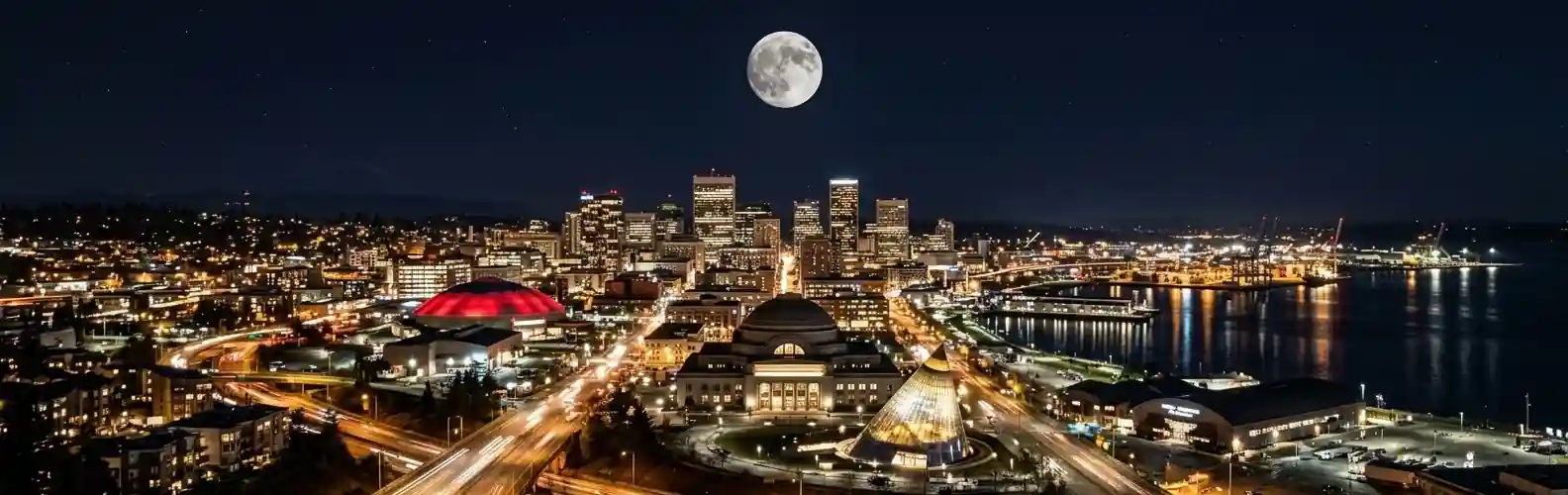
☽ Best Places to View the Moon in Tacoma, Washington
Tacoma sits at roughly 47.25°N on Commencement Bay in Puget Sound, with around 230,000 residents — one of Washington's largest cities. Nicknamed the "City of Destiny" after its selection as the Northern Pacific Railroad's western terminus in the 19th century, Tacoma has spent recent decades turning old industrial land into public waterfront, nowhere more strikingly than at a former toxic smelter site tied to the environmental inspiration behind a science-fiction classic. Between that reclaimed peninsula, a bridge strung with glass sculptures, and views out toward Mount Rainier, Tacoma gives a genuinely varied set of places to watch the moon — mostly around dusk, since several of the best spots follow official sunset closing times.
Dune Peninsula & Wilson Way Bridge, Point Defiance Park
An 11-acre park opened in 2019 on the former ASARCO smelter site, associated with the environmental inspiration behind Tacoma-born author Frank Herbert's novel Dune. The paved Frank Herbert Trail and outdoor sculptures now sit where slag once piled up, and the 605-foot Wilson Way Bridge connecting the peninsula to Ruston Way gives open views toward Mount Rainier and the Olympic Mountains. Like the rest of Point Defiance Park, it's open from half an hour before sunrise to half an hour after sunset, making it best for moonrise around dusk rather than a late-night visit.
Point Defiance Park
A 760-acre park established in 1888, with a substantial forested area along Five Mile Drive, beaches, and shoreline. It gives Tacoma its most significant stretch of trees and open water within the city, though it keeps the same sunrise-to-sunset hours as Dune Peninsula.
Chihuly Bridge of Glass & Museum of Glass
A 500-foot pedestrian bridge lined with glass artworks by Dale Chihuly, connecting downtown Tacoma to the Museum of Glass across the Thea Foss Waterway. As a public bridge rather than a park facility, it's Tacoma's most reliable central option for an evening walk.
Ruston Way Waterfront
A paved walking and biking path running along Commencement Bay, now connected all the way to Point Defiance via the Wilson Way Bridge. The Waterwalk section keeps the same half-hour-before-sunrise-to-half-hour-after-sunset hours as the nearby parks, so it's best treated as a dusk destination.
Tacoma Narrows Bridge
The twin suspension bridges spanning the Tacoma Narrows, site of the original 1940 bridge's famous collapse in high winds, nicknamed "Galloping Gertie." Viewing areas near the bridge give an open sightline across the water toward the Kitsap Peninsula.
Wright Park
A historic city park with the W. W. Seymour Botanical Conservatory, an easy, centrally located green space away from the waterfront crowds. Like the waterfront parks, it closes half an hour after sunset, so it works best as a dusk stop rather than a late-evening one.
◉ Best Times for Moon Photography
📷 Quick Photography Tips
Tacoma runs on Pacific Time (UTC-8, or UTC-7 during Daylight Saving Time). Clocks move forward on the second Sunday in March and back on the first Sunday in November.
For the moon phase in any other city worldwide, visit our Dynamic Moon Phase Calculator for instant lunar data tailored to wherever you are.
The moon phase today in Tacoma, Washington is shown in detail above — complete with exact illumination percentage, moonrise/set times, and the best viewpoints to see it. For the moon phase today in any other city or location worldwide, visit our Dynamic Moon Phase Calculator on the home page.
◐ While Actually There
Dune Peninsula is the strangest, best story in the city. For decades, a copper smelter operated on that spit of land, gradually building the peninsula itself out of arsenic- and lead-laden slag dumped into the Sound — pollution that's part of the story behind the environmental themes in Tacoma-born author Frank Herbert's novel Dune. A three-year, roughly $75 million cleanup later, that same ground is now a public park with commissioned sculpture, a trail named for Herbert, and a footbridge giving one of the best Mount Rainier views in the city — an unusually direct line from environmental damage to public reclamation.
The rest of Tacoma's waterfront tells a gentler version of the same story: an industrial "City of Destiny" gradually turning its shoreline over to walking paths, art installations, and parkland. The Chihuly Bridge of Glass does that with color rather than ecology, stringing blown-glass artworks across a stretch of water that used to belong entirely to freight traffic.
Most of the waterfront parks — Dune Peninsula, the rest of Point Defiance, Ruston Way's Waterwalk, and Wright Park — close half an hour after sunset, so they suit a dusk visit rather than a late one. The Chihuly Bridge, as a public downtown bridge rather than a gated park, is the more flexible choice if you want to stay out later.
"Tacoma turned a toxic smelter site tied to the story behind Dune into a park with one of the best views of Mount Rainier in the city — pollution to parkland, in one place."
✓ Your Tacoma Moon Chase Checklist
Before You Go
- Check the moonrise time and phase on this page for each night of your stay
- Check current Museum of Glass hours if you want to go inside rather than just cross the Chihuly Bridge
- Check the forecast before heading out — Pacific Northwest skies are cloudy more often than not outside summer
- Plan parking in advance at Dune Peninsula, since spots fill quickly on clear evenings, and remember the park closes half an hour after sunset
- Dress in layers regardless of season — evenings by the water are cooler than inland
What to Bring
- A warm, wind-resistant layer for evenings near the water, especially in winter
- A tripod, useful at open spots like Dune Peninsula and Ruston Way
- A rain jacket or umbrella outside the summer months
- Comfortable shoes for the trails through Point Defiance Park's forested areas
- Spare camera batteries kept warm in an inner pocket during cold, damp evenings
On the Night
- Time a Dune Peninsula or Ruston Way visit for dusk, since both close half an hour after sunset
- Shoot RAW and bracket exposures, especially where the Chihuly Bridge's glass artworks mix with moonlight
- Mind wind at exposed waterfront spots, particularly on the Wilson Way Bridge
- Head downtown to the Chihuly Bridge if you want to stay out past the parks' closing times
- Check clear-sky odds in advance — summer offers the most reliable viewing conditions
? Tacoma Moon Phase — Frequently Asked Questions
Q. What is the moon phase today in Tacoma?
The moon phase today in Tacoma is a New Moon with 0% illumination. The next full moon is in 17 days, on Oct 25. Moonrise is at 6:26 AM and moonset at 6:02 PM.
Q. Where is the best place to view the moon in Tacoma?
For open water views at dusk, Dune Peninsula and the 605-foot Wilson Way Bridge in Point Defiance Park look toward Mount Rainier and the Olympic Mountains, and the Ruston Way waterfront gives a long, open sightline over Commencement Bay. Downtown, the Chihuly Bridge of Glass is Tacoma's most reliable central option for an evening walk and is not bound by park hours. Viewing areas near the Tacoma Narrows Bridge look across the water toward the Kitsap Peninsula, and Wright Park suits a calmer, centrally located stop away from the waterfront. Several of these parks close half an hour after sunset, so they work best around dusk.
Q. Where does the moon rise and set in Tacoma, and how high does it climb?
At about 47.3°N, Tacoma's moonrise and moonset points swing across the horizon each month, from roughly northeast to southeast for rising and northwest to southwest for setting. A winter full moon climbs high in the south, to roughly 66° above the horizon, while a summer full moon stays low, peaking near 19°. From the waterfront, the open water to the west and the Olympic Mountains frame a setting moon, while a moon rising in the southeast can line up with Mount Rainier on a clear evening. Hills, buildings and trees limit the view inland and downtown, so the waterfront spots suit the widest sightlines. Check the azimuth for your date and exact spot.
Q. Is light pollution a problem for moon observing in Tacoma?
The moon is bright enough to observe and photograph from almost anywhere in Tacoma, so light pollution rarely limits the lunar disc itself. It does wash out earthshine on a thin crescent and any faint sky detail. Downtown, the port and the busy waterfront carry substantial artificial lighting, so Tacoma is better suited to moonrise viewing and photography than to dark-sky observing around a new moon. The waterfront parks also close half an hour after sunset, so a late-evening visit is better planned from downtown, such as the Chihuly Bridge of Glass.
Q. What camera settings and phases work best for moon photography in Tacoma?
For a full moon, start with Looney 11 (f/11, ISO 100, 1/100 s) and refine using your histogram, since it is a baseline rather than a guarantee. The moon is much brighter than the surrounding water and shoreline, so shoot RAW and bracket or blend exposures to keep both crater detail and the foreground. A full moon rises around sunset in the east, which is well timed for Dune Peninsula and Ruston Way before the parks close half an hour after sunset. A 200–400 mm lens helps isolate the moon against Mount Rainier or the Tacoma Narrows Bridge, with a tripod for bracketing and manual focus on the moon using magnified live view.
Q. How do Pacific Northwest rain, clouds and wind affect moon viewing in Tacoma?
Tacoma gets roughly 39 to 40 inches of rain a year, mostly outside summer, so overcast skies are common much of the year. Winters are cold and rainy with the region's longest nights, while summers are short and notably dry by regional standards, generally offering the best odds of clear skies. Open waterfront spots like the Wilson Way Bridge and Ruston Way are more exposed to wind off the Sound than downtown streets, so a tripod helps. Cold, damp evenings can drain camera batteries faster than expected, so carry a spare in an inner pocket, and bring a rain jacket outside the summer months.
Q. Can I visit Tacoma's moon viewpoints after dark?
Access varies by site. Dune Peninsula, the rest of Point Defiance Park, Ruston Way's Waterwalk and Wright Park are all open from half an hour before sunrise to half an hour after sunset, so they suit a dusk visit rather than a late one. The Chihuly Bridge of Glass is a public downtown bridge rather than a gated park, so it is the more flexible choice for staying out later, while the Museum of Glass keeps its own hours. Parking at Dune Peninsula can fill quickly on clear evenings, so plan ahead.
✦ Explore Further
Moon Phase Today: Seattle
Check tonight's moon phase in Seattle, just north of Tacoma on Puget Sound.
🌲Moon Phase Today: Portland
See the moon over Portland, south of Tacoma in Oregon.
🇺🇸Moon Phase in the United States
Browse moon phase pages for cities across the United States, from Seattle to Miami.
🌍World Moon Phase Directory
Find the moon phase, rise and set times for cities in every region of the world.
Northern Lights Forecast
Check the aurora forecast, since strong geomagnetic storms can occasionally bring northern lights to the Pacific Northwest.