
Moon Phase India
Moon Phase India: Waning Crescent
On Monday 5 October 2026, the moon phase today in India is a Waning Crescent, with 34% illumination. Next full moon: 26 Oct.
The Moon wobbles slightly as it orbits Earth — a phenomenon called libration. Hit Animate Day to watch the surface shift live. Over time, this lets us see 59% of the lunar surface rather than just 50%.
DismissTimes shown for New Delhi (Indian Standard Time, UTC+5:30). India has a single time zone and no daylight saving time, so they apply nationwide.


Explore Indian Cities
Moon phase, moonrise/moonset, and local viewing details for cities across India.
More cities added regularly.
India Moon Phase FAQ
What is the moon phase today in India?
On Monday 5 October 2026, the moon phase today in India is a Waning Crescent, with 34% illumination. Next full moon: 26 Oct. The Moon is about 23.6 days into its 29.5-day cycle.
Does the moon phase look different in different parts of India?
The phase itself doesn't change from place to place — everyone on the night side of Earth sees the same phase at the same moment. What shifts across India is when the Moon rises and sets, and where it sits in the sky. The country runs from about 8°N at Kanyakumari to above 34°N in Kashmir, so the Moon's path depends on how far north you are. In Delhi, at 28.6°N, a full moon near the December solstice passes almost overhead, within about 10° of the zenith, while a full moon near the June solstice crosses the southern sky at only roughly 33° to 43°. In Chennai, at 13.1°N, the same full moons climb to roughly 75° to 85° in winter and 48° to 59° in summer. In the south, crescent moons often look tilted, lying on their back like a bowl or a boat, rather than standing upright.
What time zone are India's moonrise and moonset times shown in?
All times on this page use the local time of the city you search for. India uses Indian Standard Time, IST, UTC+5:30, all year, and does not observe daylight saving time, so there is no clock change to account for. The country spans about 68°E to 97°E while IST is based on the 82.5°E meridian, so the Sun and Moon cross the sky about 21 minutes later on the clock than that meridian in Delhi, about 38 minutes later in Mumbai and about 24 minutes earlier in Kolkata, and moonrise comes roughly two hours earlier in Arunachal Pradesh than in western Gujarat.
How often is there a full moon?
A full moon happens roughly every 29.5 days — the length of the synodic month, the time it takes the Moon to cycle through all its phases as seen from Earth. That works out to about 12 or 13 full moons a year. In the Hindu lunar calendar the full moon is called Purnima and the new moon Amavasya, and many festivals follow them, such as Holi on the full moon of Phalguna and Diwali around the new moon in autumn, though the exact dates vary with the regional calendar. Check the "Next Full Moon" figure on the calculator above for the exact upcoming date.
Which way does the Moon rise and set in India?
Like the Sun, the Moon rises in the east and sets in the west, but how far north or south of due east it rises depends on the date and on how far north you are. At Delhi, over a month and a year, the Moon rises somewhere between roughly north-east and south-east, a wider arc than at Chennai, where it stays between roughly east-north-east and east-south-east. Because the country is in the Northern Hemisphere, a waxing (growing) Moon is lit on its right side and a waning Moon on its left, though near the zenith the orientation depends on which way you face. Cloud is the main obstacle: the south-west monsoon, roughly June to September, covers most of the country, the north-east monsoon brings rain to the Tamil Nadu coast from October to December, and fog can blanket the northern plains in midwinter, so the clearest skies generally come between about October and May.
Can I check the moon phase for a specific Indian city?
Yes — type any Indian city or town into the location search on the calculator at the top of this page. We're also building out dedicated pages for individual cities; browse what's live so far in the "Explore Indian Cities" section above.
Astronomy Watch India
Understanding the Moon's Phases
The Moon itself never changes shape — what changes is the angle at which sunlight falls across its surface. Over the course of a 29.5-day orbit around Earth, that shifting angle cycles through eight recognizable phases, each offering something different to watch for.
Watching the Moon from India
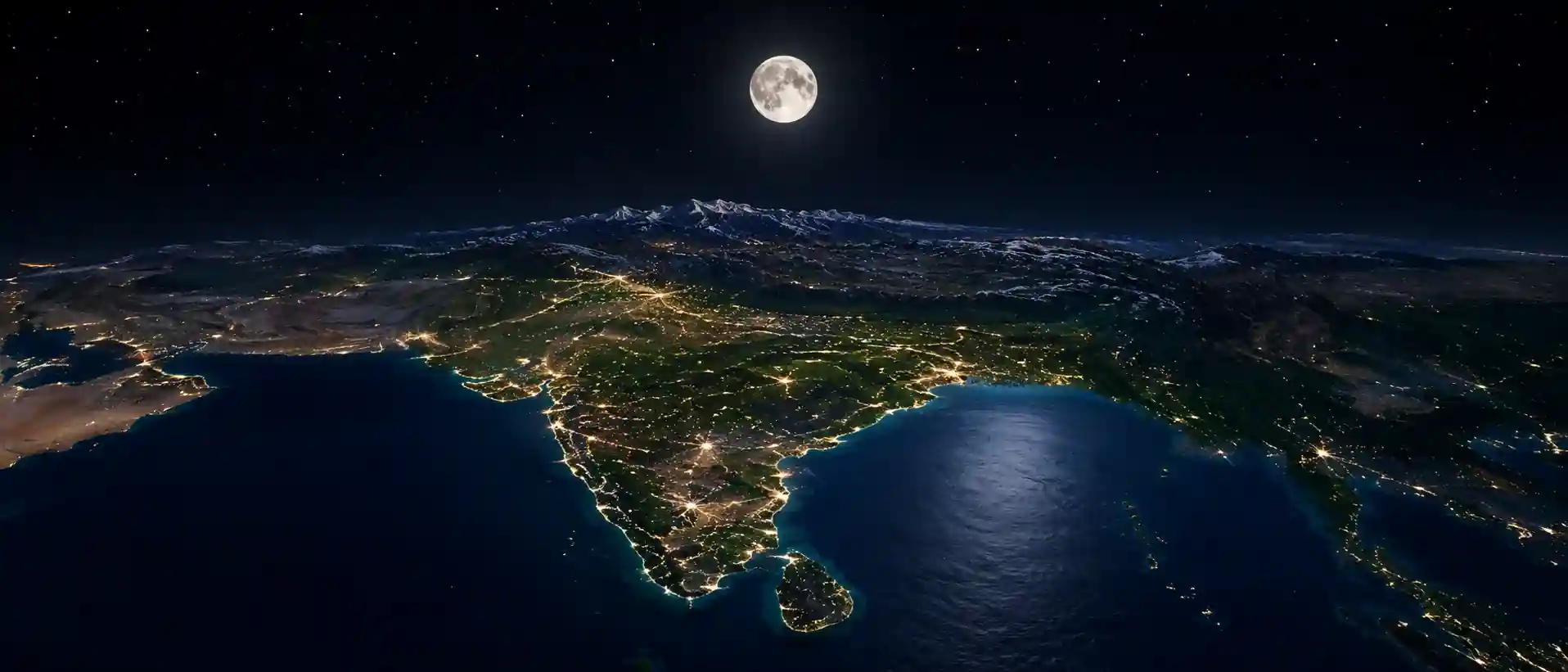
India stretches from about 6.7°N in the Nicobar Islands and 8.1°N at Kanyakumari on the mainland to beyond 34°N in the Himalaya, and the Tropic of Cancer crosses the middle of the country, so the Moon's path depends heavily on how far north you are. At New Delhi, 28.6°N, a full Moon near the December solstice passes almost overhead, within about 10° of the zenith, while a full Moon near the June solstice crosses the southern sky at only roughly 33° to 43°. At Chennai, 13.1°N, the same Moons climb to roughly 75° to 85° in winter and 48° to 59° in summer, and in the south crescent Moons often lie tilted like a bowl or a boat. In the north, Delhi's moonrise swings across roughly north-east to south-east through the year, a wider arc than in the tropics. India uses Indian Standard Time, UTC+5:30, all year with no daylight saving time, and because the country spans about 29 degrees of longitude, moonrise comes roughly two hours earlier in Arunachal Pradesh than in western Gujarat. Cloud is the main obstacle: the south-west monsoon, roughly June to September, covers most of the country, the north-east monsoon brings rain to the Tamil Nadu coast from October to December, and fog can blanket the northern plains in midwinter, so the clearest skies generally come between about October and May. Many Indian festivals follow the Moon: Holi falls on the full moon of Phalguna, Diwali on the new moon, and the Islamic months begin with the first crescent sighting. Use the calculator above for exact moonrise, moonset, and phase times wherever you are in India.
Select a phase